BIS Certification
 CDSCO
CDSCO
 PESO
PESO
 CPCB
CPCB
 LMPC
LMPC
 WPC Approval
 Global Approvals
 TEC
TEC
 ARAI
ARAI
 BEE
BEE
 ISO Certification
 DGCA Certification
 NOC For Steel
 APEDA Registration























 Business Registration
 FSSAI Mark Certification












 (32).jpg)
 Legal Services
 Trademark Registration
 Copyright Registration
 Patent Registration
 By
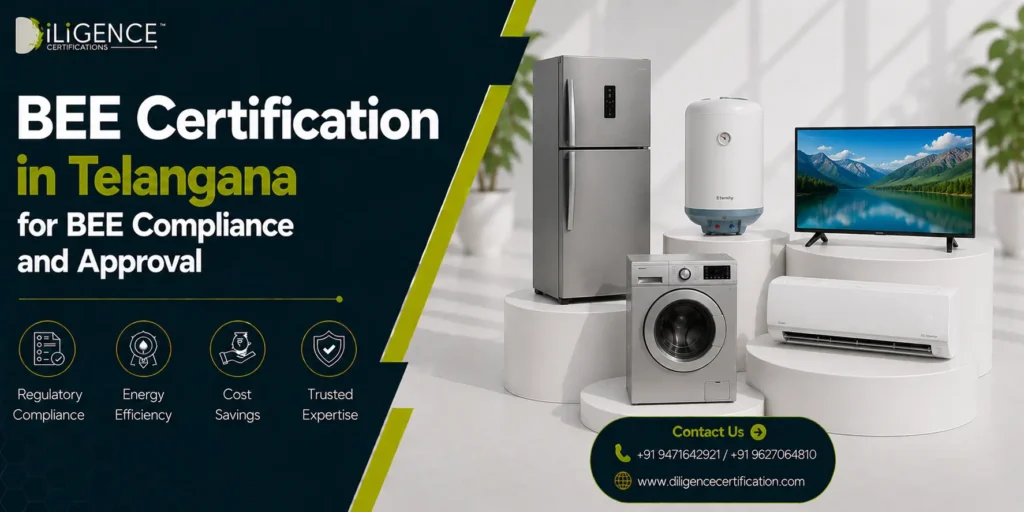
By - The certification of BEE in Telangana is essential for manufacturers, importers, and distributors of energy consuming appliances and electric devices.
- Companies in Telangana working with air conditioning systems, refrigerators, LED bulbs, ceiling fans, motors, chillers, and suchlike devices should find out whether BEE star labelling is mandatory or optional.
- It helps to make sure that there will be no problems connected with the non-compliance of the goods.
Introduction
Once an appliance distributor based out of Hyderabad reached out to our compliance department because he was stuck in a seemingly insignificant situation, which proved to be quite critical. He had bought in some ceiling fans and refrigerators designed for energy saving and was to be marketed all over Telangana.
Then one large retailer asked a direct question: “Do these products have valid BEE star label approval?”
That single question stopped the entire order.
This is where many businesses realise the value of BEE Certification in Telangana. Product quality, attractive packaging and competitive pricing are not enough when the product falls under BEE’s Standards and Labelling programme. equipment categories under mandatory and voluntary phases.In the case of regulated appliances, the device should fulfill energy standards and also have a correct rating label prior to entering into the market of India.
The Standards and Labelling program of the Bureau of Energy Efficiency provides information to consumers on choosing energy-efficient devices in order to save electricity. The Bureau of Energy Efficiency claims that the program helps the consumers to make a knowledgeable decision in terms of saving on energy costs.
The programme currently covers several appliances andFor Telangana businesses, this matters even more because Hyderabad, Secunderabad, Warangal, Karimnagar and other industrial zones are active markets for appliances, electrical goods, HVAC systems, motors, pumps and commercial equipment.
What Is BEE Certification in Telangana?
BEE Certification in Telangana is the approval process through which eligible appliances and electrical products are tested, registered and permitted to display the BEE star rating label before sale in India.
BEE certification is not a local state licence issued only by Telangana authorities. It is a central regulatory approval managed through BEE’s star labelling system. However, Telangana-based manufacturers, importers, distributors and brand owners must follow the same BEE compliance requirements if their products are sold in the Indian market.
In simple terms, BEE certification confirms three things:
- The product has been tested for energy performance.
- The declared energy efficiency values meet BEE requirements.
- The brand is allowed to use the approved star label for that model.
For a customer, the star label shows how energy-efficient the product is. For a business, it acts as a market-entry requirement for regulated product categories.
Why BEE Certification Matters for Telangana Businesses
Telangana has a strong industrial and trading ecosystem. Hyderabad is a major hub for electronics trading, commercial cooling systems, home appliances, construction projects, IT parks, warehouses, hospitals and institutional procurement.
Many buyers in these sectors do not purchase appliances only on price. They check compliance.
A five-star air conditioner without valid BEE registration is not a compliant product. A refrigerator with a printed star label but no approved model registration can create legal and commercial problems. A fan manufacturer selling under an unapproved energy label may face product withdrawal, dealer rejection or compliance notices.
BEE certification helps businesses:
- Sell regulated appliances legally
- Build trust with dealers and customers
- Participate in organised retail and institutional supply
- Avoid misleading energy efficiency claims
- Reduce risk during inspection or market surveillance
- Improve brand credibility in competitive product categories
BEE also conducts check testing to verify compliance of labelled products. This means approval is not just a one-time formality. Businesses must ensure that the product sold in the market matches the tested and approved specifications.
Products Covered Under BEE Certification in Telangana
BEE’s Standards and Labelling programme covers multiple products. Some products fall under mandatory labelling, while others may be under voluntary labelling depending on the latest BEE notification.
Common product categories include:
| Mandatory BEE Product Category | BEE Relevance |
|---|---|
| Room Air Conditioners (Fixed Speed & Variable Speed) | Mandatory star rating and energy efficiency declaration |
| Frost Free Refrigerators | Energy performance testing and mandatory star label compliance |
| Direct Cool Refrigerators | Mandatory energy efficiency and star rating compliance |
| Ceiling Fans | Efficiency-based mandatory star labelling requirement |
| LED Lamps | Energy consumption and performance compliance under BEE standards |
| Tubular Fluorescent Lamps (TFL) | Mandatory energy efficiency and labelling compliance |
| Distribution Transformers | Mandatory energy efficiency performance requirement |
| Grid Connected Solar Inverters | Mandatory energy performance evaluation and labelling compliance |
| Washing Machines (Semi-Automatic, Top Load & Front Load) | Mandatory star rating compliance and energy efficiency declaration |
| Colour Televisions | Mandatory energy efficiency labelling requirement |
| Ultra HD (UHD) Televisions | Energy performance testing and mandatory star labelling |
| Storage Type Electric Water Heaters (Geysers) | Mandatory energy efficiency and star rating compliance |
| Light Commercial Air Conditioners (LCAC) | Commercial cooling efficiency and mandatory labelling requirement |
| Chillers | Commercial energy performance compliance and star labelling |
| Deep Freezers | Mandatory energy efficiency testing and star rating compliance |
| Cassette, Floor Standing Tower, Ceiling & Corner Air Conditioners | Energy performance evaluation and mandatory BEE labelling |
| Domestic LPG Stoves | Mandatory energy efficiency labelling and performance compliance |
| Induction Hobs (Effective from 1 July 2026) | Mandatory energy efficiency testing and BEE star labelling |
| Refrigerators (Overall Category) | Energy performance verification and star rating compliance |
The exact applicability depends on the product category, model type, technical specification and latest BEE schedule. Businesses should not assume that a product is exempt simply because competitors are selling similar items.
Mandatory vs Voluntary BEE Star Labelling
One common confusion among Telangana businesses is the difference between mandatory and voluntary BEE labelling.
Mandatory labelling means the product cannot be sold in India without valid BEE approval if it falls under the notified category. Voluntary labelling means the brand can choose to apply for star labelling, usually to improve market positioning and consumer trust.
| Type | Meaning | Business Impact |
| Mandatory BEE Labelling | Compulsory for notified products | Product cannot be legally sold without approval |
| Voluntary BEE Labelling | Optional for selected products | Helps in branding, tenders and consumer confidence |
BEE’s official Standards and Labelling programme was created to reduce energy consumption without reducing the service provided by appliances. This makes the star label important not only for compliance but also for consumer decision-making.
BEE Certification Process in Telangana
The process for BEE Certification in Telangana must be handled carefully because a small mismatch in documents, test reports or model details can delay approval.
Step 1: Product Applicability Check
The first step is to confirm whether the product falls under BEE’s mandatory or voluntary labelling programme.
This includes checking:
- Product category
- Technical specification
- Applicable BEE schedule
- Star rating table
- Model family or model grouping
- Indian or imported product status
A wrong applicability decision can waste time and money. For example, a business may test the product under the wrong category or apply under an incorrect schedule.
Step 2: Brand and Company Documentation
The applicant must prepare company-level and brand-level documents. These may include:
- Company registration certificate
- GST certificate
- Trademark certificate or brand authorisation
- Factory licence, if applicable
- Authorisation letter
- Importer details, if applicable
- Contact details of authorised signatory
- Product technical documents
For importers in Telangana, brand ownership and authorisation documents become especially important. BEE must clearly understand who is responsible for the product in India.
Step 3: Product Testing from Recognised Laboratory
Testing is one of the most important stages in BEE certification. The product must be tested as per the applicable standard and BEE schedule.
The test report usually includes:
- Model details
- Rated power consumption
- Energy performance values
- Technical specifications
- Test conditions
- Laboratory observations
- Compliance result
Testing should be planned before mass printing of packaging or star labels. Many businesses make the mistake of designing labels first and testing later. This creates rework when the final star rating is different from the expected rating.
Step 4: BEE Portal Registration
The applicant must register on the BEE portal and create the required company profile. After profile verification, the model registration application is submitted.
This stage includes:
- Applicant details
- Brand details
- Product category
- Model information
- Test report upload
- Label information
- Fee submission
- Supporting documents
Accuracy matters here. Even minor spelling differences between the test report, trademark certificate, invoice and model name can cause objections.
Step 5: Model Registration Application
Once the company registration is completed, the specific model must be registered. Each model or model family must match the tested parameters.
Details commonly required include:
- Model number
- Rated capacity
- Power input
- Energy consumption
- Star rating claim
- Label period
- Manufacturing unit details
- Technical brochure
- Test report reference
For products with multiple variants, model grouping must be checked properly. Businesses should not assume that all similar-looking products can be covered under one approval.
Step 6: Label Approval
After successful review, BEE approves the label details for the product. The business can then use the approved star label in the prescribed format.
The label must not be casually edited. Star rating, annual energy consumption, label period, model number and other declarations must match BEE approval.
Step 7: Market Compliance and Renewal
After approval, the company must ensure continued compliance. The product sold in the market should match the approved model.
Businesses must also track:
- Label validity period
- Renewal deadline
- Updated BEE schedules
- Revised star rating table
- Change in product design or components
- Packaging and label accuracy
If the product design changes, fresh testing or approval may be required.
Documents Required for BEE Certification in Telangana
The exact document list depends on the product category and applicant type. However, most BEE certification applications require the following:
| Document | Purpose |
| Company registration certificate | Confirms legal business identity |
| GST certificate | Verifies tax registration |
| Trademark certificate | Confirms brand ownership |
| Brand authorisation letter | Required if brand is not owned by applicant |
| Factory details | Required for manufacturing unit verification |
| Product specification sheet | Explains technical parameters |
| Test report | Proves energy efficiency performance |
| Authorised signatory letter | Confirms responsible person |
| Import documents | Required for imported products |
| Label design details | Needed for BEE star label approval |
| Undertaking or declaration | Confirms compliance responsibility |
For Telangana importers, import-export code, foreign manufacturer details and authorisation documents may also be needed.
BEE Certification in Telangana for Manufacturers
Manufacturers in Telangana must treat BEE certification as part of product planning, not as a last-minute sales requirement.
Before production, the manufacturer should check:
- Whether the product category is covered under BEE
- Required energy performance level
- Testing standard
- Expected star rating
- Label validity
- Packaging declaration
- Product design consistency
For example, a ceiling fan manufacturer in Telangana may design a fan with a certain motor, blade size and wattage. If the motor supplier changes later, the energy performance may also change. That can affect BEE compliance.
This is why manufacturers should maintain proper production control after approval.
BEE Certification in Telangana for Importers
Importers often face a different challenge. The product may already be sold in another country, but Indian energy efficiency requirements may differ.
Before importing regulated appliances, an importer should verify:
- Whether the foreign test report is acceptable
- Whether Indian testing is required
- Whether the brand owner has authorised Indian sale
- Whether the model number matches import documents
- Whether BEE approval is required before sale
- Whether packaging needs India-specific star labelling
A shipment reaching India without proper compliance planning can create storage cost, dealer delay and cash-flow pressure.
BEE Certification in Telangana for Dealers and Distributors
Dealers and distributors may not always apply directly for BEE certification, but they carry commercial risk if they sell non-compliant products.
Before stocking regulated products, dealers should ask:
- Is the model registered with BEE?
- Is the star label valid?
- Does the label period match current requirements?
- Does the packaging show correct model details?
- Is the supplier authorised?
- Is the product category mandatory under BEE?
This is especially important for organised retail chains, government supply, institutional projects, hospitals, hotels, builders and large commercial buyers.
Why Telangana Businesses Should Not Delay BEE Compliance
Telangana’s appliance and electrical product market is competitive. Hyderabad dealers, online sellers and institutional buyers increasingly check compliance before purchase.
Delayed BEE certification can affect:
- Product launch
- Retail listing
- E-commerce approval
- Tender participation
- Dealer confidence
- Inventory movement
- Brand reputation
A product stuck for compliance reasons is like a vehicle ready for delivery but without registration. It may look complete, but it cannot move legally in the market.
Why Choose Diligence Certifications for BEE Certification in Telangana?
Diligence Certifications assists manufacturers, importers, brand owners and distributors with BEE certification and product compliance support across India.
Our role is not limited to form filling. We help businesses understand whether their product falls under mandatory or voluntary BEE labelling, what documents are required, how testing should be planned, and how the model registration should be prepared.
Our support includes:
- Product applicability review
- Document checklist preparation
- Testing coordination guidance
- BEE portal application support
- Model registration assistance
- Label approval guidance
- Renewal and compliance tracking
- Query handling support
For Telangana-based businesses, this reduces confusion and helps avoid avoidable delays.
Conclusion
BEE Certification in Telangana is not just a regulatory formality. It is a practical requirement for businesses dealing in energy-consuming appliances and electrical products. Whether you are a manufacturer in Hyderabad, an importer supplying Telangana dealers, or a distributor handling star-labelled products, BEE compliance should be checked before product launch.
The right approach is simple: confirm applicability, test the product properly, prepare accurate documents, apply through the correct process and use only the approved label.
For expert support with BEE Certification in Telangana, contact Diligence Certifications and get your product compliance reviewed before it reaches the market.
Frequently Asked Questions
1. Is BEE Certification mandatory in Telangana?
BEE Certification in Telangana is mandatory if the product falls under BEE’s notified mandatory star labelling category. Since BEE is a central regulatory body, the same rules apply across India, including Telangana.
2. Which products need BEE Certification in Telangana?
Products such as air conditioners, refrigerators, ceiling fans, LED lamps, distribution transformers, motors, pumps, chillers, washing machines and other notified appliances may require BEE certification depending on the applicable schedule.
3. Can I sell appliances in Telangana without BEE star rating?
If the product category is under mandatory BEE labelling, it cannot be legally sold without valid BEE approval and correct star label declaration.
4. How long does BEE Certification take?
The timeline depends on product testing, document readiness, portal registration and BEE review. Testing and model approval usually take the maximum time
5. Is BEE Certification different from BIS Certification?
Yes. BIS certification usually relates to product quality and safety standards, while BEE certification relates to energy efficiency and star labelling. Some products may require both.
6. Do importers need BEE Certification?
Yes, importers must obtain BEE approval if the imported product falls under a mandatory BEE labelling category before selling it in India.
7. What is the validity of BEE star label approval?
Validity depends on the product category and label period notified by BEE. Businesses must track renewal and revised star rating requirements.
8. Can one BEE approval cover multiple models?
Only eligible models can be grouped as per BEE rules. Model grouping depends on technical similarity, capacity, performance and applicable schedule.
9. What happens if the product fails BEE testing?
If the product does not meet the required energy performance level, the claimed star rating may not be approved. Design improvement or retesting may be required.