 BIS Certification
 CDSCO
CDSCO
 PESO
PESO
 CPCB
CPCB
 LMPC
LMPC
 WPC Approval
 Global Approvals
 TEC
TEC
 ARAI
ARAI
 BEE
BEE
 ISO Certification
 DGCA Certification
 NOC For Steel
 APEDA Registration














 Business Registration
 FSSAI Mark Certification









 (32).jpg)
 Legal Services
 Trademark Registration
 Copyright Registration
 Patent Registration
 By
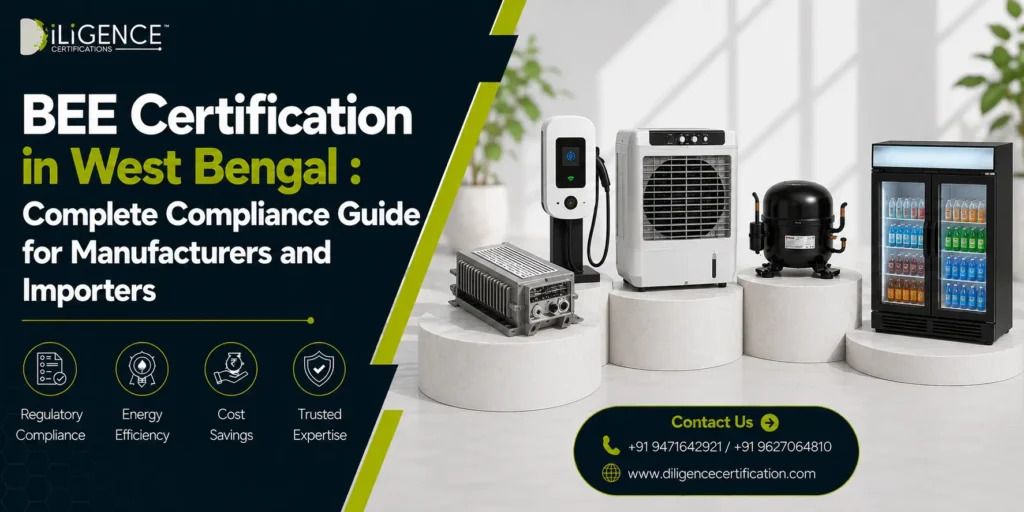
By - BEE Certification in West Bengal is required for regulated energy-consuming products before sale, import, or distribution in India.
- It helps manufacturers, importers, and brand owners meet BEE Standards and Labelling requirements.
- Diligence Certifications supports testing coordination, documentation, model registration, and BEE application handling.
Introduction
Once there was a supplier of appliances in Kolkata who contacted us when he had completed his shipment of ceiling fans for distribution; however, he was still waiting for the approval of his product labels. There were already waiting dealers, warehouses were becoming costly, and a launch date had been set.
The issue was not product quality. The issue was compliance planning.
Most manufacturers and importers will not need to get BEE Certification in West Bengal until the product is ready for sale. At that point, it is likely that testing, documentation, brand authorization, sample information, and online registration may have taken longer than anticipated.
BEE approval is not just a formality .All energy-consuming products sold within India must comply with the requirements for entering the market; the location of the business does not affect the compliance requirements; the compliance of products is related to product categories and to BEE’s Standards & Labelling program.
What is BEE Certification in West Bengal?
Obtaining BEE certification for your product in West Bengal means you have received recognition from the Bureau of Energy Efficiency for your product which falls under the Bureau of Energy Efficiency’s Standards & Labelling Programme. Obtaining BEE certification also allows your product to carry the Bureau of Energy Efficiency star mark or ‘energy efficiency performance indicator.
BEE is part of the Ministry of Power and was created by the Energy Conservation Act 2001. BEE’s Standards & Labelling Programme allows consumers to compare energy consumption and the cost savings possible when selecting appliances.
Essentially, the BEE certification tells the market that a product has been tested, evaluated, and approved according to energy efficiency norms.
Why Should Your Business Get BEE Certification in West Bengal?
West Bengal has many types of business including: trading, importing, manufacturing, warehousing, and retailing/distributing. Many of the products shipped or sold into Kolkata are then distributed throughout Eastern India to states such as Assam, Odisha, Bihar, Jharkhand and Northeastern States.For businesses dealing in regulated appliances protects the product from market restrictions and compliance objections.
Brand due diligence includes compliance with the Bureau of Energy Efficiency (BEE). Today, products without requisite BEE approval will generally experience issues of importation, distribution, onboarding by distributors, listing on e-commerce platforms, and regulatory scrutiny. In addition, for brands selling on e-commerce platforms (e.g., Amazon, FlipKart, etc.) as well as through modern retailers and distributor networks, BEE compliance is frequently verified by vendors prior to accepting the product.
Products That May Require BEE Certification
BEE certification applies to specific product categories notified under the Standards and Labelling scheme. The list may change based on BEE notifications, product schedules, and regulatory updates.
Common product categories include:
- Air conditioners
- Refrigerators
- Ceiling fans
- LED lamps
- Colour televisions
- Washing machines
- Distribution transformers
- Electric water heaters
- Induction motors
- Domestic LPG stoves
- Deep freezers
- Commercial beverage coolers
- Chillers
- Pumps
- Office automation products
Before applying for BEE Certification in West Bengal, the first step is product-category confirmation. Many delays happen because businesses assume that all models fall under the same requirement. In practice, capacity, rating, technology, and product design can affect applicability.
Mandatory and Voluntary BEE Registration
BEE certification may be mandatory or voluntary, depending on the product category.
It is a requirement in India to have a product registered with BEE (Bureau of Energy Efficiency) before it can be sold, or have a BEE star rating. A brand may choose to obtain BEE registration on a voluntary basis to indicate that it is energy efficient and to build confidence in their product for potential customers.
In addition to this, it is important to consider how selling products without approval could put your business at risk. For example, dealers could stop stocking the product, online retailers may prevent listing of the product, or purchasers could question the credibility of the product.
Documents Required for BEE Certification in West Bengal
The exact document list depends on whether the applicant is an Indian manufacturer, foreign manufacturer, importer, or brand owner. However, the common documents usually include:
- Company registration certificate
- GST certificate
- Factory licence, if applicable
- Trademark or brand authorisation
- Authorisation letter from manufacturer
- Product technical specifications
- Test report from recognised laboratory
- Model details and series information
- Sample label design
- Manufacturing unit details
- Undertaking and declarations
- Contact person details
- Importer details, if applicable
For importers in West Bengal, documentation must be handled carefully. If the brand owner, manufacturer, and importer are different entities, authorisation documents must clearly support the application.
BEE Certification Process in West Bengal
The process for BEE Certification in West Bengal usually follows these stages.
1. Product Applicability Check
The product is first checked against the current BEE schedule. This confirms whether certification is mandatory, voluntary, or not applicable.
A wrong applicability assessment can waste time and testing cost. This is why businesses should confirm the product category before sending samples for testing.
2. Document Preparation
After applicability is confirmed, documents are collected from the manufacturer, importer, or brand owner. At this stage, company details, brand ownership, authorisation, and technical specifications must match.
Even small mismatches in model number, brand name, or product rating can lead to queries.
3. Product Testing
The product is tested through an approved or recognised laboratory as per the applicable Indian standard and BEE schedule. The test report becomes the technical base for star rating and model registration.
Testing is one of the most sensitive stages. If the sample fails or the model details are inconsistent, the application may be delayed.
4. Online Application Filing
The application is filed on the BEE portal with complete documents, test reports, model details, and label information.
This stage requires accuracy. BEE registration is not only about uploading documents; it is about presenting the product data correctly.
5. BEE Review and Query Handling
BEE reviews the application and may raise queries. Common queries relate to test reports, label design, model grouping, authorisation, or company details.
Quick and correct query response helps reduce delay.
6. Approval and Label Use
Once approved, the brand can use the BEE star label as per prescribed conditions. The label must be used correctly on the product, packaging, and marketing material.
Misuse of the label or incorrect star rating representation can create compliance risk.
BEE Certification Cost in West Bengal
The cost of BEE Certification in West Bengal depends on product category, number of models, testing requirements, government fee, documentation complexity, and professional support required.
There is no single fixed cost for all products.
For example, the cost for one LED lamp model may not be the same as the cost for multiple air-conditioner models. Importer cases may also involve additional authorisation and documentation requirements.
For an accurate estimate, businesses should contact Diligence Certifications with product details, model list, technical specifications, and brand information.
Timeline for BEE Certification in West Bengal
The timeline depends on testing, documentation readiness, application filing, and BEE review. If the test report is ready and documents are complete, the process is smoother.
Delays usually happen because of:
- Incorrect product category selection
- Incomplete technical documents
- Wrong model grouping
- Delay in sample testing
- Brand authorisation mismatch
- Query response delay
- Label design correction
It is advisable that companies complete BEE compliance prior to product launch; rather than when they have shipped the first shipment of goods to their warehouse. Some of the most common errors that companies in West Bengal make, regarding BEE delays, arise from treating certification as a last stage process.
One importer may finalise packaging before label approval. Another may print star labels without checking the approved design. A manufacturer may send a product for testing without confirming whether the model family can be grouped.
These mistakes are avoidable.
The best practice is to align compliance, testing, packaging, and sales planning together. BEE approval should be part of the product launch calendar.
Benefits of BEE Certification in West Bengal
BEE certification gives both regulatory and commercial benefits.
| Benefit | Business Impact |
|---|---|
| Legal compliance | Helps sell regulated products in India |
| Market access | Supports dealer, distributor, and e-commerce onboarding |
| Consumer trust | Star label helps buyers compare energy efficiency |
| Brand credibility | Shows commitment to quality and energy savings |
| Reduced risk | Avoids compliance objections and market disruption |
| Better positioning | Energy-efficient products are easier to promote |
For today’s customer, electricity cost matters. A visible star label can influence the purchase decision, especially for appliances used daily.
BEE Certification for Importers in West Bengal
Importers in Kolkata and nearby trade hubs often deal with products manufactured outside India. In such cases, BEE compliance must be planned before import or market sale.
The importer may need documents from the foreign manufacturer, including authorisation, technical specifications, test support, and factory details.
A common problem is delayed coordination with overseas manufacturers. Foreign suppliers may not understand Indian BEE requirements, which causes repeated document corrections.
Diligence Certifications helps importers prepare the required compliance file and coordinate documentation in a structured manner.
BEE Certification for Manufacturers in West Bengal
Manufacturers in West Bengal need BEE approval when their product falls under the mandatory scheme. The process requires technical accuracy because the declared product performance must match testing and labelling requirements.
Manufacturers should maintain proper records for:
- Model specifications
- Product rating
- Manufacturing location
- Test samples
- Brand use
- Label design
- Production consistency
If product specifications change after approval, the business must check whether fresh approval, amendment, or re-registration is required.
Why Choose Diligence Certifications?
Diligence Certifications works with manufacturers, importers, traders, and brand owners for Indian regulatory approvals. Our team supports BEE compliance from applicability check to documentation and application handling.
Businesses choose us because we focus on practical execution, not just advisory language.
Our support includes:
- Product applicability assessment
- Document checklist preparation
- Testing coordination guidance
- BEE portal application support
- Query handling
- Label compliance assistance
- Importer and manufacturer documentation support
Conclusion
BEE Certification in West Bengal is an important compliance step for manufacturers, importers, traders, and brand owners dealing in regulated energy-consuming products. It supports legal market access, improves product credibility, and helps customers identify energy-efficient products.
The safest approach is to start BEE compliance before product launch, packaging, import planning, or distributor onboarding. This avoids last-minute testing issues, document corrections, and label approval delays.
For BEE Certification in West Bengal, contact Diligence Certifications and talk to our consultants for product applicability, documentation, testing coordination, and complete application support.
Frequently Asked Questions
Is BEE Certification mandatory in West Bengal?
BEE Certification in West Bengal is mandatory if the product falls under BEE’s compulsory Standards and Labelling programme. The requirement depends on the product category, technical specification, and current BEE notification.
Who requires BEE Certification in West Bengal?
If you’re a manufacturer, importer or trader of energy-consuming products or appliances in any regulated categories or have your brand on these products or appliances then you must obtain BEE certification before you can legally sell them in India.
How long does BEE Certification take?
The length of time required to obtain BEE certification depends on testing and other requirements (i.e. documentation, application process, and approval). Properly completed and submitted documents, along with correct test reports, may reduce delay in receiving BEE certification.
Can importers apply for BEE Certification?
If you are an importer you may apply for BEE certification however your application will likely require authorisation from the overseas manufacturer and documentation related to the product and brand.
What are the consequences of selling a product without BEE approval
The penalty for selling a product requiring BEE certification without BEE certification is that you may not be able to continue doing business in India, you may not be able to sell your product through dealers and/or you may suffer a loss of sales or business.
Is BEE Certification required for all electrical products?
No. BEE certification is required only for products covered under the applicable BEE Standards and Labelling schedule.
Can one BEE registration cover multiple models?
In some cases, model grouping may be possible. It depends on product category, technical similarity, and BEE rules.
Is product testing compulsory for BEE registration?
Yes, testing is usually required for products covered under BEE registration. The test report supports energy performance and star rating.
Can Diligence Certifications help with BEE queries?
Diligence Certifications provides assistance for filing applications, preparing documents, coordinating testing, and responding to BEE inquiries.
What is the process for getting BEE Certified in West Bengal?
To begin the process you should provide Diligence Certifications information about your product - i.e., product description, model number, technical specifications, and brand name - in order to determine whether BEE certification is applicable.