

 BIS Certification
 CDSCO
CDSCO
 CPCB
CPCB
 LMPC
LMPC
 WPC Approval
 Global Approvals
 TEC
TEC
 ARAI
ARAI
 BEE
BEE
 ISO Certification
 DGCA Certification
 NOC For Steel
 APEDA Registration













 Business Registration
 FSSAI Mark Certification











 Legal Services
 Trademark Registration
 Copyright Registration
 Patent Registration
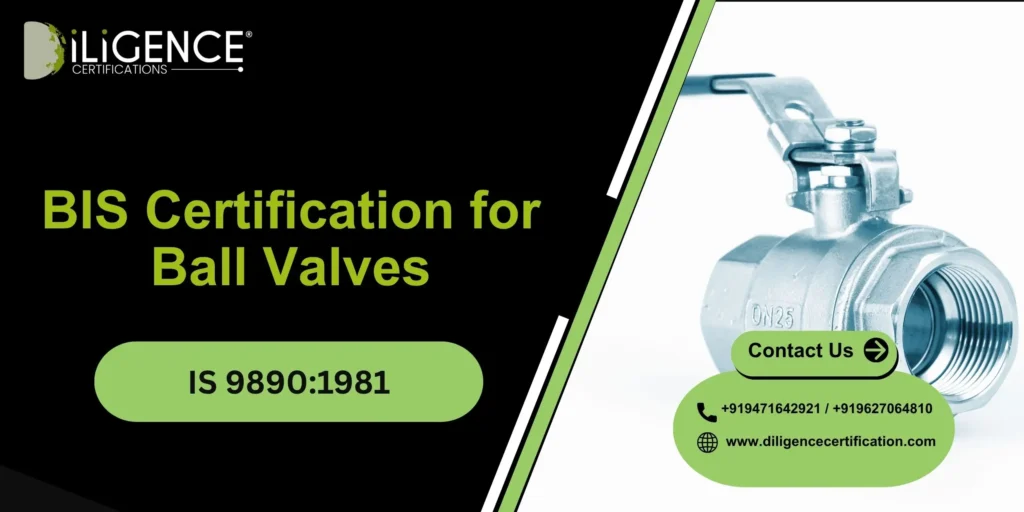
- Ensures Product Quality & Reliability:BIS certification of ball valves ensures that these products comply with the quality, performance, and reliability requirements specified in IS 9890:1981.
- Mandatory Compliance for Manufacturers: It is mandatory for manufacturers to comply with BIS norms in order to manufacture and supply certified in India.
- Covers Design, Material & Testing Requirements:The standard covers requirements for materials, construction, pressure rating, and testing of ball valves.
- Use of ISI Mark for Establishing Market Trust:The products are also marked with the ISI mark, which helps in building trust with customers.
- Applicable for Industrial & Domestic Use:BIS Certification for Ball Valves is applicable for ball valves used in water supply systems, gas pipelines, and other industrial applications.
Introduction
BIS Certification for Ball Valves as per IS 9890:1981 ensures that ball valves manufactured and supplied in India conform to the quality, safety, and performance requirements specified by the Bureau of Indian Standards (BIS). This standard indicates the specifications for the design, material, construction, and test requirements for ball valves for applications in water supply systems, oil and gas transmission lines, and other industrial applications. By obtaining , it is possible to display the ISI mark on the product, which indicates that it conforms to Indian standards. This is important for consistent performance, durability, and safe usage of the product, making it suitable for both residential and industrial applications.
What is IS 9890:1981?
IS 9890:1981 is an Indian standard that defines the requirements for ball valves used in various fluid control systems. It defines the guidelines for the design, materials, manufacturing, dimensions, rating, and testing of ball valves for their safety, reliability, and efficiency.IS 9890:1981 is applicable to various used in water supply, oil, gas, and other industries, ensuring their suitability for use in various pressure requirements. By adhering to IS 9890:1981, various manufacturers can design and manufacture quality ball valves, fulfilling the requirements of the market.
Key Points:
- Indian Standard for Ball Valves:IS 9890:1981 specifies technical specifications for the manufacture of ball valves for fluid control systems.
- Covers Design and Construction Requirements:IS 9890:1981 offers guidelines for proper valve design, construction, and dimensions for effective and efficient functioning.
- Specifies Material Requirements:IS 9890:1981 specifies materials for effective and efficient functioning and durability.
- Includes Testing and Performance Requirements:IS 9890:1981 specifies requirements for pressure tests, leakage tests, and performance efficiency.
- Ensures Safety and Reliability:Compliance with this standard ensures safe and efficient performance for effective and efficient functioning.
Products Covered Under IS 9890 : 1981
IS 9890:1981 describes the standard for BIS Certification for Ball Valves that are used for controlling the flow of liquids and gases. The standard describes valves that are used for domestic, commercial, and industrial applications. The standard describes ball valves that are manufactured from various materials, such as brass, steel, and other alloys, and are used for controlling the flow of fluids such as water, oil, and gases. The standard for typically describes manually operated that are designed for specific pressure ratings and sizes. The standard describes valves that are used for pipeline and plumbing applications. The standard describes valves that are designed for safe, leak-proof, and efficient operation.
Key Reasons:
- Manually Operated Ball Valves:This category includes hand-operated ball valves used in the control of fluid flow in pipelines.
- Valves for Liquid and Gas Applications:This category includes ball valves used in water, oil, gas, and other non-corrosive fluids.
- Different Material Types:This category includes ball valves of brass, stainless steel, and other materials.
- Various Sizes and Pressure Ratings:This category includes ball valves of various sizes and pressure ratings.
- Applications in Various Industries:This category includes ball valves used in plumbing, industrial, water supply, and gas applications.
Importance and Benefits of BIS Certification
| Importance | Benefits |
| Compliance with Indian Standards:The product complies with the quality, safety, and performance standards set by BIS. | Enhanced Product Reliability:Certified ball valves ensure reliable and durable performance. |
| Mandatory Testing Procedures:The product is tested rigorously with tests such as pressure tests, leakage tests, and durability tests. | Increased Market Credibility:ISI mark creates trust among consumers, dealers, and government bodies. |
| Use of Standardized Materials:Standardized materials are used to provide strength and resistance to corrosion. | Legal Market Access:Facilitates compliance with Indian laws, enabling legal trade. |
| ISI Mark Certification:The certified product bears the mark of certification, guaranteeing authenticity. | Reduced Risk of Failures:Rigorous quality checks ensure low leakage, breakdowns, or safety hazards. |
| Regular Surveillance by BIS:The BIS organization regularly keeps an eye on the product quality. | Competitive Advantage:Certified products make your brand stand out in the market. |
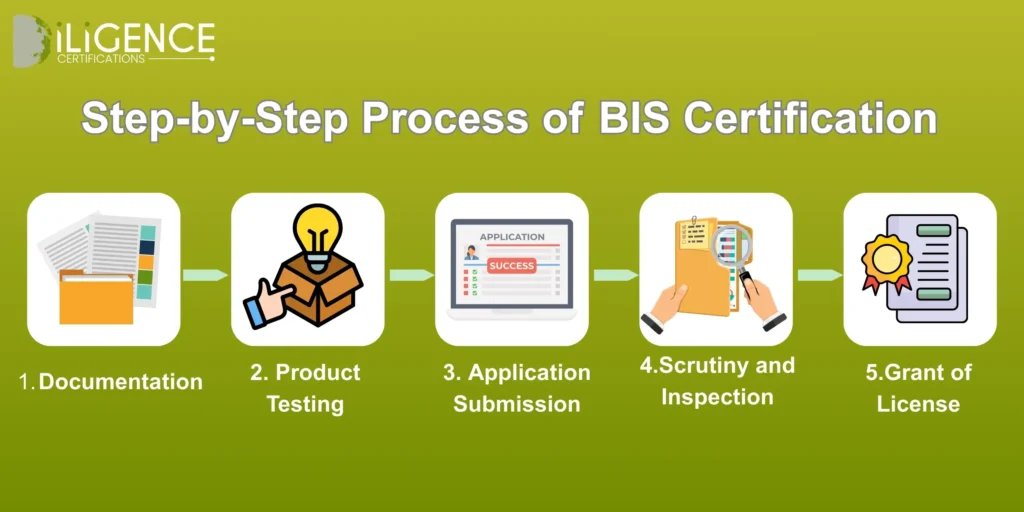
Step-by-Step Process of BIS Certification
Step1:Documentation
- Collect required technical documents
- Prepare product specifications
- Gather company registration details
- Ensure documents follow BIS format
Step2:Product Testing
- Send samples to a BIS-approved lab
- Conduct safety and quality tests
- Receive test reports
- Confirm compliance with BIS standards
Step3:Application Submission
- Fill out the BIS application form
- Upload all required documents
- Attach valid test reports
- Pay the necessary BIS fees
Step4:Scrutiny and Inspection
- BIS reviews submitted documents
- Authority verifies test results
- Factory/product inspection may occur
- Clarifications requested if needed
Step5:Grant of License
- BIS approves the application
- License number is issued
- Product can carry BIS mark
- Renewal required before expiry
Documents Required for BIS Certification
| Category | Documents Required |
| Business Documents | Business license/registration, ISO certificate, organizational details |
| Manufacturer Details | Factory layout, process flow chart, machinery list, production details |
| Product Documents | Product specifications, component list, user manual, model details |
| Testing Documents | Test report from BIS-recognized lab, sample details, test request form |
| Legal & Compliance | Authorization letter, brand ownership proof, trademark certificate (if any) |
| Import/Foreign Manufacturer (If applicable) | AIR (Authorized Indian Representative) details, contract agreement, overseas manufacturer documents |
Timelines, Costs, Validity & Renewal
- Timelines: Usually from 20 to 30 days, with only 7-15 days for the testing.
- Costs: The cost of the government and the test varies depending on the product. There can be some additional charges though.
- Validity: The validity period is 2 years in most situations.
- Renewal: The renewal is done before the expiration; there should be updated documents/tests; the renewal
Why Choose Diligence Certifications
Diligence Certifications is a reliable and trustworthy firm that specializes in providing end-to-end services related to according to IS 9890:1981. The firm has a team of professionals who help manufacturers in the entire certification process of BIS Certification of their products. With their expert guidance, manufacturers can save time and make the certification process easy and hassle-free by ensuring accuracy and transparency in their services. Diligence Certifications ensures that manufacturers do not face any problems in the certification process and can easily maintain the quality of their products and attain BIS Certification in the shortest time possible.
Conclusion
IS: 9890:1981 is of utmost importance in maintaining the quality and reliability of the product. The certification helps the manufacturer comply with the Indian standard and at the same time provides the customer with quality and reliable products. Thus, with the BIS certification, the business not only gets the legal right to trade in the country but also gains the trust of the customers with the ISI mark. Therefore, BIS certification is important for the business in every way and provides it with a competitive advantage.
Frequently Asked Questions (FAQs)
What is IS 9890:1981?
It is an Indian standard that provides requirements for ball valves.
Is BIS certification mandatory for ball valves?
It is not mandatory, but it is highly recommended in accordance with government notifications.
Who provides BIS certification?
The BIS provides certification.
What is ISI mark?
It is a mark that shows compliance with BIS standards.
What products are covered by IS 9890:1981?
Ball valves used for water, gas, oil, and industrial purposes.
What tests have to be conducted for certification?
Pressure, leakage, and durability tests have to be conducted.
How long does BIS certification take?
It takes a few weeks or months depending on documentation.
Can foreign manufacturers also apply for BIS certification?
Yes, through FMCS (Foreign Manufacturers Certification Scheme).
What documents have to be submitted?
Test reports, product details, factory details, and application forms have to be submitted.
Why is BIS certification significant?
BIS certification is significant because it provides quality products.