 BIS Certification
 CDSCO
 PESO
 CPCB
 LMPC
 WPC Approval
 Global Approvals
 TEC
 ARAI
 BEE
 ISO Certification
 DGCA Certification
 NOC For Steel
 APEDA Registration



















 Business Registration
 FSSAI Mark Certification












 (32).jpg)
 Legal Services
 Trademark Registration
 Copyright Registration
 Patent Registration
 By
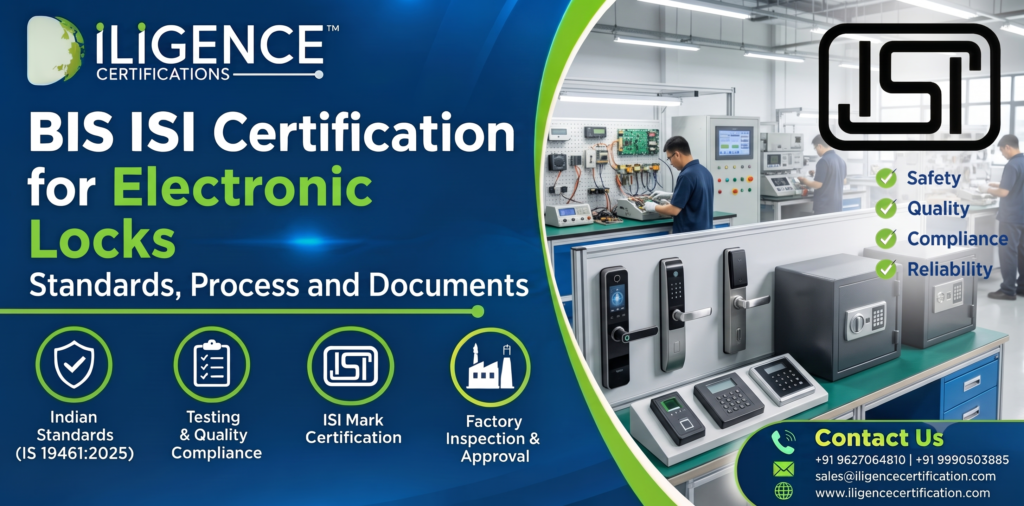
- IS 19461:2025 specifies requirements for electronic locks used in security equipment.
- The standard covers applications involving currency, precious metals, important documents and restricted premises.
- It addresses security features, access control and alarm notification.
- BIS granted India’s first certification licence under this standard on 13 July 2026.
- Manufacturers should verify applicable QCO requirements before deciding on certification.
- Product evaluation, technical documentation and factory quality control are important compliance considerations.
What Is IS 19461:2025?
IS 19461:2025 is an Indian Standard titled Electronic Locks for Security Equipment - Specifications. It establishes technical requirements for electronic locking systems used to protect valuable assets, important documents and restricted premises.
The standard provides a framework for evaluating product security features, electronic operation, access control and alarm notification. Manufacturers can use the applicable BIS conformity assessment route to demonstrate compliance with the relevant requirements .
1. BIS Certification for Electronic Locks Under IS 19461:2025
The Bureau of Indian Standards (BIS) develops Indian Standards to establish technical and quality requirements for products manufactured or sold in India.
IS 19461:2025 was established on 10 December 2025. It addresses electronic locks designed for security equipment and relevant access control applications.
Unlike traditional mechanical locks, electronic locking systems use electrical and electronic components to manage access. Depending on their design, these products may operate through passwords, electronic codes or other authentication methods.
The standard addresses several important areas:
- Security and access control functionality
- Electronic locking mechanisms
- Authentication and code management
- Alarm notification requirements
- Product specifications
- Technical documentation and identification
Manufacturers should evaluate their product design against the complete standard before beginning the conformity assessment process.
2. Which Products Are Covered Under IS 19461?
The standard addresses electronic locks used in security equipment for storing currency, precious metals and important documents. It also covers relevant electronic locks used in access control systems for securing premises.
Some examples of applications include:
| Product category | Application |
|---|---|
| Electronic safe locks | Protecting cash, jewellery and valuable assets |
| Electronic vault locks | Controlling access to high-security storage |
| Electronic locker locks | Restricting unauthorised access |
| Security equipment locks | Securing important documents and precious metals |
| Electronic access control locks | Managing entry into restricted premises |
Important: Product applicability depends on its intended use, construction, design and technical characteristics. Not every residential smart lock, digital door lock or electronic door lock automatically falls within the scope of IS 19461:2025.
Manufacturers should review the standard’s scope before selecting the applicable certification route.
3. Is Certification Mandatory for Electronic Locks in India?
Manufacturers and importers should understand the difference between an established Indian Standard and a mandatory product certification requirement.
BIS certification is generally voluntary unless the Central Government makes compliance compulsory through a Quality Control Order (QCO) or another applicable legal requirement.
Therefore, publication of does not automatically make certification compulsory for every electronic locking product.
Before manufacturing, importing or selling a product, businesses should verify:
- Whether an applicable QCO covers their product.
- Whether the product falls within the scope of the relevant order.
- Whether the applicable implementation date has arrived.
- Whether any exemptions or transitional provisions apply.
- Whether another product-specific regulatory requirement is relevant.
Where certification is mandatory, manufacturers must follow the applicable requirements and obtain the necessary BIS authorisation
Where no mandatory requirement applies, manufacturers may consider voluntary certification under the relevant conformity assessment scheme.
4. Important Technical Requirements
Electronic locking systems used in security applications must provide reliable operation and
appropriate access control.
The following technical areas require attention during product development and compliance preparation.
A. Security and Access Control
The locking mechanism should provide controlled access and the required protection against unauthorised operation.
Manufacturers should evaluate the locking mechanism, access control functions and applicable security provisions.
B. Authentication and Code Management
Electronic locks may use passwords, access codes or other electronic authentication methods.
Manufacturers should review applicable requirements concerning code management, code alteration and multiple access codes.
C. Alarm Notification
Alarm notification is an important feature of security equipment.
The relevant provisions address notification of security-related events. Manufacturers should evaluate the alarm functionality against the requirements specified in the standard.
D. Electronic Hardware and Software
Electronic locking systems depend on hardware components and software to manage their operation.
Manufacturers should maintain appropriate technical information, including:
- Electronic circuit diagrams
- Component specifications
- Hardware details
- Software documentation
- Product operating information
This information helps support technical evaluation and product traceability.
E. Additional Security Features
Depending on the product configuration, additional features may include:
- Alarm integration
- Remote control functionality
- Time-related locking functions
- Protection against acid attacks
- X-ray resistance
- Resistance to explosives
These features should not be treated as compulsory for every electronic lock. Their applicability must be checked against the relevant provisions”
5. Testing Requirements for Electronic Locks
Product testing helps determine whether a locking system meets the applicable technical and performance requirements.
The exact test methods and acceptance criteria depend on the product Electronic lock testing configuration and the complete requirements of the standard.
Important evaluation areas include:
| Evaluation area | Purpose |
|---|---|
| Functional evaluation | Checks the operation of the locking mechanism |
| Access control evaluation | Examines authorised and unauthorised access functions |
| Security feature assessment | Reviews applicable protection mechanisms |
| Alarm notification evaluation | Checks relevant alarm functions |
| Electronic system assessment | Examines electronic components and controls |
| Software documentation review | Reviews relevant software information |
| Product marking verification | Checks identification and traceability details |
Testing note: This table provides an overview of evaluation areas, not the complete official test schedule. Manufacturers should refer and applicable BIS product-specific requirements for exact test procedures, sampling and acceptance criteria.
6. Factory Testing vs External Laboratory Testing
Manufacturers should understand the difference between internal quality checks and independent product evaluation.
| Factory testing | External laboratory testing |
|---|---|
| Conducted at the manufacturing facility | Conducted by an appropriate testing laboratory |
| Supports routine production quality control | Provides independent evaluation evidence |
| Helps identify manufacturing defects | Evaluates applicable product requirements |
| Maintains consistency between batches | Supports conformity assessment |
Manufacturers should maintain suitable inspection procedures, quality records and testing arrangements as required under the applicable certification scheme.
A laboratory report alone does not provide permission to use the BIS Standard Mark. The complete conformity assessment procedure must be followed.
7. Step-by-Step Certification Process
Manufacturers planning to obtain approval should prepare their product specifications and documentation before submitting an application.
The general procedure involves the following stages.
Step 1: Identify the Applicable Indian Standard
Check whether the product falls within the scope of IS 19461:2025.
Review its intended application, design, locking mechanism and technical specifications.
Step 2: Determine the Applicable Certification Scheme
Identify the relevant BIS conformity assessment scheme.
Also establish whether certification is voluntary or required under an applicable QCO.
Step 3: Prepare Technical Documentation
Organise product specifications, circuit diagrams, component details, manufacturing information and software documentation.
Step 4: Submit the Application
Submit the application through the applicable BIS procedure with the required manufacturer and product information.
Step 5: Product Sample Testing
Product samples undergo evaluation against the relevant requirements through the prescribed testing arrangements.
Step 6: Factory Assessment
Where required under the applicable scheme, BIS evaluates the manufacturing facility, production process, quality control arrangements and testing capabilities.
Step 7: Compliance Verification
BIS reviews the submitted documents, test results and factory assessment findings.
If deficiencies are identified, manufacturers may need to implement corrective actions and submit supporting evidence.
Step 8: Grant of BIS Licence
After successful completion of the applicable assessment, BIS may grant the relevant licence or authorisation.
Manufacturers must follow the licence conditions, including product marking and ongoing compliance requirements.
8. Documents Required for Certification
Proper documentation helps manufacturers demonstrate product conformity and manufacturing control.
The following documents may be required depending on the applicable certification scheme:
- Company incorporation certificate.
- Manufacturing unit registration documents.
- Factory address and contact information.
- Authorisation letter for the application signatory.
- Product technical specifications.
- Electronic circuit diagrams.
- Product drawings and component details.
- Bill of Materials (BOM).
- Hardware and software documentation.
- Manufacturing process flow chart.
- Quality control and inspection procedures.
- Details of available testing equipment.
- Calibration records, where applicable.
- Product labels and marking details.
- Relevant product test reports.
- Other supporting documents required by BIS.
The final documentation checklist should be prepared according to the manufacturer’s location, product configuration and applicable certification route.
9. Product Marking Requirements
Product identification and traceability are important for electronic locking systems.
The marking provisions of include relevant details such as:
- Manufacturer’s name
- Manufacturer’s trademark, if any
- Product classification
- Model number
- Serial number
- Month and year of manufacture
- Batch number, where applicable
The BIS Standard Mark may be used only after receiving the necessary authorisation and in accordance with the applicable licence conditions.
Submitting an application or obtaining a successful laboratory report does not provide permission to use the mark.
10. Common Mistakes Manufacturers Should Avoid
Manufacturers may experience delays when product documentation, testing arrangements or regulatory requirements are not properly understood.
Common mistakes include:
- Selecting an incorrect Indian Standard.
- Ignoring the product scope and exclusions.
- Submitting incomplete technical specifications.
- Failing to maintain circuit diagrams and software documentation.
- Overlooking applicable alarm notification provisions.
- Using incorrect product identification details.
- Assuming a test report is equivalent to a BIS licence.
- Using the Standard Mark without authorisation.
- Not maintaining manufacturing quality records.
A proper compliance review before application submission can helpElectronic lock manufacturers reduce documentation gaps and unnecessary delays.
11. Why Choose Diligence Certifications for Compliance Support?
Understanding Indian Standards and conformity assessment procedures can be challenging, particularly for manufacturers introducing new electronic products.
Diligence Certifications provides consultancy support to businesses seeking product certification and regulatory compliance in India.
Our assistance may include:
- Identifying the relevant Indian Standard.
- Reviewing product scope and certification requirements.
- Preparing and organising application documentation.
- Coordinating applicable product testing.
- Supporting factory assessment preparation.
- Explaining product marking requirements.
- Providing guidance on certification-related queries.
Our objective is to help manufacturers understand their compliance responsibilities and organise the necessary documentation.
Important: Diligence Certifications operates as a certification consultancy, not as a BIS authority or independent testing laboratory. Final certification decisions rest with BIS.
Conclusion
IS 19461:2025 establishes an important technical framework for electronic locks used in security equipment and access control applications.
Manufacturers should understand the standard’s scope, evaluate their product design, maintain the necessary technical documents and verify applicable regulatory requirements before proceeding.
Businesses looking for assistance with Indian product standards and conformity assessment can contact Diligence Certifications for consultancy and compliance support.
Frequently Asked Questions
Q1. What is the Indian Standard for Electronic Locks?
IS 19461:2025 is the Indian Standard titled Electronic Locks for Security Equipment - Specifications.
Q2. Is BIS certification mandatory for electronic locks in India?
Not automatically. The publication of IS 19461:2025 does not itself make certification mandatory. Manufacturers should verify whether an applicable QCO or other legal requirement covers their particular product.
Q3. When was IS 19461:2025 established?
IS 19461:2025 was established by BIS on 10 December 2025.
Q4. What types of electronic locks are covered?
The standard covers electronic locks used in security equipment for storing currency, precious metals and important documents, as well as access control systems for securing premises.
Q5. What documents are required for BIS certification?
Documents generally include company registration details, factory information, product specifications, circuit diagrams, software and hardware documentation, manufacturing details and quality control records.
Q6. Does a test report mean that a product is BIS certified?
No. A test report provides evidence of product evaluation. BIS certification requires completion of the applicable conformity assessment procedure and grant of the relevant licence or certificate.