




 BIS Certification
 CDSCO
CDSCO
 CPCB
CPCB
 LMPC
LMPC
 WPC Approval
 Global Approvals
 TEC
TEC
 ARAI
ARAI
 BEE
BEE
 ISO Certification
 DGCA Certification
 NOC For Steel
 APEDA Registration


















 Business Registration
 FSSAI Mark Certification












 Legal Services
 Trademark Registration
 Copyright Registration
 Patent Registration
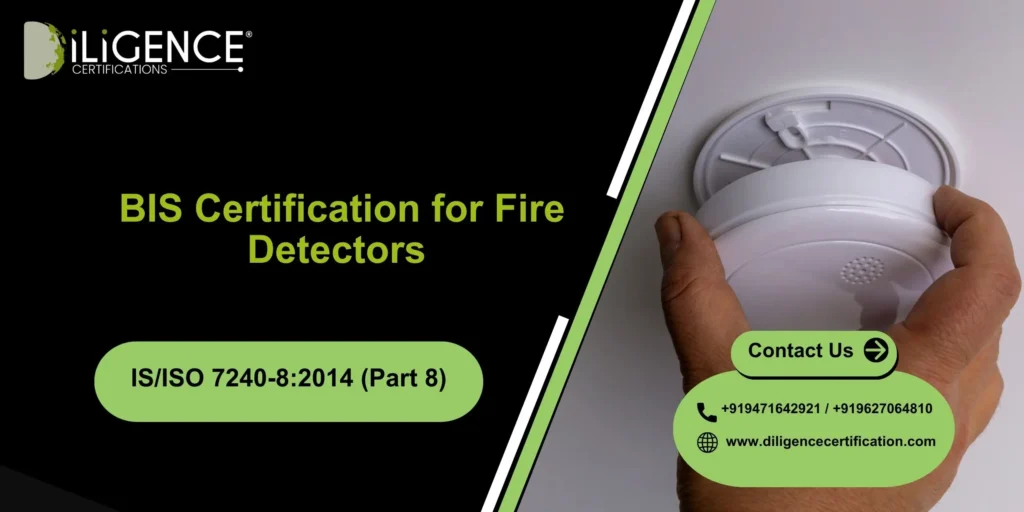
- BIS certification for fire detector IS/ISO 7240-8:2014 (Part 8) focuses on fire detectors that combine carbon monoxide (CO) sensing with heat detection.
- These detectors provide early fire detection by identifying both gas emission and temperature rise.
- BIS certification ensures product quality, safety, and compliance with Indian standards.
- Mandatory compliance is required for manufacturers selling such detectors in India.
- Certification enhances product credibility, market acceptance, and regulatory approval.
Introduction | BIS certification for fire detector
Fire safety systems are a critical component in residential, commercial, and industrial environments. With the increasing complexity of fire hazards, traditional smoke detectors alone are often not sufficient. This is where advanced fire detection systems, such as those covered under IS/ISO 7240-8:2014 (Part 8), play a vital role.
This standard specifically deals with point-type fire detectors that use a combination of carbon monoxide sensors and heat sensors. These detectors are designed to identify fire at an early stage by detecting the presence of CO gas along with a rise in temperature.In India, the Bureau of Indian Standards (BIS) regulates the certification of such fire detection devices to ensure safety, performance, and reliability. Obtaining BIS certification for fire detector under IS/ISO 7240-8:2014 is essential for manufacturers who want to supply compliant products in the Indian market.
What is BIS certification for fire detector IS/ISO 7240-8:2014 (Part 8)?
BIS certification for fire detector IS/ISO 7240-8:2014 (Part 8) is an Indian standard aligned with international guidelines that specifies requirements, test methods, and performance criteria for fire detectors that combine:
- Carbon monoxide (CO) sensing
- Heat detection
These detectors are designed to provide enhanced fire detection by identifying combustion gases before visible flames or smoke appear, along with temperature changes.
Key Features of the Standard
- Defines performance requirements for CO and heat-based detectors
- Specifies testing procedures for sensitivity and response time
- Ensures reliability in different environmental conditions
- Covers design, construction, and marking requirements
- Aligns with global fire safety standards
Why is BIS certification for fire detector Required?
BIS certification for fire detector under IS/ISO 7240-8:2014 is essential for several reasons:
1. Legal Compliance Manufacturers must comply with Indian regulations to sell fire detection products in the market.
2. Safety Assurance Certification ensures that detectors function accurately during emergencies.
3. Quality Standardization BIS ensures uniform quality across all certified products.
4. Market Trust Certified products gain higher acceptance among consumers and businesses.
5. Government and Tender Eligibility Only BIS-certified products are eligible for many government and institutional tenders.
Importance and Benefits
Below is a comparison of the importance and benefits of BIS certification under IS/ISO 7240-8:2014:
| Importance | Benefits |
| Ensures fire safety compliance | Reduces risk of fire-related damage |
| Maintains product quality standards | Builds brand credibility |
| Mandatory for market entry | Enhances customer trust |
| Validates performance reliability | Improves product acceptance |
| Supports regulatory approvals | Opens business opportunities |
BIS Certification Process
Obtaining BIS certification for fire detectors under IS/ISO 7240-8:2014 involves a structured process:
Step 1: Application Submission
The manufacturer submits an application to BIS with product details, specifications, and required documents.
Step 2: Documentation Review
BIS evaluates technical documents including:
- Product design
- Manufacturing process
- Quality control measures
Step 3: Product Testing
Samples are sent to BIS-recognized laboratories for testing based on IS/ISO 7240-8:2014 requirements.
Step 4: Factory Inspection
BIS officials inspect the manufacturing unit to verify:
- Production capability
- Quality control systems
- Testing facilities
Step 5: Grant of License
After successful verification and testing, BIS grants certification and allows use of the ISI mark.
Step 6: Surveillance and Renewal
Regular inspections and audits ensure continued compliance.
Challenges of Getting this Certification Without a Consultant
Obtaining BIS certification independently can be complex and time-consuming. Some common challenges include:
1. Complex Documentation Understanding and preparing technical documents as per BIS requirements can be difficult.
2. Testing Requirements Coordinating with laboratories and ensuring product compliance requires technical expertise.
3. Regulatory Knowledge Lack of clarity on BIS guidelines may lead to application rejection.
4. Time Delays Improper submissions can significantly delay the certification process.
5. Factory Compliance Issues Meeting inspection requirements without prior preparation can be challenging.
6. Communication Gaps Handling queries from BIS authorities requires experience and prompt response.
Why Choose Diligence Certification for This Certification
Diligence Certification offers end-to-end support for obtaining BIS certification under IS/ISO 7240-8:2014.
1. Expert Guidance A team of professionals with in-depth knowledge of BIS regulations.
2. Documentation Support Preparation and verification of all required documents to avoid rejection.
3. Testing Coordination Assistance in product testing with BIS-approved laboratories.
4. Faster Approval Streamlined processes help reduce approval time.
5. End-to-End Assistance Support from application submission to certification grant.
6. Post-Certification Support Help with renewal, compliance, and surveillance audits.
Conclusion
BIS certification for fire detector under IS/ISO 7240-8:2014 (Part 8) is crucial for ensuring the safety, reliability, and performance of fire detectors that use carbon monoxide and heat sensors. With increasing fire safety requirements across industries, certified products are not only a regulatory necessity but also a competitive advantage.
Manufacturers who invest in certification gain better market access, improved brand trust, and compliance with national and international safety standards. However, due to the complexity of the process, professional guidance can make a significant difference in achieving timely and successful certification.
Frequently Asked Questions (FAQs)
What is IS/ISO 7240-8:2014 (Part 8)?
It is a standard for fire detectors combining carbon monoxide and heat sensors.
Is BIS certification mandatory for these detectors?
Yes, it is required for selling compliant products in India.
What type of detectors are covered under this standard?
Point-type fire detectors using CO and heat sensing technology.
How long does BIS certification take?
It usually takes a few weeks to months depending on compliance.
What tests are conducted under this standard?
Performance, sensitivity, environmental, and reliability tests.
Can foreign manufacturers apply for BIS certification?
Yes, through the Foreign Manufacturers Certification Scheme (FMCS).
What is the validity of BIS certification?
Typically valid for one year and renewable.
What happens if a product fails testing?
The application is rejected or requires modifications and retesting.
Is factory inspection mandatory?
Yes, BIS conducts inspections before granting certification.
Why are CO and heat detectors important?
They provide early and more accurate fire detection compared to traditional systems.