 BIS Certification
 CDSCO
CDSCO
 PESO
PESO
 CPCB
CPCB
 LMPC
LMPC
 WPC Approval
 Global Approvals
 TEC
TEC
 ARAI
ARAI
 BEE
BEE
 ISO Certification
 DGCA Certification
 NOC For Steel
 APEDA Registration










 Business Registration
 FSSAI Mark Certification

 (32).jpg)
 Legal Services
 Trademark Registration
 Copyright Registration
 Patent Registration
 By
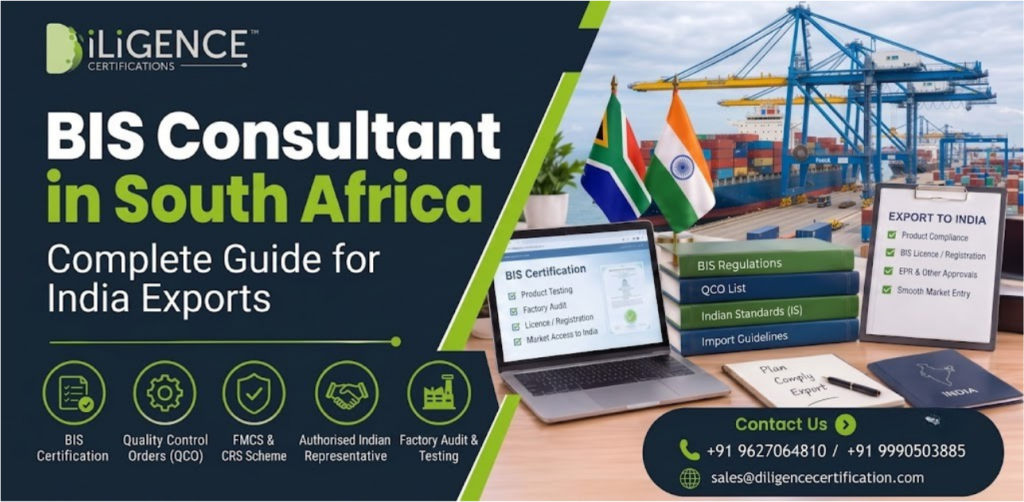
By - BIS certification may be mandatory for certain products exported from South Africa to India.
- Check the applicable Indian Standard and Quality Control Order before exporting products.
- Foreign manufacturers may need to follow the Foreign Manufacturers Certification Scheme (FMCS).
- Prepare the required company documents, factory records, product specifications, and testing documents.
- A BIS Consultant in South Africa can help exporters understand certification requirements and prepare their applications with guidance from Diligence Certifications.
Introduction
BIS Consultant in South Africa. You have found a buyer in India. The buyer likes your product. The price is good. Both sides are ready to move. Then someone asks you a question you never thought about: does your product need BIS certification before it can be sold in India.
For people who export products this is the moment when everything gets confusing.
You might already have quality certificates, test reports or approvals from countries. Your factory might follow quality procedures. These things do not automatically mean that your product meets the certification rules in India.
The first step is to look at the rules, for your product. Some products do not need BIS certification while others have to follow an Indian Standard before they can be sold in India.
Getting this information early can stop a business from making plans based on ideas.
A BIS Consultant in South Africa can help you understand the steps prepare the needed papers and go through the certification process. At Diligence Certifications the main goal is to help businesses know what needs to be done before they spend time and money on an application.
What South African Businesses Should Know About BIS
BIS stands for the Bureau of Indian Standards. BIS is the national standards body of India. BIS runs product certification schemes according to the laws and regulations that’re in place.
For an exporter it is important to know that BIS certification does not mean approval for all products coming into India. The need for BIS certification depends on the product category the Indian Standard and any compulsory certification orders that are currently active.
For instance two products that look alike might have technical specifications. One product could be, under a certification requirement while the other product might not be. So just looking at the product name is not enough to know if BIS certification is needed.
Before applying, a manufacturer should establish:
- The exact product and its technical specifications.
- Whether BIS certification is compulsory for that product.
- Which Indian Standard applies.
- Which certification scheme should be followed.
- What testing, factory and documentation requirements must be met.
These are practical questions, not just paperwork. Their answers can affect the manufacturer’s export schedule, production plans and discussions with the Indian buyer.
Does Your Product Need BIS Certification to Enter India?
I think there is no answer for every South African exporter. India has introduced certification requirements for selected products through regulations and Quality Control Orders. If your product is covered by an order you must check the requirements before marketing or supplying it in India.
Suppose an African company manufactures an electrical product, an industrial material or a component used by another manufacturer. I would not assume that all products, in that category follow the process. The specific product applicable order must be checked.
I would also say it is equally important not to assume that certification is compulsory when it is not. Starting an application can create work and expense.
I suggest a sensible first step is to review the product specifications and compare them with the BIS requirements. If the position is unclear professional guidance can help the manufacturer identify what needs to be confirmed.
I recommend checking the requirements through the Bureau of Indian Standards website.
How a BIS Consultant Can Help
Most manufacturers do not want another explanation of regulatory terms. They want to know which rules apply to their product and what steps to take next.
That is where a consultant becomes useful.
Understanding the standard. The consultant starts by reviewing the product information. This may include specifications, intended use, model details and manufacturing information. The purpose is to identify the Indian Standard and to check whether the product falls under a compulsory certification requirement. If more information is needed the manufacturer can provide it before the application is prepared.
Choosing the certification route. Foreign manufacturers may encounter two terms while researching BIS certification: FMCS and CRS. FMCS stands for Foreign Manufacturers Certification Scheme. It covers products manufactured outside India except, for electronics and IT products handled under the CRS route. CRS stands for Compulsory Registration Scheme. Applies to specified product categories, including notified electronics and IT goods. These schemes are not interchangeable. The correct route depends on the product and the current rules so it should be confirmed before starting the application.
Getting the documents ready. A manufacturer might already have many of the papers that are needed. Not all of them might be in the format, for the application. A consultant can help find what is missing. Make sure the product details, factory address, company information and technical records match. This is important because the application should clearly explain the product and the place where it is made. Wrong or missing information can cause problems. Slow things down.
Preparing for testing and factory assessment. For FMCS cases the process can involve product testing and an assessment of the manufacturing facility. The factory must be capable of producing goods that meet the Indian Standard. A consultant can explain what the manufacturer needs to prepare and help identify gaps. However the actual requirements and certification decision remain with BIS.
BIS Certification Process for South African Manufacturers
The process depends on the product and scheme. For a product under FMCS the following is an overview of the main stages.
1. Start with the product details
Prepare a description of the product. Include all specifications. Include all model numbers. Include the use. If the product has variants list each one separately. Do not assume that one description will fit all versions. These details are important. These details are important because they help determine which Indian Standard and certification requirements apply.
2. Confirm whether certification is compulsory
Check the regulations and the current list of products that require compulsory certification. Do not rely on articles, supplier statements or what another company may have done. If the product is not on the list certification may not be needed.. If it is then the correct process must be followed.
3. Confirm the scheme
Once the need for certification is clear decide whether the product follows the FMCS route or another applicable scheme like CRS for electronics and IT products. This decision should be made early. It helps avoid spending time and effort on the application process.
4. Review the factorys readiness
For FMCS the application is for the foreign manufacturing facility. The manufacturer must review the production process, quality control systems, testing equipment and technical records. Compare them against the requirements. If there are gaps it is better to find out than later in the process.
5. Prepare the application documents
The required documents vary depending on the product. The manufacturer should collect company details, factory information, product data and technical records as specified for the application. Always check the checklist before submitting. A general list found online might not include all the needed items, for your product.
6. Arrange the Authorized Indian Representative
For FMCS the foreign manufacturer must appoint an Authorized Indian Representative or AIR as required by BIS. The representative must meet eligibility rules. Accept the duties involved. The manufacturer should understand these duties fully before making the appointment.
7. Submit the application through the prescribed route
BIS provides a way to submit FMCS applications. The application must include all information, supporting documents and the correct fees. Before sending, double-check that company details, manufacturing address and product specifications are accurate and match across all forms.
8. Complete the required testing and assessment
Depending on the product and the scheme, testing and factory assessment may be needed. The manufacturer must show that the product meets the Indian Standard and satisfies all requirements. If the product does not pass additional work may be needed before certification can move forward.
9. Respond to questions. Follow the decision
BIS may ask for clarification or more information during the process. Responses should be complete. Backed by accurate records. If all requirements are met BIS may grant a licence or approval. Until this happens the manufacturer should not assume that the application gives permission to use the Standard Mark or to sell the product in the market for certification.
Documents You May Need
The documents depend on the product, the applicable standard and the certification scheme. For an FMCS application, the manufacturer may need some or all of the following:
- Company registration and manufacturer information.
- Full factory name and address.
- Product specifications and model details.
- Manufacturing process information.
- Quality-control procedures and inspection records.
- Details of testing equipment and technical personnel.
- Technical documents required by the relevant Indian Standard.
- AIR nomination and prescribed declarations.
- Application forms and other scheme-specific documents.
This is a starting point, not a universal checklist. A product-specific review is needed to establish the final requirements.
One detail worth checking carefully is consistency. If the factory address appears differently across company records, technical documents and application forms, resolve the difference before submission. The same applies to product names, models and specifications.
What Is the Difference Between FMCS and CRS?
This is a common question for overseas manufacturers because both schemes are associated with BIS.
FMCS is the Foreign Manufacturers Certification Scheme. It is used for eligible products manufactured outside India, excluding the specified electronics and IT goods handled under CRS.
CRS is the Compulsory Registration Scheme. It applies to notified product categories, particularly certain electronics and IT products.
The manufacturer’s location alone does not decide the scheme. The product category and current regulatory requirements are what matter.
If you are unsure which scheme applies to your product, confirm this before preparing an application. Choosing the wrong route can mean unnecessary work and lost time.
How Much Does BIS Certification Cost?
The price changes depending on the application so giving one number would not be fair.
Depending on the situation the total cost can have BIS charges, product checking, factory review and any travel costs that come with it. The company might also need to plan for papers to be made or changes needed to follow the rules.
Fees for help from experts are different from the costs.
Before moving ask for a full explanation of what needs to be done and what money might be needed. The item how many models are. What the rules say should all be thought about.
Watch out for any promise that approval’s certain for a set price. Getting certified depends on following the rules and getting the decision, from BIS.
How Long Does the Process Take?
The timeline depends on the product and the work that must be finished for the application. The timeline is shaped by the product and the amount of work.
A manufacturer who has all the papers. A factory that is already set up for the requirements is in a better position than one that still needs to find testing sites, fix records or solve technical problems.
Testing, checking the factory looking at the documents and answering questions can all change the schedule. Because of this it is better to check the requirements before the Indian buyer expects the shipment.
A consultant can help show the steps that are expected. An exact date, for approval should not be promised without a reason.
Mistakes That Can Make the Process More Difficult
I have seen exporters struggle with a simple assumptions that could have been avoided. Assuming that certification from overseas is enough is a mistake.
A certificate that comes from South Africa does not automatically meet the certification requirements for the target market. Using the standard incorrectly can cause trouble.
A general name for a product is not always enough to find the Indian Standard. Technical details must be checked carefully. Leaving preparation until the last minute is risky. Arranging the factory getting technical documents ready and doing testing can take time.
Check all of these before setting an export date. Treating FMCS and CRS as the scheme is wrong. The coverage and the steps for each are different. Confirm the path. Assuming that a consultant can promise approval is mistaken.
A consultant can help prepare and organize. The final decision, on certification is made by BIS. These points may seem simple. Dealing with them early helps exporters plan the process properly.
Why Choose Diligence Certifications for BIS Consultant in South Africa Certification?
When a company is just starting out in a market it can be hard to know where to begin. There are often rules, documents and steps to sort through before the company can make a plan.
Diligence Certifications can support manufacturers by helping them understand the BIS certification path and get ready, for the process.
This support might include reviewing product details identifying the rules that apply and guiding the manufacturer through the paperwork and application steps. If testing or a factory inspection is needed Diligence Certifications can also help the manufacturer know what to prepare.
The approach should be based on the product and the actual factory. It should not assume that every company does things the way.
You can learn more about Diligence Certifications and the BIS certification services they offer.
Still the final outcome depends on the manufacturer’s ability to follow the rules and on the decision made by BIS. Being well prepared can help uncover problems but it does not remove the need to meet the rules that apply.
Conclusion
If you are a manufacturer who wants to export products to India you must understand the BIS certification requirements before you start the export process. The BIS certification requirements change depending on the product category the Indian Standard and the current rules. Looking at these details early can help you avoid delays problems with paperwork and extra expenses.
Working with a BIS Consultant in South Africa can help African manufacturers choose the right BIS certification scheme gather the needed documents and learn about the steps involved in the application process. Diligence Certifications can help African manufacturers go through these BIS certification requirements and get ready for the procedures.
Before you export make sure that your product meets the BIS requirements and that all the needed approvals are in place. Good preparation can make the BIS certification process easier to handle and help your business plan its entry, into the market with confidence.
Frequently Asked Questions
1. What is BIS certification in India?
BIS certification is a conformity assessment system managed by the Bureau of Indian Standards. It helps ensure that products covered by applicable Indian standards and compulsory certification requirements meet the specified requirements.
2. Do South African manufacturers need BIS certification to export to India?
Some South African manufacturers need BIS certification before exporting products to India. The requirement depends on the product category, applicable Indian Standard and current government regulations.
3. What does a BIS consultant in South Africa do?
A BIS consultant helps South African manufacturers understand applicable certification requirements, identify the appropriate certification scheme, prepare documents and navigate the application process.
4. What is the Foreign Manufacturers Certification Scheme (FMCS)?
FMCS is a BIS certification scheme for eligible foreign manufacturing facilities producing products covered by the scheme. It involves applicable product standards, testing and factory assessment requirements.
5. What documents are required for BIS certification for foreign manufacturers?
Depending on the product and certification scheme, documents may include company registration details, factory information, product specifications, manufacturing process details, quality-control records, testing information and Authorized Indian Representative documents.
6. What is the difference between BIS FMCS and CRS?
FMCS is intended for eligible foreign manufacturers under the applicable product certification requirements. CRS, or the Compulsory Registration Scheme, applies to notified product categories, including specified electronics and IT products. The correct route depends on the product and current BIS requirements.
7. How much does BIS certification cost for South African exporters?
The cost depends on the product, applicable scheme, testing requirements, factory assessment, prescribed BIS fees and professional consultancy charges. Manufacturers should obtain a product-specific cost estimate before applying.
. How long does it take to obtain BIS certification?
The timeline depends on document readiness, product testing, factory assessment requirements and responses to BIS queries. Manufacturers should confirm the expected process and timeline before committing to an export schedule.
9. Can South African manufacturers use their existing international quality certificates for BIS certification?
Existing international quality certificates may support a manufacturer's quality documentation, but they do not automatically replace mandatory BIS certification. The manufacturer must meet the applicable Indian requirements.
10. How can Diligence Certifications help South African businesses obtain BIS certification?
Diligence Certifications can guide businesses in reviewing product requirements, identifying the applicable certification route, preparing documents and understanding testing and factory assessment requirements. The final certification decision rests with BIS.