 BIS Certification
 CDSCO
CDSCO
 PESO
PESO
 CPCB
CPCB
 LMPC
LMPC
 WPC Approval
 Global Approvals
 TEC
TEC
 ARAI
ARAI
 BEE
BEE
 ISO Certification
 DGCA Certification
 NOC For Steel
 APEDA Registration











 Business Registration
 FSSAI Mark Certification








 (32).jpg)
 Legal Services
 Trademark Registration
 Copyright Registration
 Patent Registration
 By
By - A CPCB e waste EPR consultant helps you with registration, on the CPCB portal, yearly targets, EPR certificates and returns while the legal responsibility stays with your company.
- Under the E-Waste (Management) Rules, 2022 manufacturers, producers, refurbishers and recyclers must register before doing business.
- A consultant cannot cut your target fix sales data. Promise approval on a fixed date.
- Before hiring ask who will handle your file how categories are decided what is included after registration and for a written fee breakup.
- Registration is the start. You still need to buy certificates, file returns and keep your records matching your GST and import data.
Introduction
Picture a small importer of laptop accessories. A big buyer asks him for his EPR registration, and he has never heard of it. He opens the CPCB portal, sees a very long product list, gets stuck at the first question, and closes the tab. “Next week,” he tells himself. Next week turns into next month. This is the point where most people start searching for a CPCB e waste EPR consultant.
The rules are not impossible. They are just detailed, and one wrong entry at the start can trouble you for years. So here is a plain, honest guide: what a consultant really does, when you actually need one, and how to choose without getting fooled by big promises.
What Is a CPCB E Waste EPR Consultant?
A CPCB e-waste EPR consultant is a person or a company that helps your business follow the ewaste rules set by the Central Pollution Control Board. This consultant helps with registering on the CPCB ewaste EPR website. This consultant helps with figuring out your recycling target. This consultant helps with getting the EPR certificates. This consultant helps with making sure all reports are submitted before the deadline.
In short the CPCB e waste EPR consultant handles the forms and website tasks. The business remains the one that must follow the law and the registration is, in your companys name. What the CPCB e waste EPR consultant provides is report submission, which helps you avoid costly mistakes.
What Do the E-Waste Rules Say?
The E-Waste (Management) Rules 2022 have been active since 1 April 2023. These rules replaced the 2016 rules. The main idea of these rules is Producer Responsibility or EPR. I find it clear that if you sell products you are also responsible for making sure the waste, from those electronic products gets recycled properly.
The main points, in short:
- Manufacturers, producers, refurbishers and recyclers must register on the CPCB portal. Doing business without registration is not allowed.
- Producers get yearly recycling targets that are linked to what they have sold.
- To meet the target, producers buy EPR certificates from registered recyclers. These certificates are generated on the CPCB portal.
- Schedule I, the list of covered products, now has 106 items of electrical and electronic equipment.
- The recycling targets are 60 percent for 2023-24 and 2024-25, 70 percent for 2025-26 and 2026-27, and 80 percent from 2027-28 onwards.
Rules and portal steps can change through new notices, so please check the latest CPCB notice before you file anything.
Who Needs E-Waste EPR Registration?
You will most likely need it if you do any of these things:
- Make electrical or electronic products in India
- Import such products and sell them
- Sell products under your own brand, even when someone else makes them
- Refurbish used electronic items
- Dismantle or recycle e-waste
Each of these roles has a separate route on the portal. Many first-time applicants pick the wrong one and lose weeks. If you are not sure where you fit, ask before you apply, not after.
What Does a CPCB E Waste EPR Consultant Actually Do?
A lot of websites say “complete end-to-end support” and leave it there. In real terms, the work looks like this:
- Checks your products. Each product you sell is matched with the right category, so your application starts on the right foot.
- Prepares your documents. Usually this means company registration proof, GST details, PAN, and an import code if you are an importer. The exact list depends on your business.
- Files the application. The form is filled on the portal, papers are uploaded, and any query from the officials is answered.
- Explains your target. You get a clear idea of how many tonnes you need to recycle, based on your sales.
- Guides you on EPR certificates. You are told how and when to buy them from registered recyclers.
- Prepares your returns. Sales and certificate records are put together for the filings required on the portal.
- Keeps you updated. When CPCB changes something, you hear what it means for your business.
If you want help with all these steps, you can read about the CPCB e-waste EPR registration service from Diligence Certifications.
What a Consultant Cannot Do
Nobody talks about this part, but it matters. A good consultant will tell you the limits upfront.
- They cannot reduce your target. It comes from the rules and your own sales data.
- They cannot promise approval on a fixed date. The officials decide, and queries can add time.
- They cannot fix wrong data. If your sales numbers are incomplete, the problem will come back later.
- They cannot take over your legal responsibility.
So if anyone guarantees approval or says “you don’t have to do anything”, be careful.
Do You Really Need a Consultant?
Some businesses manage on their own, especially when they have few products and a person who understands compliance. Others struggle. A quick comparison:
| Point | Filing on your own | Hiring a consultant |
| Time from your team | High, mostly the first time | Lower, mainly sharing papers and data |
| Category mistakes | More likely if you are new to the rules | Less likely with an experienced person |
| Portal queries | You reply yourself | The consultant helps you draft replies |
| Returns and dates | You track every date | The consultant can track them for you |
| Cost | No service fee | Service fee on top of government charges |
Help makes the most sense when you sell many product types, import regularly, have no compliance person in-house, or have already received a query or notice.
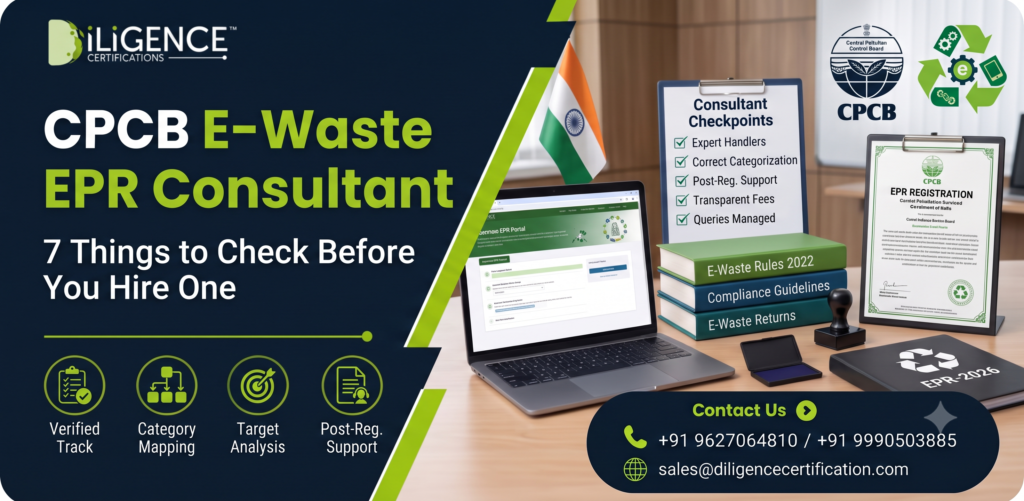
7 Things to Check Before You Hire a CPCB E Waste EPR Consultant
Here is the list you should have with you when you speak to any consultant, including us.
1. Ask who will actually handle your file. Some companies use one person to sell their services. Then they give the work to someone. Make sure you get the name of the person who will work on your case.
2. Ask how they decide your category. A good consultant will ask for product lists, model names and how the products are used. If someone makes a decision in two minutes without asking any questions that’s a warning sign.
3. Ask what happens after registration. Registration is the start. Find out if returns, certificate guidance and renewal tracking are included or if they cost extra.
4. Ask for a fee breakdown in writing. Government fees and consultant fees are two things. A reliable company will show both clearly.
5. Ask how portal queries are handled. It is normal to have queries. Ask who will reply, how quickly and whether you will see the reply before it is sent.
6. Ask how they will keep you updated. You should know where your file stands without having to chase anyone. A simple email or WhatsApp message is enough.
7. Ask what they will not promise. An honest consultant will tell you what is, outside their control. A company that promises everything is probably promising much.
Red Flags to Avoid
- Approval promised in a fixed number of days
- A very low price that never mentions government charges
- No written scope of work
- Pressure to pay in full before any document review
- No mention of returns or follow-up work
- Unwillingness to explain how your file will be handled
How the E-Waste EPR Registration Process Works
The exact steps depend on your category, but the flow is usually like this:
- Find your category. Decide whether you are a producer, manufacturer, refurbisher or recycler, and list your products properly.
- Gather your documents. Keep company papers, GST details and product details ready. Importers also need their import code.
- Create your login. Register on the CPCB e-waste EPR portal and complete your profile.
- Fill in the application. Enter product and sales details and upload the papers.
- Pay the government charges. The fee for your category is shown on the portal.
- Answer queries. If the officials ask for more details, reply clearly and on time.
- Receive registration and targets. After approval, your registration and yearly target show on the portal.
There is no fixed processing time. It depends on how clean your application is and whether queries come up.
What Happens After Registration?
This is where many companies slip. Getting the certificate is not the end. You still need to:
- Keep track of your yearly recycling target
- Buy EPR certificates from registered recyclers on the portal
- File the returns that the portal requires
- Maintain records of sales, purchases and certificates for any check or audit
- Watch for rule changes and portal updates
CPCB has been linking data across systems and checking more closely, so your sales records should match your tax and import records. It is far easier to keep them tidy from day one.
Common Mistakes Businesses Make
- Placing products in the wrong category
- Registering under the wrong entity type
- Giving sales numbers that do not match GST or import records
- Forgetting returns once the certificate is in hand
- Leaving certificate purchase to the last moment
- Ignoring messages on the portal
Most of these can be avoided with a simple checklist and someone who has done it before.
Why Choose Diligence Certifications for CPCB e waste EPR consultant Certification?
Choosing a consultant is about trust, so we will keep this short and honest. At Diligence Certifications, we try to explain compliance in a way that a busy business owner can follow without a legal background.
- Plain explanations. We tell you the rules in simple words, so you know what you are signing up for.
- Clear scope. Before work starts, you know what is included and what is not.
- Careful document review. We check your product list, category choice and papers before filing, to cut down avoidable mistakes.
- Honest timelines. We do not promise approval dates, because the final decision is with the authorities.
- Help beyond filing. We can guide you on targets, certificates and returns, so you are not left alone after registration.
If you would like to talk through your case first, you are welcome to ask. There is no pressure to go ahead.
Conclusion
E-waste EPR cannot be finished in a day. It begins with selecting the category then moves on to obtaining certificates handling returns. It stays a part of your business each year.
A good CPCB e waste EPR consultant can save your time reduce errors and keep you updated.
You still need to learn the basics by yourself. Before deciding examine the seven questions. Ask them directly.
If you need help with your e-waste registration send an email to Diligence Certifications. Share your product list. They will honestly tell you what the next step should be.
Frequently Asked Questions
1. What does a CPCB e waste EPR consultant do?
They help you register on the CPCB e-waste portal, understand your recycling target, arrange EPR certificates and file returns.
2. Is EPR registration mandatory for e-waste in India?
Yes. Under the E-Waste (Management) Rules, 2022, manufacturers, producers, refurbishers and recyclers must register on the CPCB portal.
3. Who needs e-waste EPR registration?
Anyone who makes, imports or sells electrical and electronic products under their own brand, and anyone who refurbishes, dismantles or recycles e-waste.
4. Can I apply without a consultant?
Yes, you can apply on your own on the CPCB portal. Many businesses take help because categories, documents and returns can be confusing.
5. What documents are usually needed?
Commonly asked documents are company registration proof, GST details and PAN, plus an import code for importers. Please check the portal for the final list.
6. What is an EPR certificate?
It is proof that a certain quantity of e-waste has been recycled. Producers buy these from registered recyclers to meet their targets, and they are generated on the CPCB portal.
7. What are the e-waste recycling targets?
The rules set 60 percent for 2023-24 and 2024-25, 70 percent for 2025-26 and 2026-27, and 80 percent from 2027-28 onwards.
8. How long does registration take?
There is no fixed time. It depends on how complete your application is and whether the officials raise queries.
9. Can a consultant guarantee approval?
No. The final decision is with the authorities, so be careful with anyone who promises approval.
10. What happens after registration?
You track your yearly target, buy EPR certificates, file the required returns and keep your records ready for any check.