 BIS Certification
 CDSCO
CDSCO
 PESO
PESO
 CPCB
CPCB
 LMPC
LMPC
 WPC Approval
 Global Approvals
 TEC
TEC
 ARAI
ARAI
 BEE
BEE
 ISO Certification
 DGCA Certification
 NOC For Steel
 APEDA Registration






















 Business Registration
 FSSAI Mark Certification












 (32).jpg)
 Legal Services
 Trademark Registration
 Copyright Registration
 Patent Registration
 By
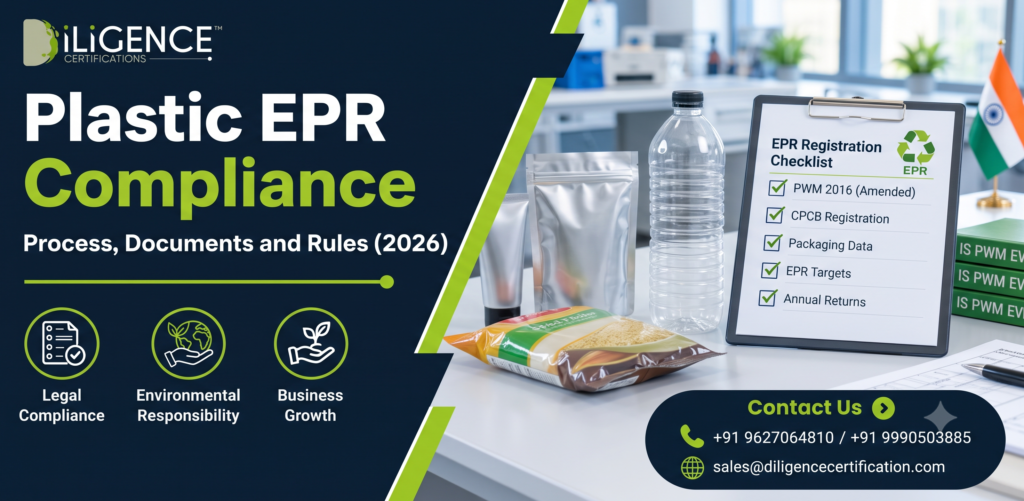
By - Plastic EPR compliance helps businesses understand their responsibilities under India’s plastic waste management rules.
- Producers, Importers and Brand Owners (PIBOs) may need CPCB or relevant State Pollution Control Board registration, depending on the applicable rules.
- Businesses should maintain accurate plastic packaging data and supporting documents.
- Applicable EPR targets, recycling obligations and annual reporting requirements must be followed.
- Regular recordkeeping and timely compliance help businesses avoid errors and regulatory issues.
Introduction
Imagine a company that sells food that is made by makers or beauty products or home goods under its own name. Even if another company is the one making those products the company must still take responsibility, for the waste that is created.
Plastic EPR compliance means following the waste management rules in India. Plastic EPR compliance also includes things like registering, reporting packaging meeting recycling goals and keeping records.
According to the Plastic Waste Management Rules, 2016 as updated businesses that fit the criteria need to know what they must do. These businesses must follow the process set by the CPCB or the SPCB/PCC.
This guide explains EPR compliance the documents needed, how to register, the types of packaging and the new changes to the 2026 portal, all, in English.
What Is Plastic EPR Compliance?
Plastic EPR compliance means following the rules for packaging under India’s Extended Producer Responsibility system.
The main goal is to make companies that are covered by these rules take responsibility for managing the waste that comes from the plastic packaging they put into the market. This includes tasks like collecting waste recycling it and reusing it wherever possible. It also involves handling the end-of-life disposal of waste in a way.
For example a company that sells drinking water might put thousands of bottles into the market each month. That company must check if it falls under the EPR rules. If it does it must complete registration submit reports. Carry out waste management duties as required.
The same applies to businesses that sell cosmetics, electronic devices, packaged food, cleaning products and other items that come with packaging. These companies must also understand their responsibilities, under the EPR system. They must act accordingly.
Who Needs Plastic EPR Compliance in India?
The plastic packaging EPR framework includes types of businesses. The correct category depends on what the business does and on the definitions inside the rules.
1. Producers
Producers are companies that create packaging or covered packaging materials. I think a company that makes bottles, containers or packaging materials needs to check Producers activities against the definitions. The exact registration requirements depend on the type of business and the rules that apply.
2. Importers
Importers that bring covered packaging or packaged products into India may have Plastic EPR compliance responsibilities. For example a company that imports packaged electronic accessories must look at the packaging that comes with the products Importers import and decide what responsibilities apply to Importers role. Importers should keep import documents, product information and packaging data to support the Importers Plastic EPR compliance assessment.
3. Brand Owners
Brand owners sell products under the brand owners own brand names. Brand owners may use third-party factories to make, fill or pack the Brand owners products. Consider a skincare company that sells shampoo in bottles, under the company’s brand. Another company may make the shampoo. Give the finished bottles. The brand owner should not automatically assume that outsourcing production removes the Brand owners Plastic EPR compliance responsibilities. The business must review the Brand owners role under the rules. Decide if registration and other obligations apply.
4. Plastic Waste Processors
Plastic Waste Processors (PWPs) are businesses that do recognised activities such as recycling and other allowed waste processing operations. These businesses have their registration and reporting responsibilities. The businesses records are also important because proof of processing can help covered entities meet the entities Plastic EPR compliance obligations. The Central Pollution Control Board (CPCB) gives guidance, on registration. On the plastic packaging EPR framework.
What Are the Four Categories of Plastic Packaging Under EPR?
Correct packaging classification is an important part of plastic EPR compliance. Different packaging categories may have different applicable targets and requirements.
Category I: Rigid Plastic Packaging
Category I generally covers packaging such as bottles, tubs, containers and similar forms.
For example a company that sells cleaning liquid in bottles must keep accurate records of the packaging material and the quantities put into the market.
Businesses should follow the definitions provided. Not classify packaging based only on how it looks.
Category II: Plastic Packaging
Category II usually includes things like plastic films, bags, pouches and wrappers. These are common in products. For example a snack company might use plastic wrappers for chips or candies. A personal-care brand might use pouches for shampoo or lotion refills. It’s important for businesses to keep track of the packaging details so they can put the material in the category. Getting this right helps avoid mistakes
Category III: Multilayered Plastic Packaging
Category III covers packaging that mixes plastic with materials as set out in the rules. Many food and consumer goods come in packaging. That’s when different layers are stuck together. Before putting it in this category businesses need to check what materials are used. They shouldn’t just assume that any laminated packaging needs to be reported. Each case must be looked at carefully.
Category IV: Compostable Plastic Packaging
Category IV is, for packaging that fits under the plastic rules. Just because a product says “biodegradable” or “eco-friendly” doesn’t mean it’s plastic. Businesses must check the material’s status. Look at official documents before deciding how to classify it. Taking the time to verify helps make sure the packaging data is accurate. This also reduces the risk of errors when doing EPR calculations.
What Are the Main Requirements for Plastic EPR Compliance?
The exact requirements depend on the business category, its operations, the packaging involved and the latest applicable rules. However, businesses should review several important areas.
Registration With the Appropriate Authority
Covered entities must determine the correct registration route under the applicable rules.
According to CPCB’s plastic packaging EPR guidance, PIBOs operating in more than two States or Union Territories register through CPCB, while those operating in one or two States or Union Territories follow the applicable SPCB/PCC route, subject to the current rules and instructions.
Plastic Waste Processors have separate registration requirements under the framework.
Businesses should verify their registration category and authority before submitting an application.
Accurate Packaging Data
Businesses need reliable information about the plastic packaging associated with their products.
Depending on the business, this may include:
- Product and packaging descriptions.
- Packaging material and category.
- Relevant quantities introduced into the market.
- Sales or import records.
- Supplier and manufacturer information.
- Supporting documents used for reporting.
The information should be consistent across business records and compliance submissions.
Fulfilment of Applicable EPR Targets
Covered businesses must understand their obligations by looking at the rules that apply to them and the targets that have been officially notified. Depending on the category they fall into and the rules that are in place compliance may require recognised recycling, reuse or other waste-management methods that are allowed. Businesses should not use a target number unless they have carefully checked the rules for the financial year.
Supporting Evidence and Certificates
When EPR certificates or other proof is required businesses must ensure that the documents are valid and clearly refer to the permitted activities. They should also maintain records of all transactions and any information about the registered processor involved. A claim of recycling that is not backed by evidence should not be considered as proof that compliance has been achieved.
Annual Returns and Recordkeeping
Entities that are covered by the rules must follow the reporting requirements. Keep the records that the rules demand. The amounts of packaging the certificates and the figures in the returns should be matched before submission. Businesses should also pay attention to notices, instructions, on the portal and the dates when reports need to be submitted.
How to Complete Plastic EPR Compliance Step by Step
Having a plan can make the process of registering and staying compliant much easier to manage.
Step 1: Identify Your Business Category
Start by thinking about what your business does. Not just the name of your industry or what’s on your company registration. Are you making products? Importing? Owning a brand?. Something else covered by the rules? If your business has than one role check if there are extra or separate rules that apply to each role.
Step 2: Collect Packaging Information
Gather details about your products and the packaging you use. If you don’t have the info ask your suppliers. For example if you’re a brand owner buying finished goods from a contract manufacturer you’ll need the packaging specs, production numbers or sales data to keep records.
Step 3: Gather the Necessary Documents
Get all the documents and all the information that your registration category asks for. Check again your company details PAN number, information about the person and your packaging records before you start the application. Make sure that the final list of documents is what the portal asks for.
Step 4: Complete the Registration on the Appropriate Portal
Go through the registration steps that fit your business type and how you operate. Put in the information carefully. Make sure it lines up with your documents. Keep a copy of your application and any receipt or confirmation message you get.
Step 5: Compute and Organise Your Obligations
Look at the EPR targets that’re relevant, to your business. Find out what you need to do for the time period. Use your packaging data and the newest rules when you do the calculations. If you are not sure ask for help to understand the rules that depend on your business type or the kind of packaging you use.
Step 6: Maintain Compliance Evidence
Keep records of EPR certificates, transactions and other documents that show you’re following the rules. Check that the processors you work with are registered. Save proof that links to your compliance records.
Step 7: Review Returns and Deadlines
Make a compliance calendar, with reporting periods return dates and other needs. Before submitting compare the numbers you report with your records. Fix any mistakes or missing info before moving to the period.
Documents Required for Plastic EPR Compliance
The required documents may vary depending on the entity category, registration authority and application circumstances. The following is a general preparation checklist, not a universal list of mandatory documents.
Commonly relevant documents and information include:
- Company PAN: Used to identify the business and support the registration process.
- GST details: Applicable GST registration information, where relevant.
- Business registration documents: Such as incorporation or other entity registration proof, depending on the organisation type.
- Company address: Registered address and other details requested in the application.
- Authorised-person details: Name, designation, contact details and PAN information, as required by the portal.
- Product information: Details about products associated with the plastic packaging.
- Packaging specifications: Material composition, packaging category and relevant quantities.
- Sales or import records: Supporting information appropriate to the business’s activities.
- Manufacturer or supplier information: Where required to establish packaging details or support reported figures.
- Existing compliance records: Relevant registration information, certificates and previous submissions, where applicable.
CPCB’s guidance manual for the earlier centralised plastic EPR portal describes company information, PAN, authorised-person details and other application information. Since the portal process has changed, applicants should confirm the current document requirements before filing.
Common Documentation Mistakes
One common mistake is entering a company name that does not match the supporting business records. Incorrect PAN details, incomplete packaging data and unclear supporting files can also create problems.
Businesses should verify each field before submission and keep their documents organised in a central folder.
Where information is obtained from an outside manufacturer, the business should check its accuracy instead of assuming that the supplier’s figures are automatically correct.
Important 2026 Update: CPCB Plastic EPR Portal Transition
Businesses handling plastic EPR compliance should pay particular attention to the 2026 portal transition.
According to the official CPCB plastic packaging EPR portal, the previous portal was discontinued with effect from 28 June 2026. Existing registered-unit data was migrated to the Common EPR Portal.
The old portal is now available for stakeholders to check historical information up to 28 June 2026 against their migrated records. New updates, notifications and circulars should be checked through the Common EPR Portal.
Existing registrants should take the following steps:
- Open the current Common EPR Portal.
- Follow the prescribed process to link or access the existing account.
- Use the same Company PAN and Authorised Person PAN as the previous account where required. CPCB states that these PAN details must match exactly.
- Review the migrated registration and business information.
- Report any migration-related mismatch through the prescribed portal process.
- Check the latest instructions before making changes or filing new information.
What Happens If a Business Does Not Follow Plastic EPR Compliance?
Failure to meet applicable obligations can expose a business to regulatory action under the relevant environmental rules and legislation.
The nature of the consequences depends on the violation, the applicable legal provisions, the business’s circumstances and the action taken by the competent authority.
Possible compliance problems include:
- Failure to obtain required registration.
- Incorrect or incomplete packaging data.
- Failure to fulfil applicable EPR targets.
- Unsupported claims about recycling or waste processing.
- Missing or inaccurate annual returns.
- Failure to respond appropriately to official communications.
- Inadequate records supporting reported compliance.
For example, a business may report that it has met its recycling obligations but lack records supporting the reported quantity. Another company may submit packaging data that does not match its sales or import records.
These situations require review and correction. Their legal implications may differ, so businesses should not assume that every error results in the same penalty.
To reduce compliance risks, maintain reliable records, verify supporting evidence, review current targets and address discrepancies promptly.
Common Plastic EPR Compliance Mistakes Businesses Should Avoid
Assuming That a Third-Party Manufacturer Handles Everything
Outsourcing manufacturing does not automatically settle the brand owner’s legal responsibilities. Each business should determine its own position under the applicable rules.
Using Unverified Packaging Figures
Packaging quantities should be based on reliable business records and the applicable reporting methodology. Unsupported estimates can create inconsistencies in calculations and returns.
Choosing the Wrong Packaging Category
Incorrect classification can affect reporting and the calculation of obligations. Check the packaging composition and relevant definitions before preparing the final figures.
Accepting Unsupported EPR Certificates
Businesses should verify the relevant processor, certificate information and transaction evidence. A supplier’s assurance alone may not be sufficient to establish that an obligation has been properly fulfilled.
Ignoring the Common EPR Portal Migration
Existing registrants should verify their migrated information and follow the current portal process. Continuing to depend entirely on older account instructions can create unnecessary confusion.
Treating Registration as the Final Step
Registration does not remove the need to fulfil ongoing obligations. Businesses should continue monitoring applicable targets, recordkeeping requirements and reporting deadlines.
How Businesses Can Make Plastic EPR Compliance Easier
A practical compliance system should operate throughout the year, not only when a return is due.
Maintain a Central Packaging Data Sheet
Keep a record of product names, packaging categories, material composition and relevant quantities.
If multiple suppliers manufacture the same product, distinguish their packaging specifications where necessary. Update the information whenever the packaging changes.
Coordinate With Suppliers
Ask manufacturers and packaging suppliers for accurate details about the materials they use.
A supplier may change a bottle, pouch or wrapper without the compliance team immediately knowing about it. Regular communication helps prevent old packaging information from being used in current reports.
Organise Compliance Evidence
Maintain records of registration, applicable certificates, transactions, returns and official communications.
Use a consistent naming system and ensure that supporting documents can be matched with the figures reported on the portal.
Review Official Updates
Environmental requirements and portal procedures may change through amendments, notifications and directions.
Businesses should regularly review the CPCB’s official plastic waste management resources and consult the applicable notification when a change affects their obligations.
Assign Responsibility to a Team Member
Make it clear who is responsible for packaging data, supplier communication, portal access, document storage and reporting.
For smaller businesses, one person may manage several tasks. What matters is that the responsibilities are clearly assigned and the records remain accessible.
How a Brand Can Manage Its Responsibilities
Consider a hypothetical Indian company selling household cleaning products under its own brand. A third-party factory manufactures the products and supplies them in plastic bottles.
Initially, the brand owner assumes that the manufacturer will handle all environmental requirements. During an internal review, the company realises that it must assess its own position under the plastic packaging EPR framework.
The company takes these steps:
- Reviews whether its activities bring it within the relevant business category.
- Collects packaging specifications and quantity data from the manufacturer.
- Compares packaging information against available sales and stock records.
- Determines the applicable obligations using the current rules.
- Arranges fulfilment through permitted mechanisms and maintains supporting evidence.
- Creates a calendar for registration updates, record reviews and applicable returns.
This approach gives the company better control over its compliance information. It also reduces dependence on last-minute requests to suppliers.
This is an illustrative example, not a verified client case study. Actual responsibilities depend on the business’s circumstances and the applicable legal requirements.
Why Choose Diligence Certifications for Plastic EPR Compliance Certification?
Understanding the rules is one part of the process. Applying them correctly to a particular business may require a review of its activities, packaging, documents and registration status.
Diligence Certifications can be considered by businesses seeking professional guidance on the applicable plastic EPR registration and compliance process.
A practical support process should begin by understanding the business rather than assuming that every company needs the same documents or follows the same registration route.
Professional assistance may include:
- Reviewing the business category and likely registration requirements.
- Identifying the documents and packaging information needed for an application.
- Helping organise business and compliance records.
- Reviewing information for consistency before submission.
- Explaining the applicable registration and reporting process.
- Identifying issues that require confirmation from the relevant authority.
Businesses can learn more about the company through the Diligence Certifications homepage
For information about the available compliance offerings, visit the Diligence Certifications services page
Before engaging a service provider, confirm the scope of work, documents required and responsibilities of each party. Registration approval, processing time and regulatory outcomes cannot be guaranteed by a consultant.
Conclusion
Plastic EPR compliance is an ongoing responsibility for businesses covered by India’s plastic packaging EPR framework. It involves more than applying for registration. Companies must understand their role, classify packaging correctly, maintain reliable data, fulfil applicable obligations and keep their reporting records in order.
The 2026 transition to the Common EPR Portal makes it particularly important for existing registrants to verify migrated information and follow current official instructions.
If your business manufactures plastic packaging, imports packaged products or sells products under its own brand, begin by reviewing your activities and the applicable rules. Organise your documents early, reconcile packaging information and seek professional guidance if any part of the process is unclear.
Frequently Asked Questions
1. What is Plastic EPR Compliance?
Plastic EPR compliance means following the applicable Extended Producer Responsibility requirements for plastic packaging, including registration, reporting and waste-management obligations.
. Who needs Plastic EPR Registration in India?
Eligible Producers, Importers and Brand Owners (PIBOs) dealing with plastic packaging may need registration under the applicable rules.
3. What is the full form of EPR?
EPR stands for Extended Producer Responsibility.
4. Is CPCB registration required for Plastic EPR?
Registration requirements depend on the business category and applicable rules. Businesses should check whether registration is required through CPCB or the relevant State Pollution Control Board or Pollution Control Committee.
5. What documents are required for Plastic EPR Registration?
Commonly required information may include PAN, GST details, company registration documents, product and packaging information, and relevant sales or production data.
6. What are the categories of plastic packaging under EPR?
The framework covers four main categories: Category I (rigid plastic packaging), Category II (flexible plastic packaging), Category III (multilayered plastic packaging) and Category IV (specific plastic sheets and compostable or biodegradable plastic packaging, as defined by the rules).
7. Is Plastic EPR applicable to Brand Owners?
Yes, eligible Brand Owners may have EPR responsibilities for plastic packaging sold under their brands, even when another company manufactures or packs the product
8. What is an EPR target?
An EPR target is an applicable obligation for managing or processing plastic packaging waste under the rules. The specific requirement depends on the business category and relevant compliance year
9. What happens if a business does not follow Plastic EPR rules?
Non-compliance may lead to regulatory action or environmental compensation, depending on the violation and applicable provisions.
10. How can a business maintain Plastic EPR compliance?
A business should confirm its category, complete applicable registration, maintain accurate packaging records, meet relevant EPR obligations and submit required returns on time