 BIS Certification
 CDSCO
CDSCO
 PESO
PESO
 CPCB
CPCB
 LMPC
LMPC
 WPC Approval
 Global Approvals
 TEC
TEC
 ARAI
ARAI
 BEE
BEE
 ISO Certification
 DGCA Certification
 NOC For Steel
 APEDA Registration



















 Business Registration
 FSSAI Mark Certification









 (32).jpg)
 Legal Services
 Trademark Registration
 Copyright Registration
 Patent Registration
 By
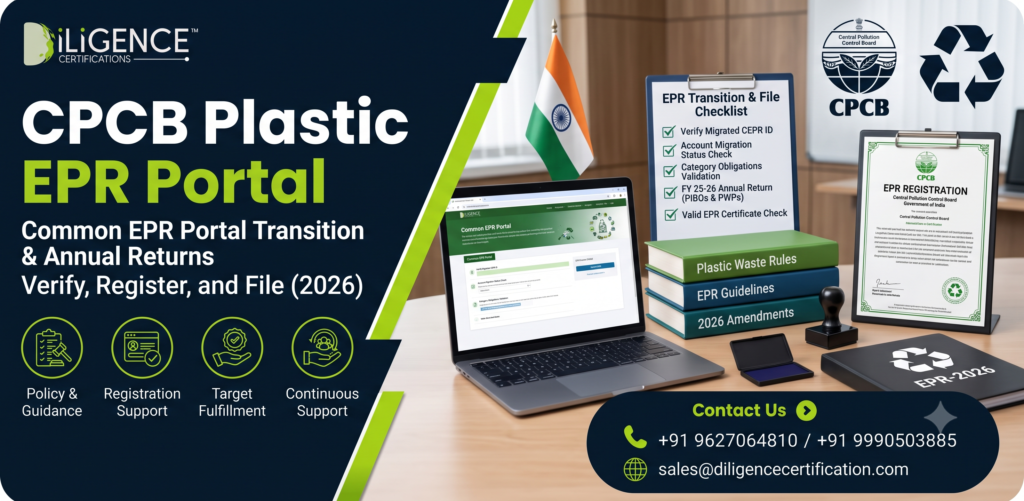
By - The CPCB plastic EPR portal is where producers, importers and brand owners register and report their plastic packaging.
- The old separate plastic portal was closed on 28 June 2026. Work now happens on CPCB’s Common EPR Portal.
- If you are already registered, log in, check your data, and file the FY 2025-26 annual return before the revised date.
- The CPCB plastic EPR portal is the official place for producers, importers, brand owners and plastic waste processors to register and report plastic packaging.
- The old separate plastic portal was discontinued on 28 June 2026, and the work now happens on CPCB’s Common EPR Portal with one login.
Introduction
A person who owns a snack brand in Gujarat called us. Was feeling a bit worried. His team had saved the EPR login page in their browser. They tried to open it to submit the return. It no longer worked the way it used to. “Is the website not working?” he asked. It was not broken. It had just been moved.
If you have had something, like this happen you are not alone. The CPCB plastic EPR website changed in 2026. Many instructions online still show the process. So here is a simple guide: what the website is, who needs to use it what has changed and what you need to do.
What is the CPCB plastic EPR portal?
The official website of the Central Pollution Control Board (CPCB) is focused on plastic packaging EPR. EPR stands for Extended Producer Responsibility. The concept is simple. If your business puts packaging into the market your business has to make sure that the plastic waste is gathered and recycled. Your business uses the website to sign up to tell how much packaging was used to keep track of EPR certificates and to submit the report. All of these actions are done under the Plastic Waste Management Rules, 2016 which are updated from time, to time.
What changed on the CPCB plastic EPR portal in 2026?
Most old blogs miss this part, so please read it carefully.
CPCB has joined its separate EPR websites into one Common EPR Portal. Earlier, a company had different logins for plastic, e-waste, batteries, tyres and used oil. Now it is one login for everything.
As per reports from several compliance sources, the old plastic portal was discontinued on 28 June 2026. Your company details, targets, past returns and certificates were moved to the new system. Every business gets one Common EPR ID, also called the CEPR ID.
The good news: the rules are the same. Your targets, record keeping and annual return duties have not changed. Only the website and the login are new.
So if any article asks you to start a fresh application on the old portal address, that article is outdated.
Who needs to register on the CPCB plastic EPR portal?
Four types of businesses are covered:
- Producers: those who make plastic packaging, or make products packed in plastic.
- Importers: those who bring plastic packaging or packaged goods into India.
- Brand owners: those who sell products under their own brand in plastic packaging.
- Plastic waste processors (PWPs): recyclers and other processors who issue EPR certificates.
CPCB’s own FAQ document talks about some exemptions, for example export-oriented units and certain micro and small brand owners. Rules and notices keep changing, so please check your own status before you decide that you are exempt.
One more thing that confuses people. If your company has its own recycling unit for its own packaging, you may have to register as both a PIBO and a recycler. CPCB’s FAQs say so.
Which plastic packaging categories are there?
The portal asks you to put your packaging into four categories. Please get this right, because your targets and certificates are matched category by category.
- Category I: rigid packaging like bottles, jars and containers.
- Category II: flexible packaging like single-layer films and carry bags.
- Category III: multi-layered packaging, like many chips and sachet packs.
- Category IV: compostable plastic packaging.
Documents you should keep ready
The exact list can change, so always check the list shown inside the portal. Usually, businesses keep these ready:
- PAN and GST details of the company
- Company registration details (CIN, for companies)
- Import Export Code, if you are an importer
- Name and contact details of the authorised person
- Details of plastic packaging used, category-wise
- Past sales or purchase records of plastic packaging
In our experience, the delay is rarely because of missing papers. It is because of small mismatches. For example, the company name is spelled one way in GST and another way in PAN. Fix such things before you begin.
How to register on the CPCB plastic EPR portal, step by step
Screens may look a little different from time to time, but the flow is more or less the same.
- Open the official Common EPR Portal. Type the address yourself or go through the official CPCB website. Do not click on links from random messages.
- Create your login. Use an email ID and mobile number that the company will keep for years, not someone’s personal ones.
- Choose the plastic packaging stream and select your role: producer, importer, brand owner or processor.
- Fill in company details. Names, PAN, GST and addresses should match your records exactly.
- Add your plastic packaging details. Put each type of packaging in the right category.
- Upload the documents that the portal asks for.
- Submit and track the application. If CPCB raises a query, reply quickly.
A CPCB document says that a complete application is processed within a fixed number of days. Take that as a guide, not a promise. Queries and portal issues can add time.
IF you Already registered? Do this first
This is the biggest gap in most guides, so please do not skip it.
If you registered earlier, your data was moved for you. But please do not assume everything moved perfectly. Log in with your Common EPR ID and check:
- Company name, PAN and GST details
- Name and phone number of the authorised person
- Your plastic packaging categories
- Your EPR targets and last year’s data
- Old certificates and past returns
If something looks wrong, take a screenshot and raise it through the help option on the portal. Do it now, not on the last day.
Reports also say the old portal may stay open only for checking history up to 28 June 2026. That helps you match old records with the new ones.
FY 2025-26 annual return: what is the last date?
The annual return is your yearly report to CPCB. You tell them how much plastic packaging you placed in the market and how you met your targets.
The usual date was 30 June. But after the portal move, the annual return module was not working for some time. As per reports from compliance firms in September 2026, a special revised timeline has been notified:
- Plastic waste processors: 31 October 2026
- Producers, importers and brand owners: 31 December 2026
A word of caution. Dates in this area have changed many times before. Please check the official notice on the Common EPR Portal or the CPCB website before you rely on any date. We are writing this on 12 October 2026, so do look for newer updates.
Also, the pause on penalties was linked to the time when the module was not available. Now that a date is notified, it is safer to plan as if the normal consequences can apply.
EPR certificates and recycled content: plan these early
EPR certificates. These come from registered plastic waste processors and are created on the portal. Compliance sources report that, from January 2026, certificates must match the same category as your obligation. So a certificate of one category may not cover a shortfall in another. Check your certificate wallet on the portal. Do not depend only on a copy sent by the recycler.
Recycled plastic content. The Plastic Waste Management (Amendment) Rules, 2026 are reported to bring recycled content duties from FY 2025-26. So you may need proof of how much recycled plastic goes into your packaging, such as supplier papers and purchase bills.
CPCB is also moving towards one common platform for trading EPR certificates across waste types. Keep an eye on official notices for this.
Common mistakes on the CPCB plastic EPR portal
- Following an old guide and using the old portal address.
- Putting a product in the wrong packaging category.
- Waiting for the last week to file, and then facing login or data problems.
- Buying certificates without checking that the recycler is registered.
- Not keeping bills and sales records for the quantities declared.
- Using one person’s personal email for the company login.
- Assuming that one more extension will come.
What if you do not comply?
In the past CPCB took steps like giving compensation when goals weren’t reached sending letters asking for reasons and in some cases stopping registration.
Importers could also face checks, at customs, where officers might ask for proof that they have EPR registration.
What actually happens depends on your situation and the latest rules. It is much simpler to ask an expert than to have to deal with a notice later.
Why Choose Diligence Certifications for CPCB plastic EPR portal Certification?
Most businesses do not struggle because the rules are too hard. They struggle because the work is spread across accounts, purchase, packaging and legal teams, and nobody puts it together.
At Diligence Certifications, we help with that practical side:
- Finding out which role and packaging category apply to your business
- Checking your documents and data before submission
- Helping you verify the migrated details on the new portal
- Guiding you on annual return data, certificates and record keeping
- Explaining updates in simple words, so your team knows what to do
If you need help with registration, you can read about our CPCB plastic EPR registration service and share your situation with us.
Let us be clear about one thing. Approvals are given by CPCB, and timelines depend on the authority and on your data. We cannot promise an approval or a fixed date. What we can do is help you submit clean, correct and well-prepared information.
Conclusion
The CPCB plastic EPR portal is now a part of a bigger Common EPR system. If you remember only one thing from this article, remember that. New to EPR? Register on the new portal with clean data. Already registered? Log in, check what was moved, and plan your annual return well before the revised date.
Start early, keep your records neat, and confirm every date on the official notice. You can also see live notices on the official CPCB Common EPR Portal. And if you want someone to look at your plastic EPR portal data once, write to us. We will tell you honestly what is pending and where you stand.
Frequently Asked Questions