 BIS Certification
 CDSCO
CDSCO
 PESO
PESO
 CPCB
CPCB
 LMPC
LMPC
 WPC Approval
 Global Approvals
 TEC
TEC
 ARAI
ARAI
 BEE
BEE
 ISO Certification
 DGCA Certification
 NOC For Steel
 APEDA Registration










 Business Registration
 FSSAI Mark Certification









 (32).jpg)
 Legal Services
 Trademark Registration
 Copyright Registration
 Patent Registration
 By
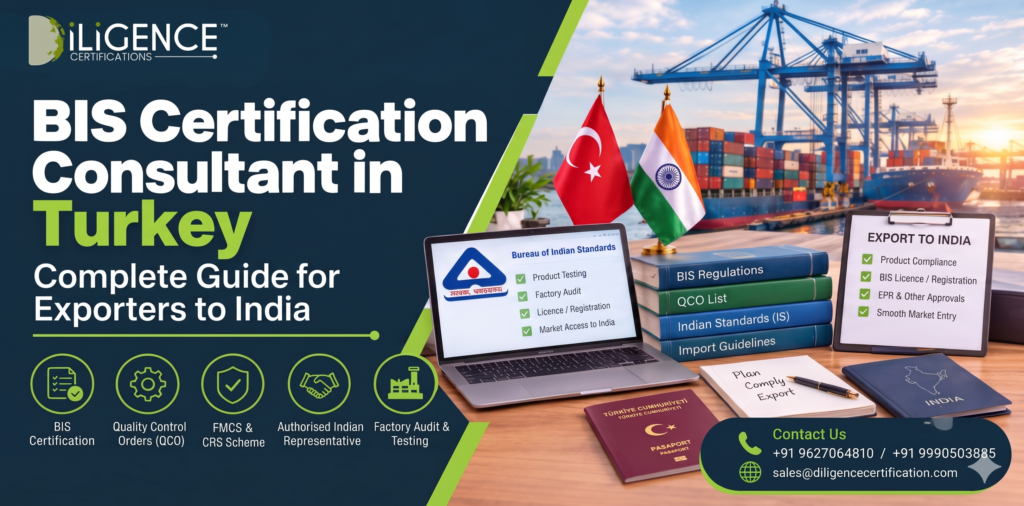
By - A BIS Consultant in Turkey helps Turkish manufacturers understand Indian certification requirements before exporting products to India.
- BIS certification depends on the product category, applicable Indian Standard and relevant Quality Control Order (QCO).
- Turkish manufacturers may need FMCS certification or CRS registration, depending on the product and applicable regulations.
- Common requirements include company documents, product specifications, factory details, testing reports and an eligible Authorized Indian Representative, where applicable.
- Professional BIS consultancy can help exporters prepare documents, coordinate testing and manage the certification process for smoother entry into the Indian market.
Introduction
Picture a manufacturer that has received an order from an Indian distributor. The product samples have been approved. The price has been finalised. Both companies are ready to move. Then before shipment the Indian buyer asks for a BIS certificate.
The manufacturer may already have quality documents or a CE mark. Naturally the first question is whether these approvals are enough to sell the product in India. This is where a BIS Consultant in Turkey can help. The first step is not to start an application or pay a testing laboratory. It is to check whether Indian regulations apply to the product, which Indian Standard is relevant and what certification route the manufacturer must follow.
The Bureau of Indian Standards also known as BIS is the national standards body of India. I understand that depending on the product and on the rules that apply the manufacturer may need an ISI Mark licence, registration, under the Compulsory Registration Scheme (CRS) or another approval before the manufacturer can sell its products in India.
What Is BIS Certification, and Why Does It Matter for Turkish Exporters?
BIS certification shows that a product follows the rules set by the Indian Standard under the proper certification scheme. For products that fall under certification getting the needed approval isn’t just about building brand trust. It is a requirement. A Turkish company that wants to export to India should not think all products need BIS certification. The need depends on the product type the Indian Standard that applies the Quality Control Order, in force and when that order started.
For instance a manufacturer sending equipment that is regulated may have to finish the BIS process before selling it in India.. Another manufacturer shipping a product not covered by any mandatory BIS rule may not have to get that approval.
The important thing is this: BIS rules apply to products. Always check the standard and any official regulatory notice before starting tests or preparing shipment.
Does a Turkish CE certificate replace BIS certification?
No. A CE marking or a Turkish conformity document cannot replace an Indian BIS approval. These documents can serve as supporting information yet Indian rules require separate assessment. The product must adhere to the rules that apply to its category and must meet Indian BIS approval standards.
Key Takeaways: BIS Consultant in Turkey
- A BIS Consultant in Turkey helps exporters understand product certification requirements and prepares exporters for the relevant approval process.
- Foreign manufacturers may use the Foreign Manufacturers Certification Scheme (FMCS) for products that are not in the notified electronics and IT categories.
- Products covered by the Compulsory Registration Scheme (CRS) follow a process than products that need an ISI Mark licence.
- An Authorized Indian Representative is needed for manufacturers under the rules that apply.
- Product testing, how ready the factory. Correct paperwork can change how long certification takes.
- Turkish or European approvals don’t automatically mean you’re certified in India.
- Look at the BIS notifications and the Quality Control Orders, for your product before sending goods to India.
Which Products from Turkey May Require BIS Certification?
Turkey has manufacturers and exporters working in industrial sectors such, as metals, electrical equipment, machinery, chemicals and household products. Whether a product needs BIS certification depends on the product’s specification and the Indian regulations that cover it.
Some product categories to investigate include:
1. Steel and metal products
Certain steel grades and metal products fall under Indian Quality Control Orders. A Turkish manufacturer must identify the product standard and check the current implementation status before exporting.
Do not assume that one approval covers every steel grades and metal products made at the factory.
Different steel grades and metal products different product types or standards may have requirements.
2. Electrical and household products
Electrical equipment and household appliances may fall under different mandatory certification requirements. Some products use the ISI Mark route, while notified electronics and IT products may fall under CRS.
The correct route must be determined from the specific product description and applicable notification.
3. Electronics and IT equipment
Certain electronic and IT products are covered by CRS. Manufacturers should check the current product list, applicable Indian Standard, testing requirements and registration conditions.
4. Chemicals and other regulated goods
Some chemicals and industrial goods are controlled by quality control obligations. The exact details, exceptions and dates when rules start to apply must be looked up in the recent official notice.
A product name by itself is not enough to know if it follows the rules. The parts it is made of how it will be used its details and the standards it must meet can all be important.
Tip: Before making an offer to a buyer in India make a list of the products with model numbers details, about what they do how they are used and where they are made. This helps the person who checks certifications to find out what rules apply.
Which BIS Certification Scheme Applies to Turkish Manufacturers?
One of the most important tasks is identifying the correct scheme. The process for an industrial product requiring an ISI Mark licence is not identical to the process for an electronic product covered by CRS.
Foreign Manufacturers Certification Scheme (FMCS)
BIS operates FMCS for eligible products manufactured outside India. Under this scheme, a foreign manufacturer can obtain a licence to use the BIS Standard Mark on products that meet the relevant Indian Standard.
The process generally involves documentation, verification of manufacturing and testing facilities, factory inspection, sample testing and assessment of the results. The exact requirements depend on the product and applicable scheme.
For a Turkish factory, preparation should include:
- Checking the relevant Indian Standard.
- Reviewing production processes and quality controls.
- Confirming the availability of required in-house testing facilities and competent personnel.
- Preparing the necessary application documents.
- Arranging the required Indian representation.
- Preparing for inspection and product sample testing.
A consultant can help the manufacturer understand these steps, identify documentation gaps and coordinate the application. However, the final certification decision rests with BIS.
Compulsory Registration Scheme (CRS)
CRS is used for notified electronics and IT products covered by the scheme. It differs from the conventional FMCS route.
Depending on the product, the process can involve testing at a recognised laboratory, preparation of technical and manufacturing documents, online registration and review by BIS.
An exporter should not pick CRS just because the product is electronic. The product needs to be in the listed CRS categories. The correct registration rules need to be met.
How do you pick the scheme?
Begin with the product, not the name of the scheme.
Look at the BIS product lists find the correct Indian Standard and study the related notification. If the classification is not clear get help from an expert before starting testing or production, for the market.
How to Get BIS Certification in Turkey: Step-by-Step Process
The process changes depending on the certification scheme. These steps can help foreign manufacturers get started.
Step 1: Check if BIS certification is needed
Gather the product’s description, model details how it will be used and where it’s made. Compare this with the list of products that need mandatory certification and the relevant Quality Control Orders (QCO). Do this before planning to ship. A buyer might ask for it. You must confirm the actual rule from official sources.
Step 2: Find the Indian Standard
The correct standard tells you what technical rules your product must meet. Two products that look alike might have standards or test needs. Make sure you know what category your product falls into before asking a lab for a quote.
Step 3: Choose the certification path
Decide if your product is under FMCS, CRS or another scheme. This choice affects how you apply what tests are needed what inspections happen and what documents you must submit. Picking the path can lead to extra work and delays.
Step 4: Put together your application documents
Collect all paperwork: manufacturer’s legal info, factory details, product specs, manufacturing process documents and anything else the scheme requires. Keep everything. If company names, addresses, model numbers or technical details don’t match across documents BIS may ask for clarifications. Reject the application.
Step 5: Set up a representative
Foreign manufacturers must appoint an Authorized Indian Representative as per BIS rules. BIS gives guidance on who can be appointed and what their dutiesre including agreeing to help ensure compliance with the licence terms.
Step 6: Do testing and inspections if needed
Depending on the scheme you may need to test samples and have your factory checked. For FMCS BIS does a factory visit to look at your manufacturing and testing setup and take samples for testing. Once the inspection and test reports are satisfactory and other conditions are met your application moves toward a licence.
Step 7: Answer BIS questions carefully
Look at every query from BIS. Reply with correct clear evidence. Rushing or missing details can slow things down. A consultant can help organize your answers and track what’s still pending. They can’t promise BIS will approve your application or issue a licence by a certain date.
Step 8: Get approval and keep things compliant
Once approved check your licence or registration carefully. Look at the product scope, model coverage and marking rules. Certification isn’t the end. You must keep following the rules, for product marking keeping production records renewing your licence undergoing surveillance and meeting any ongoing duties.
Documents Required for BIS Certification
The exact checklist depends on the product and scheme. A Turkish manufacturer may need to prepare the following documents, subject to the official application requirements:
- Company registration or incorporation documents.
- Factory address and manufacturing facility details.
- Product specifications and technical datasheets.
- Applicable Indian Standard details.
- Manufacturing process flow chart.
- Plant and machinery information.
- Details of in-house testing equipment and personnel, where required.
- Quality-control procedures and inspection records.
- Product labels, markings and model information.
- Test reports, where required under the applicable scheme.
- Authorisation and Authorized Indian Representative documents.
- Application forms, declarations and undertakings.
- Other product-specific documents requested by BIS.
This list is a preparation guide, not a universal official checklist. Some items may not apply to every product, while additional documents may be required for particular schemes.
Before filing, check the latest BIS forms and guidance for the relevant scheme.
How Long Does BIS Certification Take?
There is no single timeline for all Turkish manufacturers. Processing time depends on the scheme, product category, document quality, testing arrangements, factory inspection requirements and responses to BIS queries.
An application involving factory inspection and independent product testing has different steps from a registration route based primarily on product testing and documentation.
The following factors can cause delays:
- Selecting the wrong Indian Standard.
- Incomplete or inconsistent factory documents.
- Product samples that fail testing.
- Limited availability of testing facilities.
- Delays in inspection scheduling.
- Missing information about the manufacturing process.
- Slow responses to official queries.
It makes sense to start the compliance assessment well before the planned shipping date. Ask your consultant to give you a step-by-step plan. Make sure they clearly separate estimated timelines from actual confirmed deadlines.
A good consultant won’t promise approval in a number of days. They should understand that the process depends on the rules and steps involved. They need to be honest, about what’s possible and what’s not.
BIS Certification Cost for Turkish Exporters
The cost of BIS certification depends on the product and the scheme being used. It can include application and license fees, laboratory testing charges, inspection costs, travel expenses if needed documentation work and fees, for professional consultancy.
For manufacturers the total cost may also vary based on the number of products the standards involved the different models and the number of manufacturing locations.
Before accepting a quotation, ask for a written breakdown covering:
- The certification scheme and applicable standard.
- Official BIS fees and testing charges.
- Consultancy and documentation charges.
- Any inspection or travel-related expenses.
- The number of models or products covered by the scope.
- Renewal and continuing compliance costs.
- Any exclusions or additional charges that may arise.
Be careful with quotations that promise a guaranteed certificate at an unusually low price. BIS approval depends on compliance with the applicable requirements, not simply on payment.
A proper cost estimate begins with an accurate product assessment.
BIS Certification for Selling Products on Indian E-Commerce Platforms
Turkish businesses might want to sell their products using distributors, online shops or their own websites. Before putting a product up for sale they need to check if the product requires BIS certification or any other Indian rules. Selling online doesn’t mean the product doesn’t have to follow rules.
For instance a Turkish company that wants to sell a product that is controlled in India through an Indian online shop should make sure about the right way to get certification before they finish setting up the listing and sending the product. The person bringing the product into India the one selling it and the maker should all know what they are responsible for.
Before starting a listing check:
If the product is part of a required QCO.
- Which Indian Standard and certification process is needed.
- If the necessary license or registration is already done.
- If the exact model is included in the approval.
- If the product box and labels meet the rules.
- If there are rules about importing, labeling or conditions from the online shop.
Don’t think that every product needs BIS certification just because it is sold online. Also don’t think that having a listing on a shop means the product is compliant, with rules.
Common Mistakes Turkish Exporters Should Avoid
Many certification problems begin before the application is filed. A few basic checks can help reduce the risk of unnecessary expenses and delays.
Assuming CE or TSE approval is sufficient
Foreign approvals may provide useful technical information, but they do not automatically satisfy India’s mandatory certification requirements.
Applying under the wrong scheme
FMCS and CRS are not interchangeable. Confirm the product category and applicable Indian Standard before beginning the process.
Ignoring factory testing readiness
For schemes requiring in-house testing capability and factory assessment, manufacturers should verify that the necessary facilities, equipment, personnel and records are available.
Using inconsistent product details
Ensure that the product model, specifications, manufacturer name and factory address are consistent across the application, technical documents, labels and test reports.
Shipping before checking the rules
If mandatory certification applies, proceeding with shipment before the necessary approval can expose the business to avoidable compliance and commercial problems. Confirm the requirements before dispatch.
Forgetting post-approval responsibilities
The manufacturer should understand the licence scope, permitted marking, renewal deadlines and continuing compliance requirements before the first shipment.
Why Choose Diligence Certifications for BIS Consultant in Turkey Certification?
For a Turkish company entering India, the main challenge is often understanding which requirements apply before investing time and money in an application. Clear guidance at the beginning can make the process easier to plan.
Diligence Certifications supports businesses with certification and regulatory compliance services. Its assistance can be relevant when a manufacturer needs help understanding the certification route, organising documents, coordinating testing and preparing for the applicable approval process.
When evaluating a consultant, ask whether the proposed service includes:
- Product and Indian Standard applicability checks.
- Identification of the appropriate certification scheme.
- A product-specific document checklist.
- Application preparation and filing support.
- Coordination for required testing and inspection.
- Assistance with responses to regulatory queries.
- Guidance on marking, renewal and continuing obligations.
A useful consultant explains both what can be done and what remains subject to the regulator’s decision. The scope, fees, responsibilities and expected milestones should be clear before the engagement begins.
For general information about the company and its compliance services, visit Diligence Certifications.
Diligence Certifications is a consultancy, not the government authority that grants BIS licences. The final decision rests with BIS, and manufacturers should verify all requirements against current official guidance.
Conclusion
Entering the Indian market can create new opportunities for Turkish manufacturers, but certification should be checked before production, shipment and sales commitments are finalised.
A BIS Consultant in Turkey can help businesses understand the relevant Indian Standard, determine the appropriate certification route, prepare documents and coordinate the required steps. The right approach begins with an accurate product assessment, not a generic application.
Before shipping your products to India, verify the latest BIS requirements and confirm whether FMCS, CRS or another applicable route is required. Preparing early can help reduce avoidable delays and make discussions with Indian buyers more straightforward.
If your company plans to export products from Turkey to India, contact Diligence Certifications to discuss your product category, documentation and certification requirements. A product-specific assessment is the best starting point for planning the next steps.
Frequently Asked Questions
1. What does a BIS Consultant in Turkey do?
A BIS Consultant in Turkey helps Turkish manufacturers understand Indian product certification requirements. The consultant can assist with identifying the applicable Indian Standard, selecting the appropriate certification scheme, preparing documents, coordinating product testing and managing the application process.
2. Is BIS certification mandatory for Turkish products exported to India?
BIS certification is mandatory for products covered by applicable Indian regulations, including relevant Quality Control Orders and compulsory certification requirements. Turkish exporters should verify the product category, applicable Indian Standard and current regulatory requirements before shipping goods to India.
3. Can a Turkish manufacturer use a CE certificate instead of BIS certification?
No. A CE certificate or marking does not automatically replace BIS certification. If a product is subject to mandatory Indian certification requirements, the manufacturer must comply with the applicable Indian rules, even if the product already meets European standards.
4. What is the Foreign Manufacturers Certification Scheme (FMCS)?
The Foreign Manufacturers Certification Scheme (FMCS) is a BIS certification scheme for eligible products manufactured outside India. Depending on the applicable requirements, the process may involve an application, factory inspection, product sample testing and verification of manufacturing and quality-control facilities.
5. What is the difference between BIS FMCS and CRS registration?
FMCS generally applies to eligible products requiring a BIS licence under the relevant Indian Standard, while the Compulsory Registration Scheme (CRS) covers specified products, particularly notified electronics and IT goods. The applicable scheme depends on the product category and current BIS regulations.
6. Which documents are required for BIS certification in Turkey?
Commonly required documents may include company registration papers, factory details, product specifications, manufacturing process information, testing equipment details, quality-control records, product labels and authorised representative documents. The exact checklist depends on the product and certification scheme.
7. Is an Authorized Indian Representative required for Turkish manufacturers?
Foreign manufacturers may need to appoint an Authorized Indian Representative (AIR) under the applicable BIS scheme. The representative must satisfy the relevant eligibility conditions and fulfil the responsibilities specified by BIS for the particular certification route.
8. How long does it take to obtain BIS certification for products from Turkey?
The timeline varies according to the product category, certification scheme, document readiness, laboratory testing, factory inspection and responses to BIS queries. Exporters should begin the process early and obtain a product-specific timeline rather than relying on a guaranteed approval date.
9. What is the cost of BIS certification for Turkish exporters?
The total cost depends on the certification scheme, official application and licence fees, laboratory testing, factory inspection, travel expenses where applicable, and consultancy charges. Manufacturers should request a detailed quotation based on their product specifications and certification requirements.
10. How can Diligence Certifications help Turkish manufacturers obtain BIS certification?
Diligence Certifications can assist Turkish manufacturers with understanding certification requirements, identifying the relevant scheme, preparing application documents and coordinating testing and inspection activities. The specific scope of assistance depends on the product and service agreement. The final decision to grant a BIS licence or registration rests with the Bureau of Indian Standards.