 BIS Certification
 CDSCO
CDSCO
 PESO
PESO
 CPCB
CPCB
 LMPC
LMPC
 WPC Approval
 Global Approvals
 TEC
TEC
 ARAI
ARAI
 BEE
BEE
 ISO Certification
 DGCA Certification
 NOC For Steel
 APEDA Registration













 Business Registration
 FSSAI Mark Certification










 (32).jpg)
 Legal Services
 Trademark Registration
 Copyright Registration
 Patent Registration
 By
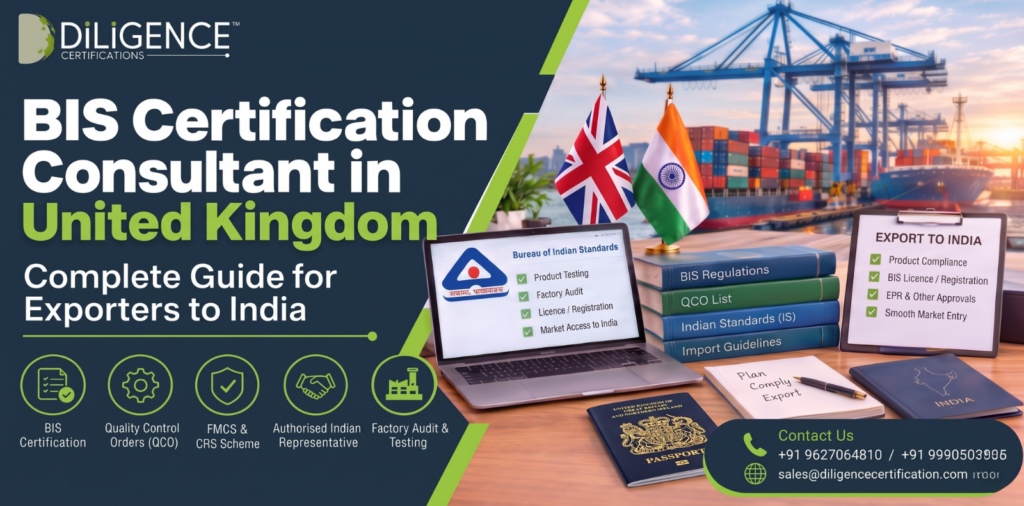
By - A BIS Consultant in United Kingdom helps UK manufacturers understand Indian product certification requirements.
- BIS certification depends on the product category, applicable Indian Standard and relevant Quality Control Order (QCO).
- UK manufacturers may need FMCS certification or CRS registration, depending on the product and applicable regulations.
- Required documents may include product specifications, factory details, test reports and company information.
- Early BIS compliance planning helps UK exporters manage testing, documentation and shipment timelines when exporting products to India.
Introduction
A BIS Consultant in United Kingdom manufacturer in the United Kingdom is getting ready to send products to a buyer, in India. The company has finished product development. It has also checked quality standards. The main commercial terms have been agreed upon. Everything looks set for shipment. Then the Indian buyer asks if the products need a Bureau of Indian Standards certificate.
For the manufacturer, this can create confusion. The products may already meet the requirements applicable in the UK, and the company may have test reports from an established laboratory. Why should it check another country’s certification rules?
The answer is that product compliance requirements vary from one market to another. A product that meets UK or European requirements does not automatically meet every Indian requirement. If the product falls under a BIS certification order the manufacturer must follow the applicable Indian rules before the product goes to market.
This is where a BIS Consultant, in the United Kingdom can help. A BIS Consultant can guide the manufacturer through product classification identify the Indian Standard prepare documentation, arrange testing and handle the relevant certification process.
What Is BIS Certification?
I know that the Bureau of Indian Standards is Indias national standards body. It creates Standards and runs tests to see if products meet the rules set by its certification framework.
I have seen that BIS certification or registration shows that a product follows the rules of the scheme. The exact steps to get certified depend on what the product’s which certification route is chosen.
I see that for example some products are covered by the Foreign Manufacturers Certification Scheme (FMCS). Other notified electronics and information technology products must go through the Compulsory Registration Scheme (CRS).
I know these schemes have requirements. A manufacturer should not think that the application steps, testing arrangements or documents are the same, for every product. If you are a UK business the first step is to find out if your product is required by a rule. After confirming this you should decide which certification route applies.
Why Do UK Manufacturers Need a BIS Consultant?
Going into the market means more than just finding a distributor and setting up shipping. I know that manufacturers need to understand the rules that cover their products. A BIS consultant can help businesses learn those rules and plan the steps to get the application ready.
1. Identifying the Correct Indian Standard
One product name can hide different designs, details and uses. Therefore choosing the Indian Standard is more than just looking at the product name.
A manufacturer may have to give specifications, drawings, intended use, model details and other product information. I see that a BIS consultant can go through these details and find the standard and certification needs. The final classification must be checked against the regulations.
2. Understanding the Correct Certification Scheme
Foreign manufacturers might have to look at FMCS if their products fit its scope. Some notified electronics and IT products might need CRS registration instead. I know that choosing the path can cause extra work, wrong testing or delays. A BIS consultant in the United Kingdom can help the manufacturer see the route and find the official requirements that must be met.
3. Preparing the Required Documents
An application can need documents, manufacturing details, product specifications, test reports and required declarations.
These documents must show the product and the factory correctly. If the model number, on a test report does not match the model listed in the application the manufacturer must explain the difference. I find that a careful document review can spot mistakes before sending the application.
4.Coordinating Product Testing
Some certification processes require product testing, under conditions. The company needs to make sure which testing setups are allowed for its use.
A consultant can help manage the process explain what needs to be prepared and gather the information needed for testing.
Testing has to follow the rules of the program. A consultant cannot take the place of a lab. Promise that the test will go well.
5.Planning the Export Schedule
Certification can influence production timelines, delivery promises and when products are launched.
If a company waits until its items are ready to leave the UK before checking rules it might deal with extra business pressure.
Early planning helps the company figure out what steps are likely collect papers and set up testing or inspection when needed.
BIS Certification Schemes for UK Manufacturers
The certification route depends on the product and the applicable Indian requirements. Two important schemes that foreign manufacturers should understand are FMCS and CRS.
Foreign Manufacturers Certification Scheme (FMCS)
The Foreign Manufacturers Certification Scheme is a BIS certification route for foreign manufacturers whose products fall within the schemes scope.
Foreign Manufacturers Certification Scheme allows qualifying manufacturers to obtain a BIS licence for products subject, to the relevant requirements.
The process may involve:
- Identifying the applicable Indian Standard.
- Preparing the prescribed application documents.
- Providing manufacturing and technical information.
- Meeting the applicable Authorised Indian Representative requirements.
- Arranging product testing through the required laboratory route.
- Preparing the factory for assessment or inspection, where applicable.
- Responding to queries raised during the assessment.
- Complying with the conditions attached to the licence.
Exact requirements depend on the product and the current BIS procedures. Applications, in October 2026 must follow the online process and the applicable instructions.
Applications should not rely on guides that describe paper-based submission.
Compulsory Registration Scheme (CRS)
The Compulsory Registration Scheme covers electronics and information technology products that are listed. That fall within its scope.
For example a UK company that makes a specific type of equipment must check whether the product is covered by the Compulsory Registration Scheme and whether it meets the CRS requirements.
The company must confirm the Indian Standard, product category, model details and documentation requirements before applying to the Compulsory Registration Scheme.
CRS should not be treated as a general alternative to FMCS. The correct route depends on the product and its applicable regulatory requirements.
Is ISI Mark Certification Required?
Certain products covered by mandatory BIS certification requirements must comply with the applicable certification and marking conditions.
However, the ISI Mark, FMCS and CRS should not be treated as interchangeable terms. They relate to different aspects of the BIS certification framework.
A manufacturer should first identify the applicable requirement and then confirm which licence, registration or marking conditions apply to its product.
Documents Required for BIS Certification from the United Kingdom
The documents needed vary depending on the product and the rules that apply. Still getting the main technical and production details ready ahead of time can help make everything more orderly.
Some documents and information that are often needed are:
1. Company registration details are required. These details help to find out who the manufacturer is and which company is responsible, for the application.
2. Factory information may be required. The manufacturer might need to share the factory address and other details about the place where the product is made.
3. Product specifications: Technical details help figure out which Indian Standard and certification rules might apply.
4. Product drawings: Drawings and technical descriptions could be needed to understand how the product is designed and built.
5. Model and variant details: The application must list the products that’re part of the certification.
6. Test reports: When needed test reports show that the product meets the rules that apply.
7. Quality-control information: Depending on the rules details about how the product’s controlled, checked and managed may be needed.
8. Testing equipment details: Some information may be needed to check if the factory can do the tests.
9. Brand and trademark information: The manufacturer needs to make sure the branding on the product is correct.
10. Authorised Indian Representative documents: These might be needed if the manufacturer is from another country.
11. Prescribed forms and declarations: The person applying must fill out the forms and declarations that go with the rules.
This list is a guide. It is not a list, for every BIS application. The latest official rules should be checked before submitting anything.
Why Must Product Details Match Across Documents?
Think about a UK manufacturer that makes three models of a product. The catalogue of this UK manufacturer lists Model A, Model B and Model C. The only test report that is available is for Model A.
The UK manufacturer must not think that the test report automatically covers Model B or Model C. Whether the models can be listed together depends on the requirements that apply and on the technical differences between Model A, Model B and Model C.
A similar problem can happen when the factory address, the brand name or the product description is different, in the application documents that the UK manufacturer submits.
The UK manufacturer should check these details carefully before submitting so that the chance of questions or rework is reduced.
Step-by-Step BIS Certification Process for UK Exporters
Although the exact method can be different the following steps offer a way for a UK manufacturer who wants to sell products that are controlled in India.
Step 1: Check If BIS Certification Is Required
Begin by finding out what the product is, what it is used for and what its technical details are.
Look at the Indian Standard, the Quality Control Order that applies and any recent notices. Don’t just depend on the product’s name.
If the product doesn’t need BIS certification there might still be rules that apply. The manufacturer needs to check all the rules about bringing products into India and making sure they meet the standards.
Step 2: Find the Right Plan
After understanding the rules figure out if FMCS, CRS or another way is right for the product.
The manufacturer must make sure they know the way to go before they do tests or get ready to fill out any forms.
Step 3: Look at the Factory
If the factory needs to be checked or inspected the manufacturer should look at the rules about making and checking the product.
This can include checking the records from the factory the way inspections are done the testing places and how the product quality is controlled.
Any problems should be fixed to meet the rules.
Step 4: Get the Papers Ready
Gather all the details the list of models the factory information, declarations and any other required papers.
Make sure everything is correct and matches up. If there are changes to how the product’s made or what it is like the manufacturer should check before sending the papers.
Step 5: Do the Tests
Check what tests are needed and where they will be done.
The manufacturer should make sure the samples match what is needed and the tests are complete. A bad sample or not enough tests can cause work.
Step 6: Send the Application
Give the application through the way for the plan that is being used.
For FMCS UK manufacturers applying in 2026 should use the Manakonline process. Follow the online instructions.
Step 7: Answer Questions and Prepare for Inspection
The government might ask for details or proof during the check.
The manufacturer should answer properly. Give the needed information. If an inspection is needed the factory should be ready for the steps that are required.
Step 8: Get the Right Approval
The manufacturer should wait for confirmation of the right license or registration.
After getting approval it must follow the rules that go with the certification, like what productsre covered how they are marked and what must be done after.
Never think that the certification is done just because an application was sent or tests were done.
How Long Does BIS Certification Take?
No single timeline fits every UK manufacturer. The time a manufacturer needs changes based on factors: the product itself the certification scheme in use how testing is arranged how complete the documents are, the inspection rules and how fast any questions or problems are resolved.
For example a UK manufacturer that has all documents will see a smoother faster process. A factory that is prepared moves quickly. That smooth path is very different from a company that still needs to update product specifications or set up testing procedures.
Businesses should not promise a fixed approval date to buyers before a manufacturer has checked all the requirements. It is risky to set a deadline without knowing the picture.
A practical schedule must include time for collecting documents testing the product preparing the application reviewing the assessment and fixing any problems that arise. Each step takes time. Delays can happen. Planning with flexibility helps avoid last‑minute stress, for the manufacturer.
- Delays may arise when you choose the Indian Standard.
- Delays can occur if you provide documents that are incomplete or inconsistent.
- Delays happen when you submit product or model information that is unclear.
- Delays are caused by laboratory testing that takes longer than expected.
- Delays may result from factory readiness problems.
- Delays can be caused by slow responses to official queries.
- Delays can occur if product specifications change during the application.
- Delays are often due, to following application instructions.
A consultant can help organise the process. A consultant cannot guarantee the approval date or the final decision.
BIS Certification Cost for UK Manufacturers
The total cost depends on the product and the certification route. Potential expenses may include official fees, laboratory testing, inspection-related costs, document preparation and consultancy services.
FMCS and CRS have different procedures, so manufacturers should not assume that their costs are identical.
Before appointing a consultant, ask for a written quotation that explains:
- The proposed certification route and its basis.
- Applicable government fees.
- Laboratory testing charges.
- Professional consultancy fees.
- Any expected inspection or travel expenses.
- Potential additional testing or application costs.
- Renewal and ongoing compliance requirements, where applicable.
A clear quotation helps the manufacturer understand what is included in the service.
The lowest initial price may not represent the lowest overall cost if important stages are excluded. Businesses should compare the scope of work, not just the headline fee.
Common BIS Certification Mistakes UK Exporters Should Avoid
Assuming UKCA or CE Marking Is Enough
UKCA and CE marking relate to their respective regulatory frameworks. They do not automatically replace a mandatory Indian certification requirement.
A manufacturer should assess Indian requirements separately and confirm whether its product falls under a compulsory BIS scheme.
Applying Before Checking the Product Category
A product’s commercial name may not provide enough information to identify the applicable standard.
Technical specifications, intended use and product construction should be checked before selecting the certification route.
Assuming One Test Report Covers Every Model
Different models may have different technical features. The manufacturer should confirm the scope of any test report and whether model grouping is permitted under the applicable requirements.
Ignoring the Authorised Representative Requirements
Foreign manufacturers should check whether an Authorised Indian Representative is required and review the relevant eligibility and documentation conditions.
The manufacturer should follow the current official instructions rather than rely on assumptions about who can act as a representative.
Waiting Until Shipment Is Ready
Discovering a certification requirement after production and shipping arrangements are complete can create avoidable problems.
A compliance review should take place early enough to inform production and delivery planning.
Relying on Outdated Online Information
Certification procedures, product coverage and application methods can change.
UK manufacturers should verify current official instructions before preparing their applications, especially when older online articles describe a different submission process.
BIS Certification for E-Commerce Exports to India
Selling products through an e-commerce platform does not automatically remove applicable product certification obligations.
A UK brand planning to sell regulated electronics, electrical products or other notified goods to Indian customers should confirm the relevant requirements before launching its products.
For example, a British brand may intend to list an electronic accessory on an Indian marketplace. Before the listing goes live, the business should verify the product’s regulatory status, identify the responsible manufacturer and confirm whether the applicable model is covered by the required approval.
The company should also assess other relevant Indian requirements, such as import documentation and product labelling, where applicable.
BIS certification is one part of the compliance process when the product falls under a mandatory BIS requirement. It should not be confused with every other legal requirement involved in selling products in India.
How to Choose the Right BIS Consultant in United Kingdom
Choosing a consultant requires more than comparing quotations. The manufacturer should understand the consultant’s experience, proposed process and scope of work.
Check Their Understanding of BIS Schemes
Ask the consultant to explain why FMCS, CRS or another route may apply to your product.
The explanation should relate to the actual product specifications and official requirements, rather than general statements about the industry.
Ask How They Identify the Applicable Standard
The consultant should explain how the product’s intended use, technical specifications and regulatory coverage will be checked.
This initial assessment is important because the rest of the process depends on selecting the correct requirements.
Request a Clear Document Checklist
Ask for a written list of the information and documents required from your company.
This helps your technical, quality and export teams understand their responsibilities.
Clarify Testing and Inspection Support
Confirm whether the consultancy service includes coordination of product testing, assistance with technical documents and preparation for any required factory assessment.
Also establish which third-party charges are excluded from the quotation.
Understand the Support Available After Submission
Ask whether the service includes assistance with application queries, document corrections and relevant post-approval obligations.
The agreement should clearly define what the consultant will do and which responsibilities remain with the manufacturer.
Avoid Guaranteed Approval Claims
A consultant can help prepare an application and coordinate compliance activities, but cannot guarantee that BIS will grant a licence or registration.
The decision depends on the applicable rules and the authority’s assessment.
Why Choose Diligence Certifications for BIS Consultant in United Kingdom Certification?
For UK manufacturers planning to enter the Indian market, the first priority is to understand the product-specific requirements before investing in an application.
Diligence Certifications provides BIS certification and related regulatory compliance support to businesses seeking guidance on Indian product requirements.
The process should begin with a review of the product, manufacturing details and intended market. This helps identify the relevant questions before documents, testing and application activities are arranged.
Before proceeding, prepare the product specifications, model details, factory information and any existing test reports. This information can support an initial review of the applicable requirements.
The proposed service scope, fees and expected timeline should be confirmed for the individual product. The final decision remains with the relevant authority, and no consultant can guarantee certification approval.
Conclusion
Entering the Indian market can create valuable opportunities for manufacturers in the United Kingdom. However, product compliance should be addressed before the first shipment is arranged.
The right approach begins with identifying the product, checking the applicable Indian Standard and confirming whether a compulsory certification requirement applies. The manufacturer can then determine the correct scheme, prepare the necessary documents and plan any required testing or inspection.
Working with a BIS Consultant in United Kingdom can help make the process more organised and easier to understand. However, every product has its own requirements, and the final application strategy should be based on current official guidance.
If your company plans to export products from the United Kingdom to India, consider arranging a product-specific compliance review before committing to a shipment date. Understanding the requirements early can help your team plan documentation, testing, costs and timelines more effectively.
Call to Action: Contact Diligence Certifications to discuss the BIS certification requirements applicable to your product and your plans for entering the Indian market.
Frequently Asked Questions
1. What does a BIS Consultant in the United Kingdom do?
A BIS Consultant in the United Kingdom helps British manufacturers understand Indian product certification requirements. The consultant can assist with identifying the applicable Indian Standard, selecting the correct certification route, preparing documents, coordinating testing and supporting the application process.
2. Is BIS certification mandatory for products exported from the UK to India?
BIS certification is mandatory for products covered by applicable Indian compulsory certification requirements. UK manufacturers should check the relevant Quality Control Order, Indian Standard and current BIS notifications to determine whether their products require certification or registration before being sold in India.
3. Can UK manufacturers apply for BIS certification?
Yes. Eligible UK manufacturers can apply for the applicable BIS certification or registration scheme when their products fall within its scope. They must meet the relevant technical, documentation, testing and other regulatory requirements.
4. What is the Foreign Manufacturers Certification Scheme (FMCS)?
The Foreign Manufacturers Certification Scheme (FMCS) is a BIS certification route for eligible foreign manufacturers whose products are covered by the scheme. Depending on the applicable requirements, the process may involve product testing, factory assessment, documentation and compliance with licence conditions.
5. What is the difference between BIS FMCS and CRS registration?
FMCS and the Compulsory Registration Scheme (CRS) are different BIS regulatory routes. FMCS applies to eligible foreign manufacturers covered by its requirements, while CRS applies to notified products within its scope. The correct route depends on the product category and applicable Indian regulations.
6. What documents are required for BIS certification for UK manufacturers?
Depending on the certification scheme, documents may include company registration details, factory information, product specifications, technical drawings, model details, test reports, quality-control records, brand information and prescribed declarations. Authorised Indian Representative documents may also be required where applicable.
7. How long does BIS certification take for a UK manufacturer?
The timeline varies according to the product, certification scheme, testing requirements, document readiness and any factory assessment or regulatory queries. Manufacturers should confirm the applicable process before committing to an export deadline because no single timeline applies to every product.
8. What is the cost of BIS certification for UK companies?
The cost depends on the product and certification route. Potential expenses include applicable government fees, laboratory testing, inspection-related expenses and consultancy charges. UK manufacturers should request a detailed quotation based on their product and the required certification process.
9. Is UKCA or CE marking sufficient for selling products in India?
UKCA or CE marking does not automatically replace mandatory Indian product certification requirements. Manufacturers must separately check the applicable Indian regulations and determine whether BIS certification, CRS registration or another approval is required for their products.
10. How can Diligence Certifications help UK manufacturers obtain BIS certification?
Diligence Certifications can provide guidance on Indian product compliance, including reviewing product details, identifying relevant certification requirements, assisting with documentation and supporting applicable testing and application activities. The service scope, fees and timeline should be confirmed for each product. Final approval depends on the relevant authority and applicable requirements.