


 BIS Certification
 CDSCO
CDSCO
 CPCB
CPCB
 LMPC
LMPC
 WPC Approval
 Global Approvals
 TEC
TEC
 ARAI
ARAI
 BEE
BEE
 ISO Certification
 DGCA Certification
 NOC For Steel
 APEDA Registration






 Business Registration
 FSSAI Mark Certification
 Legal Services
 Trademark Registration
 Copyright Registration
 Patent Registration
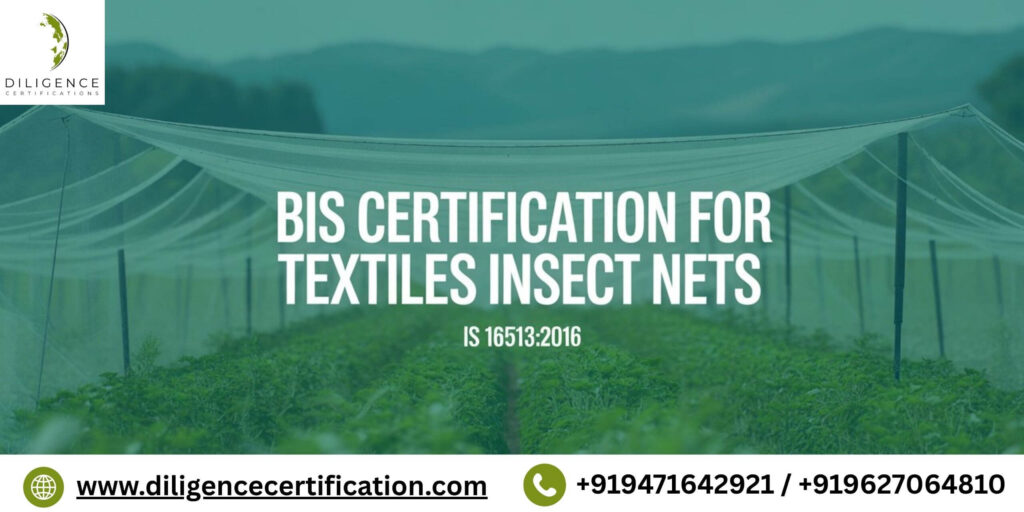
- Textiles Insect Nets Under IS 16513:2016 are a strong barrier protecting your crops and home from pests, without chemicals.
- Ensures safety, durability, and effectiveness in protecting against insects like mosquitoes
- BIS certification is mandatory before selling insect nets in the Indian market
- Covered under the ISI Mark Certification Scheme by the Bureau of Indian Standards (BIS)
- Application includes submission of manufacturing details, quality control plan, and test reports
- BIS conducts factory inspection and product sample testing
- Certification timeline usually takes 3–6 months depending on compliance
- License validity is 2 years and can be renewed
Introduction
Textiles insect nets are used in many different sectors such as households, hospitals, agriculture, industries etc. where they are used to protect people and closing from harmful insects and mosquitoes. Insects nets should adhere to the requirements for safety, durability and quality.
To ensure that insect nets are manufactured, stored and supplied in such a manner, The Bureau of Indian Standards (BIS) delineated IS 16513:2016 to be the governing standard. Manufacturers, importers, and suppliers of insect nets must obtain BIS Certification for textiles insect nets prior to putting these products into the Indian market.
What Are BIS Certification for Textiles Insect Nets?
BIS Certification for Textiles Insect Nets is an official quality assurance of the Bureau of Indian Standards (BIS) to ensure insect nets meet safety, performance and durability requirements specified for IS 16513:2016. These insect nets are used in homes, hospitals, agriculture and industry to protect people and products from insects and mosquitoes.
The Government of India has made it compulsory for these types of textiles insect nets to be BIS Certified. This is to stop substandard and unsafe insect nets selling within the Indian market and to ensure consumer safety.
Simply put, BIS Certification:
- Ensures that insect nets are compliant with Indian Standard IS 16513:2016.
- Ensures as a consumer you will have a safe, hygienically sound and effective product.
- Allows manufacturers and importers to legally sell insect nets in India.
- Allows the use of ISI Mark, which affirms a level of trust for the consumer.
Without the BIS certification textiles insect nets cannot be marketed, sold or distributed in India.
What is IS 16513:2016?
IS 16513:2016 is the Indian Standard for textiles insect nets that includes requirements, test methods, and performance criteria to ensure:
- Proper mesh size to restrict insects effectively.
- Strength and durability of the textile material.
- Resistance to wear, tear, and environmental exposure.
- Safety and hygiene standards for consumer use.
- Manufacturers wishing to market insect nets in India must comply with the Standard.
Why is BIS Certification for Textiles Insect Nets Mandatory?
The Government of India has mandated BIS Certification for textiles insect nets for several reasons:
- To protect the health and safety of consumers.
- To prevent substandard or unsafe products from being sold in the market.
- To safeguard fair pricing and quality standards in trade.
- To encourage international recognition of Indian textile products.
- As per Government of India regulations, textiles insect nets without certification cannot be sold or distributed in India.
Types of Textiles Insect Nets
| HDPE Woven Nets | Best for high durability and UV resistance. Ideal for open-field vegetables. |
| Polyester Knitted Nets | More flexible; better for greenhouses and nurseries. |
| Anti‑UV Coated Nets | Extended lifespan—up to 5 years in harsh sunlight. |
| Pollination-Friendly Variants | Designed with specific mesh densities to balance pest exclusion and pollinator access—perfect for cucumber, chilli, and brinjal growers. |
Why BIS Certification Matters for Insect Nets?
“BIS mark confirms long-lasting, safe, certified nets.”
- Legal compliance: As per agro‑textile norms, BIS Certificate for Insect Nets in Agriculture is mandatory for sale and subsidy eligibility.
- Qualitative assurance: Standards like IS 2153 define tensile strength, UV resistance, and mesh precision.
- Farmer trust: In Karnataka’s subsidy scheme, only BIS-certified nets were approved—leading to 4,000 hectares of protected crops last fiscal.
Example: A Goa nursery invested ₹1.2 lakh in BIS-certified nets from Fabtex. They saw live plant mortality drop from 12% to 3%—a direct result of textile durability and proper mesh rating.
BIS Certification for Textiles Insect Nets for Agriculture and Horticulture as per IS 16513:2016
In modern agricultural and horticultural practices, safeguarding crops from pests and insects is paramount to achieving high yields and maintaining the quality of produce. To address this critical need, IS 16513:2016, the Indian Standard for insect nets used in agriculture and horticulture, outlines comprehensive quality and performance benchmarks for these protective nets. This standard ensures that insect nets are not only effective in protecting crops but also durable and suitable for the specific climatic and environmental conditions in India. Meeting the requirements of IS 16513:2016 is essential for manufacturers and suppliers who aim to provide reliable solutions to farmers and growers.
The Bureau of Indian Standards (BIS) Certification for insect nets signifies adherence to these established quality standards, boosting trust among consumers and stakeholders. Additionally, BIS Certificate helps manufacturers enhance their marketability by showcasing their commitment to quality and compliance. This blog delves into the core aspects of IS 16513:2016, highlights the BIS certification process, and explains how Diligence Certifications can provide end-to-end assistance in obtaining BIS , ensuring a seamless and efficient experience for your business.
Key Highlights of IS 16513:2016
IS 16513:2016 specifies the material, physical, and mechanical properties of textiles insect nets used in agriculture and horticulture. Below is a summary of the standard’s key features:
| Aspect | Details |
| Material | Polyethylene or polypropylene with UV stabilization. |
| Mesh Size | Varies as per application; commonly ranges from 25 to 50 mesh. |
| Tensile Strength | Minimum values specified to ensure durability. |
| UV Resistance | Minimum retention of physical properties after UV exposure. |
| Weight | Expressed in grams per square meter (gsm), with standard values defined. |
| Color | Typically white or transparent, though variations are permissible. |
| Workmanship | Free from visible defects such as holes, tears, or unsealed edges. |
Documents Required for BIS Certification
- Company registration documents.
- Manufacturing process details.
- List of machinery and equipment.
- Product test reports.
- Quality control certificates.
- Factory inspection reports.
BIS Certification Process for Textiles Insect Nets
The Bureau of Indian Standards (BIS) certification ensures that insect nets meet the required quality standards and provide reliable protection for crops. Here are the steps involved in the BIS process:
- Application Submission: Submit Form V with the required documentation, including test reports, manufacturing details, and quality control measures.
- Factory Inspection: A BIS officer inspects the manufacturing unit to verify compliance with IS 16513:2016.
- Sample Testing: Samples of the insect nets are collected and tested in a BIS-recognized laboratory.
- Grant of License: Upon successful verification and testing, BIS issues the certification license.
- Marking Requirements: Certified products must display the ISI mark along with license details.

Test Equipment Required for IS 16513:2016
Compliance with IS 16513:2016 requires access to specific testing equipment to measure material and performance attributes. Below is a list of essential equipment:
| Test | Equipment Required |
| Tensile Strength | Universal Testing Machine (UTM) |
| Mesh Size | Digital Vernier Calipers or Mesh Measuring Device |
| UV Resistance | UV Weathering Tester |
| Weight | Precision Weighing Balance |
| Visual Inspection | Magnifying Glass or Manual Inspection Tool |
Scheme of Inspection and Testing (SIT)
The Scheme of Inspection and Testing (SIT) serves as a comprehensive framework that manufacturers must follow to ensure their products meet the stringent requirements of IS 16513:2016. This scheme is integral to maintaining high standards of quality and consistency in the production of insect nets used in agriculture and horticulture. The SIT encompasses a range of quality assurance measures, including:
- Raw Material Testing: Manufacturers must verify the quality of raw materials used in the production of insect nets. This includes assessing the UV stabilization properties to ensure durability and resistance to environmental factors such as sunlight and moisture. Only high-quality, certified raw materials should be used to meet the standards outlined in IS 16513:2016.
- In-Process Inspection: Regular inspections during the production process are crucial for ensuring consistent product quality. These checks focus on parameters such as mesh size, uniformity, and tensile strength, ensuring that the nets meet performance requirements at every stage of manufacturing. Any deviations are promptly addressed to maintain quality control.
- Final Product Testing: Once the insect nets are fully manufactured, rigorous testing is conducted to ensure compliance with IS 16513:2016. This includes evaluating attributes such as strength, durability, mesh size accuracy, and resistance to wear and tear. The final product must meet all specified criteria before it is deemed fit for distribution.
- Documentation: Detailed records of all inspections, tests, and quality control measures must be maintained. This includes raw material certifications, in-process inspection reports, and final product test results. These documents are essential for internal audits, regulatory compliance, and demonstrating adherence to BIS standards during external audits.
By implementing a robust SIT, manufacturers not only ensure product quality and compliance but also build trust with their customers and stakeholders. This systematic approach minimizes the risk of defects and enhances the reliability of insect nets in agricultural and horticultural applications.
Benefits of BIS Certification for Textiles Insect Nets
Enhanced Product Credibility
BIS certification ensures that your insect nets meet stringent quality and safety standards, enhancing customer trust and product reliability.
Market Access and Competitiveness
Certified products are preferred in both domestic and international markets, giving your business a competitive edge.
Regulatory Compliance
Compliance with IS 16513:2016 helps avoid legal and regulatory issues, ensuring smooth operations.
Quality Assurance
The certification process involves thorough testing and inspections, which ensures consistent product quality.
Increased Customer Satisfaction
BIS Certificate for textiles insect nets provide effective protection for crops, leading to better yields and improved customer satisfaction. Farmers and businesses alike benefit from products that perform reliably under various environmental conditions.
Why Choose Diligence Certifications?
Diligence Certifications is a trusted partner in achieving BIS Certification for textiles insect nets for agriculture and horticulture. Here’s how we can help:
- Expert Guidance: Our team offers comprehensive support throughout the BIS certification process.
- Documentation Assistance: We ensure that your application and supporting documents are accurate and complete.
- Testing Coordination: We facilitate sample testing at BIS-accredited laboratories.
- Audit Preparation: Our experts prepare your manufacturing unit for factory inspections.
- Post-Certification Support: We provide ongoing support for compliance and renewal of certification.
Our commitment to excellence and understanding of BIS regulations makes us the ideal partner for navigating the certification process.
Applications of Textiles Insect Nets in Agriculture and Horticulture
Crop Protection
Insect nets act as a physical barrier against pests, reducing the need for chemical pesticides and ensuring healthier crops.
Controlled Environment Agriculture
Insect nets are widely used in greenhouses and shade houses to maintain controlled environments, promoting optimal plant growth.
Pollination Management
By selectively allowing pollinators while keeping harmful insects out, insect nets contribute to effective pollination management.
Protection Against Weather Extremes
High-quality insect nets can also provide a degree of protection against harsh sunlight, wind, and rain, safeguarding sensitive crops.
Conclusion
Obtaining BIS certification for textiles insect nets under IS 16513:2016 demonstrates your unwavering commitment to quality, reliability, and sustainable agricultural practices. It not only ensures compliance with stringent industry standards but also enhances your product’s marketability and customer trust. Certified textiles insect nets serve as a cornerstone for crop protection, helping farmers achieve better yields while reducing dependency on chemical solutions.
With Diligence Certifications by your side, the certification process becomes streamlined and stress-free. Our team of experts is dedicated to providing personalized guidance, handling complex documentation, coordinating testing, and preparing your facility for inspections. From the initial application to post-certification support, Diligence Certifications ensures a seamless journey towards obtaining the prestigious BIS certification.
Take the first step towards setting your products apart in a competitive market. Contact Diligence Certifications today and let us help you achieve compliance with IS 16513:2016. Together, we can contribute to a greener, healthier, and more productive agricultural landscape. Reach out to us now and elevate your brand to new heights of quality and trust!
Frequently Asked Questions
What is BIS Certification for textiles insect nets?
It is a compulsory product quality certification given by the Bureau of Indian Standards as a pathway to bringing insect nets to market that meet IS 16513:2016.
Is BIS Certification compulsory for insect nets in India?
Yes, manufacturers and importers can only sell insect nets legally in India if they are certified under BIS.
What does IS 16513:2016 cover?
This standard provides performance, durability, safety and material quality requirements for textiles insect nets.
How long does it normally take to get BIS Certification?
The certification process generally takes 4–6 weeks, depending on the product testing and the verification of documents.
What documents do I need for certification?
You typically need a copy of your company registration, details of the factory, test reports, quality management and internal controls documents, and process flow charts.
Who provides the certification for textile insect nets?
The Bureau of Indian Standards (BIS) provides the certification.
What is the period of validity of the BIS Certification?
The license is typically valid for 2 years, after which it has to be renewed.
Can foreign manufacturers apply for BIS Certification?
Yes, foreign manufacturers can apply by appointing an Indian Authorized Representative.
What happens if a manufacturer sells an insect net without BIS Certification?
The manufacturer may face penalties, seizure of product or action from the authorities.
How does BIS Certification benefit consumers?
It means that consumers can be assured that they are purchasing an insect net that is safe, does its job well against insects and is durable.