


 BIS Certification
 CDSCO
CDSCO
 CPCB
CPCB
 LMPC
LMPC
 WPC Approval
 Global Approvals
 TEC
TEC
 ARAI
ARAI
 BEE
BEE
 ISO Certification
 DGCA Certification
 NOC For Steel
 APEDA Registration









 Business Registration
 FSSAI Mark Certification



 Legal Services
 Trademark Registration
 Copyright Registration
 Patent Registration
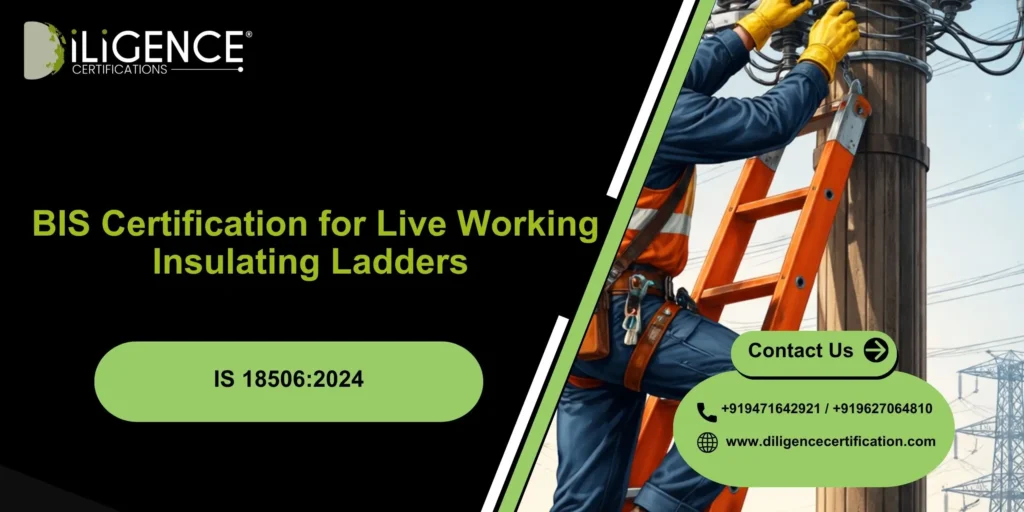
- BIS for Insulating Ladders IS 18506:2024 specifies safety requirements for insulating ladders used in live electrical working conditions.
- BIS certification ensures that ladders provide proper insulation and reduce electrical hazards.
- The standard is aligned with IEC 61478:2003, ensuring international safety compliance.
- Certification is mandatory for manufacturers supplying insulating ladders in regulated sectors.
- BIS approval enhances product credibility, safety assurance, and market acceptance in India.
Introduction | BIS for Insulating Ladders
Working in live electrical environments is one of the most high-risk activities in industrial and utility sectors. Professionals such as linemen, electricians, and maintenance workers frequently perform tasks on energized systems where even minor safety lapses can result in serious injuries or fatalities. One of the most critical safety tools used in such operations is the insulating ladder.
To ensure these ladders meet strict safety and performance requirements, the Bureau of Indian Standards (BIS) introduced IS 18506:2024, aligned with IEC 61478:2003. This standard focuses on ladders made from insulating materials designed for live working conditions.
This blog provides a complete and easy-to-understand guide on BIS for Insulating Ladders under IS 18506:2024, covering its importance, benefits, certification process, and challenges.
What is BIS for Insulating Ladders IS 18506:2024?
BIS for Insulating Ladders IS 18506:2024 is an Indian Standard that specifies the requirements for ladders made from insulating materials used in live working environments. These ladders are specially designed to prevent electrical conductivity and ensure worker safety while working on energized electrical systems.
The standard is harmonized with IEC 61478:2003, which is an internationally recognized guideline for live working equipment. It ensures that insulating ladders:
- Provide adequate electrical insulation
- Maintain mechanical strength and stability
- Resist environmental conditions such as moisture and heat
- Meet safety and performance benchmarks
BIS certification under this standard confirms that the product has been tested and complies with these requirements, making it safe for use in high-risk electrical operations.
Why BIS for Insulating Ladders is Required
BIS for Insulating Ladders is not just a regulatory requirement but a critical safety assurance for users and manufacturers. Below are the key reasons why this certification is essential:
1. Ensures Electrical Safety The product is designed to function in an electrically live environment. The insulation ladder ensures that the flow of current is stopped.
2. Compliance with Indian Regulations Manufacturers need to follow BIS standards to market their product in the country.
3. Quality Assurance The BIS certification ensures that the product meets high standards of quality.
4. Market Trust and Credibility The product is considered reliable and trusted by the market, especially by government bodies and industries.
5. Alignment with International Standards IS 18506:2024 is in compliance with the IEC, hence helpful for the manufacturer to penetrate the global market.
Importance and Benefits of BIS for Insulating Ladders
| Importance | Benefits |
| Ensures worker safety in live electrical environments | Reduces risk of electric shocks and accidents |
| Mandatory compliance for selling in India | Avoids legal penalties and product bans |
| Standardizes product quality | Builds customer trust and brand reputation |
| Verifies insulation and mechanical strength | Improves product durability and reliability |
| Supports industrial safety norms | Enhances acceptance in government and private sectors |
| Aligns with IEC standards | Enables export opportunities |
| Encourages quality manufacturing | Minimizes product defects and failures |
Step-by-Step Process of BIS for Insulating Ladders
Step1:Documentation
- Collect required technical documents
- Prepare product specifications
- Gather company registration details
- Ensure documents follow BIS format
Step2:Product Testing
- Send samples to a BIS-approved lab
- Conduct safety and quality tests
- Receive test reports
- Confirm compliance with BIS standards
Step3:Application Submission
- Fill out the BIS application form
- Upload all required documents
- Attach valid test reports
- Pay the necessary BIS fees
Step4:Scrutiny and Inspection
- BIS reviews submitted documents
- Authority verifies test results
- Factory/product inspection may occur
- Clarifications requested if needed
Step5:Grant of License
- BIS approves the application
- License number is issued
- Product can carry BIS mark
- Renewal required before expiry
Documents Required for BIS Certification
| Category | Documents Required |
| Business Documents | Business license/registration, ISO certificate, organizational details |
| Manufacturer Details | Factory layout, process flow chart, machinery list, production details |
| Product Documents | Product specifications, component list, user manual, model details |
| Testing Documents | Test report from BIS-recognized lab, sample details, test request form |
| Legal & Compliance | Authorization letter, brand ownership proof, trademark certificate (if any) |
| Import/Foreign Manufacturer (If applicable) | AIR (Authorized Indian Representative) details, contract agreement, overseas manufacturer documents |
Timelines, Costs, Validity & Renewal
- Timelines: Usually from 20 to 30 days, with only 7-15 days for the testing.
- Costs: The cost of the government and the test varies depending on the product. There can be some additional charges though.
- Validity: The validity period is 2 years in most situations.
- Renewal: The renewal is done before the expiration; there should be updated documents/tests; the renewal
Challenges of Getting this Certification Without a Consultant
While the BIS for Insulating Ladders process may seem straightforward, many manufacturers face difficulties when applying without expert guidance. Some common challenges include:
1. Complex Documentation It is often a complicated process to prepare accurate and complete documentation.
2. Understanding Technical Requirements It demands technical knowledge to comprehend IS 18506:2024 and ensure compliance with the product.
3. Testing Delays Delays may occur if there is improper preparation of the sample or if the testing process is wrong.
4. Factory Compliance Issues Many factories have not been prepared for BIS inspections, leading to rejection.
5. Application Errors Any small errors in filling out the application forms may cause delays or rejection.
6. Lack of Process Knowledge It is often difficult to go through the process of BIS certification without proper knowledge.
Why Choose Diligence Certification for This Certification
Choosing the right consultancy can significantly simplify the BIS certification process. Diligence Certification offers comprehensive support tailored to your needs.
1. Expert Guidance Experts with in-depth knowledge of BIS standards ensure proper compliance.
2. End-to-End Support Efficient support from document preparation to certification approval.
3. Faster Approval Process Accurate planning and execution ensure timely certification approval.
4. Documentation Assistance Experts help in preparing and verifying documents, thus avoiding mistakes.
5. Testing Coordination Assistance in arranging product testing with recognized laboratories.
6. Inspection Readiness Help in making your factory ready for BIS inspection and compliance.
7. Post-Certification Support Assistance in renewals, audits, and maintaining compliance.
By choosing Diligence Certification, manufacturers can focus on production while experts handle the certification process.
Conclusion
BIS for Insulating Ladders under IS 18506:2024 is essential for ensuring safety, quality, and compliance in electrical work environments. These ladders play a critical role in protecting workers from electrical hazards, making certification not just a regulatory requirement but a necessity.
The certification process involves multiple steps, including testing, documentation, inspection, and approval. While it may be complex, proper planning and expert guidance can simplify the process significantly.Manufacturers who invest in BIS for Insulating Ladders gain not only legal compliance but also improved product credibility, market trust, and long-term business growth.
Frequently Asked Questions (FAQs)
What is IS 18506:2024?
It is an Indian standard for insulating ladders used in live electrical working conditions.
Is BIS certification mandatory for insulating ladders?
Is BIS certification mandatory for insulating ladders?
What is the purpose of insulating ladders?
They prevent electrical current flow and protect workers during live operations.
Which international standard is IS 18506 aligned with?
It is aligned with IEC 61478:2003.
Who needs to apply for BIS certification?
Manufacturers and importers of insulating ladders.
What tests are conducted for certification?
Electrical insulation, mechanical strength, and durability tests are conducted.
How long does BIS certification take?
It typically takes a few weeks to months depending on compliance readiness
What happens if a product fails testing?
The manufacturer must correct issues and reapply for testing.
Can foreign manufacturers apply for BIS certification?
Yes, through the BIS Foreign Manufacturer Certification Scheme.
Why should I hire a consultant for BIS certification?
A consultant simplifies the process, reduces errors, and ensures faster approval.