BIS Certification
 CDSCO
 PESO
 CPCB
 LMPC
 WPC Approval
 Global Approvals
 TEC
 ARAI
 BEE
 ISO Certification
 DGCA Certification
 NOC For Steel
 APEDA Registration























 Business Registration
 FSSAI Mark Certification












 (32).jpg)
 Legal Services
 Trademark Registration
 Copyright Registration
 Patent Registration
 By
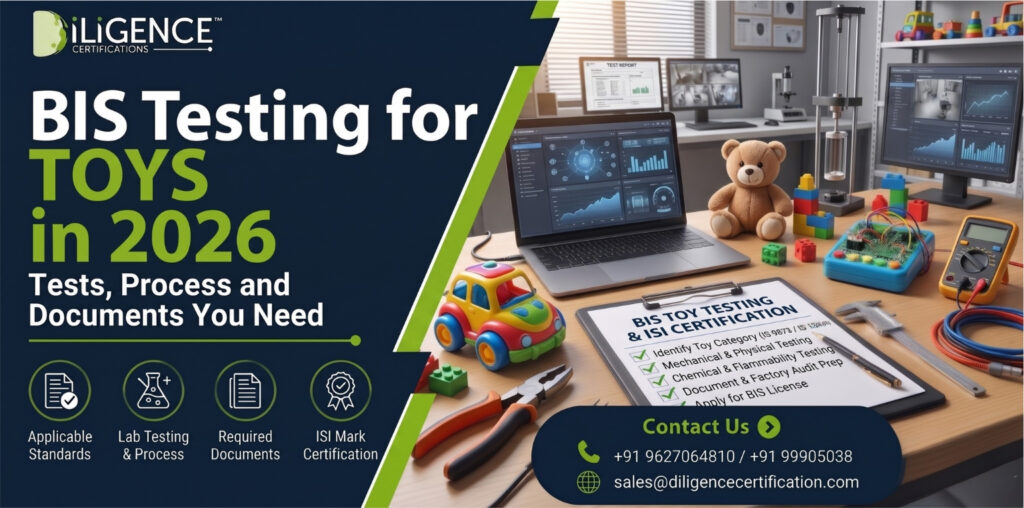
- BIS testing for toys is compulsory for toys meant for children below 14 years, under the Toys (Quality Control) Order, 2020.
- Toys made in India or imported into India need the ISI mark under a BIS licence, except toys made only for export.
- IS 9873 is the main standard. It has many parts, and which parts apply depends on your toy.
- Electric toys are tested to IS 15644 as well.
- IS 9873 (Part 1):2025 is the revised version, and the 2019 and 2025 versions can run side by side only up to 22 March 2027.
- Testing happens in two places: your own factory lab and a BIS-recognised lab. Both matter.
Introduction
If you make, import or sell toys in India, you have probably heard this line a hundred times:
But the confusing part is not the certificate. It’s the testing. Which tests? Which lab? How many samples? What if one test fails? Most first-time applicants lose weeks right here.
Think of it like a footwear testing lab. They don’t just look at a shoe and say “looks fine.” They pull the sole, bend it thousands of times, check the chemicals and write a proper report. Toy testing works the same way. Each test checks one specific risk, and each risk has a limit written in the standard.
In this blog, we’ll keep things simple. We’ll talk about what BIS testing for toys actually means, which standards apply, what tests are done, the process, documents, timeline and the mistakes people make again and again.
What Is BIS Testing for Toys?
BIS testing for toys means checking your toy against the Indian Standards made by the Bureau of Indian Standards. The idea is to make sure the toy is safe for a child to play with.
The legal base is the Toys (Quality Control) Order, 2020. It applies to products designed or clearly meant for play by children under 14 years of age. The order was later strengthened by an amendment in September 2024.
After your toy passes the tests and your factory clears the BIS inspection, you get a licence. Then you can print the ISI mark on your toy. Without it, you can’t legally sell the toy in India.
One more thing people miss. This is not a one-time test. BIS keeps checking through surveillance samples and factory visits even after you get the licence.
Which Standards Apply to Toys?
There is no single standard for every toy. IS 9873 is a series, and each part covers a different kind of risk. The BIS product manual for toys (PM/9873/13, updated in January 2026) lists the parts that matter for certification.
| Standard | What it covers |
|---|---|
| IS 9873 (Part 1) | Mechanical and physical safety, like sharp edges, small parts, strength |
| IS 9873 (Part 2) | Flammability |
| IS 9873 (Part 3) | Migration of certain elements, like lead and cadmium |
| IS 9873 (Part 4) | Experimental sets for chemistry and related activities |
| IS 9873 (Part 7) | Finger paints, requirements and test methods |
| IS 9873 (Parts 9, 10, 11) | Additional chemical safety requirements |
| IS 15644 | Safety of electric toys |
A simple example. A plain wooden block set needs mechanical, flammability and chemical checks. A battery-operated toy car needs all of that plus the electrical safety checks under IS 15644. Same shop, same child, very different test list.
The IS 9873 (Part 1):2025 change
BIS has revised Part 1 to align with the latest ISO 8124-1. The 2019 and 2025 versions are allowed to run together up to 22 March 2027. After that date, the 2025 version is the one that counts. So if you are applying now, it makes sense to plan your testing for the 2025 version from the start, instead of redoing it later.
Why BIS Testing for Toys Is Important
Let’s be honest. Nobody likes extra compliance. But toys are different from other products, because the user is a child who will put things in their mouth, pull, throw and chew.
Here is why this testing matters:
- Child safety: Small parts can choke. Sharp edges can cut. Toxic paint can harm.
- Legal need: Selling toys without the ISI mark can lead to action under the BIS Act, 2016.
- Market access: Large marketplaces and retail chains ask for the BIS licence number before listing a toy.
- Customs clearance: Imported toys without proper certification can get stuck at the port.
- Brand trust: Parents check for the ISI mark more than we think.
What Tests Are Conducted for Toys?
This is the part most people want to know. The exact list depends on the toy type, the age group and the material. But broadly, the tests fall in these buckets.
1. Mechanical and physical tests
These check whether the toy can hurt a child through its shape or because it breaks.
- Small parts test, using a gauge, for toys meant for very young children
- Sharp edges and sharp points check
- Drop test, to see if the toy breaks into dangerous pieces
- Torque and tension tests, to see if parts come off under pulling or twisting
- Impact and compression tests
- Cords, strings and straps length check
- Magnet and battery compartment checks, where relevant
2. Flammability tests
Toys should not catch fire quickly or burn in a dangerous way. Soft toys, costumes and fabric items get special attention here.
3. Chemical tests (migration of elements)
This test checks if harmful elements can come out of the toy material. Part 3 of the standard sets limits for elements such as antimony, arsenic, barium, cadmium, chromium, lead, mercury and selenium. Paint, coating, plastic and fabric are all checked.
4. Electrical safety tests for electric toys
For toys with batteries or a power supply, IS 15644 checks things like heating, insulation, battery safety and accessible live parts.
5. Marking and labelling checks
Age warnings, cautionary text, manufacturer details and the ISI mark are all checked. A toy can pass every physical test and still get stuck because the label is wrong.
BIS Testing for Electronic and Electric Toys
Battery-operated cars, talking dolls, light-up toys, remote-control toys, toy kitchens with sound. If a toy needs electricity for even one of its functions, it falls in the electric toy group. These toys are tested to IS 15644 (Safety of Electric Toys), and the product manual lists IS 15644:2006 with its amendment for this.
But here’s the thing people forget. IS 15644 does not replace the other parts. An electric toy still needs the mechanical, flammability and chemical checks of IS 9873. So electronic toys get a longer test list than simple toys.
What is checked in electric toys
| Test area | What the lab looks at |
|---|---|
| Heating | Whether any part gets dangerously hot during normal use |
| Battery safety | Correct polarity, short-circuit risk, leakage, and safe handling of rechargeable batteries |
| Battery compartment | Whether a child can open it easily, especially where button or coin cells are used |
| Live parts | Whether a child can touch any live or conductive part |
| Insulation and wiring | Wire strength, insulation quality and safe internal connections |
| Abnormal conditions | What happens if the toy is misused, jammed or a component fails |
| Moisture | Whether water or spills can create an electrical risk |
| Cords and plugs | Strength and safety, for toys that connect to a power supply |
| Moving parts | Whether motors, gears or flaps can trap fingers or hair |
| Marking | Voltage, battery type, warnings and instructions |
Battery and charger points
Battery-related issues are one of the main worries in electronic toys, because a small battery in the wrong place can be very dangerous for a young child. So the compartment design gets close attention.
If your toy comes with a charger or adapter, check separately whether that accessory has its own BIS or other regulatory requirement. Don’t assume the toy’s certificate automatically covers it.
Other approvals for smart toys
Some electronic toys have wireless features like Bluetooth, Wi-Fi or radio control. Those features can bring other approval requirements apart from the toy licence. It’s better to confirm this early, because it can change your launch plan.
Tips before sending electric toys for testing
- Send the final production version, not a prototype with a different circuit or battery.
- Keep the circuit details, battery specification and component list ready for the lab.
- Test every battery variant you plan to sell with the toy.
- Make sure the battery warnings and voltage marking are printed properly.
- Ask the lab if it is recognised for IS 15644 as well as the IS 9873 parts you need.
Simple thought: a plastic block is a one-risk product, but a talking robot is a toy, a battery product and a small electronic device in one box. The testing reflects that.
Two Kinds of Testing: Factory Lab and Recognised Lab
This confuses a lot of people, so let’s clear it up.
Factory testing: Under BIS Scheme-I, the manufacturer must have an in-house quality control setup, trained people and basic testing equipment. During the BIS inspection, samples are often tested in the factory lab in front of the BIS officer.
Recognised lab testing: Tests that you can’t do in-house are done at a BIS-recognised laboratory. The lab issues a test report, and that report goes with your application.
A good way to see it: the factory lab is your daily check, and the outside lab is the proof. BIS wants both.
Step-by-Step Process for BIS Testing and Certification
Here’s the usual flow. The details can change a bit based on your product and the latest BIS circulars.
- Identify your toy category. Check the age group, material and whether it is electric. This decides the standards and the test list.
- Check the product manual. BIS’s toy product manual explains the categories, sampling and test requirements.
- Set up your quality control system. Prepare a Quality Assurance Plan, testing equipment and trained staff.
- Choose a BIS-recognised lab. Make sure the lab is recognised for the exact parts of IS 9873 you need.
- Send samples for testing. Send the right number of samples, with the correct models and variants.
- Get the test report. If any test fails, fix the design or material and test again.
- Apply on the BIS portal. Upload the application, test report and manufacturing details.
- Factory inspection. BIS officers visit, check your process, and often test samples at the factory.
- Grant of licence. After a satisfactory inspection and review, BIS grants the licence and you can use the ISI mark.
Which BIS Licence Is Needed for Toys?
Toys need a BIS product certification licence, which lets you put the ISI mark on your toy. This is done under the standard BIS licence route known as Scheme-I, where BIS checks both your toy samples and your factory.
Here’s how the licence works in simple words.
- It is given per manufacturer and factory. The licence is issued for the place where the toy is actually made.
- It is given per product and standard. Your licence lists the toy types and the IS 9873 parts, and IS 15644 for electric toys, that you are allowed to certify.
- It has a defined scope. If you add a new toy type later, you need to extend or modify the licence first.
- It needs to be kept alive. BIS does surveillance checks, and the licence must be renewed on time.
Licence route for different businesses
| Who you are | Licence route |
|---|---|
| Indian toy manufacturer | Apply for a BIS licence for your own factory |
| Foreign toy manufacturer | Apply for a BIS licence as a foreign manufacturer, with an Authorised Indian Representative |
| Importer | Import toys that carry the ISI mark under a valid BIS licence |
| Private-label brand | Make sure the licence and marking cover your brand and the factory making the toy |
| Export-only manufacturer | Toys made only for export are treated differently under the order, so confirm before skipping |
When your existing licence needs a change
- You start making a new type of toy that is not in your licence scope
- You move to the IS 9873 (Part 1):2025 version, so confirm with BIS if a licence modification is needed
- You add a new factory or production unit
- Your brand or manufacturing arrangement changes
Simple rule: no licence, no ISI mark, and no ISI mark, no legal sale. So decide your licence route first, and only then plan the testing.
How Long Does BIS Testing for Toys Take?
There is no fixed number, and anyone who promises an exact date is guessing. It depends on a few things.
- How ready your documents and factory setup are
- Lab testing time and whether any test fails
- Number of models and variants
- How fast BIS schedules the inspection
- How quickly you respond to queries
A clean, well-prepared application moves faster. A messy one with missing papers and a failed test loops back and forth for weeks.
Cost of BIS Testing for Toys
The cost is not the same for every toy. The main things that affect it:
- Number of tests needed, which depends on the toy type
- Electric toys cost more to test than simple ones
- Number of models and variants
- Lab charges for the specific parts of the standard
- BIS application and licence fees
- Retesting, if the first sample fails
- Setting up or upgrading your in-house lab
My suggestion: ask for a clear breakup before you start, so there are no surprises in the middle.
Common Mistakes to Avoid
We see these again and again.
- Using the wrong lab. Not every lab is recognised for every part of IS 9873. Check first.
- Testing to the old version. With IS 9873 (Part 1):2025 coming in, plan for it now.
- Ignoring chemical tests. Paint and plastic issues are a big reason for failure.
- Sending only one model. Variants in colour, size or material can change the test result.
- Weak labelling. Missing age warnings or wrong marking can hold up your file.
- Poor factory setup. BIS inspects the factory, not just the report. An empty QC room won’t work.
- Treating it as one-time. Licence needs follow-up, surveillance and renewal.
- Using supplier test reports blindly. A report for a different product or standard may not be accepted.
Who Needs This? Manufacturers, Importers and Private Labels
Indian manufacturers: You apply for the BIS licence for your factory and test your toys under the scheme.
Importers: You can’t just import and sell. The toy must carry the ISI mark under a valid BIS licence.
Private-label brands: If someone else makes toys under your brand, the licence and marking need to be sorted properly. Don’t assume the factory’s paperwork covers you.
Overseas manufacturers: Foreign makers who export toys to India also need a BIS licence, and they appoint an Authorised Indian Representative to handle the process.
Export-only makers: Toys made purely for export are treated differently under the order. Check the exact wording before you skip certification.
How Diligence Certifications Can Help
We know that toy compliance feels heavy, especially the first time. That’s where Diligence Certification can support you.
- Checking which parts of IS 9873 and IS 15644 apply to your toy
- Guiding you on the right sample plan and lab testing
- Guiding you on the right BIS licence route and the Quality Assurance Plan
- Helping with the BIS application and query replies
- Supporting you during factory inspection preparation
You can look at our BIS certification services to know more. We don’t promise approvals, because approval depends on your product and your compliance. What we do is keep the process clear and organised.
Conclusion
BIS testing for toys is not something to rush through at the last minute. The rules are clear, the standards are published, and the order is mandatory for toys meant for children under 14.
Sort out your toy category first. Then pick the right lab, prepare your documents and plan for IS 9873 (Part 1):2025. A little preparation upfront saves a lot of time later.
And please, double-check the latest BIS circulars before you apply. Standards and timelines do get updated.
Frequently Asked Questions
1. Is BIS testing mandatory for toys in India?
Yes. Toys meant for children below 14 years need BIS certification and the ISI mark under the Toys (Quality Control) Order, 2020.
2. Which standard is used for toy testing?
IS 9873 is the main series. Electric toys are also tested to IS 15644.
3. What is IS 9873 (Part 1):2025?
It's the revised mechanical and physical safety standard for toys, aligned with ISO 8124-1.
4. Can I still use IS 9873 (Part 1):2019?
Both versions can run together up to 22 March 2027. After that, the 2025 version is needed.
5. What tests are done on toys?
Mechanical and physical, flammability, chemical migration, electrical safety for electric toys, and marking checks.
6. Can I test my toys in my own factory?
You need an in-house lab for factory testing, but some tests are done at a BIS-recognised lab.
7. Do imported toys need BIS certification?
Yes. Imported toys need the ISI mark under a valid BIS licence too.