BIS Certification
 CDSCO
 PESO
 CPCB
 LMPC
 WPC Approval
 Global Approvals
 TEC
 ARAI
 BEE
 ISO Certification
 DGCA Certification
 NOC For Steel
 APEDA Registration























 Business Registration
 FSSAI Mark Certification












 (32).jpg)
 Legal Services
 Trademark Registration
 Copyright Registration
 Patent Registration
 By
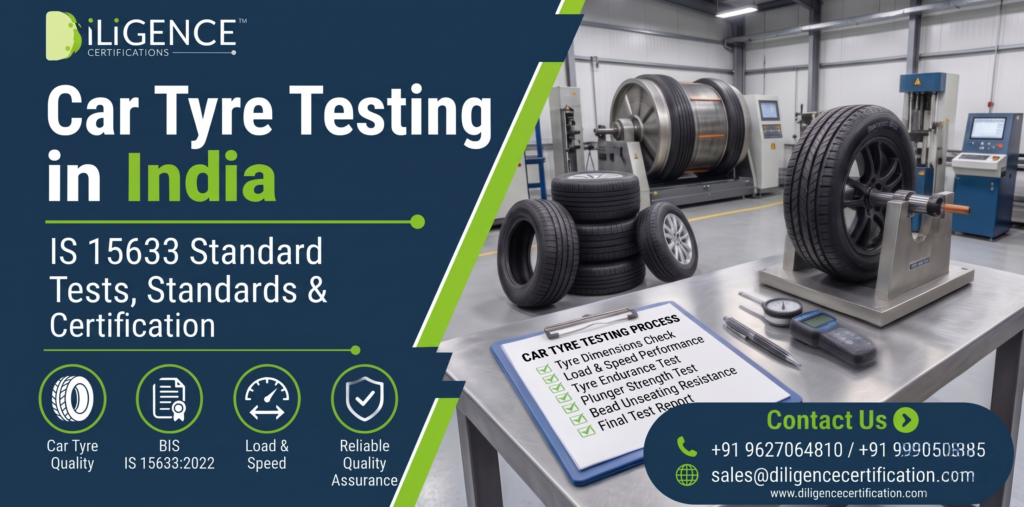
- Car tyre testing checks the safety, strength, durability and performance of tyres used in passenger cars.
- IS 15633:2022 is the key Indian Standard for pneumatic tyres used in passenger car vehicles.
- Important tests include load and speed performance, endurance, tyre strength, dimensions and bead unseating resistance for applicable tubeless tyres.
- BIS Amendment No. 2 to IS 15633:2022 had an implementation deadline of 5 August 2026.
- Manufacturers and importers should check the latest BIS requirements and applicable Quality Control Orders before selling tyres in India.
- Testing must be conducted by a laboratory with the required testing capability and acceptance under the applicable certification process.
Introduction
Car tyres are one of the most important safety components of a vehicle. They support the vehicle’s weight, maintain road grip, absorb road shocks and help the driver control the car while driving. A tyre must perform properly in different conditions, including high temperatures, wet roads, rough surfaces, heavy loads and high speeds.
A tyre that looks good from the outside may still have internal defects. Weak construction, poor bonding, incorrect dimensions or low-quality materials can affect its performance. These problems may lead to air leakage, uneven wear, tyre damage or even failure during driving.
This is why car tyre testing is important for manufacturers, importers and suppliers. It helps check whether a tyre meets the required safety and performance specifications before it reaches the market.
In India, passenger car tyres are covered by the relevant Indian Standard, including IS 15633:2022. The standard covers technical requirements for diagonal and radial-ply pneumatic tyres designed for passenger car vehicles. This guide explains the major tests, standards, testing process and BIS certification considerations in simple language.
What Is Car Tyre Testing?
Car tyre testing is the process of examining a tyre to check whether it meets specified requirements for dimensions, strength, durability, load capacity, speed performance and other safety-related properties.
During testing, a tyre may be exposed to controlled conditions that represent the stresses it can experience on the road. Special machines and equipment are used to measure its performance.
The testing process can help identify problems such as:
- Incorrect tyre dimensions
- Weak tyre construction
- Poor bonding between rubber and other materials
- Excessive deformation under load
- Failure during endurance testing
- Incorrect markings or specifications
- Problems with bead seating in applicable tubeless tyres
Testing requirements depend on the tyre category, design, size and applicable standard. A test plan should therefore be prepared according to the relevant specification rather than using the same tests for every tyre.
Why Is Car Tyre Testing Important?
1. Improves vehicle safety
Tyres remain in direct contact with the road. Their condition and performance affect braking, steering, cornering and vehicle stability. Testing helps identify weaknesses that may affect these functions.
2. Checks strength and durability
A car tyre must withstand repeated loading, road friction and changing operating conditions. Strength and endurance tests help assess whether its construction can handle the required performance conditions.
3. Supports product quality
Testing helps manufacturers identify production problems before tyres are supplied to customers. It can also support quality control between different production batches.
4. Helps meet regulatory requirements
Where a Quality Control Order applies, manufacturers and importers must follow the relevant compliance requirements. Testing and certification may form part of this process.
5. Builds customer confidence
Customers expect tyres to perform safely and consistently. Meeting applicable standards and maintaining proper quality checks can help manufacturers build trust in their products.
BIS Standard for Car Tyre Testing in India
The main Indian Standard relevant to passenger car pneumatic tyres is:
IS 15633:2022 - Automotive Vehicles: Pneumatic Tyres for Passenger Car Vehicles - Diagonal and Radial Ply.
The standard specifies requirements for passenger car tyres, including relevant general, dimensional and performance requirements. It applies to the tyre types and vehicle categories covered by its scope.
Manufacturers should not rely only on the standard number printed in an old document. They should check the latest published version, amendments and BIS product manual before preparing samples or applying for certification.
Important 2026 update
BIS issued guidelines on 30 March 2026 for implementing Amendment No. 2 to IS 15633:2022. The stated implementation deadline was 5 August 2026.
The amendment includes changes relating to the scope, definitions, testing provisions and marking requirements. It also expands the scope to cover tyres for N1 category vehicles. Other changes address matters such as high-load-capacity tyres, temporary-use spare tyres and certain tyre-size requirements.
As the implementation deadline has passed, manufacturers and existing licence holders should ensure that their products and compliance records reflect the amended requirements.
Other standards may apply to different tyre categories:
| Indian Standard | Product category |
|---|---|
| IS 15633:2022 | Passenger car pneumatic tyres |
| IS 15636:2022 | Commercial vehicle pneumatic tyres |
| IS 15627:2022 | Pneumatic tyres for two- and three-wheeled motor vehicles |
These standards are not interchangeable. The correct standard must be selected according to the product’s intended vehicle category and scope.
Major Tests Conducted During Car Tyre Testing
The applicable test schedule should always be taken from the current edition of IS 15633 and its amendments. The following are important tests associated with passenger car tyre evaluation.
1. Tyre Dimension Test
The tyre dimension test checks whether the tyre’s physical measurements meet the specified requirements.
Measurements may include:
- Section width
- Overall or outer diameter
- Relevant dimensional characteristics
Incorrect dimensions can affect the fitment of a tyre on a vehicle. They may also influence vehicle handling, clearance and performance.
2. Load and Speed Performance Test
A car tyre must carry the required load while operating at its declared speed conditions. This test evaluates tyre performance under specified load and speed combinations.
The tyre is tested using suitable equipment under controlled conditions. Its performance is observed to identify signs of damage or unacceptable changes.
This test is important because tyres experience different stresses when a vehicle carries passengers, luggage or additional weight.
3. Endurance Test
The endurance test evaluates how a tyre performs under repeated operating conditions for a specified period.
The test is designed to assess the tyre’s ability to withstand continuous stress. It can help identify construction weaknesses, excessive heating or damage during the test.
The exact test conditions and acceptance requirements must be taken from the applicable standard.
4. Tyre Strength Test (Plunger Test)
The plunger test evaluates the strength of the tyre structure against a controlled penetrating force.
A testing machine applies force through a specified plunger towards the tyre. The force and related measurements are recorded according to the standard.
This test helps assess the resistance of the tyre structure to localised external pressure. It is particularly useful for identifying weaknesses in the tyre’s construction.
5. Bead Unseating Resistance Test
This test is applicable to relevant tubeless tyre designs.
The bead is the part of the tyre that sits against the rim. It must remain properly seated during vehicle operation.
During testing, force is applied in a controlled manner to evaluate the resistance of the tyre bead to being pushed away from its rim seating position.
Correct bead performance is important for maintaining the tyre’s fitment and air retention.
6. Tread Wear Indicator Check
Tread wear indicators help show when the tyre tread has reached a specified wear level.
The test checks whether the indicators meet the applicable dimensional and marking requirements. This is important because tread condition affects road contact and water evacuation.
7. Marking and Labelling Verification
A tyre must carry the markings required by the applicable standard.
Depending on the tyre type, these may include:
- Manufacturer or brand identification
- Tyre size designation
- Load index
- Speed symbol
- Construction details
- Other required identification and compliance information
Markings must be clear, legible and consistent with the approved product details. The latest amendment should be checked because marking requirements can change.
How Is Car Tyre Testing Performed?
The testing process generally follows a structured sequence. The exact procedure depends on the standard, product type and certification requirements.
Step 1: Identify the tyre category
First, the manufacturer identifies the product category, tyre construction, size and intended vehicle application.
For passenger car tyres, the relevant requirements of IS 15633 should be reviewed.
Step 2: Review the applicable standard
The current standard, amendments and BIS product manual should be checked. This helps identify the required tests, sample details and acceptance criteria.
Step 3: Prepare tyre samples
Representative samples are prepared according to the applicable sampling and product manual requirements. Samples should correctly represent the product intended for certification.
Step 4: Submit samples to the laboratory
Samples are submitted to a laboratory that has the required testing equipment and capability. For BIS certification, the laboratory and testing arrangements must meet the applicable BIS requirements.
Step 5: Conduct the required tests
The laboratory performs the applicable tests, which may include dimensional, load and speed, endurance, strength and marking checks.
Step 6: Review the test results
The results are compared with the requirements of the relevant standard. Any non-conformity should be investigated.
Step 7: Take corrective action if required
If a sample does not meet a requirement, the manufacturer should identify the reason and take corrective action. A fresh sample may need to be tested according to the applicable procedure.
Step 8: Maintain test and quality records
The manufacturer should maintain test reports, production inspection records and other documents required under the applicable certification and quality-control process.
Equipment Used for Car Tyre Testing
Different machines are used for different tests. The equipment required depends on the test schedule and the laboratory’s approved scope.
| Testing equipment | Purpose |
|---|---|
| Tyre dimension measuring equipment | Measures tyre dimensions |
| Load and speed performance machine | Evaluates performance under specified load and speed conditions |
| Endurance testing machine | Assesses durability under controlled operating conditions |
| Tyre strength testing machine | Performs the plunger strength test |
| Bead unseating tester | Measures bead unseating resistance for applicable tyres |
| Measuring instruments | Checks dimensions and other specified parameters |
| Marking inspection tools | Helps verify required tyre markings |
Equipment should be suitable for the relevant test method and maintained in proper working condition. Calibration and measurement records are also important for reliable results.
Common Defects Found During Car Tyre Testing
Testing may identify defects caused by raw materials, manufacturing conditions, design issues or quality-control problems.
| Common defect | Possible reason |
|---|---|
| Incorrect dimensions | Errors in design or manufacturing control |
| Weak tyre structure | Incorrect material selection or construction |
| Tread separation | Bonding or curing problems |
| Sidewall damage | Material or manufacturing defects |
| Excessive deformation | Construction or performance-related issues |
| Poor bead performance | Bead design or manufacturing problems |
| Incorrect markings | Labelling or production-control errors |
Manufacturers should investigate the root cause of each failure instead of simply repeating the test. Corrective action should address the actual problem in the production process.
Documents Required for Car Tyre Testing and BIS Certification
The documents required depend on the testing laboratory, product details and certification route. Commonly required information may include:
- Company registration documents
- Manufacturer name and factory address
- Product specifications and technical details
- Tyre size and designation details
- Product drawings or construction details, where required
- Raw material information
- Manufacturing process details
- Quality-control and inspection records
- Test sample details
- Previous test reports, if available
- Details of manufacturing and testing equipment
- Authorisation documents, where applicable
For BIS applications, additional documents and declarations may be required. The current BIS application requirements and product manual should be checked before submission.
BIS Certification for Car Tyres in India
BIS certification is an important compliance requirement for products covered under applicable Quality Control Orders.
The Pneumatic Tyres and Tubes for Automotive Vehicles (Quality Control) Order, 2009 is relevant to specified automotive tyre and tube products. Passenger car tyres covered by IS 15633 are included in the BIS product-certification framework.
However, the exact requirement should be checked for the particular tyre size, type, category and intended use. Certain exemptions or specific provisions may apply under the relevant order and government notifications.
General BIS certification process
1. Identify the applicable Indian Standard
Confirm that the product falls within IS 15633 and identify the applicable amendments.
2. Review the BIS product manual
Check the sampling requirements, test equipment, inspection arrangements and scope-of-licence provisions.
3. Prepare the application documents
Collect company, factory, product and manufacturing details.
4. Arrange product testing
Submit representative samples through the applicable BIS testing process.
5. Complete factory assessment requirements
BIS may conduct an assessment of the manufacturing facility and quality-control arrangements as part of the certification process.
6. Address non-conformities
If any issue is identified during testing or assessment, corrective action may be required.
7. Complete the certification process
The licence is granted only after the applicable requirements have been fulfilled and BIS has completed its assessment.
8. Follow ongoing compliance requirements
After certification, the manufacturer must follow the applicable marking, inspection, testing and surveillance requirements.
A test report by itself is not a BIS licence. The right to use the ISI mark depends on obtaining and maintaining the required BIS licence.
Common Mistakes Manufacturers Should Avoid
Manufacturers can reduce delays and compliance problems by avoiding these common mistakes:
- Using an outdated version of the Indian Standard.
- Ignoring published amendments.
- Selecting the wrong standard for the tyre category.
- Submitting samples that do not represent regular production.
- Providing incorrect tyre size or technical details.
- Ignoring marking requirements.
- Choosing a laboratory without checking its relevant testing scope.
- Failing to investigate repeated test failures.
- Treating a laboratory test report as a substitute for BIS certification.
- Not maintaining production and inspection records.
A proper review before sample submission can help reduce avoidable testing and documentation problems.
How to Choose a Car Tyre Testing Laboratory
Choosing a suitable laboratory is important because tyre testing requires specialised machines and technical knowledge.
Before selecting a laboratory, consider the following points:
Check testing capability
Confirm that the laboratory can perform the tests required for your tyre category and size.
Review accreditation scope
If NABL accreditation is relevant to your testing requirement, check the laboratory’s current accreditation scope. Accreditation for one test does not automatically mean that every tyre test is covered.
Check BIS acceptance requirements
For a BIS application, confirm that the testing arrangement meets the current BIS requirements. NABL accreditation and BIS recognition are separate matters.
Confirm sample requirements
Ask about the number of samples, sample preparation, testing schedule and required product information.
Review reporting details
The test report should clearly identify the sample, applicable standard, test methods and results.
Role of Diligence Certifications in Car Tyre Testing and BIS Certification
Diligence Certifications provides guidance and consultancy support for businesses dealing with product certification and regulatory compliance.
For manufacturers and importers of car tyres, understanding the applicable Indian Standard, preparing documents and following the correct certification process can be challenging.
Diligence Certifications can assist businesses with:
- Understanding applicable BIS certification requirements
- Identifying relevant product standards and compliance steps
- Preparing and reviewing application documents
- Providing guidance on the certification process
- Supporting communication and coordination during the application process
Important: Diligence Certifications is a consultancy service provider, not a physical tyre testing laboratory. Actual product testing must be carried out by a suitable laboratory under the applicable requirements. Consultancy support does not guarantee a test result or BIS licence.
Visit the Diligence Certifications website to learn more about its compliance support services.
Benefits of Proper Car Tyre Testing
A planned testing and quality-control system can provide several benefits:
- Helps identify product defects before market supply.
- Supports compliance with applicable Indian Standards.
- Improves consistency between production batches.
- Helps manufacturers review product design and construction.
- Provides documented evidence of product evaluation.
- Supports customer confidence and product quality.
- Helps reduce the risk of avoidable manufacturing failures.
Testing should be treated as an important part of product development and manufacturing quality control, not only as a final certification step.
Conclusion
Car tyre testing plays an important role in checking the safety, strength, dimensions and performance of passenger car tyres. Tests such as load and speed performance, endurance, tyre strength, dimensional checks and applicable bead unseating resistance help evaluate whether a tyre meets the required specifications.
In India, IS 15633:2022 is the key standard for passenger car pneumatic tyres. Manufacturers should also consider Amendment No. 2, which had an implementation deadline of 5 August 2026, along with the latest BIS product manual and applicable Quality Control Order provisions.
Before manufacturing, importing or selling car tyres, businesses should identify the correct standard, arrange the required testing and complete the applicable BIS certification process. Proper preparation and regular quality checks can help improve product reliability and support regulatory compliance.
Frequently Asked Questions
1. What is car tyre testing?
Car tyre testing is the process of checking a tyre's dimensions, strength, durability, load capacity, speed performance and other specified properties to assess whether it meets applicable requirements.
2. Which BIS standard is used for passenger car tyre testing in India?
IS 15633:2022 is the main Indian Standard for pneumatic tyres used in passenger car vehicles, covering diagonal and radial-ply tyres within its scope.
3. Is BIS certification mandatory for car tyres in India?
BIS certification is required for products covered by applicable Quality Control Order provisions. Manufacturers and importers should verify the exact product category, tyre type and any applicable exemptions before placing a product on the Indian market.
4. What are the main tests conducted on car tyres?
Important tests include dimensional checks, load and speed performance, endurance, tyre strength (plunger test), tread wear indicator checks, marking verification and bead unseating resistance testing for applicable tubeless tyres.
5. What is the purpose of the tyre endurance test?
The endurance test evaluates how a tyre withstands repeated operating stress under specified conditions. It helps identify weaknesses that may affect durability.
6. What is a plunger test in tyre testing?
A plunger test evaluates tyre strength by applying a controlled force through a specified plunger against the tyre structure. It helps assess resistance to localised penetration forces.