BIS Certification
 CDSCO
 PESO
 CPCB
 LMPC
 WPC Approval
 Global Approvals
 TEC
 ARAI
 BEE
 ISO Certification
 DGCA Certification
 NOC For Steel
 APEDA Registration























 Business Registration
 FSSAI Mark Certification












 (32).jpg)
 Legal Services
 Trademark Registration
 Copyright Registration
 Patent Registration
 By
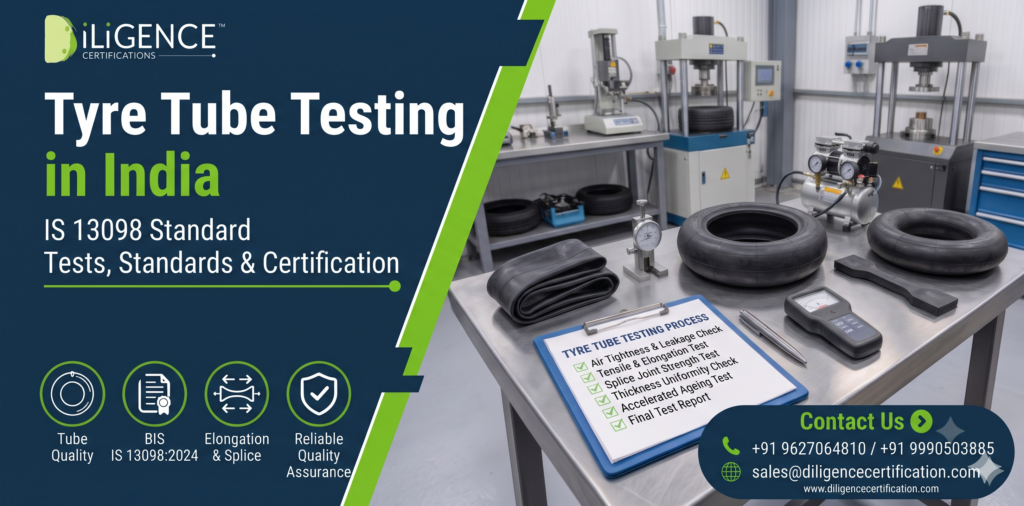
- Tyre tube testing checks the quality, strength, durability and air-retention capacity of inner tubes.
- IS 13098:2024 is the relevant Indian Standard for automotive tubes for pneumatic tyres covered by its scope.
- Important tests include elongation, splice strength, air tightness, ageing resistance and thickness uniformity.
- Testing helps manufacturers identify defects before products reach the market.
- Manufacturers should verify applicable BIS certification and Quality Control Order requirements.
- A laboratory test report does not automatically provide BIS certification.
Introduction
Tyre tubes are important components used in different types of vehicles, including motorcycles, scooters, bicycles, trucks, buses and agricultural vehicles. They are fitted inside compatible tyres and help maintain air pressure during vehicle operation.
Although an inner tube looks like a simple rubber product, it performs an important function. It must hold compressed air, withstand pressure and handle continuous movement, heat and friction.
If a tyre tube has poor rubber quality, weak joints or air leakage, it may not perform properly. Such problems can affect vehicle safety and product reliability.
This is why tyre tube testing is important.
Tyre tube testing involves checking the physical, mechanical and performance properties of inner tubes to determine whether they meet the applicable quality requirements. It helps manufacturers identify defects, improve production quality and support regulatory compliance.
In India, manufacturers and importers should also understand the relevant Bureau of Indian Standards (BIS) requirements. Depending on the product category and applicable government notifications, BIS certification may be necessary before a product can be manufactured, imported or sold.
This guide explains tyre tube testing, applicable standards, important tests, laboratory equipment, documentation, common defects and the BIS certification process.
What Is Tyre Tube Testing?
Tyre tube testing is the process of examining rubber inner tubes to check their strength, flexibility, dimensions, durability and air-holding capacity.
Tyre tubes are generally manufactured using natural rubber, butyl rubber or other suitable elastomeric compounds.
During manufacturing, rubber is processed, shaped, joined and cured to produce the finished tube. Manufacturing defects or unsuitable materials can affect the performance of the final product.
Tyre tube testing helps identify problems such as:
- Air leakage.
- Weak rubber material.
- Poor tensile strength.
- Low elongation.
- Cracks and surface defects.
- Incorrect dimensions.
- Weak splice joints.
- Defective valve connections.
- Poor ageing resistance.
- Uneven wall thickness.
Why Is Tyre Tube Testing Important?
An inner tube continuously experiences pressure and movement during vehicle operation. It may also be exposed to temperature changes and mechanical stress.
Testing helps manufacturers:
- Maintain consistent product quality.
- Identify manufacturing defects.
- Improve rubber compound quality.
- Reduce customer complaints.
- Verify compliance with applicable Indian Standards.
- Support BIS certification wherever required.
- Improve product reliability and market acceptance.
Applicable BIS Standard for Tyre Tube Testing
The main Indian Standard for automotive inner tubes is:
IS 13098:2024 - Automotive Vehicles: Tubes for Pneumatic Tyres - Specification (Second Revision).
This standard covers automotive tubes for pneumatic tyres within its defined scope. It replaced the earlier IS 13098:2012 edition and was implemented from 4 January 2025.
What Does IS 13098:2024 Cover?
The standard covers specified automotive vehicle categories, including:
- L1 and L2: Certain two-wheeled motor vehicles.
- L5: Certain three-wheeled motor vehicles.
- M: Passenger vehicles.
- N: Goods vehicles.
- T: Agricultural and other covered vehicle categories.
It establishes requirements related to materials, classification, fit, physical properties, ageing performance, air tightness and marking.
Manufacturers should check the official standard for exact product scope, classifications and exclusions.
Difference Between IS 13098:2012 and IS 13098:2024
IS 13098:2012 was the earlier version of the automotive inner tube standard. BIS later published the revised IS 13098:2024.
The revision introduced changes to certain product requirements, including marking requirements for Class A tubes.
Manufacturers should use the revised standard and current BIS product manual rather than relying on outdated testing documents.
Other Standards Related to Tyre Tubes
| Indian Standard | Subject |
|---|---|
| IS 13098:2024 | Automotive tubes for pneumatic tyres |
| IS 10939:2023 | Designation system for automotive tyre tube valves |
| IS 11031:2023 | Storage and handling of inner tubes, valves and flaps |
These standards cover different aspects of tyre tube products and should not be treated as interchangeable.
Types of Tyre Tubes
Different vehicles use different types of inner tubes. Their dimensions, rubber compounds and construction may vary.
1. Motorcycle Inner Tubes
Motorcycle tubes are used in compatible tube-type tyres. They must maintain air pressure and withstand regular road movement, heat and mechanical stress.
Important checks include dimensions, rubber thickness, elongation, splice strength and air tightness.
2. Scooter Inner Tubes
Scooter tubes are manufactured according to the compatible tyre size and application. Testing helps verify their dimensions, flexibility and air-retention properties.
3. Bicycle Inner Tubes
Bicycle tubes are generally lightweight and flexible. They are available in different sizes for road bicycles, mountain bikes and other bicycles.
Their applicable testing requirements should be identified separately. Automotive standard IS 13098 should not automatically be assumed to cover every bicycle tube.
4. Truck and Bus Inner Tubes
Commercial vehicle tubes are designed for compatible heavy-duty tyres. They require suitable rubber properties, reliable joints and proper air retention.
5. Agricultural Vehicle Inner Tubes
Agricultural tubes are used in compatible tractor and agricultural tyres. They may experience uneven surfaces, heavy loads and changing operating conditions.
The relevant product classification and standard should be confirmed before testing.
Major Tests Performed During Tyre Tube Testing
Tyre tube testing includes several physical and mechanical checks. Each test evaluates a different product characteristic.
1. Material Testing
Material testing checks whether the rubber used in manufacturing meets the applicable requirements.
Rubber quality affects the strength, flexibility and durability of the finished tube.
Poor-quality material may become brittle, develop cracks or lose its physical properties.
This test helps manufacturers:
- Evaluate rubber compound quality.
- Identify unsuitable raw materials.
- Maintain consistent production.
- Reduce early product failure.
2. Tube Classification Test
Classification identifies the appropriate tube class according to the applicable standard.
Different classifications may have different material and performance requirements. Correct identification is necessary before testing.
3. Fit Test
The fit test checks whether the tube is suitable for its intended tyre size and application.
An inner tube should fit properly inside a compatible tyre without unnecessary stretching, folding or deformation.
It helps identify dimensional problems and compatibility issues.
4. Thickness Uniformity Test
This test checks whether the rubber wall has consistent thickness at the specified measurement locations.
A laboratory may use a dial thickness gauge or other suitable measuring equipment.
Uneven thickness can create weak areas and affect product performance.
5. Elongation Test
The elongation test measures how much rubber can stretch before breaking.
A prepared rubber specimen is placed in a tensile testing machine. The machine applies force until the specimen reaches the required endpoint.
This test helps evaluate:
- Rubber flexibility.
- Stretching ability.
- Mechanical properties.
- Material consistency.
Low elongation may indicate unsuitable rubber compound quality or material deterioration.
6. Strength of Splice Test
A splice is the joint formed when rubber ends are joined during tube manufacturing.
The splice strength test evaluates the strength and quality of this joint.
A weak splice may separate during stretching or use.
Common causes include:
- Improper joint preparation.
- Incorrect curing conditions.
- Poor bonding.
- Contamination.
- Unsuitable rubber compound.
Manufacturers should maintain proper control over splicing and curing.
7. Set After Ageing Test
This test evaluates the permanent deformation characteristics of rubber after ageing under specified conditions.
It helps determine whether the material maintains the required properties after the prescribed ageing procedure.
8. Accelerated Ageing Test
Accelerated ageing testing examines changes in rubber properties after exposure to controlled ageing conditions.
A laboratory uses a specified procedure to evaluate deterioration under elevated temperatures.
The test may identify excessive hardening, loss of flexibility and material deterioration.
9. Air Tightness Test
Air tightness is one of the most important tests for an inner tube.
It checks whether the tube can retain air without leakage. The tube is inflated according to the specified procedure and inspected for escaping air.
A water tank may be used to identify air bubbles.
Common reasons for leakage include:
- Small holes.
- Damaged rubber surfaces.
- Weak splice joints.
- Defective valve connections.
- Manufacturing defects.
10. Marking and Labelling Inspection
Marking inspection checks whether the required product information is correctly provided.
Depending on the applicable standard, details may include:
- Manufacturer’s name or trade name.
- Tube size designation.
- Manufacturing date.
- Required product classification.
- Other prescribed identification.
- BIS Standard Mark, where authorised.
For Class A tubes, IS 13098:2024 implementation guidelines specify a minimum blue-line width of 2 mm. The latest standard should be checked for complete marking requirements.
Tyre Tube Testing Procedure: Step-by-Step
Manufacturers should follow a systematic procedure to ensure that their products meet the applicable requirements.
Step 1: Identify the Product Category
Identify the type of inner tube, vehicle application, dimensions, rubber material, classification and valve type.
This information helps determine the applicable testing requirements.
Step 2: Select the Applicable Indian Standard
For automotive pneumatic tyre tubes covered by its scope, check IS 13098:2024.
Review the latest standard, amendments and BIS product manual.
Step 3: Prepare Product Samples
Arrange representative samples from actual production.
Before submission, check:
- Surface quality.
- Tube dimensions.
- Splice condition.
- Valve installation.
- Product identification.
Step 4: Conduct Laboratory Testing
The laboratory performs the required tests according to the applicable standard.
These may include material evaluation, fit, thickness uniformity, elongation, splice strength, ageing, air tightness and marking inspection.
Step 5: Evaluate Test Results
The laboratory compares test results with the applicable acceptance requirements.
For example, low elongation may indicate a material problem, while air leakage may indicate a damaged surface or weak valve connection.
Step 6: Correct Manufacturing Defects
If a sample fails, manufacturers should identify the root cause and take corrective action.
Possible improvements include:
- Better rubber compound formulation.
- Improved mixing conditions.
- Proper splice preparation.
- Correct curing conditions.
- Better valve fitting.
- Regular production inspections.
Step 7: Complete Compliance Requirements
After the required testing and documentation, manufacturers can proceed with the applicable certification process.
A successful laboratory test report does not automatically authorise the use of the BIS Standard Mark.
Equipment Used for Tyre Tube Testing
Different tests require different laboratory instruments.
| Equipment | Purpose |
|---|---|
| Tensile testing machine | Measures stretching properties |
| Dumb-bell cutter | Prepares rubber specimens |
| Vernier caliper | Measures dimensions |
| Micrometer | Measures thickness |
| Dial thickness gauge | Checks thickness uniformity |
| Extensometer | Measures elongation |
| Hot air oven | Provides ageing conditions |
| Stopwatch | Measures test duration |
| Air compressor | Inflates the tube |
| Pressure indicator | Monitors inflation pressure |
| Water tank | Identifies air leakage |
Why Is Proper Laboratory Equipment Important?
Accurate testing depends on suitable equipment, trained personnel and controlled testing conditions.
Manufacturers should check equipment availability, calibration records, maintenance procedures and laboratory experience before selecting a testing facility.
Common Defects Found During Tyre Tube Testing
Understanding common defects helps manufacturers improve production quality.
1. Air Leakage
Air leakage may occur because of holes, weak joints, valve defects or damaged rubber.
Prevention: Inspect rubber surfaces, maintain splice quality, check valve installation and conduct air-tightness checks.
2. Uneven Wall Thickness
This may result from poor extrusion or inconsistent material distribution.
Prevention: Maintain equipment, monitor thickness and conduct regular production inspections.
3. Weak Splice Joint
Poor joint preparation, contamination or improper curing can cause splice failure.
Prevention: Clean joining surfaces, control splice pressure and follow suitable curing procedures.
4. Low Elongation
Low elongation may indicate unsuitable rubber formulation or material deterioration.
Prevention: Use appropriate raw materials, control mixing and conduct regular material testing.
5. Poor Ageing Resistance
Rubber may become hard or brittle after ageing.
Prevention: Select suitable compounds, control curing and store products correctly.
6. Incorrect Dimensions
Incorrect dimensions can affect compatibility with the intended tyre.
Prevention: Check product specifications and maintain dimensional inspection records.
7. Valve-Related Defects
Poor valve installation or unsuitable components may cause air leakage.
Prevention: Check valve quality, compatibility and fitting during production.
Raw Materials Used in Tyre Tube Manufacturing
The quality of an inner tube depends heavily on the raw materials used during production.
1. Natural Rubber
Natural rubber offers flexibility and useful mechanical properties. It can contribute to the elasticity and strength of inner tubes when properly formulated.
2. Butyl Rubber
Butyl rubber is widely used in inner tube manufacturing because of its air-retention properties and low air permeability.
3. Carbon Black
Carbon black is used as a reinforcing material in rubber compounds. It can improve strength and other mechanical properties.
4. Vulcanising Agents
Vulcanising agents help create cross-links in rubber during curing and improve the physical properties of the finished product.
5. Processing Oils and Additives
These materials may support processing and help achieve the required rubber properties.
Documents Required for Tyre Tube Testing and BIS Certification
Proper documentation helps manufacturers organise the testing and certification process.
The documents may vary according to the product and application.
| Document | Purpose |
|---|---|
| Business registration | Identifies the business |
| Factory address proof | Confirms manufacturing location |
| Product specifications | Provides product details |
| Product drawings | Shows dimensions and design |
| Raw material details | Identifies rubber compounds |
| Manufacturing flow chart | Explains production stages |
| Machinery list | Identifies manufacturing equipment |
| Testing equipment list | Shows quality control facilities |
| Quality control records | Provides inspection details |
| Product samples | Used for laboratory testing |
| Factory layout | Shows manufacturing arrangements |
| Authorisation documents | Establishes applicant authority, where applicable |
Overseas manufacturers may need additional documentation and authorised Indian representative arrangements, depending on the applicable certification scheme.
This is a general preparation list, not a fixed checklist for every application.
BIS Certification for Tyre Tubes in India
BIS stands for the Bureau of Indian Standards. It is India’s national standards body and operates product certification schemes.
For automotive pneumatic tyre tubes, IS 13098 is the main relevant Indian Standard.
BIS certification establishes that a product has been assessed and licensed under the applicable certification requirements.
Is BIS Certification Mandatory for Tyre Tubes?
The requirement depends on the product category and applicable government notifications.
IS 13098 appears in BIS Scheme-I product certification information under automobile accessories. The Pneumatic Tyres and Tubes for Automotive Vehicles Quality Control Order, 2009 is also relevant.
Manufacturers and importers should verify:
- Whether their product falls within the applicable QCO.
- Whether any exemption applies.
- The latest government amendments.
- The applicable Indian Standard.
- The required certification scheme.
- Current manufacturing and import restrictions.
Not all rubber tubes, bicycle tubes and automotive tubes necessarily have identical certification requirements.
What Is the BIS ISI Mark?
The ISI Mark is a product certification mark associated with BIS.
It indicates that the product is covered by a valid BIS licence and manufactured according to the applicable certification requirements.
A manufacturer must obtain the required licence before using the BIS Standard Mark.
Step-by-Step BIS Certification Process
Step 1: Identify the Applicable Standard
Confirm whether IS 13098:2024 applies to the product and check the relevant classification.
Step 2: Review the BIS Product Manual
Understand the applicable testing requirements, inspection procedure and scheme of inspection and testing.
Step 3: Prepare Manufacturing Facilities
Maintain suitable machinery, production controls, quality assurance arrangements and required testing facilities.
Step 4: Arrange Product Testing
Arrange product testing through an appropriate laboratory according to the applicable BIS procedure.
Step 5: Submit the BIS Application
Prepare business, factory, product and technical documents and submit the application through the applicable BIS process.
Step 6: Factory Inspection
BIS may inspect the manufacturing facility and review production arrangements, testing facilities, inspection records and quality control systems.
Step 7: Sample Testing
Product samples may be selected and tested according to the certification procedure.
Step 8: Grant of BIS Licence
If all applicable requirements are met, BIS may grant the licence. The manufacturer can then use the Standard Mark subject to licence conditions.
Step 9: Maintain Certification
Manufacturers must maintain product quality and comply with BIS surveillance and licence conditions.
Benefits of Tyre Tube Testing for Manufacturers
Tyre tube testing supports product development and manufacturing quality control.
1. Better Product Quality
Testing helps manufacturers identify whether rubber compounds and finished tubes meet required specifications.
2. Improved Reliability
Air tightness, splice strength and ageing tests help identify weaknesses that may affect product performance.
3. Reduced Manufacturing Defects
Regular inspections help identify production problems before defective products reach customers.
4. Better Customer Confidence
Consistent product quality helps improve brand reputation and customer confidence.
5. Support for BIS Compliance
Testing provides important technical evidence for the applicable certification process.
6. Improved Production Control
Test results help manufacturers identify production stages that require improvement.
How to Select the Right Tyre Tube Testing Laboratory
Choosing the right laboratory is important for manufacturers.
Consider these factors:
- Testing experience: Select a laboratory experienced in rubber products and automotive inner tubes.
- Testing scope: Confirm its ability to perform the tests required under IS 13098:2024.
- NABL accreditation: Check accreditation under ISO/IEC 17025 for the relevant testing scope.
- Equipment: Verify the availability and suitability of testing instruments.
- Technical staff: Check whether trained personnel are available.
- Test reports: Ensure reports clearly mention samples, methods and results.
- BIS acceptance: If testing is for BIS certification, confirm laboratory acceptance under the applicable BIS procedure.
NABL accreditation for unrelated tests does not automatically establish accreditation for tyre tube testing or BIS acceptance.
Difference Between Tyre Testing and Tyre Tube Testing
Tyre testing and tyre tube testing are different activities.
| Tyre Testing | Tyre Tube Testing |
|---|---|
| Evaluates the complete tyre | Evaluates the inner tube |
| Checks tyre construction and performance | Checks tube material and properties |
| May include load and endurance tests | Includes air tightness and splice strength tests |
| Evaluates tread and other tyre characteristics | Evaluates rubber properties and dimensions |
| Uses tyre-specific standards | Uses applicable tube-specific standards |
For example, IS 15627 covers pneumatic tyres for two- and three-wheeled motor vehicles, while IS 13098:2024 covers automotive tubes for pneumatic tyres.
Manufacturers should identify whether they need tyre testing, tyre tube testing or both.
Common Mistakes Manufacturers Should Avoid
Manufacturers should avoid these common mistakes:
- Using an outdated Indian Standard.
- Incorrectly classifying the product.
- Preparing non-representative samples.
- Ignoring splice quality.
- Not checking thickness uniformity.
- Ignoring air leakage.
- Using unsuitable rubber materials.
- Selecting a laboratory without checking its testing scope.
- Submitting incomplete documents.
- Confusing a laboratory report with BIS certification.
Avoiding these mistakes can make testing and compliance preparation more organised.
How Diligence Certifications Can Help with Tyre Tube Testing and BIS Certification
Manufacturers and importers sometimes find it difficult to understand Indian Standards, technical documentation and BIS certification procedures.
Diligence Certifications provides compliance consultancy and guidance to businesses seeking product certification and regulatory support.
For tyre tube-related requirements, businesses may need assistance with understanding the applicable Indian Standard, preparing documents and coordinating the certification process.
Diligence Certifications can help with:
- Understanding applicable BIS requirements.
- Identifying relevant Indian Standards.
- Guidance on the BIS certification process.
- Preparing application-related documentation.
- Understanding product testing requirements.
- Coordination during the certification process.
- Factory inspection preparation.
- Assistance with applicable compliance requirements.
Important: Consultancy and Laboratory Testing Are Different
Diligence Certifications provides consultancy and compliance support. It is not a physical tyre tube testing laboratory.
Actual product testing must be conducted by a technically competent laboratory with appropriate testing facilities and the accreditation or recognition required for the purpose.
A laboratory test report and BIS certification are separate steps. Manufacturers must obtain the required BIS licence before using the BIS Standard Mark.
Visit Diligence Certifications to understand the available certification and compliance consultancy services.
Conclusion
Tyre tube testing plays an important role in maintaining the quality, safety and reliability of automotive inner tubes.
Since inner tubes are responsible for retaining air inside compatible tyres, their material quality, dimensions, flexibility, splice strength and air tightness must be properly evaluated.
For automotive pneumatic tyre tubes covered by its scope, IS 13098:2024 is the relevant Indian Standard. It includes requirements related to materials, classification, fit, thickness uniformity, elongation, splice strength, ageing, air tightness and marking.
Manufacturers should use the latest applicable standard, select an appropriate testing laboratory and maintain proper manufacturing quality controls.
They should also verify current BIS certification and Quality Control Order requirements for their exact product before manufacturing, importing or selling it in India.
With proper testing, documentation and compliance planning, manufacturers can improve product quality, reduce defects and build greater confidence in their tyre tube products.
Frequently Asked Questions
1. What is tyre tube testing?
Tyre tube testing is the process of checking the quality, strength, flexibility, dimensions and air-retention capacity of rubber inner tubes. It helps manufacturers identify defects and verify compliance with applicable product standards.
2. Which BIS standard is used for automotive tyre tube testing?
IS 13098:2024 is the relevant Indian Standard for automotive vehicles - tubes for pneumatic tyres. It is the second revision of the earlier IS 13098:2012.
3. Is BIS certification mandatory for tyre tubes in India?
BIS certification requirements depend on the product category and applicable Quality Control Order. Manufacturers should check the latest government notifications and confirm whether their specific product requires a BIS licence.
4. Which tests are performed on tyre tubes?
Important tests include material testing, classification, fit testing, thickness uniformity, elongation, splice strength, set after ageing, accelerated ageing, air tightness and marking inspection.
5. Why is the air tightness test important?
The air tightness test checks whether an inner tube can retain air without leakage. It helps identify holes, weak joints, damaged rubber surfaces and defective valve connections.
6. What is the purpose of the elongation test?
The elongation test measures how much a rubber specimen can stretch before breaking. It helps evaluate the flexibility and mechanical properties of the rubber material.