BIS Certification
 CDSCO
CDSCO
 PESO
PESO
 CPCB
CPCB
 LMPC
LMPC
 WPC Approval
 Global Approvals
 TEC
TEC
 ARAI
ARAI
 BEE
BEE
 ISO Certification
 DGCA Certification
 NOC For Steel
 APEDA Registration























 Business Registration
 FSSAI Mark Certification












 (32).jpg)
 Legal Services
 Trademark Registration
 Copyright Registration
 Patent Registration
 By
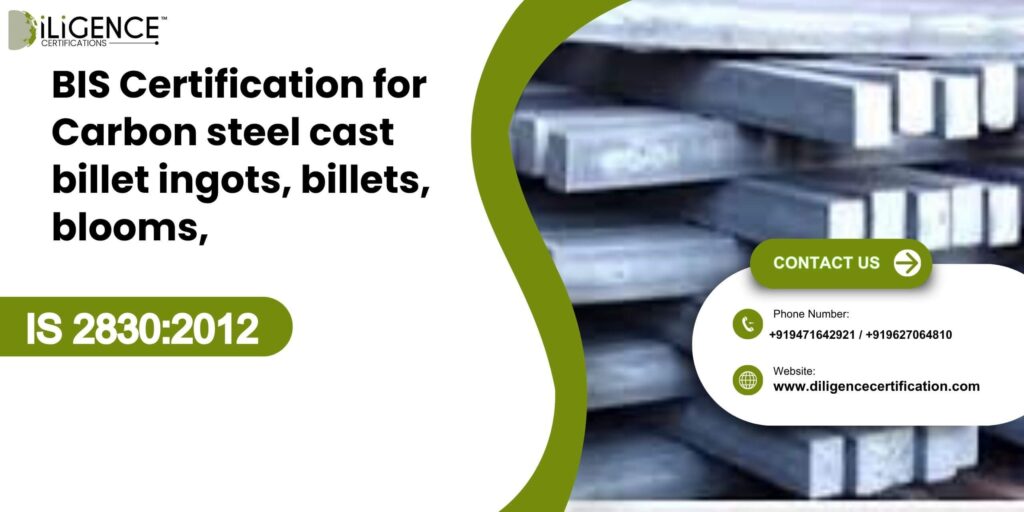
By - Ensures quality and consistency of Carbon steel cast billet, blooms, ingots, and slabs as per IS 2830:2012.
- It is required by the Quality Control Orders of the Ministry of Steel for structural applications.
- It comprises a BIS audit, lab testing, marking checks, and surveillance.
- It contributes to the credibility of the brand and thus leads to a lower rejection rate by manufacturers and re-rollers.
- It forms a part of the demand in the supply chains of infrastructure and construction industries.
Introduction
One case of a steel re-rolling mill in Raipur that was on the edge of losing a large amount of money because of a batch of billets that didn’t pass chemical and camber checks. The problem went back to the supplier who didn’t have BIS certification under IS 2830:2012. Such situations are typical in India’s steel sector where the use of non-certified semi-finished products leads to the rejection of materials and delay of projects. BIS certification for carbon steel cast billet ingots, billets, blooms, and slabs is the guarantee of quality, safety, and standardization of the products according to national norms. Bureau of Indian Standards
What is IS 2830:2012?
IS 2830:2012 is the Indian Standard that specifies the technical and quality requirements for carbon steel cast billet ingots, billets, blooms, and slabs used for re-rolling into structural steel. It ensures uniformity in chemical composition, dimensional accuracy, and surface quality, making it essential for producing reliable and safe steel for construction and infrastructure.
Key Points:

- It is a standard issued by the Bureau of Indian Standards (BIS) to regulate semi-finished products of carbon steel for structural purposes.
- The standard includes the chemical composition and mechanical properties and also requires the casting to be free from defects.
- It defines the tolerances for bend, camber, and dimensions of billets and slabs.
- The standard provides for marking, stamping, and heat number identification in order to ensure traceability.
- It is a compulsory standard for manufacturers who are supplying materials for general structural purposes. ISI MARK
Why is BIS Certification Mandatory
- It is a requirement imposed by the Quality Control Order (QCO) of the Ministry of Steel for steel products of structural grades.
- It makes sure that billets, blooms, and slabs are in conformity with IS 2830:2012 standards regarding chemical composition and measurements.
- Provides safety to users by making sure that steel that is unsafe or of low quality does not reach the supply chain.
- It enhances the reputation of the local market by giving the producers the right to use the ISI mark.
- It is a prerequisite for taking part in tenders of the government and infrastructure sectors.
- Enables regulatory traceability and accountability across the steel manufacturing process.
Importance & Benefits of BIS Certification
| Importance of BIS Certification | Benefits of BIS Certification |
| First of all, the product complies with the IS 2830:2012 standards for structural steel materials. | The product quality is enhanced and thus the rejection or failure rates are reduced. |
| Moreover, the safety and reliability of steel used for construction and infrastructure are ensured. | Therefore, it is helpful to build the trust between re-rollers, fabricators, and end users. |
| It also serves as a certificate of conformity under the Quality Control Orders of the Ministry of Steel. | Furthermore, it is a great incentive for attracting clients and retaining them through enhanced brand credibility. |
| BIS certification is also an excellent method to prohibit the production and distribution of substandard or non-compliant steel products. | Such certification will give you access to different kinds of government and big infrastructure tenders. |
| Moreover, it defines the common manufacturing and testing standards for the entire industry. | Rework, wastage, and customer complaints are also minimized through the implementation of this standard. |
| At the same time, traceability and accountability in the production process are deepened. | On top of that, it is very helpful for regulatory compliance and smooth audit clearance. |
| By contributing to consumer safety, it is also a factor that helps promote fair competition in a steel market. | Besides, consumers will have access to international markets through certified quality standards. |
Step-by-Step Process of BIS Certification

Step1:Documentation
- Collect factory documents, process flow charts, and quality manuals which are necessary.
- Also, remember to take calibration certificates, testing equipment lists, and personnel details.
- Write marking and traceability procedures for heat and cast identification.
- Make sure that all the papers conform to IS 2830:2012 and BIS Product Manual guidelines.
Step2:Product Testing
- Perform chemical, physical, and dimensional tests as per IS 2830:2012.
- In addition, bending, camber, and surface defect inspections are also done to confirm the quality.
- Confirm that the test results are signed by a lab recognized by BIS or an in-house NABL accredited one.
- Keep the detailed test reports of the samples for verification at the time of the inspection.
Step3:Application Submission
- Submit the online BIS application along with the technical documents required.
- Describe the product clearly (billet, bloom, slab, ingot) and the grades covered.
- Make the application and inspection fee payment through the BIS portal.
- Upload quality system documents and recent internal test results.
Step4:Scrutiny and Inspection
- BIS officials review submitted documents and verify compliance readiness.
- Inspectors visit the factory to audit production, testing, and marking practices.
- Samples are drawn for independent testing at BIS-approved labs.
- Address any non-conformities with corrective actions and proof of closure.
Step5:Grant of Licence
- BIS issues the licence after successful verification and sample approval.
- The manufacturer is authorised to use the ISI Standard Mark on approved products.
- Licence validity typically extends for two years, subject to renewal.
- Continuous compliance is monitored through surveillance audits and testing.
Documents required for BIS Certification
| Document | Description |
| Factory registration | Company incorporation, GST, and address proof. |
| Process flow chart | Steps from casting to finished product. |
| Quality manual | QC plan and testing frequency as per IS 2830:2012. |
| Test reports | Chemical and physical test results of products. |
| Calibration certificates | Valid proof for lab equipment accuracy. |
| Lab details | Equipment list and technician credentials. |
| Traceability records | Heat number and marking procedure. |
| Machinery list | Overview of key production equipment. |
| Authorized signatory letter | Nomination for BIS communication. |
| Audit or compliance reports | Past inspection or quality certifications. |
Timelines, Costs, Validity & Renewal
- Timelines: The waiting time for approving a file and test can be from 6 to 8 weeks.
- Costs: The costs are paid for the application, inspection, and testing, as well as the annual marking.
- Validity: The licence is valid for two years from the date of issue.
- Renewal: You can renew the license 30 days prior to the expiration date, bringing along the updated reports and payment of the fees.
Why Choose Diligence Certifications
- Expert BIS knowledge in the certification process of carbon steel billets, blooms and slabs as per IS 2830:2012.
- Complete support starting from the preparation of documents to filing the application, testing, and audit coordination.
- Good knowledge of the standards of steel production and the requirements of the BIS inspection.
- Experience of getting the approvals done quickly as a result of the efficient communication with the authorities.
- Support going on after the licence renewal, compliance checking, and audit getting ready.
Conclusion
BIS certification for carbon steel cast billet ingots, billets, blooms, and slabs as per IS 2830:2012 is not only a legal requirement but also a token of product reliability and a source of trust in the industry. The manufacturers who follow the BIS standards deliver safer and more uniform steel that meets the needs of India’s expanding infrastructure. Working with a knowledgeable consultancy like Diligence Certifications makes the journey easy, the approval time short, and the compliance status ready for every audit. BIS certification today is a differentiator in the market. It is a pledge of quality and the trust that is the hallmark of the steel industry’s environmental and social responsibility.