 BIS Certification
 CDSCO
 PESO
 CPCB
 LMPC
 WPC Approval
 Global Approvals
 TEC
 ARAI
 BEE
 ISO Certification
 DGCA Certification
 NOC For Steel
 APEDA Registration























 Business Registration
 FSSAI Mark Certification












 (32).jpg)
 Legal Services
 Trademark Registration
 Copyright Registration
 Patent Registration
 By
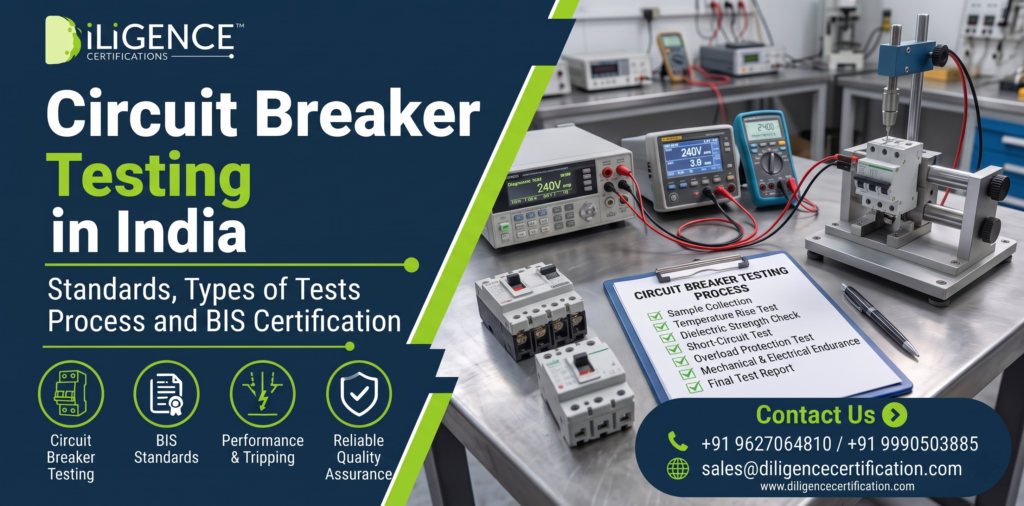
- Circuit breaker testing checks whether a circuit breaker can safely control electrical circuits and protect equipment from overloads and short circuits.
- IS/IEC 60898-1 is an important standard for household and similar AC circuit breakers.
- IS/IEC 60947-2 covers low-voltage industrial circuit breakers.
- RCCBs and RCBOs have separate applicable standards under the IS 12640 series.
- Manufacturers must identify the applicable BIS requirements before applying for product certification.
- Testing should be conducted by a competent laboratory with suitable equipment and testing facilities.
Introduction
Electricity is an essential part of modern life. Homes, offices, factories, commercial buildings and industrial facilities all depend on electrical systems for their daily operations. However, electricity can also create serious safety risks when electrical circuits are overloaded or short circuits occur.
A circuit breaker is one of the most important safety devices used in an electrical installation. It automatically interrupts the flow of electricity when it detects an abnormal electrical condition. This helps protect electrical equipment, wiring and connected systems from potential damage.
But how can manufacturers ensure that a circuit breaker will work properly when an electrical fault occurs?
The answer is circuit breaker testing.
Circuit breaker testing is a process used to check the safety, performance, reliability and operating capacity of circuit breakers under different electrical and environmental conditions. These tests help determine whether a product can handle its rated electrical load and interrupt fault currents safely.
For manufacturers, testing is important before introducing circuit breakers into the market. It helps identify product defects, improve manufacturing quality and demonstrate compliance with applicable Indian and international standards.
In India, circuit breaker manufacturers must understand the relevant Bureau of Indian Standards (BIS) requirements, applicable Quality Control Orders (QCOs) and product-specific certification procedures.
This guide explains circuit breaker testing, different types of circuit breakers, important testing methods, applicable standards, the BIS certification process, required documents and common reasons for testing failure.
What Is Circuit Breaker Testing?
Circuit breaker testing is the process of examining an electrical protection device to verify whether it performs safely and correctly under specified operating conditions.
A circuit breaker is designed to automatically disconnect an electrical circuit when the current exceeds a safe level or when a fault occurs.
For example, imagine a factory using several heavy electrical machines. If the electrical current suddenly increases beyond the permitted limit, the circuit breaker detects the abnormal condition and interrupts the electrical supply.
Without proper protection, excessive current may damage machines, overheat electrical cables or create a fire risk.
Circuit breaker testing checks whether the device can perform this protective function reliably.
The testing process may include checking:
- Electrical insulation strength.
- Rated current and voltage performance.
- Overload protection.
- Short-circuit breaking capacity.
- Temperature rise during operation.
- Mechanical operating performance.
- Electrical endurance.
- Contact resistance.
- Operating and tripping characteristics.
- Protection against environmental conditions, where applicable.
The exact tests depend on the type of circuit breaker and the standard under which the product is being evaluated.
What Is a Circuit Breaker and How Does It Work?
A circuit breaker is an automatic electrical switching device used to protect an electrical circuit against abnormal current conditions.
Unlike a traditional fuse, which needs replacement after it operates, many circuit breakers can be reset and used again after the fault has been identified and corrected.
A typical circuit breaker contains several important components.
1. Contacts
Contacts are responsible for connecting and disconnecting the electrical circuit.
When the circuit breaker is switched ON, the contacts remain connected and allow electricity to flow. When a fault occurs, the contacts separate and interrupt the electrical supply.
2. Operating Mechanism
The operating mechanism controls the opening and closing of the circuit breaker.
It may operate manually or automatically, depending on the design.
3. Trip Unit
The trip unit detects abnormal electrical conditions and sends a signal to interrupt the circuit.
Depending on the circuit breaker, the trip mechanism may use thermal, magnetic, electronic or other operating principles.
4. Arc Extinguishing System
When electrical contacts separate under load, an electrical arc may develop.
The arc extinguishing system helps control and extinguish this arc safely.
5. Insulation System
Insulating materials prevent unwanted current flow between electrical components and the enclosure.
The quality of insulation plays an important role in the safety and reliability of a circuit breaker.
Types of Circuit Breakers
Different electrical applications require different types of circuit breakers. Their construction, operating capacity and protection functions can vary.
Understanding the product category is important because the applicable testing requirements and standards may also differ.
1. Miniature Circuit Breaker (MCB)
A Miniature Circuit Breaker, commonly called an MCB, is widely used in residential, commercial and light industrial electrical installations.
It protects electrical circuits against overloads and short circuits.
MCBs are commonly installed in distribution boards to protect lighting circuits, power sockets and other electrical loads.
Important MCB testing areas include:
- Temperature rise testing.
- Overload performance testing.
- Short-circuit testing.
- Dielectric strength testing.
- Mechanical endurance testing.
- Tripping characteristic verification.
2. Molded Case Circuit Breaker (MCCB)
An MCCB is generally used in commercial buildings, industrial facilities and electrical distribution systems.
It can handle higher current ratings than many commonly used MCBs.
MCCBs provide protection against overloads and short circuits. Depending on the design, they may also have adjustable protection settings.
Important testing areas include:
- Rated current verification.
- Temperature rise testing.
- Short-circuit breaking capacity.
- Dielectric properties.
- Mechanical endurance.
- Electrical endurance.
- Trip unit performance.
3. Air Circuit Breaker (ACB)
An Air Circuit Breaker uses air as the medium for extinguishing the electrical arc.
It is commonly used in industrial power distribution systems, large commercial buildings and electrical panels.
ACBs are designed for applications requiring higher current handling and advanced protection features.
Testing may include:
- Insulation testing.
- Contact resistance measurement.
- Temperature rise testing.
- Short-circuit performance.
- Mechanical operation testing.
- Protection system verification.
4. Vacuum Circuit Breaker (VCB)
A Vacuum Circuit Breaker uses a vacuum interrupter to extinguish the electrical arc.
It is commonly used in medium-voltage electrical distribution systems.
Because it uses vacuum technology, it offers different operating characteristics compared with low-voltage air circuit breakers.
Testing requirements may include:
- Vacuum integrity assessment.
- Contact resistance measurement.
- Insulation testing.
- Mechanical endurance testing.
- Operating time measurement.
- Short-circuit interruption performance.
The applicable standard depends on the equipment category and voltage level.
5. SF6 Circuit Breaker
An SF6 circuit breaker uses sulphur hexafluoride gas as an insulating and arc-extinguishing medium.
It has been used in medium-voltage and high-voltage electrical installations.
Its testing may involve:
- Gas leakage checks.
- Gas pressure monitoring.
- Insulation performance.
- Contact resistance.
- Operating mechanism performance.
- Opening and closing time.
- Dielectric performance.
Special environmental and handling requirements also apply because SF6 is a potent greenhouse gas.
6. Residual Current Circuit Breaker (RCCB)
An RCCB protects against electric shock and electrical hazards caused by residual current or earth leakage.
It detects an imbalance between the current flowing through the live and neutral conductors and disconnects the circuit when the specified conditions are met.
Important testing areas include:
- Residual current operating tests.
- Tripping time measurement.
- Insulation testing.
- Temperature rise.
- Mechanical endurance.
- Electrical endurance.
An RCCB without integral overcurrent protection does not replace an MCB or MCCB for overload and short-circuit protection.
7. Residual Current Circuit Breaker with Overcurrent Protection (RCBO)
An RCBO combines residual current protection with overcurrent protection in one device.
It provides protection against earth leakage, overloads and short circuits.
Testing verifies both residual current and overcurrent protection functions, along with the applicable mechanical and electrical performance requirements.
Why Is Circuit Breaker Testing Important?
Circuit breaker testing is important because even a small manufacturing defect can affect the safety of an entire electrical installation.
A circuit breaker that does not operate correctly may fail to disconnect the supply during an electrical fault.
Here are some major reasons why testing is necessary.
1. Electrical Safety
The primary purpose of a circuit breaker is to protect electrical circuits.
Testing verifies whether the device can interrupt abnormal current conditions within the required limits.
2. Protection Against Overloading
An overloaded electrical circuit may generate excessive heat.
Circuit breaker testing checks whether the device responds correctly when the current exceeds its specified operating conditions.
3. Short-Circuit Protection
A short circuit can produce extremely high electrical current within a very short period.
The circuit breaker must safely interrupt this current without creating unacceptable damage or hazards.
Short-circuit testing evaluates this important protective function.
4. Product Reliability
Manufacturers need to ensure that their products perform consistently.
Testing helps identify manufacturing defects, weak components and design-related problems before products reach customers.
5. Compliance With Indian Standards
Products covered by applicable Indian regulatory requirements must meet the relevant standards and certification conditions.
Testing provides evidence of product performance and helps manufacturers demonstrate compliance.
6. Reduced Maintenance Problems
Properly tested circuit breakers are less likely to experience unexpected operating failures caused by defects that should have been identified during product evaluation.
7. Better Customer Confidence
Buyers generally prefer electrical protection devices that have been manufactured and tested according to applicable quality and safety requirements.
Compliance documentation can help manufacturers establish trust in their products.
Important Standards for Circuit Breaker Testing in India
Choosing the correct standard is one of the most important steps in circuit breaker testing.
Different products have different construction requirements, current ratings, operating conditions and safety functions.
A standard applicable to a household MCB may not be suitable for an industrial MCCB or a medium-voltage vacuum circuit breaker.
The following are important standards to understand.
1. IS/IEC 60898-1:2015
This standard covers circuit breakers used for overcurrent protection in household and similar AC electrical installations.
It is particularly relevant to MCBs used in residential and similar applications.
The standard addresses:
- General requirements.
- Classification and characteristics.
- Construction and marking.
- Temperature rise.
- Dielectric properties.
- Overload performance.
- Short-circuit performance.
- Mechanical and electrical operation.
- Test procedures.
It helps verify whether the circuit breaker can operate safely under the specified conditions.
2. IS/IEC 60898-2:2016
This standard covers circuit breakers designed for AC and DC operation in household and similar installations.
It is relevant to products falling within its defined scope.
The testing requirements depend on the product design and its intended operating conditions.
3. IS/IEC 60947-2:2016
This is an important standard for low-voltage industrial circuit breakers.
It covers circuit breakers used in industrial and similar electrical applications.
It includes requirements relating to:
- Rated operational voltage.
- Rated current.
- Breaking capacity.
- Making capacity.
- Short-circuit performance.
- Dielectric properties.
- Temperature rise.
- Mechanical endurance.
- Electrical endurance.
- Operating characteristics.
This standard is especially important for industrial circuit breakers such as applicable MCCB and ACB products.
4. IS 12640 (Part 1):2024
This standard covers residual current operated circuit breakers without integral overcurrent protection for household and similar uses.
It is relevant to RCCBs.
The standard addresses residual current protection, operating characteristics, electrical performance and other safety requirements.
5. IS 12640 (Part 2):2016
This standard covers residual current operated circuit breakers with integral overcurrent protection for household and similar uses.
It is relevant to RCBO products.
It includes requirements for the combined residual current and overcurrent protection functions.
6. IS/IEC 60947-1
This standard provides general rules for low-voltage switchgear and controlgear.
It is used alongside the relevant product-specific part of the IS/IEC 60947 series where applicable.
Important: The standards mentioned above are not interchangeable. Manufacturers should verify the latest applicable edition, amendments, product scope and BIS certification requirements before starting testing. The exact standard must be selected according to the circuit breaker’s type, rating, intended application and relevant regulatory notification.
Major Tests Conducted During Circuit Breaker Testing
Circuit breaker testing includes several electrical, mechanical and performance evaluations.
Each test checks a particular aspect of product safety and operation.
The following are some of the important tests performed on circuit breakers.
1. Temperature Rise Test
The temperature rise test checks how much heat is generated inside the circuit breaker when it carries electrical current.
During normal operation, electrical current flows through the contacts and internal conducting components. This creates some heat.
However, excessive temperature can damage insulation, affect contact performance and reduce the life of the device.
Purpose of the test:
- Check temperature increase during operation.
- Verify the performance of electrical contacts.
- Evaluate the heating of terminals and conducting parts.
- Identify excessive resistance or poor connections.
How is the test performed?
The circuit breaker is connected to a suitable test arrangement and supplied with the specified current.
Temperature measurements are taken at relevant points using suitable measuring instruments.
The measured temperature rise is compared with the limits specified in the applicable standard.
2. Dielectric Strength Test
The dielectric strength test evaluates the insulating properties of a circuit breaker.
Electrical insulation must prevent unwanted current flow between live parts and other conductive components.
Weak insulation may cause leakage current, electric shock or electrical breakdown.
Purpose of the test:
- Check insulation strength.
- Identify insulation defects.
- Verify electrical separation.
- Evaluate the safety of insulating components.
How is the test performed?
A specified test voltage is applied between selected electrical parts according to the applicable test procedure.
The circuit breaker is examined for insulation breakdown, flashover or other unacceptable electrical behaviour.
The voltage level, duration and connection arrangement depend on the applicable standard.
3. Short-Circuit Test
Short-circuit testing is one of the most important evaluations for a circuit breaker.
A short circuit can produce a very high current because the electrical resistance of the fault path becomes extremely low.
The circuit breaker must interrupt the fault current safely.
Purpose of the test:
- Verify short-circuit breaking capacity.
- Check the ability to interrupt fault current.
- Evaluate the mechanical strength of internal components.
- Assess the safety of the device during fault conditions.
How is the test performed?
The circuit breaker is connected to a specialised short-circuit testing setup.
A controlled fault current is produced according to the specified test conditions.
The breaker is operated under the required test sequence.
After the test, the device is examined for damage and compliance with the applicable performance criteria.
This test requires specialised high-power laboratory facilities.
4. Overload Test
The overload test checks whether the circuit breaker responds correctly when the electrical current exceeds its rated operating conditions.
An overloaded circuit may cause excessive heating if the protective device does not operate as required.
Purpose of the test:
- Check overcurrent protection.
- Verify tripping characteristics.
- Evaluate thermal protection performance.
- Confirm compliance with the specified operating limits.
How is the test performed?
The circuit breaker is supplied with specified current levels for defined time periods.
The operating time and tripping behaviour are measured.
The results are compared with the requirements of the relevant standard.
5. Mechanical Endurance Test
A circuit breaker must operate reliably over repeated switching operations.
The mechanical endurance test checks whether its operating mechanism can withstand the specified number of mechanical operations.
Purpose of the test:
- Check the durability of moving components.
- Evaluate the operating mechanism.
- Identify mechanical wear.
- Verify reliable opening and closing operations.
How is the test performed?
The circuit breaker is operated repeatedly under specified conditions.
The required number of operations and operating sequence depend on the applicable standard.
After completing the test, the device is checked for mechanical damage and proper functioning.
6. Electrical Endurance Test
Electrical endurance testing evaluates the ability of a circuit breaker to perform repeated electrical switching operations.
Unlike mechanical endurance testing, this evaluation involves electrical operating conditions.
Purpose of the test:
- Check electrical contact durability.
- Evaluate switching performance.
- Identify excessive contact wear.
- Verify reliable electrical operation.
The breaker is subjected to the specified electrical operating cycles and assessed against the applicable acceptance requirements.
7. Contact Resistance Test
Contact resistance testing measures the resistance across the electrical contacts and relevant conducting paths.
High contact resistance may generate additional heat during operation.
Purpose of the test:
- Check the quality of electrical connections.
- Identify poor contact conditions.
- Evaluate contact performance.
- Detect manufacturing or assembly defects.
A suitable low-resistance measuring instrument is used to measure resistance.
The results are evaluated according to the applicable product requirements and testing procedure.
8. Tripping Characteristic Test
The tripping characteristic test verifies how the circuit breaker responds to different current levels.
Different circuit breakers have different operating characteristics.
For example, a breaker designed for a particular application must trip within the specified time when subjected to the relevant fault or overload current.
Purpose of the test:
- Verify operating current.
- Measure tripping time.
- Check protection performance.
- Evaluate the consistency of the trip mechanism.
The results are compared with the operating limits specified in the relevant standard.
9. Insulation Resistance Test
Insulation resistance testing checks the resistance offered by insulating materials between electrical conductors and other conductive parts.
Low insulation resistance may indicate moisture, contamination, damaged insulation or other defects.
Purpose of the test:
- Evaluate insulation condition.
- Identify possible leakage paths.
- Check insulation quality.
- Support electrical safety assessment.
A suitable insulation resistance measuring instrument is used according to the applicable procedure.
10. Arc Extinguishing Test
When a circuit breaker interrupts current, an electrical arc may form between its separating contacts.
The arc must be controlled and extinguished safely.
Testing evaluates the performance of the arc-control and extinguishing system under the specified operating conditions.
The assessment may form part of the relevant interruption and short-circuit test sequences rather than being a separate universal test for every circuit breaker.
11. Operating Time Test
The operating time test measures how quickly a circuit breaker opens or closes after receiving an operating command.
This is particularly important for industrial and power distribution applications.
Purpose of the test:
- Measure opening time.
- Measure closing time.
- Check operating mechanism performance.
- Identify timing inconsistencies.
Specialised timing equipment is used to record the operating sequence.
12. Environmental Testing
Circuit breakers may be installed in different environments.
Temperature, humidity, dust and other environmental conditions can affect their performance.
Depending on the product standard and intended application, environmental evaluations may include:
- Humidity exposure.
- Temperature-related testing.
- Corrosion resistance.
- Environmental conditioning.
- Resistance to specified external influences.
Not every circuit breaker requires every environmental test. The applicable requirements must be checked against the relevant standard.
Circuit Breaker Testing Requirements: MCB, MCCB, ACB and RCCB
Although all these products are used for electrical protection, their testing requirements are different.
| Circuit breaker type | Main protection or function | Important testing areas |
|---|---|---|
| MCB | Overload and short circuit | Temperature rise, dielectric, tripping, short circuit |
| MCCB | Overload and short circuit | Breaking capacity, temperature rise, endurance, dielectric |
| ACB | Industrial power protection | Short circuit, insulation, operating time, endurance |
| VCB | Medium-voltage switching and protection | Dielectric, mechanical operation, vacuum integrity, interruption |
| SF6 breaker | Switching and fault interruption | Gas leakage, insulation, operating time, interruption |
| RCCB | Residual current protection | Residual current operation, tripping time, endurance |
| RCBO | Residual current and overcurrent protection | Residual current, overload, short circuit, endurance |
The table provides a general overview. The final test programme must follow the relevant product standard and its specified test sequences.
Circuit Breaker Testing Procedure: Step-by-Step Process
A proper testing process is necessary to obtain reliable and repeatable results.
Manufacturers should prepare product specifications and technical documents before sending samples to a testing laboratory.
Here is a general explanation of the circuit breaker testing process.
Step 1: Identify the Circuit Breaker Type
The first step is to identify the exact product category.
Determine whether the product is an MCB, MCCB, ACB, RCCB, RCBO or another type of circuit breaker.
The product category determines the applicable standard and testing requirements.
Step 2: Check the Applicable Indian Standard
After identifying the product type, select the relevant Indian Standard.
For example:
- IS/IEC 60898-1 for applicable household and similar AC circuit breakers.
- IS/IEC 60947-2 for applicable industrial circuit breakers.
- IS 12640 (Part 1) for RCCBs.
- IS 12640 (Part 2) for RCBOs.
Always verify the current standard edition and applicable amendments.
Step 3: Prepare Product Technical Specifications
Manufacturers should prepare complete product information.
This may include:
- Product name and model number.
- Rated voltage.
- Rated current.
- Frequency.
- Number of poles.
- Rated short-circuit capacity.
- Rated insulation voltage, where applicable.
- Trip characteristics.
- Product drawings.
- Circuit diagrams.
- Technical specifications.
Accurate specifications help the laboratory select the correct testing procedure.
Step 4: Select a Suitable Testing Laboratory
The manufacturer should select a laboratory with the required technical competence and testing facilities.
The laboratory should have equipment suitable for the applicable standard and product category.
Where required for BIS certification, manufacturers should verify that the laboratory and test report meet the applicable BIS acceptance conditions.
Step 5: Submit Product Samples
The required samples are submitted to the laboratory.
The sample quantity depends on the applicable standard, test sequence and certification procedure.
Samples should represent the actual product intended for manufacturing and sale.
Step 6: Conduct Required Tests
The laboratory performs the required tests according to the applicable standard.
These may include:
- Electrical performance tests.
- Temperature rise tests.
- Short-circuit tests.
- Dielectric tests.
- Mechanical endurance tests.
- Electrical endurance tests.
- Tripping characteristic tests.
The exact test programme depends on the product.
Step 7: Evaluate Test Results
After completing the tests, the laboratory evaluates the results.
The measurements are compared with the acceptance criteria specified in the relevant standard.
If the product does not meet the requirements, the manufacturer may need to investigate the failure and improve the design or manufacturing process.
Step 8: Obtain the Test Report
Once the testing is completed, the laboratory prepares a test report.
The report generally contains:
- Product identification.
- Sample details.
- Applicable standard.
- Tests conducted.
- Testing conditions.
- Measurement results.
- Observations.
- Compliance status.
The manufacturer should review the report carefully before proceeding with the applicable certification process.
Step 9: Complete the Applicable BIS Certification Requirements
Where BIS certification is mandatory, the manufacturer must follow the relevant certification scheme and product-specific requirements.
This may involve application submission, factory assessment, sample testing, technical documentation and other applicable compliance conditions.
A successful laboratory test alone does not automatically provide permission to use the BIS Standard Mark.
BIS Certification for Circuit Breakers in India
The Bureau of Indian Standards is India’s national standards body.
It develops and publishes Indian Standards and operates product certification schemes to help ensure that products meet specified quality and safety requirements.
Circuit breakers are important electrical safety products. Their regulatory requirements depend on the product category, applicable Quality Control Order and relevant Indian Standard.
The Electrical Equipment (Quality Control) Order, 2020, and its subsequent amendments cover specified low-voltage switchgear and controlgear products.
For relevant industrial circuit breakers, BIS has published requirements under Scheme X.
The applicable certification route must be checked according to the exact product and regulatory notification.
Why Is BIS Certification Important?
BIS certification helps establish that a product has been evaluated against the relevant Indian Standard under the applicable certification scheme.
It is important for several reasons:
- Product safety: It helps verify that the product meets specified safety requirements.
- Quality assurance: It provides a framework for evaluating product quality and performance.
- Regulatory compliance: It helps manufacturers meet applicable mandatory certification requirements.
- Market acceptance: BIS certification supports compliance with Indian product regulations.
- Manufacturing control: The certification process can require manufacturers to maintain consistent production quality.
Documents Required for BIS Certification of Circuit Breakers
Manufacturers generally need to prepare technical, business and manufacturing-related documents.
The exact documentation depends on the certification scheme and the nature of the product.
Commonly required documents may include:
- Company registration certificate.
- Manufacturing address proof.
- Factory details.
- Product technical specifications.
- Product drawings.
- Circuit diagrams.
- List of product models and ratings.
- Manufacturing process details.
- Quality control procedures.
- Testing equipment details.
- Calibration records.
- Details of quality control personnel.
- Raw material specifications.
- Product photographs.
- Applicable laboratory test reports.
- Details of authorised representatives, where required.
- Other documents requested under the applicable BIS certification procedure.
Preparing the documents properly can help avoid unnecessary delays during application processing.
Common Reasons Why Circuit Breakers Fail Testing
Circuit breakers may fail testing for several reasons.
A failure does not always mean that the complete product design is unsuitable. Sometimes, the problem is related to a particular component, material, assembly process or manufacturing inconsistency.
Understanding common failure reasons helps manufacturers improve product quality.
1. Poor Electrical Contact Quality
Poor contact surfaces or incorrect contact pressure may increase electrical resistance.
This can result in excessive heating during operation.
How to prevent it: Use suitable contact materials, maintain proper contact pressure and control the assembly process.
2. Insufficient Insulation Strength
Low-quality insulation or incorrect insulation distances may lead to electrical breakdown.
How to prevent it: Select suitable insulating materials and maintain the required clearances and creepage distances.
3. Improper Short-Circuit Performance
A circuit breaker may fail if its internal components cannot withstand the specified fault conditions.
How to prevent it: Improve the design of the contacts, arc-control system and mechanical components.
4. Incorrect Tripping Characteristics
The breaker may trip too early, too late or outside the specified operating range.
How to prevent it: Check the trip mechanism, protection settings and manufacturing tolerances.
5. Excessive Temperature Rise
Poor electrical connections and unsuitable conducting materials can cause excessive heat generation.
How to prevent it: Improve conductor sizing, contact quality and thermal design.
6. Mechanical Problems
Weak springs, incorrect assembly or poor-quality moving components may affect opening and closing operations.
How to prevent it: Use quality components and perform regular production inspections.
7. Inconsistent Manufacturing Quality
Products manufactured with inconsistent materials or assembly processes may not deliver uniform performance.
How to prevent it: Establish a proper quality control system and conduct routine inspections.
Difference Between Circuit Breaker Testing and BIS Certification
Many manufacturers confuse product testing with BIS certification.
Both are important, but they are not the same.
| Circuit breaker testing | BIS certification |
|---|---|
| Evaluates product performance | Evaluates compliance under a BIS certification scheme |
| Conducted by a competent testing laboratory | Granted by BIS under the applicable scheme |
| Checks electrical and mechanical requirements | Includes applicable product and manufacturing compliance requirements |
| Produces a laboratory test report | May result in a BIS licence or certificate |
| Identifies product failures | Establishes compliance subject to scheme requirements |
A test report is an important part of the certification process, but it does not automatically grant BIS certification.
Manufacturers must complete the applicable BIS procedure before using the Standard Mark.
Why Choose Diligence Certifications for Circuit Breaker Certification?
Manufacturers looking for assistance with circuit breaker certification need proper guidance on Indian Standards, testing requirements and applicable BIS procedures.
Diligence Certifications provides consultancy support to businesses seeking assistance with product certification and regulatory compliance in India.
The support may include:
- Guidance on applicable BIS standards.
- Assistance in identifying certification requirements.
- Documentation support.
- Guidance on laboratory testing requirements.
- Assistance with the BIS application process.
- Support in understanding certification-related queries.
- Guidance on applicable regulatory updates.
The objective is to help manufacturers understand the compliance requirements and organise their certification activities more effectively.
It is important to note that Diligence Certifications provides consultancy support. It does not operate as a physical circuit breaker testing laboratory and does not independently issue BIS licences.
Conclusion
Circuit breaker testing is an important part of electrical product safety and quality assurance. It helps manufacturers verify whether their products can operate reliably under normal electrical conditions and respond correctly during overloads and short circuits.
From temperature rise and dielectric strength to short-circuit performance and mechanical endurance, each test evaluates a different aspect of circuit breaker performance.
Manufacturers must also understand the applicable Indian Standards, including IS/IEC 60898-1, IS/IEC 60947-2 and the relevant parts of IS 12640.
For businesses manufacturing or importing circuit breakers in India, understanding the applicable BIS certification requirements is equally important. The correct standard, testing procedure, technical documentation and certification scheme should be identified before starting the compliance process.
With proper product design, suitable laboratory testing and a well-managed certification process, manufacturers can improve product quality and meet the applicable electrical safety requirements.
Frequently Asked Questions
1. What is circuit breaker testing?
Circuit breaker testing is the process of checking the electrical safety, performance and reliability of a circuit breaker. It verifies whether the device can handle normal current, overloads and short-circuit conditions safely.
2. Which Indian Standards are used for circuit breaker testing?
The applicable standards depend on the product type. IS/IEC 60898-1 covers household and similar AC circuit breakers, IS/IEC 60947-2 covers low-voltage industrial circuit breakers, and the IS 12640 series covers relevant RCCBs and RCBOs.
3. What are the main tests performed on circuit breakers?
Important tests include temperature rise testing, dielectric strength testing, short-circuit testing, overload testing, mechanical endurance testing, electrical endurance testing, contact resistance testing and tripping characteristic verification.
4. Is BIS certification mandatory for circuit breakers in India?
BIS certification requirements depend on the circuit breaker category and applicable Quality Control Orders (QCOs). Manufacturers should check the latest government notifications and BIS product requirements before applying.
5. What is the difference between MCB and MCCB testing?
MCB testing focuses on household and similar electrical protection requirements, while MCCB testing evaluates industrial circuit breaker performance, including short-circuit breaking capacity, temperature rise, insulation and endurance.
6. Why is short-circuit testing important for circuit breakers?
Short-circuit testing checks whether a circuit breaker can safely interrupt a specified fault current. It helps verify the breaking capacity and ensures that the device performs correctly during dangerous electrical faults.
7. What is the purpose of a temperature rise test?
A temperature rise test measures the heat generated inside a circuit breaker when it carries electrical current. It helps identify excessive heating caused by poor contacts, high resistance or unsuitable electrical components.