BIS Certification
 CDSCO
 PESO
 CPCB
 LMPC
 WPC Approval
 Global Approvals
 TEC
 ARAI
 BEE
 ISO Certification
 DGCA Certification
 NOC For Steel
 APEDA Registration























 Business Registration
 FSSAI Mark Certification












 (32).jpg)
 Legal Services
 Trademark Registration
 Copyright Registration
 Patent Registration
 By
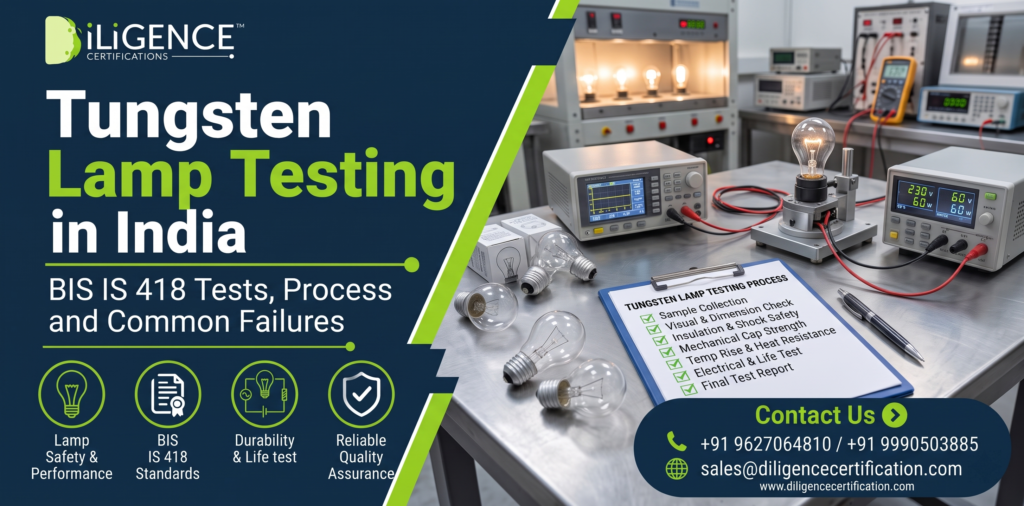
- Tungsten lamp testing means checking a general service filament bulb for safety, performance and marking before it is sold.
- In India, the main standards are IS 418 (performance) and IS 15518 Part 1 (safety).
- Testing is done in two places: the factory’s own lab, and a BIS recognised lab.
- Most failures come from simple things like wrong marking, weak caps and poor filament quality.
- Keep your records, calibration reports and sample details ready before you start.
- Always check the current BIS notification once before applying, because rules and lab scopes can change.
Introduction
Think of it like a school exam. The student may say he knows everything, but the paper tells the truth. Tungsten lamp testing is that paper for your bulb.
In this blog, we will go step by step. What is tested, which standards apply, how the process works, where people fail, and how you can avoid it. Everything is in very simple words, so even a first-time applicant can follow.
What Is Tungsten Lamp Testing?
A tungsten lamp is the old-style bulb we all grew up with. Inside the glass, a thin coil of tungsten wire (the filament) gets very hot when current passes through it. It glows and gives light. This is why it is also called an incandescent lamp or GLS (general lighting service) lamp.
Tungsten lamp testing is a set of checks done on sample bulbs in a lab. The lab checks things like:
- Does the bulb have correct markings on it?
- Does the cap fit properly in the holder?
- Is it safe from electric shock?
- Does it give the light it claims, at the power it claims?
- Does it last as long as the rated life?
If the bulb passes, the test report supports your BIS application. If it fails, you fix the issue and test again.
Tungsten Lamp vs Other Lamp Types
People often mix these up. Each type has its own standard, so first confirm what you are actually making or selling.
| Lamp Type | How It Gives Light | Simple Point |
|---|---|---|
| Tungsten filament (GLS) | Heated tungsten coil | Old style bulb, covered by IS 418 and IS 15518 Part 1 |
| Tungsten halogen | Tungsten coil with halogen gas | Different standards apply, do not assume IS 418 |
| CFL | Gas discharge and phosphor coating | Needs a different standard |
| LED lamp | Light emitting diodes with a driver | Has its own safety and performance standards |
If your product is a normal filament bulb, this blog is for you. For other types, check the correct standard first.
Which Standards Apply?
Two main standards are used for tungsten filament lamps in India.
| Standard | What It Covers | In Simple Words |
|---|---|---|
| IS 418:2004 | Tungsten filament lamps for domestic and similar general lighting purposes (performance) | Light output, power, life, dimensions, marking |
| IS 15518 (Part 1):2004 | Safety requirements for incandescent lamps, tungsten filament lamps | Shock safety, insulation, strength of cap, heat and fire resistance |
Besides these, some supporting standards are referred inside them. For example, there are standards for lamp cap dimensions, cap temperature rise measurement and sampling plans.
A simple example: Suppose you make a 60 W, 230 V bulb with a B22 cap. The lab will test it against IS 418 for light, power and life, and against IS 15518 Part 1 for safety. Both reports are needed.
Note: IS 418:2004 has been amended after it was published, so always use the latest amendment. Also check the BIS website once to confirm the current status of the product under the certification scheme before you apply.
Why Is Tungsten Lamp Testing Important?
- Safety first: A badly made cap or weak insulation can give shock or start a fire.
- Legal need: Products covered under the BIS scheme need proper testing to get the licence.
- Brand trust: A bulb that fails early brings returns and bad reviews.
- Fewer rejections: If you test early, you find defects before the market finds them.
- Better planning: Test results tell you which raw material or process needs improvement.
- Smooth audits: Good test records make factory inspection much easier.
What Tests Are Conducted?
Below is a simple view of the test groups. The exact list and clauses are in the standards, and the lab will follow them.
| Test Group | What the Lab Checks | In Simple Words |
|---|---|---|
| Marking | Rated voltage, wattage, manufacturer name or mark, other required details | Is everything written clearly and does it stay after rubbing? |
| Dimensions and cap | Bulb size, cap type, fit in gauge | Will it fit the holder properly? |
| Protection against shock | Live parts cannot be touched when lamp is fitted | Can a finger reach any live part? |
| Insulation and electric strength | Insulation resistance and high voltage withstand | Does the lamp stay safe under high voltage? |
| Mechanical strength of cap | Torque and fixing strength | Does the cap stay firmly on the bulb? |
| Cap temperature rise | Heating at the cap during operation | Does the cap get too hot? |
| Heat and fire resistance | Resistance of insulating parts to heat and fire | Will it burn or soften under heat? |
| Electrical and light performance | Power consumption, luminous flux, efficacy | Does it give the claimed light at the claimed power? |
| Life test | Burning hours until failure | How long does the bulb really last? |
Performance Parameters Explained Simply
These words come up again and again in a test report. Here is what they mean.
| Term | Meaning in Simple Words |
|---|---|
| Rated voltage | The voltage the bulb is made for, for example 230 V |
| Rated wattage | The power the bulb is meant to use, for example 60 W |
| Luminous flux | Total light given by the bulb, measured in lumens |
| Luminous efficacy | Light given per watt used, in lumens per watt |
| Rated life | The number of burning hours the maker claims |
| Lumen maintenance | How well the bulb keeps its brightness as it ages |
| Cap temperature rise | How much hotter the cap gets compared to room temperature |
The lab compares your actual measured values with the limits in the standard. Small differences are allowed, but only within the permitted tolerance.
Two Kinds of Testing: Factory Lab and Recognised Lab
Many people get confused here, so let us make it clear.
1. In-house factory lab
The BIS scheme expects a manufacturer to have a basic testing set-up in the factory for routine checks. This is used for daily and batch-wise quality control. Equipment should be in good condition and calibrated on time.
2. BIS recognised lab
For the full set of tests, samples go to a lab recognised by BIS. This is independent testing, and the report from here carries weight. Before sending samples, confirm that the lab has tungsten filament lamps in its scope.
Simple way to remember: factory lab is for your daily control, recognised lab is for the official proof.
Step-by-Step Process
- Confirm the product and standard. Check that your lamp falls under IS 418 and IS 15518 Part 1, and note the rated voltage, wattage and cap type.
- Study the standards. Read the latest versions with amendments. Mark the clauses that apply to your model.
- Prepare the factory. Arrange raw material control, production line checks and the in-house test set-up.
- Make sample lamps. Produce samples from regular production, not special hand-picked pieces.
- Label the samples properly. Marking should be complete and correct on every sample.
- Select a recognised lab. Check that it has tungsten filament lamps in its scope and ask for the sample quantity and time needed.
- Submit samples with documents. Send the request form, sample details and any other papers the lab asks for.
- Review the test report. If any test fails, find the root cause, correct it and retest where needed.
- Use the report for registration. Attach the report with your BIS application and be ready for the factory inspection.
Which BIS Registration Is Needed?
The route depends on who you are. Please check the current BIS rules for your case.
| Who You Are | Usual Route | Simple Point |
|---|---|---|
| Indian manufacturer | Standard Mark licence for the product | Factory inspection and sample testing are part of it |
| Foreign manufacturer | Licence through the foreign manufacturers certification route | An authorised Indian representative is usually needed |
| Importer | Imports must come from a licensed manufacturer | Check labelling and licence details on each consignment |
| Brand owner or private label | Product must be made by a licensed factory | Brand name details must follow BIS conditions |
If your model, brand name, wattage range or factory changes, the licence may need an update. Do not skip this.
Documents Required
The exact list may change, so confirm with BIS or your consultant. In general, these are needed.
Company documents
- Business registration proof
- Factory address and ownership details
- Authorised signatory details
- Details of quality control staff
Product documents
- Model list with rated voltage, wattage and cap type
- Marking details and label drawing
- Manufacturing process flow chart
- List of raw materials and suppliers
Testing records
- Recognised lab test report
- Calibration certificates of test equipment
- In-house inspection and test records
- Raw material test records
How Long Does It Take?
There is no single fixed time. It depends on how ready you are.
- Sample preparation and lab booking take some days.
- The life test needs real burning hours, so it takes time and cannot be rushed.
- Retesting after a failure adds more time.
- Document corrections and factory inspection scheduling also affect the total.
Start early. Keep a buffer for retesting, because it is more common than people expect.
Cost: What Decides It?
We are not mentioning any amounts here, because they change from lab to lab and case to case. These are the main factors.
- Number of models and variants being tested
- Lab testing charges for the selected tests
- BIS application and licence charges
- Inspection and travel costs
- Retest charges, if any test fails
- Equipment calibration and in-house lab upkeep
If you want a clear breakup, ask the lab for a written quotation and check the current fee list on the BIS website.
Common Failures and Easy Fixes
| Common Failure | Why It Happens | Easy Fix |
|---|---|---|
| Marking fades or is missing | Poor ink or wrong printing process | Use better ink and recheck the label format |
| Cap loosens in strength test | Weak cementing or poor cap material | Improve cap fixing and quality of cement |
| Cap runs too hot | Bad contact or poor design | Check cap quality and the joining process |
| Life is below rated value | Poor filament or gas filling problem | Improve filament quality and the bulb process |
| Power consumption out of tolerance | Filament not as per design | Control filament dimensions and winding |
| Insulation test fails | Moisture or defective insulating material | Check material quality and storage conditions |
Common Mistakes
- Using special hand-picked samples instead of regular production samples
- Not reading the latest amendments of the standard
- Incomplete or unclear marking on the bulb
- Sending samples to a lab that does not have this product in scope
- Expired or missing calibration of in-house instruments
- Poor records for raw material and daily checks
- Changing the model or raw material after testing without informing anyone
- Starting too late and not keeping a buffer for retests
Who Needs This?
- Manufacturers making filament lamps in India, who need testing for the licence.
- Importers who must ensure that the product comes from a licensed source.
- Private label brands who get lamps made by another factory under their own name.
- Overseas manufacturers who want to sell in India and need the right BIS route.
- Traders and distributors who want to check that the stock they sell is properly marked and certified.
Why Choose Diligence Certifications for tungsten lamp testing Certification?
Testing and certification look simple from outside, but the real work is in the details. A wrong label, a missing document or a delayed lab slot can cost weeks.
Diligence Certifications helps you with the whole path in a practical way. The team can help you understand the standards, prepare your documents, plan the testing and keep the process organised. You can visit the Diligence Certifications homepage to know more about the company, and check the services page for the support available.
We do not promise approval, because the final decision always rests with the authority and the lab results. What we promise is clear guidance, honest advice and good follow-up at each step.
After Registration: Market Checks
Getting the licence is not the end. BIS can check products in the market and also inspect the factory from time to time.
- Keep producing lamps in the same quality as the tested samples.
- Continue routine in-house testing and keep the records.
- Use the Standard Mark exactly as allowed in the licence.
- Inform BIS about any major change in the process, product or address.
- Renew the licence on time.
Tips to Pass in the First Attempt
- Read IS 418 and IS 15518 Part 1 fully before making samples.
- Check the filament, cap and glass quality at the raw material stage.
- Run your own pre-test on a few samples before sending to the lab.
- Check the marking for clarity, spelling and rub resistance.
- Make sure your instruments are calibrated and records are updated.
- Send samples from regular production, with a proper sample record.
- Talk to the lab beforehand about sample quantity and test schedule.
- Keep extra time in your plan, so a retest does not disturb your launch.
Quick Checklist Before Sending Samples
- Latest standards and amendments checked
- Model, voltage, wattage and cap type confirmed
- Marking is complete and clear
- Samples taken from regular production
- Pre-test done in the factory lab
- Calibration reports are valid
- Lab scope confirmed for this product
- Sample details and request form ready
- Documents arranged in one folder
Conclusion
A tungsten lamp may look like a very basic product, but safe and reliable lighting does not happen by chance. Proper testing against IS 418 and IS 15518 Part 1 shows that your bulb is safe, gives the light it promises and lasts as long as it claims.
Start with the right standards, prepare your factory, test early and keep your records clean. If you do these four things, the process becomes much smoother. And if you need a guide at any point, Diligence Certifications is there to support you.
Frequently Asked Questions
1. What is tungsten lamp testing?
It is the testing of a filament bulb in a lab for safety, performance, marking and life, as per the applicable standards.
2. Which standards are used for tungsten lamp testing in India?
The main ones are IS 418 for performance and IS 15518 Part 1 for safety. Some supporting standards are also referred inside them.
3. Is a tungsten lamp the same as a halogen lamp?
No. A halogen lamp also has a tungsten filament, but it has halogen gas inside and follows different standards. Do not assume IS 418 covers it.
4. Who can test tungsten lamps for BIS?
A lab recognised by BIS with this product in its scope. Always confirm the lab's current scope before sending samples.
5. Do I need an in-house lab in my factory?
Yes, a manufacturer is expected to have a basic in-house set-up for routine checks, along with calibrated instruments.
6. What are the main safety tests?
Protection against shock, insulation resistance, electric strength, strength of the cap and resistance to heat and fire.