BIS Certification
 CDSCO
CDSCO
 PESO
PESO
 CPCB
CPCB
 LMPC
LMPC
 WPC Approval
 Global Approvals
 TEC
TEC
 ARAI
ARAI
 BEE
BEE
 ISO Certification
 DGCA Certification
 NOC For Steel
 APEDA Registration























 Business Registration
 FSSAI Mark Certification












 (32).jpg)
 Legal Services
 Trademark Registration
 Copyright Registration
 Patent Registration
 By
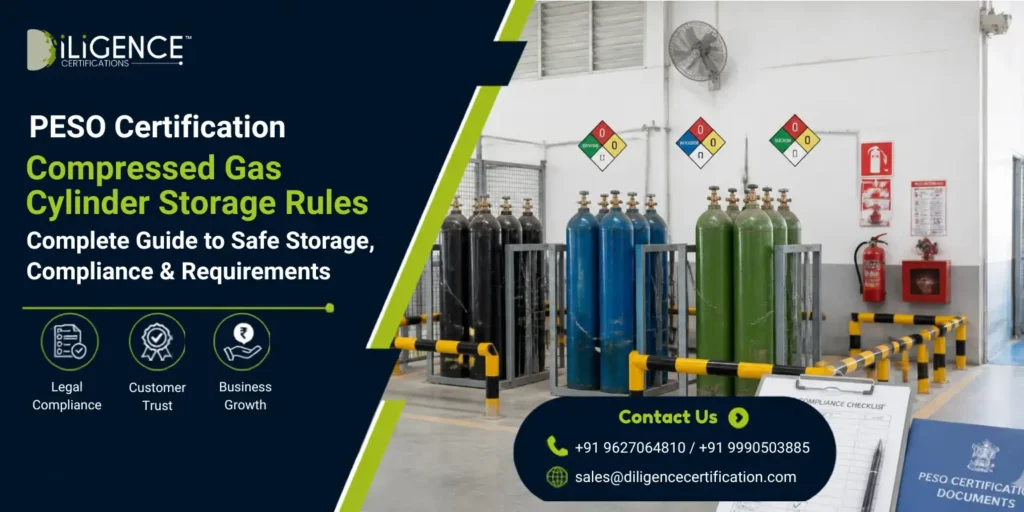
By - This guide includes important details regarding the rules for storage of compressed gas cylinders and the legalities and safety standards that organizations need to know when storing compressed gas cylinders.
- They include eligibility, documents, storage area, safety, handling, inspection, licensing, renewal, amendment, and compliance assistance.
- This guide is intended to help organizations understand the guidelines regarding the storage of compressed gas cylinders.
Introduction
Storage of compressed gas cylinders requires certain rules concerning safety, storage, handling, and compliance aspects to be considered. Compressed gas cylinders can cause serious hazards and dangers depending on their improper storage, exposure to the wrong conditions, unsafe handling, or storing at unapproved places.
Proper storage of the compressed gas cylinders can include requirements related to storage premises, ventilation, storage arrangement, fire safety, access control, handling practices, identification, inspections, documentation, and other required approvals or licenses.
Here the correct understanding of Compressed Gas Cylinder Storage Rules becomes extremely important.
Activities including storage of the compressed gases and other dangerous goods in India are regulated by Petroleum and Explosives Safety Organization (PESO). Depending on gas type, volume, storage arrangement, storage premises, and character of activities performed, certain approvals, licenses, inspections, or compliance requirements can be applied.
Correct regulatory recommendations will allow organizations to understand what exactly is required from them in terms of the storage of such goods.
For organizations handling compressed gas cylinders, it is important not only to comply with the correct documentation but also provide safe storage practices to avoid leaks, fire, damaged cylinders, unauthorized access, etc.
What are Compressed Gas Cylinder Storage Rules?
Compressed Gas Cylinder Storage Requirements means all those safety, operational, storage, handling, and regulatory requirements which companies need to follow while storing the compressed gas cylinders in a business premise.
These requirements may change as per the type of gas, nature of the cylinders, amount of cylinders stored, storage location, storage setup, and regulations.
Proper storage generally involves attention to:
- Suitable Storage Premises
- Safe Cylinder Arrangement
- Adequate Ventilation
- Fire Safety
- Restricted Access
- Cylinder Identification
- Safe Handling
- Protection from Damage
- Separation of Incompatible Materials
- Emergency Preparedness
- Inspection and Maintenance
- Documentation and Records
Businesses should assess their storage arrangement according to the applicable legal and technical requirements instead of using the same storage method for every type of compressed gas.
A Petroleum and Explosives Safety Organisation can also help organizations understand whether their proposed storage facility requires any specific approval, licence, inspection, or additional compliance measure.
Applications of Compressed Gas Cylinder Storage Rules
Compressed gas cylinder storage requirements can apply to many businesses and industrial facilities that keep compressed gases for commercial, manufacturing, medical, laboratory, or operational purposes.
Some entities that may require professional support include:
- Industrial Gas Storage Facilities
- LPG and Compressed Gas Facilities
- Manufacturing Plants
- Welding and Fabrication Units
- Industrial Gas Businesses
- Medical Gas Facilities
- Laboratories
- Hospitals and Healthcare Facilities
- Chemical Manufacturing Businesses
- Food Processing Facilities
- Engineering Industries
- Gas Distribution Businesses
- Warehouses
- Commercial Establishments
- Businesses Modifying Existing Storage Facilities
The exact requirement will depend on the kind of compressed gas, its quantity, size of cylinders, storage site, premises, etc.
Businesses involved in storing compressed gas cylinders can find out about relevant requirements at an early stage of the process in order to save time on changing premises, storage sites, etc., in the future.
Who Needs to Follow Compressed Gas Cylinder Storage Rules?
Companies and organizations that store compressed gas cylinders as part of their business or industrial activities should evaluate the applicable storage and safety requirements.
They include the following:
- Industrial Gas Companies
- LPG Businesses
- Gas Storage Facilities
- Manufacturing Plants
- Welding Businesses
- Fabrication Units
- Hospitals and Healthcare Facilities
- Laboratories
- Chemical Industries
- Engineering Companies
- Food Processing Units
- Gas Distribution Businesses
- Industrial Warehouses
- Owners of New Facilities
- Businesses Already Operating
- Businesses Requiring Storage Modification
Professional advice can be helpful to determine what is the correct course of action regarding compliance when building or remodeling a new cylinder storage facility.
It is particularly useful for businesses that are bringing new kinds of gases into their company, adding more storage facilities, changing their premises, or modifying their cylinder storage facilities.
Types of Compliance Supported Under Compressed Gas Cylinder Storage Rules
Compliance of Premises & Storage Facilities
The storage premises should be evaluated according to applicable requirements relating to layout, ventilation, fire safety, accessibility, cylinder protection, electrical safety, and other relevant conditions.
A consultant can help review:
- Suitable Premises
- Storage Area
- Storage Layout
- Ventilation
- Fire Safety
- Cylinder Arrangement
- Safety Distances
- Restricted Access
- Electrical Safety
- Security Measures
- Facility Maintenance
Useful for:
- Industrial Gas Businesses
- LPG Storage Facilities
- Manufacturing Plants
- Medical Gas Facilities
- Chemical Industries
- Industrial Warehouses
Proper assessment of the premises can help businesses identify potential compliance gaps before the storage facility becomes operational or an inspection takes place.
A well-planned storage area can also make routine cylinder movement, identification, inspection, and emergency response easier to manage.
Storage, Handling & Operational Compliance
Compressed gas cylinders should be stored and handled carefully according to their characteristics and applicable requirements.
Compliance may include:
- Controlled Storage
- Safe Cylinder Handling
- Proper Cylinder Positioning
- Protection from Physical Damage
- Fire Prevention
- Restricted Access
- Adequate Ventilation
- Cylinder Identification
- Emergency Preparedness
- Leak Prevention
- Inventory Management
- Safe Internal Movement
Cylinders should not be treated like ordinary warehouse materials. They require appropriate handling and storage practices because pressure, gas properties, cylinder condition, and environmental conditions can affect safety.
Businesses should maintain suitable procedures for receiving, storing, moving, using, inspecting, and returning cylinders. Staff involved in cylinder handling should also understand the relevant safety procedures.
Documentation & Inspection Compliance
Documentation plays an important role in maintaining safe compressed gas cylinder storage.
Records may include:
- Business Records
- Licence and Approval Records
- Site and Layout Details
- Gas Details
- Cylinder Details
- Storage Details
- Equipment Information
- Technical Documents
- Safety Records
- Inspection Records
- Inventory Records
- Regulatory Correspondence
- Maintenance Records
A consultant can help organize documents and identify inconsistencies before submission or inspection.
Proper documentation can make compliance management more systematic and help businesses respond effectively when an authority requests additional information, clarification, or supporting records.
Documents Required for Compressed Gas Cylinder Storage Compliance
The documents depend on the type of gas, storage quantity, premises, cylinder arrangement, business activity, and applicable regulatory requirements.
Generally, documents may include:
- PAN Card
- GST Registration Certificate
- Business Registration Certificate
- Identity Proof
- Address Proof
- Site Plan
- Layout Plan
- Ownership or Lease Documents
- Organization Details
- Gas Details
- Cylinder Details
- Storage Details
- Equipment Details
- Technical Specifications
- Safety Documents
- Fire Safety Documents
- Security Details
- Inspection Documents
- Maintenance Records
- Authorization Letter, where applicable
- Digital Signature Certificate, where applicable
The assistance of a professional consultant would be helpful in determining documents that can be used to prove the applicability of the proposal for the storage of compressed gas cylinders.
As the documentation required will vary from one type of gas or storage activity to another, organizations need to ensure that they do not rely entirely on a general checklist.
Step-by-Step Process for Compressed Gas Cylinder Storage Compliance
Step 1: Eligibility Assessment
The consultant reviews the proposed storage activity and identifies applicable requirements based on:
- Type of Gas
- Quantity
- Cylinder Type
- Premises
- Storage Arrangement
- Facility Design
- Equipment
- Safety Arrangements
- Security Arrangements
This assessment helps establish the appropriate compliance pathway and identifies important requirements that should be addressed before the storage facility is established or modified.
Step 2: Gathering Required Documents
Relevant documents are compiled and examined for accuracy and consistency.
This involves verifying the consistency of information regarding the company, premises, gas, cylinders, storage system, safety systems, and other information.
Consistency in documentation can prevent unnecessary clarifications.
Step 3: Preparation and Filing of Application
Where an approval or licence is applicable, the required application is prepared with accurate information about:
- Applicant
- Business
- Property
- Gas
- Cylinders
- Storage
- Technical Information
- Safety Arrangements
- Security Arrangements
Accurate information is important because incorrect or inconsistent details may result in queries or requests for clarification.
Step 4: Verification of Application
The competent authority can check documents, premises, technical aspects, storage conditions, security measures, and other necessary requirements.
It is also necessary to perform an inspection or provide further clarification depending on the kind of the operation.
The consultant can help the business learn about the requirements for an inspection and provide necessary documentation.
Step 5: Grant of Applicable Approval or License
After satisfactory completion of the applicable requirements, the relevant approval or licence may be granted where required.
Benefits include:
- Regulatory Compliance
- Safer Operations
- Controlled Storage Activities
- Regulatory Recognition
- Better Business Credibility
The approval or licence should be maintained according to applicable conditions and regulatory requirements.
Step 6: Ongoing Compliance
Companies must continue meeting the required criteria pertaining to safety, storage, documentation, inspection, handling, and regulatory compliance.
Regulatory compliance does not end with the granting of approval or licence. Companies should continue checking their storage facility, cylinders, equipment, documentation, fire safety, ventilation, access control, and other pertinent requirements.
Timeline, Cost & Validity of Compressed Gas Cylinder Storage Compliance
The timeline, cost, and validity depend on the type of compressed gas, storage arrangement, documentation, premises readiness, inspection, applicable government fees, professional charges, and regulatory processing.
| Timeline | Cost | Validity |
| The compliance timeline depends on document verification, technical assessment, inspection, and application processing. | The cost depends on the applicable government fee and professional service charges, if any. | The applicable approval or licence remains valid as per applicable regulations, licence conditions, and approval requirements. |
| Proper documentation helps reduce processing delays. | Additional charges may vary depending on the type of gas and compliance requirements. | Businesses should follow applicable renewal, inspection, or update requirements whenever necessary. |
| Processing time may vary based on application completeness and regulatory verification. | Proper planning helps manage compliance costs efficiently. | Maintaining updated business, technical, safety, and regulatory information supports continued compliance. |
Importance & Benefits of Compressed Gas Cylinder Storage Rules
| Importance | Benefits |
| Helps organizations understand and comply with applicable regulations and safety requirements. | Enhances business credibility and demonstrates commitment to regulatory compliance. |
| Supports safe storage, handling, operation, transportation, and management of regulated products. | Improves confidence among customers, business partners, workers, and regulatory authorities. |
| Encourages responsible industrial practices and regulatory discipline. | Enables smoother compliance with applicable safety and operational requirements. |
| Promotes long-term operational safety and responsible management of regulated activities. | Reduces compliance risks and improves operational efficiency. |
| Helps businesses fulfill their legal and regulatory responsibilities. | Strengthens long-term business growth and industry reputation. |
Why are Compressed Gas Cylinder Storage Rules Important?
Regulations on the storage of compressed gas cylinders are important in the business environment since incorrect storage could result in many problems.
Compressed gases are stored in pressurized cylinders, and not all compressed gases have similar features. As a result, proper planning of the storage should be done depending on the gas characteristics and regulations.
The importance of proper compliance can be understood through aspects such as:
- Compliance with Regulations
- Safety of Premises
- Safe Storage of Cylinders
- Safe Handling of Materials
- Reliability of Operations
- Protection of Workers
- Protection of Property
- Reducing Risks
- Sensible Regulation Management
Proper storage becomes very crucial where a business firm is planning to set up a new plant, increase the number of gas cylinders, change the storage area, use new gases, or upgrade existing plants.
An expert evaluation is likely to assist in recognizing possible storage and compliance issues prior to operational issues.
Consequences of Non-Compliance with Compressed Gas Cylinder Storage Rules
Non-compliance can create regulatory, operational, financial, reputational, and safety concerns.
Regulatory Non-Compliance
Businesses may face regulatory difficulties when applicable approvals, licences, storage requirements, or safety conditions are not followed.
Action by the Competent Authority
The competent authority may take appropriate action for violations of applicable requirements.
Operation Restrictions
Storage or related activities may face restrictions until identified compliance issues are resolved.
Business Activity Time Lags
Non-compliance can delay approvals, modifications, expansions, renewals, or amendments.
Suspension or Withdrawal of Approval
Serious or continuing violations may result in regulatory action concerning an approval or licence, subject to applicable law.
Safety Hazard Risks
Improper cylinder storage can increase the risk of leakage, fire, cylinder damage, pressure-related incidents, workplace accidents, and property damage.
Reputation of the Business
Regulatory or safety issues can negatively affect business credibility and stakeholder confidence.
Risk of Bad Reputation
Repeated compliance failures can damage the reputation of businesses operating in industrial and regulated sectors.
Growing the Business
Non-compliance may make future expansion, modification, or additional permissions more difficult.
For this reason, businesses should treat compressed gas cylinder safety and compliance as an ongoing responsibility rather than a one-time activity.
Renewal of Compressed Gas Cylinder Storage Approval or License
Businesses should periodically review their applicable approvals and licences, particularly when there are changes in:
- Business Activity
- Gas Type
- Storage Quantity
- Premises
- Storage Facilities
- Ownership
- Management
- Equipment
- Cylinders
- Technical Staff
- Safety Arrangements
- Security Arrangements
The applicable renewal, revalidation, amendment, or transfer process should be followed according to relevant requirements.
Common activities may include:
- Updating Business Information
- Reviewing Licence Details
- Updating Premises Information
- Updating Gas Information
- Updating Storage Information
- Submitting Required Documents
- Maintaining Safety Compliance
- Checking Regulatory Requirements
Regular review helps businesses identify changes that may affect their existing approvals or compliance responsibilities.
How Professional Assistance Helps with Compressed Gas Cylinder Storage Compliance?
A professional consultant can make compressed gas cylinder compliance easier to manage by assisting with:
- Understanding Regulatory Requirements
- Eligibility Assessment
- Documentation Preparation
- Application Filing
- Technical Compliance
- Storage Compliance
- Safety Compliance
- Regulatory Advisory
- Application Tracking
- Query Resolution
- Post-Approval Compliance
Professional assistance can help businesses to manage their regulatory needs, concentrating on their main activities.
A consultant may also work as a contact point in the course of complying with regulations and help a business organization to understand what information is needed, how documents should be arranged, and how regulation inquiries should be answered.
For facilities working with different kinds of compressed gases, professional assistance can also help businesses to assess their storage methods based on different regulatory needs rather than having one type of storage for all cylinders.
Why Choose Diligence Certifications for Compressed Gas Cylinder Storage Compliance?
Diligence Certifications helps organizations with regulatory issues regarding PESO, which comprises approvals, licensing, documentation, compliance, and regulatory assistance.
These benefits include:
- Documentation Assistance
- Assistance in Application Filing
- Compliance Assistance
- Query on Approvals
- Assistance in Technical Documentation
- End-to-End Approvals Assistance
- Compliance Assistance
- Guidance on Regulations
- Process Management
The professional help that organizations will receive helps them deal with their requirements in terms of storing cylinders in an organized way.
With the right help, organizations can be able to have an understanding of the laws that apply to them as well as do the necessary paperwork, procedure, and compliance needs.
The Diligence Certifications can also help businesses understand the path to take in terms of regulations and organization of information.
Conclusion
Compressed Gas Cylinder Storage Regulations are necessary for enterprises involved in storing, handling, distributing, and using compressed gas cylinders.
Requirements may include such issues as premises for storage, arrangement of cylinders, ventilation, fire safety, handling practices, access control, documentation, inspections, approvals, licensing, and other safety considerations.
The specific requirements may differ from one case to another depending on gas type, quantity stored, cylinder specifications, premises used, equipment, etc.
Professional advice can assist companies in identifying the requirements needed, organizing the documentation, reviewing the arrangements, preparing applications, answering inquiries, and preparing for inspections.
Through appropriate storage practices and regular assessment of requirements, enterprises will be able to ensure safety of operations and avoid unnecessary regulatory problems.
Through proper consultation, it will become possible for organizations to handle the requirements of compressed gas cylinder storage more systematically and responsibly.
Frequently Asked Questions
What are the Rules for Storage of Compressed Gas Cylinders?
These are the safety, storage, handling, and regulatory rules which govern the safe storage of compressed gas cylinders within an establishment.
Which entities are supposed to comply with storage rules of compressed gas cylinders?
Companies and organizations that store or handle compressed gas cylinders are expected to adhere to the rules for storing such cylinders depending on the type of gas being used.
Why is it important to properly store compressed gas cylinders?
Proper storage of the cylinders reduces the risk of hazards such as leakage, fires, damage to cylinders, unauthorized entry, and inappropriate handling.
Does PESO approval for compressed gas cylinders storage exist?
Yes. PESO approval is required for the storage of compressed gas cylinders under the Gas Cylinders Rules, 2016.
Which documents are needed for the storage of compressed gas cylinders?
They could include business documents, site and layout documents, gas and cylinder information, technical documents, safety documents, and necessary approval documents.
Do compressed gas cylinders need to be kept in a well-ventilated area?
Ventilation is one of the safety issues that should be considered, although the exact requirement depends on the gas, storage method, site, and relevant regulations.
Will a consultant be able to help me comply with the compressed gas cylinder regulations?
Certainly, the assistance of a professional consultant could be sought regarding compliance with regulations in regard to application, documentation, inspection, and other requirements.
Will compressed gas cylinders storage be subject to inspection?
Certainly, whether or not inspection is required depends on the nature of the activity, the storage site, approval, licensing, and other factors.
Is compliance with compressed gas cylinders a one-time job?
No, companies need to keep assessing storage, safety, documents, equipment, approval, and other related requirements.
Can Diligence Certifications be helpful for storage of compressed gas cylinders compliance?
Yes, Diligence Certifications can be helpful for organizations regarding documents, guidelines, applications, and compliance related requirements.