BIS Certification
 CDSCO
CDSCO
 PESO
PESO
 CPCB
CPCB
 LMPC
LMPC
 WPC Approval
 Global Approvals
 TEC
TEC
 ARAI
ARAI
 BEE
BEE
 ISO Certification
 DGCA Certification
 NOC For Steel
 APEDA Registration























 Business Registration
 FSSAI Mark Certification












 (32).jpg)
 Legal Services
 Trademark Registration
 Copyright Registration
 Patent Registration
 By
By - The information contained in this guide is vital for businesses to learn about gas cylinder location rules as well as the safety measures that should be considered when storing gas cylinders.
- This includes locations, premises, storage facility, ventilation, safety distance, fire precautions, handling, documentation, inspection, licensing, renewal, and compliance assistance.
- This guide is prepared to assist businesses in understanding the requirements for locating gas cylinders.
Introduction
The gas cylinders are frequently used in industries, commercial facilities, labs, hospitals, workshops, factories, restaurants, etc. In addition, as cylinders may have flammable, combustible, toxic or pressurized gases, their placement needs careful consideration.
The Gas Cylinder Location Rules are crucial as the location of cylinders will directly influence the safety at the workplace. The following factors should be taken into account prior to creating a cylinder storage area: ventilation, ignition sources, access control, fire safety, cylinder stability, surrounding activity and conditions for storage.
The gas cylinders storage, filling, handling and transport in India is regulated in accordance with relevant safety and legislative requirements, including Gas Cylinders Rules, 2016, where applicable. Based on the type and number of gas cylinders as well as the nature of activity, additional approval, license, safety arrangements or inspection may be required.
The right location planning of the cylinders storage area could assist the business organizations in reducing unnecessary risks and keeping safe environment. Compliance assistance could help to understand the applicable requirements.
What are Gas Cylinder Location Rules?
Gas Cylinder Location Rules Petroleum and Explosives Safety Organization is the term used to describe the set of rules that relate to the proper placement, storage, handling, and maintenance of gas cylinders.
The requirements depend upon the type of gas, cylinder size, number of cylinders, intended application, premises, storage configuration, and applicable regulations.
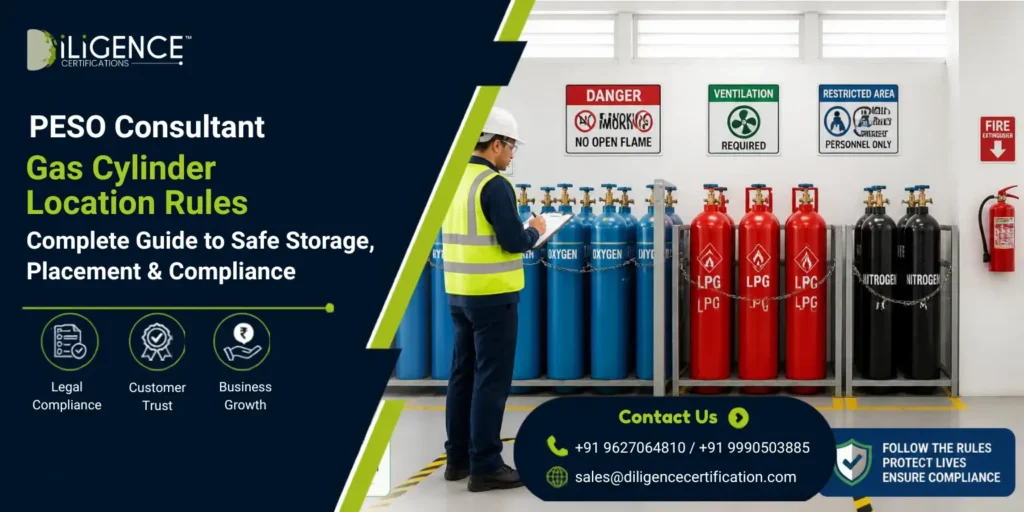
A suitable cylinder location generally requires attention to:
- Suitable Storage Area
- Adequate Ventilation
- Safe Distance from Ignition Sources
- Fire Safety Arrangements
- Restricted Access
- Proper Cylinder Positioning
- Protection from Physical Damage
- Suitable Signage
- Emergency Preparedness
- Safe Handling Practices
- Clean and Organized Storage
- Compliance with Applicable Regulations
The location should be selected after considering the surrounding premises and activities rather than simply choosing an available open space.
For businesses dealing with regulated quantities of gases, understanding the applicable regulatory requirements before setting up a storage area can help prevent costly modifications later.
Applications of Gas Cylinder Location Rules
Gas cylinder location requirements can apply to a wide range of businesses and facilities where compressed or liquefied gases are stored or used.
Some common applications include:
- Industrial Gas Storage
- LPG Storage Facilities
- Commercial Gas Storage
- Manufacturing Units
- Welding Workshops
- Hospitals and Healthcare Facilities
- Laboratories
- Restaurants and Commercial Kitchens
- Educational Institutions
- Research Facilities
- Engineering Workshops
- Chemical Industries
- Pharmaceutical Facilities
- Gas Distribution Businesses
- Industrial Plants
- Businesses Establishing New Storage Areas
- Businesses Modifying Existing Storage Areas
This will however vary depending on the gas involved and the characteristics of the gas, the amount of gas involved, the way in which it is stored, the facilities, equipment, and other relevant legislation.
In this regard, the businesses ought to make an assessment of their cylinder storage based on their particular circumstances.
A place that might be okay for one kind of gas might not necessarily be okay for another kind of gas.
Who Needs to Follow Gas Cylinder Location Rules?
Businesses and organizations that store, use, handle, fill, or distribute gas cylinders should consider applicable location and safety requirements.
These may include:
- Industrial Gas Companies
- LPG Businesses
- Gas Storage Facilities
- Manufacturing Units
- Welding Businesses
- Engineering Workshops
- Hospitals
- Laboratories
- Restaurants
- Commercial Kitchens
- Pharmaceutical Units
- Chemical Industries
- Research Facilities
- Educational Institutions
- Industrial Manufacturing Plants
- Owners of New Facilities
- Existing Businesses Modifying Storage Areas
Guidance from professionals may prove useful when a company wants to build a new facility for cylinder storage or alter an existing one.
It may assist in identifying possible problems related to ventilation, access, fire protection, separation of cylinders, adjacent operations, and other relevant factors prior to the commissioning of the facility.
Types of Compliance Supported by Gas Cylinder Location Rules
Location & Premises Compliance
The location of gas cylinders should be selected carefully because surrounding conditions can affect safety.
A cylinder storage area may need assessment for:
- Suitable Premises
- Storage Location
- Ventilation
- Safety Distances
- Fire Safety
- Ignition Sources
- Access Control
- Emergency Access
- Physical Protection
- Security Measures
Useful for:
- LPG Businesses
- Industrial Gas Facilities
- Manufacturing Units
- Hospitals
- Laboratories
- Workshops
The place of storage should be far from conditions that may lead to increased risk of fire hazard, explosion, cylinder damage, or accumulation of gases.
An assessment of the premises will go a long way in helping businesses find out compliance gaps before installation or submission.
Storage, Handling & Operational Compliance
Gas cylinders should be stored and handled using appropriate safety practices.
Compliance may include:
- Upright Cylinder Storage
- Cylinder Securing
- Safe Handling
- Proper Identification
- Gas Segregation
- Fire Prevention
- Restricted Access
- Adequate Ventilation
- Emergency Preparedness
- Safe Internal Movement
- Protection from Physical Damage
Proper operational practices help reduce the possibility of accidents during daily activities.
Businesses should also maintain suitable procedures for receiving cylinders, moving them within the premises, connecting them to equipment, storing empty cylinders, and responding to leaks or other emergencies.
Documentation & Inspection Compliance
Documentation is an important part of maintaining an organized gas cylinder storage system.
Documents may include:
- Business Records
- Cylinder Details
- Storage Details
- Site Plan
- Layout Plan
- Equipment Information
- Technical Documents
- Safety Documents
- Fire Safety Records
- Inspection Records
- Purchase or Supply Records
- Licence and Approval Records
- Regulatory Correspondence
Proper record keeping would assist businesses in proving that the storage of the cylinders is done in a systematic manner.
Record keeping could also help in making cylinder inventories, safety concerns, and inspection needs readily available.
Documents Required for Gas Cylinder Location Compliance
The documents required depend on the nature of the gas, storage quantity, premises, business activity, and applicable regulatory requirements.
Generally, documents may include:
- PAN Card
- GST Registration Certificate
- Business Registration Certificate
- Identity Proof
- Address Proof
- Site Plan
- Layout Plan
- Ownership or Lease Documents
- Organization Details
- Gas Details
- Cylinder Details
- Storage Details
- Equipment Details
- Technical Specifications
- Safety Documents
- Fire Safety Documents
- Emergency Preparedness Documents
- Inspection Documents
- Authorization Letter, where applicable
- Digital Signature Certificate, where applicable
The services of a professional consultant will be useful in finding the right documentation concerning the suggested arrangement of the gas cylinders.
Companies should not rely on a general document checklist because the requirements may vary depending on the type of gas, volume, building, and activity.
Step-by-Step Process for Gas Cylinder Location Compliance
Step 1: Location Assessment
The proposed storage location should first be assessed according to:
- Type of Gas
- Quantity
- Cylinder Type
- Storage Arrangement
- Premises
- Ventilation
- Nearby Activities
- Ignition Sources
- Fire Safety
- Access and Security
This assessment helps identify whether the proposed location is suitable and what safety measures may be required.
Step 2: Gathering Required Documents
Business, premises, technical, safety and cylinder related documentation needs to be gathered and reviewed.
Information on all documentation should correspond to the actual premises and storage setup.
Step 3: Preparation of Storage and Safety Arrangement
The cylinder storage area should be organized according to applicable requirements.
This may involve reviewing:
- Storage Layout
- Cylinder Positioning
- Ventilation
- Safety Signage
- Fire Protection
- Access Control
- Emergency Arrangements
- Cylinder Segregation
Proper planning at this stage can help reduce the need for unnecessary modifications later.
Step 4: Verification of Storage Arrangement
This storage setup may have to be checked for safety and regulatory guidelines.
The inspection and/or clarification, based on the process, may be required.
The consultant will assist the business in preparing the necessary documentation prior to any inspection.
Step 5: Applicable Approval or License
Where an approval or licence is applicable, the business should complete the relevant regulatory process.
Benefits include:
- Regulatory Compliance
- Safer Operations
- Controlled Activities
- Regulatory Recognition
- Better Business Credibility
The applicable approval or licence should be maintained according to its conditions and relevant regulatory requirements.
Step 6: Ongoing Compliance
Gas cylinder safety is not a one-time activity.
Businesses should continue monitoring:
- Cylinder Storage
- Ventilation
- Fire Safety
- Cylinder Condition
- Safety Signage
- Access Control
- Documentation
- Inspection Requirements
- Emergency Preparedness
Regular review helps ensure that the storage arrangement remains suitable as business activities change.
Timeline, Cost & Validity of Gas Cylinder Location Compliance
The timeline, cost, and validity depend on the type of gas, storage arrangement, documentation, premises readiness, inspection requirements, applicable government fees, professional charges, and regulatory processing.
| Timeline | Cost | Validity |
| The compliance timeline depends on location assessment, document verification, technical review, inspection, and applicable regulatory processing. | The cost depends on applicable government fees and professional service charges, if any. | The applicable approval or licence remains valid as per applicable regulations, licence conditions, and approval requirements. |
| Proper documentation and suitable premises can help reduce avoidable processing delays. | Additional charges may vary depending on the type of gas, storage arrangement, and compliance requirements. | Businesses should follow applicable renewal, inspection, amendment, or update requirements whenever necessary. |
| Processing time may vary based on application completeness and regulatory verification. | Proper planning can help businesses manage compliance-related expenses efficiently. | Maintaining updated business, technical, safety, and storage information supports continued compliance. |
Importance & Benefits of Gas Cylinder Location Rules
| Importance | Benefits |
| Helps organizations understand and comply with applicable regulations and safety requirements. | Enhances business credibility and demonstrates commitment to regulatory compliance. |
| Supports safe storage, handling, operation, transportation, and management of gas cylinders. | Improves confidence among customers, business partners, workers, and regulatory authorities. |
| Encourages responsible industrial practices and safety discipline. | Enables smoother compliance with applicable safety and operational requirements. |
| Promotes long-term operational safety and responsible management of gas cylinder storage. | Reduces compliance risks and improves operational efficiency. |
| Helps businesses fulfill their legal and regulatory responsibilities. | Strengthens long-term business growth and industry reputation. |
Why are Gas Cylinder Location Rules Important?
It is very essential to understand the rules for positioning gas cylinders due to the dangers that may arise from poor positioning of the cylinders.
The gas cylinders filled with compressed or liquefied gases are not supposed to be handled as any other storage material since there may be certain factors affecting the storage area.
Important aspects include:
- Compliance with Regulations
- Safety of Premises
- Safe Cylinder Handling
- Reliability of Operations
- Recognition in Industry
- Reducing Risks
- Sensible Safety Management
The well-organized space could help simplify the handling process, as well as decrease the risks of any hazards being created in the storage place.
The professional services would be especially beneficial for the firms that are not sure about compliance of the chosen place for cylinders.
Consequences of Non-Compliance with Gas Cylinder Location Requirements
Failure to follow applicable gas cylinder location and safety requirements can create regulatory, operational, financial, reputational, and safety concerns.
Regulatory Non-Compliance
Businesses may face regulatory difficulties if applicable storage, safety, approval, or licence requirements are not followed.
Action by the Competent Authority
The competent authority may take appropriate action where violations of applicable requirements are identified.
Operation Restrictions
Gas storage or related activities may face restrictions until identified compliance issues are addressed.
Business Activity Time Lags
Non-compliance can cause delays in approvals, storage modifications, expansions, renewals, or other regulatory activities.
Suspension or Withdrawal of Approval
Serious or continuing violations may result in regulatory action concerning an approval or licence, subject to applicable law.
Safety Hazard Risks
Improper cylinder placement can increase the risk of fire, gas leakage, explosion, physical damage, or workplace accidents.
Reputation of the Business
Safety or regulatory issues can negatively affect the credibility of a business.
Risk of Bad Reputation
Repeated safety failures can reduce confidence among customers, workers, suppliers, and regulatory authorities.
Growing the Business
Compliance problems may make future expansion, modification, or additional permissions more difficult.
For this reason, gas cylinder storage should be treated as an ongoing safety and compliance responsibility rather than a one-time arrangement.
Renewal of Gas Cylinder Approval or License
Where an approval or licence is applicable, businesses should periodically review its status and conditions.
The review becomes particularly important when there are changes in:
- Business Activity
- Gas Type
- Cylinder Quantity
- Storage Capacity
- Premises
- Storage Facilities
- Ownership
- Management
- Equipment
- Technical Arrangements
- Safety Arrangements
- Security Arrangements
The applicable renewal, revalidation, amendment, or transfer process should be followed according to the relevant requirements.
Common activities may include:
- Updating Business Information
- Reviewing Licence Details
- Updating Premises Information
- Updating Gas Information
- Updating Storage Information
- Submitting Required Documents
- Maintaining Safety Compliance
- Checking Regulatory Requirements
Regular review helps businesses identify changes that could affect their existing approvals, storage arrangements, or compliance responsibilities.
How Professional Assistance Helps with Gas Cylinder Location Rules?
A professional consultant can make gas cylinder compliance easier to manage by assisting with:
- Understanding Applicable Requirements
- Location Assessment
- Documentation Preparation
- Application Filing
- Technical Compliance
- Safety Compliance
- Regulatory Advisory
- Application Tracking
- Query Resolution
- Post-Approval Compliance
Professional assistance will allow companies to foresee any problems before they become costly or time-consuming. The consultant will be able to help with reviewing the proposed site, preparing the necessary documents, understanding the regulations, and preparing the company for inspection.
Why Choose Diligence Certifications for Gas Cylinder Compliance?
Diligence Certifications helps organizations with regulatory matters relating to gas cylinder storage, approvals, documentation, compliance, and regulatory assistance.
These benefits include:
- Documentation Assistance
- Assistance in Application Filing
- Compliance Assistance
- Query on Approvals
- Assistance in Technical Documentation
- End-to-End Approvals Assistance
- Compliance Assistance
- Guidance on Regulations
- Process Management
Professional help enables companies to handle the compliance of gas cylinders in a more systematic way.
Having proper guidelines, firms will be able to get knowledge regarding their needs for storage, documentation, safety, application process, and compliance.
Conclusion
Gas Cylinder Location Requirements are very significant as far as proper storing of compressed and liquefied gas cylinders is concerned.
The site selection for gas cylinders requires the following factors to be considered: ventilation, fire safety, ignition sources, access control, security, cylinder layout, emergencies, etc.
The compliance also involves the process of documentations, assessment of premises, technical requirements, inspections, approvals, licensing and renewal of license and overall safety management.
Consultation by professional helps the organizations identify the relevant requirements, organize documentation, review of storage layout, answering regulatory questions, etc.
The planning of appropriate sites for gas cylinders is not a mere process of compliance for businesses using gas cylinders.