BIS Certification
 CDSCO
CDSCO
 PESO
PESO
 CPCB
CPCB
 LMPC
LMPC
 WPC Approval
 Global Approvals
 TEC
TEC
 ARAI
ARAI
 BEE
BEE
 ISO Certification
 DGCA Certification
 NOC For Steel
 APEDA Registration























 Business Registration
 FSSAI Mark Certification












 (32).jpg)
 Legal Services
 Trademark Registration
 Copyright Registration
 Patent Registration
 By
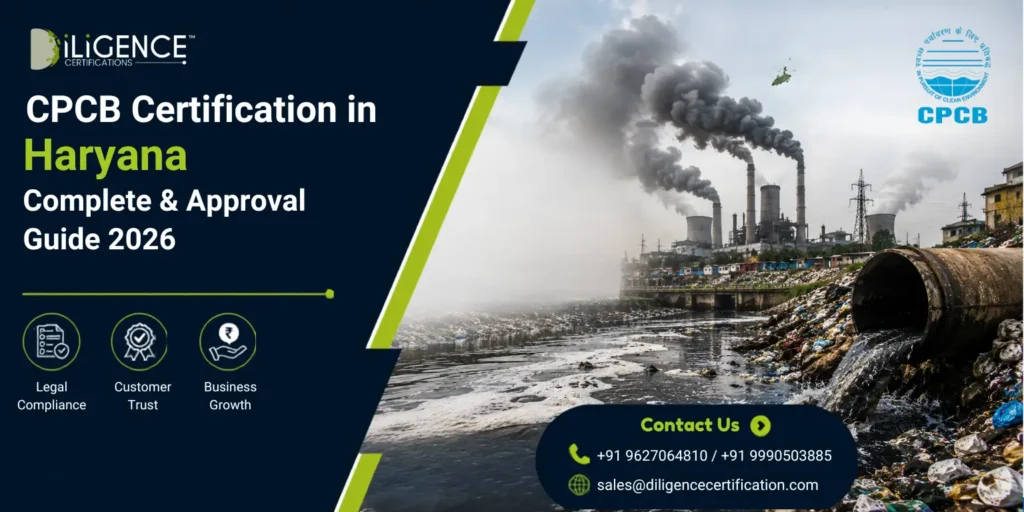
By - CPCB Certification for Haryana is an environmental certification that is compulsory for industries to comply with pollution norms.
- The CPCB certificate is needed by industries that manufacture goods, chemical units, textile industries, and many others which produce emission, effluent, or industrial waste.
- It assists industries in becoming environmentally responsible and compliant to avoid any kind of legal action.
Introduction
Environmental compliance through CPCB Certification in Haryana is mandatory for industries that can produce air, water, or soil pollution. The certification guarantees that industrial activity takes place within the limits of environment-friendly activities allowed by the National Pollution Control Regulations regulated by the Central Pollution Control Board.
Haryana has evolved as one of the top industrial centers in India with highly concentrated manufacturing areas in places such as Gurugram, Faridabad, Panipat, Sonipat, Karnal, Rohtak, Hisar, Ambala, and Panchkula. In these locations, chemical plants, textile industries, automobile parts makers, packing industries, food processing plants, and engineering industries exist.
This fast-paced growth of the industries in Haryana has made environmental inspection very stringent. CPCB Certification in Haryana makes sure that industrial activity takes place in an environmentally friendly way and does not harm the balance of the environment.
What is CPCB Certification?
Central Pollution Control Board Certification refers to environmental approval granted to industries confirming that their operations comply with pollution control norms, waste management rules, and emission standards.
It is issued under the environmental regulatory framework and monitored through central and state pollution control authorities.
Main Objectives of CPCB Certification
- Control industrial pollution at source
- Regulate emissions and effluent discharge
- Ensure scientific waste management practices
- Promote sustainable industrial development
- Maintain environmental balance
- Enforce legal compliance for industries
For Haryana-based industries, CPCB Certification is a core legal requirement before and during operations.
Types of CPCB Certification in Haryana
1. Consent to Establish (CTE)
Approval required before setting up an industrial unit.
Applicable Businesses:
- New manufacturing industries
- Processing plants
- Chemical-based units
- Infrastructure development projects
- Production facilities
Key Highlights:
- Required before construction or setup
- Evaluates environmental impact of proposed unit
- Ensures compliance planning from initial stage
2. Consent to Operate (CTO)
Approval required before starting industrial operations.
Applicable Businesses:
- Operational factories
- Manufacturing units
- Processing industries
- Production facilities
- Waste generating industries
Key Highlights:
- Mandatory before production begins
- Based on pollution control compliance
- Requires inspection and monitoring
3. Hazardous Waste Authorization
Approval for industries dealing with hazardous waste materials.
Applicable Businesses:
- Chemical industries
- Pharmaceutical units
- Paint and dye manufacturers
- Metal processing units
- Waste treatment plants
Key Highlights:
- Regulates hazardous waste handling
- Ensures safe storage and disposal
- Prevents environmental contamination
Importance & Benefits of CPCB Certification in Haryana
| Importance | Benefits |
| Ensures environmental compliance | Avoids legal penalties and fines |
| Regulates pollution levels | Promotes sustainable operations |
| Mandatory for industrial operations | Improves regulatory credibility |
| Supports environmental protection | Builds public trust |
| Enables smooth business functioning | Reduces operational risks |
| Required for approvals & expansion | Supports long-term growth |
| Ensures safe waste management | Enhances industrial safety |
| Strengthens ESG compliance | Improves investor confidence |
| Required for high-risk industries | Ensures environmental safety |
| Aligns with government norms | Supports sustainable development |
CPCB Certification is essential for maintaining a balance between industrial growth and environmental protection in Haryana.
Industries Requiring CPCB Certification in Haryana
- Chemical manufacturing units
- Textile dyeing industries
- Automobile manufacturing plants
- Food processing industries
- Pharmaceutical companies
- Plastic manufacturing units
- Steel and metal industries
- Paper and pulp industries
- Brick kilns and construction units
- Warehousing and logistics hubs
- Dairy and agro-processing units
- Paint and coating industries
- Electronic manufacturing units
- Industrial waste management units
CPCB Certification Process in Haryana
Step 1: Industry Evaluation
Determine pollution category and required consent type based on operations.
Step 2: Application Submission
Submit detailed application with industrial and operational information.
Step 3: Document Verification
Authorities verify submitted documents for accuracy and compliance.
Step 4: Site Inspection
Environmental officers may inspect the industrial site.
Step 5: Compliance Review
Application is evaluated under pollution control norms.
Step 6: Approval Issuance
CPCB-related consent is issued upon successful verification.
Documents Required for CPCB Certification in Haryana
Business Documents
- Company registration certificate
- PAN card
- GST registration (if applicable)
- Address proof of unit
- Identity proof of authorized person
Technical Documents
- Project report
- Manufacturing process details
- Plant layout diagram
- Machinery list
- Pollution control system details
Environmental Documents
- Waste management plan
- Emission control report
- Water usage details
- Environmental monitoring report
Additional Documents
- Land ownership or lease proof
- Authorization letters
- Local authority NOC (if required)
- Safety compliance documents
Timeline, Cost & Validity
| Timeline | Cost | Validity |
| Approval time depends on industry type, documentation quality, and inspection requirements. | Cost varies based on pollution category, industry scale, and type of consent required. | Certification remains valid for a defined period and must be renewed before expiry. |
| Delays may occur due to inspection scheduling or document verification. | Higher pollution category industries may require additional compliance investments. | Renewal is required based on compliance status and operational review. |
| Proper documentation helps faster processing. | Government fee depends on consent type and industry classification. | Continuous compliance is mandatory throughout validity period. |
| Environmental clearance may affect timeline. | Additional compliance costs may include monitoring systems. | Non-compliance can lead to suspension or cancellation. |
| Regulatory review impacts approval duration. | Cost structure differs for CTE, CTO, and authorization categories. | Regular inspections may be conducted during validity. |
Common Challenges Faced by Industries
- Incorrect classification of industry category
- Incomplete documentation submission
- Lack of pollution control systems
- Delay in inspection process
- Non-compliance with emission standards
- Errors in technical reporting
- Poor waste management practices
- Limited regulatory awareness
- Changes in compliance requirements
- Difficulty in meeting environmental norms
Why Choose Diligence Certification for CPCB Certification in Haryana
Diligence Certification provides structured compliance support for CPCB Certification in Haryana with complete end-to-end assistance.
1. End-to-End Support
Complete guidance from application to approval stage.
2. Correct Consent Selection
Assists in choosing appropriate certification category.
3. Documentation Assistance
Ensures accurate and complete paperwork submission.
4. Application Filing Support
Handles submission and authority coordination.
5. Inspection Support
Assists during site inspections and compliance checks.
6. Compliance Management
Ongoing support for renewals and regulatory updates.
Conclusion
The requirement for CPCB Certification for Industries in Haryana has become a must for those industries that wish to work in an environment-friendly manner. In light of Haryana’s rapidly growing industrial environment, it has become necessary to adhere to pollution control norms.
From the industrial areas in Gurugram to Panipat Textile Industries and Manufacturing Units in Faridabad, getting CPCB Certification ensures that your industry will run in an environmentally friendly way.
Frequently Asked Questions
Who requires CPCB Certificate in Haryana?
Industries engaged in production, processing, or pollution generating operations need CPCB permission
Is CPCB certification compulsory?
Yes, it is compulsory for eligible industries under environment rules.
3. What does CPCB take care of?
CPCB controls the pollution control norms.
What industries require CPCB certificate?
It includes chemical, textile, pharma, and manufacturing industries.
Chemical, textile, pharmaceutical, and manufacturing industries require it.
Can new industries apply?
Yes, they must obtain Consent to Establish before starting operations.
What happens without CPCB approval?
Industries may face penalties, restrictions, or closure actions.
Is CPCB Certification renewable?
Yes, it must be renewed periodically.
8. Do small industries need it?
Yes, if they fall under pollution-related categories.
Why is it important?
It ensures environmental protection and legal compliance.
How does Diligence Certification help?
It provides complete support for documentation, filing, and approval process.