BIS Certification
 CDSCO
 PESO
 CPCB
 LMPC
 WPC Approval
 Global Approvals
 TEC
 ARAI
 BEE
 ISO Certification
 DGCA Certification
 NOC For Steel
 APEDA Registration























 Business Registration
 FSSAI Mark Certification












 (32).jpg)
 Legal Services
 Trademark Registration
 Copyright Registration
 Patent Registration
 By
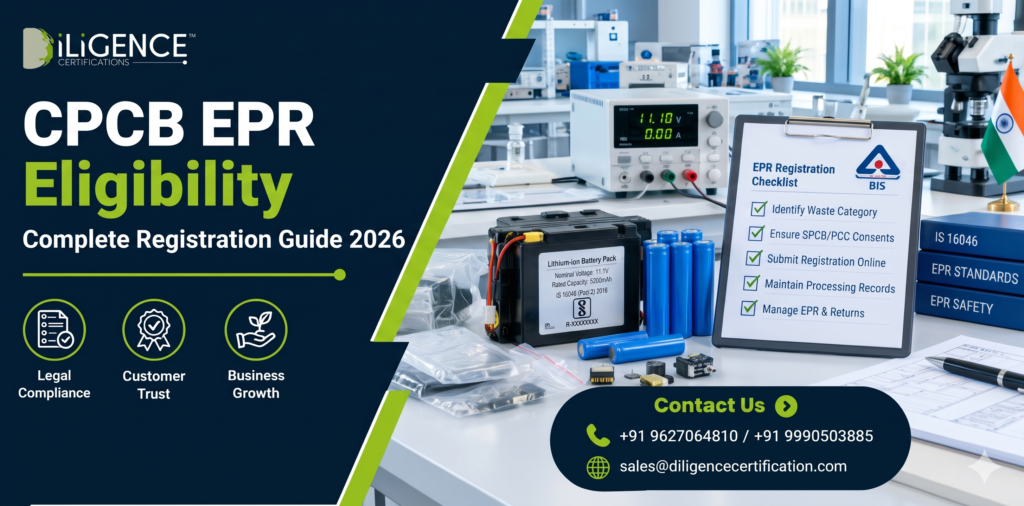
- Check whether your business requires CPCB EPR registration under the applicable waste management rules.
- Identify your business category, such as producer, importer, brand owner, manufacturer, recycler or refurbisher.
- Prepare essential documents, including PAN, GST details, company registration and product or packaging information.
- Use the correct official EPR portal and verify the latest registration requirements and applicable exemptions.
- Track EPR targets, certificates, annual returns and record-keeping obligations to maintain ongoing compliance.
Introduction
A small business that sells food that is already packaged online might not have its factory while an importer could sell electronic products using its own brand. Both types of businesses need to know what their environmental rules are before thinking that they don’t have to register.
This is why being eligible for CPCB EPR registration matters. Extended Producer Responsibility or EPR is a rule that makes businesses take responsibility for managing waste from the products they handle. Depending on the rules that apply this responsibility might include registering, meeting recycling goals using EPR certificates, reporting and keeping records.
In India different EPR systems are in place for packaging, electronic waste, batteries, waste tyres and used oil. The rules for each are not the same. A business must figure out what type of product it deals with what it actually does and what its legal role is before choosing a registration process.
For example a company that sells cosmetics in bottles should look at the rules for plastic packaging. A company that makes or brings in equipment should check the rules for electronic waste. A business that works with, than one type of product may need to check each one individually.
This guide explains who needs CPCB EPR registration what the eligibility rules are, what documents to get ready what mistakes to avoid and the steps to take before applying.
What Is CPCB EPR Registration Eligibility?
CPCB EPR registration eligibility means checking if a businesss in a group that is covered by the Extended Producer Responsibility rules. If a business is covered it must register with the authority that’s responsible, for this.
The Central Pollution Control Board runs parts of Indias EPR system using online tools and official processes. The Ministry of Environment, Forest and Climate Change creates the waste-management rules. Updates them when needed.
EPR is created to help manage waste from products and packaging in a way. Of letting local waste collection systems handle everything the rules ask businesses to take specific actions. These businesses are the ones that bring products or materials into the market.
Depending on the category, a business may need to:
- Register on the relevant official portal.
- Provide accurate business and product information.
- Report applicable production, import or sales quantities.
- Meet prescribed EPR obligations.
- Obtain or transfer eligible EPR certificates where required.
- Submit annual returns and maintain supporting records.
- Follow applicable recycling, recovery or recycled-content requirements.
Not every requirement applies to every business. The exact obligations depend on the waste stream, the business’s role and the current rules.
Who Is Eligible for CPCB EPR Registration?
Businesses should review their activities rather than rely only on their company name or industry description. The following categories commonly need to assess their position under one or more EPR frameworks.
1. Producers and manufacturers
A business that makes covered products, packaging or materials might be in an EPR category. However the legal definition of a producer or manufacturer can be different for each type of waste.
For packaging businesses should look at whether their work fits the definitions for producers. This includes checking the categories covered by any changes to the rules. Manufacturers of raw materials should also look at the registration rules that apply to them.
A company that makes packaging for businesses should not think that its duties are the same as a company that sells packaged goods to customers. The companys work needs to be checked against the rules that’re in place.
2. Importers
Importers should check if the products, packaging or materials they bring into India are covered by an EPR system.
For example an importer bringing packaged personal-care products into India might need to check the rules for packaging. An importer of electrical equipment should look at the e-waste rules. A company that brings in tyres or vehicles with new tyres should check the waste-tyre rules.
Importers should keep purchase invoices, import records, product details and quantity information in order. These papers can help show what the business is doing and support any application.
3. Brand owners
A brand owner might sell products made by someone. This does not automatically mean that the brand owner does not have to check EPR duties.
Imagine a business that sells shampoo skincare products or snacks under its brand. A different company makes the products. The items are sent to customers using the brand owners packaging and label.
The business should check if it fits the brand-owner definition under the rules. It should also find out which types of packaging and how much is involved.
An agreement, with a contract manufacturer can help explain who does what. A private deal cannot change a legal duty on its own.
4. Plastic Waste Processors
Businesses that handle waste recycling turn waste into energy convert waste into oil or do industrial composting might need to register under the rules that apply to them.
Each business must check which authority handles registration. This could be a State Pollution Control Board or a Pollution Control Committee. Depending on what they do and the rules in place.
They should also keep accurate records of the plastic waste they receive and process. These records matter for reporting and for creating EPR certificates if allowed.
5. Electronic equipment. Recyclers
The E-Waste (Management) Rules, 2022 as updated cover electric and electronic devices and the businesses involved with them.
Producers, manufacturers, people who fix devices and recyclers must check what’s expected of them. The exact duties depend on the device type the work they do and how the rules define their role.
A store selling electronics should not just assume it has the registration duties as a producer. The legal and business setup must be looked at carefully to know which rules apply.
6. Battery producers and recyclers
EPR duties for batteries are managed by the Battery Waste Management Rules, 2022 and any updates since then. The rules include types of batteries. Like those used in portable gadgets, cars, industrial machines and electric vehicles.
Businesses that make or import covered batteries well, as recyclers and those who refurbish batteries must check what registration and compliance steps they need to follow.
A company that sells a device with a battery must look closely at the product and how it’s supplied. They can’t ignore the battery when checking if they’re following the rules.
7. Waste tyre producers, recyclers and retreaders
The waste‑tyre EPR framework covers producers and other stakeholders under the rules that apply. The official portal lists producer categories that include companies that make and sell tyres in the country that sell imported new tyres that sell tyres under their own brand and some vehicle importers.
Companies that are part of the tyre supply chain should read the definitions and the portal instructions before they apply.
8. Businesses dealing with used oil
The used‑oil EPR framework covers stakeholders and activities under the hazardous and other waste‑management rules that are relevant.
A company should find out whether it is a producer or another regulated stakeholder and then look up the proper registration process. The duties for used oil are not the same as those, for packaging or electronic waste.
Does CPCB EPR Registration Apply to Small Businesses and MSMEs?
Small businesses often think they don’t need EPR registration because their turnover is low they have employees or they don’t run a manufacturing unit.. That belief can be dangerous. Just because a business is small doesn’t mean it’s exempt, from EPR rules.
Even if a business has MSME status it doesn’t automatically get a pass from all EPR requirements. Each business must look closely at the rules recent changes and any exemptions that apply to its particular category.
Take packaging for example. The CPCB issued a notice on April 28 2025 about registration rules. This notice applies to manufacturers and importers of raw materials, small and micro producers and sellers of plastic raw materials. It shows how important it is to pay attention to category- notifications instead of making assumptions based on general guidelines.
Example: A small packaged-food business
Suppose a company sells snacks through its website and online marketplaces. A third-party factory manufactures the snacks, which are packed in plastic pouches and sold under the company’s brand.
The company should establish:
- Who owns the brand.
- Who manufactures the product and packaging.
- Whether the business falls within a covered legal category.
- Which packaging materials and quantities are relevant.
- Whether any specific exemption applies.
- Which registration and reporting obligations are currently in force.
The answer cannot be determined solely by looking at the company’s turnover or employee count. The current legal provisions and the facts of the arrangement must be considered together.
Small businesses should also maintain records of product purchases, sales, packaging types and imports where relevant. Accurate information makes the eligibility review more reliable.
CPCB EPR Registration Eligibility by Waste Category
Different waste streams have different regulatory frameworks. This table can help a business identify where to begin.
| Waste category | Businesses that should check eligibility | Main points to review |
| Plastic packaging | Producers, importers, brand owners and specified waste processors | Packaging category, legal role, applicable exemptions and reporting duties |
| E-waste | Producers of covered equipment, manufacturers, refurbishers and recyclers | Equipment coverage, activity and current E-Waste Rules |
| Batteries | Covered battery producers, manufacturers, recyclers and refurbishers | Battery type, registration category and EPR obligations |
| Waste tyres | Specified producers, recyclers and retreaders | Manufacturing, import, own-brand sales and processing activities |
| Used oil | Covered producers and other specified stakeholders | Applicable definitions, activity and registration procedure |
The table is a starting point, not a final legal opinion. A business should verify the current rules and official portal instructions before concluding that registration is mandatory or unnecessary.
Plastic packaging EPR
Plastic packaging matters, for businesses that sell directly to consumers. These businesses include food brands, cosmetics companies, household product sellers and some importers.
The relevant framework might ask entities to register to report how much packaging they use and to satisfy the required EPR obligations. The exact rules vary with the entity’s category the packaging classification and the current laws.
Businesses should also check if the packaging is single‑layer or multi‑layer what material it is made of and under which category it must be reported. Incorrect classification can affect the information submitted and the calculation of applicable obligations.
E-waste EPR
E-waste Extended Producer Responsibility applies to electrical and electronic equipment. Companies need to check whether their products are listed in the schedules and meet the defined criteria.
Any business that makes or brings in covered electronics must keep records of the products they place on the market.
They should also review the registration process to make sure they are compliant. Recyclers and refurbishers must look into their obligations separately as their responsibilities differ from those of producers or importers.
Battery EPR
Battery Extended Producer Responsibility depends on the type of battery and the role the business plays. Portable batteries, batteries, industrial batteries and electric-vehicle batteries may have different rules even though they all fall under the same general regulation. Each category can come with reporting, collection and recycling requirements. Businesses should use the battery EPR portal and the latest guidance documents to confirm what process applies to them.
Waste tyre and used-oil EPR
Tyre and used-oil businesses should not assume they can use the process as plastic EPR applicants. The rules are different. Registration categories, record-keeping requirements and reporting methods vary significantly.
For example a tyre manufacturer must review how its own production, branded sales and imported products fit the definition of waste tyres.
Similarly a company handling used oil needs to determine which activities fall under the used-oil regulation and then gather the records accordingly. It’s important to check the rules before starting any compliance process.
What Documents Are Required for CPCB EPR Registration?
The required documents depend on the category and the current portal procedure. The following information is commonly useful when preparing for an application.
| Document or information | Purpose |
| PAN details | Identifies the business or applicant as required by the procedure |
| GST registration details | Supports verification of business information where applicable |
| Incorporation or constitution documents | Establishes the legal form and identity of the entity |
| Authorised person’s details | Identifies the representative handling the application |
| Registered office and contact details | Supports official communication and verification |
| Product and packaging information | Helps establish the relevant product or packaging category |
| Production, sales or import records | Supports applicable reporting and quantity declarations |
| Facility and processing details | May be needed for recyclers and other waste processors |
| Existing registration records | Helps verify the current status and relevant registration details |
| Supporting declarations and permissions | May be required according to the activity and portal instructions |
This is a preparation checklist, not a substitute for the official document list. Some documents may not apply to every applicant, and additional records may be required for a particular category.
How to prevent document errors
Before submitting the application, check the legal name, registered address and authorised-person details. Ensure that the product descriptions and quantity figures match the supporting records.
If a company has changed its address, legal name or business structure, it should confirm whether the relevant registration records need updating. It should not assume that an old certificate or portal profile automatically reflects the current position.
Keep copies of submitted applications, acknowledgements and correspondence. These records help the business track its application and respond accurately if the authority requests clarification.
How to Check CPCB EPR Registration Eligibility Before Applying
A structured eligibility review can prevent the business from selecting the wrong registration category.
Step 1: Identify the waste stream
Begin by checking what kind of waste your business produces. Is it packaging? Electronic equipment? Batteries? Tyres? Used oil?. Something else that’s regulated?
If your business handles than one type don’t group them together. List each waste category separately. That way your EPR assessment stays clear and accurate.
Step 2: Define the businesss role
Figure out what your company actually does. Do you make products? Import them? Own the brand? Process waste? Refurbish old items?. Do you do more than one of these things?
Keep in mind the same company can have duties depending on the products and the work they do. Make sure you’re clear, about each role.
Step 3: Review current rules and exemptions
Read the applicable notified rules and amendments. Check the definitions of the relevant entities and any provisions that may exclude or modify the requirements for a particular category.
Do not rely only on old articles, third-party checklists or verbal advice. Regulatory requirements can change, and the latest official notification should guide the decision.
Step 4: Prepare the relevant records
Collect business details, product information, packaging data, import records, facility information and other documents required for the category.
Check for inconsistencies before uploading the information.
Step 5: Use the correct official portal
Follow the current instructions of CPCB or the other competent authority. Make sure the application is being submitted under the correct category and that all mandatory fields are completed.
Step 6: Plan for post-registration compliance
Registration may be only the beginning of the process. Identify applicable EPR targets, certificates, annual returns, record-keeping requirements and reporting deadlines.
A compliance calendar can help the business track these tasks throughout the financial year.
Which CPCB EPR Portal Should You Use in 2026?
Businesses should use the portal and follow the instructions that apply to their specific waste stream. For packaging the Common EPR Portal at epr.cpcb.gov.in is especially important.
The Central Pollution Control Board or CPCB announced that the previous plastic packaging EPR portal is no longer in use starting from June 28 2026. All user data has been moved to the Common EPR Portal. Existing users are asked to check their migrated information and report any errors or inconsistencies using the system.
Current registrants should review their updated details confirm their account access and check for any pending compliance tasks. New applicants must follow the instructions on the current portal and should not rely on outdated tutorials that show the old discontinued process.
This transition to the portal does not mean there is a change in the legal eligibility test. Whether a business needs to register still depends on the rules and what the business actually does.
Other waste streams, such as batteries, e-waste, waste tyres and used oil each have their specific portals and procedures. Applicants in these categories should make sure they are using the portal and following the right process, for their particular waste type.
Common Mistakes When Checking CPCB EPR Registration Eligibility
Assuming every small business is exempt
Company size alone should not be treated as a universal exemption. Check the exact rule and category.
Assuming the factory is responsible for everything
A contract manufacturer and a brand owner can have different legal roles. Review the actual arrangement and the applicable definitions.
Selecting the wrong category
An importer, producer, brand owner and waste processor may have different registration requirements. Identify the role correctly before beginning the application.
Using outdated portal instructions
Old tutorials may contain discontinued links or superseded steps. Check the current official portal and guidance documents.
Providing inconsistent information
Incorrect business details, unsupported quantity figures and mismatched documents can create avoidable problems. Reconcile the information before submission.
Ignoring post-registration obligations
Registration does not automatically complete every EPR duty. Applicable targets, certificates, returns and records should be tracked separately.
Relying on an unsupported exemption
If a business believes an exemption applies, it should identify the exact legal provision and confirm that the business meets its conditions. Do not rely on a general statement that a particular industry or company size is exempt.
Why Choose Diligence Certifications for CPCB EPR Registration Eligibility Certification?
Understanding eligibility is only one part of environmental compliance. Businesses also need to identify the right category, prepare supporting documents and understand which obligations may continue after registration.
Diligence Certifications provides compliance-related support for businesses seeking guidance on regulatory registration requirements. Support may include reviewing business activities, organising application documents and helping applicants understand the relevant registration process.
Visit the Diligence Certifications homepage to learn more about its compliance services.
How professional guidance can help
- Eligibility review: Examine the business activities and identify the relevant EPR framework for verification.
- Document preparation: Organise business, product, packaging and operational records.
- Application guidance: Help check that the information in the application is consistent with supporting documents.
- Clarification support: Assist in understanding and responding to questions raised during the application process.
- Compliance planning: Help identify applicable reporting, record-keeping and target-related responsibilities.
Businesses seeking specific support can review the CPCB EPR Registration Service page.
The exact scope of support should be confirmed before engagement. A consultant cannot guarantee approval, processing time or a particular regulatory outcome. Those decisions remain subject to the competent authority and the circumstances of the application.
Conclusion
CPCB EPR registration eligibility should be checked before a business starts its registration application. The correct approach is to identify the relevant waste stream, understand the company’s legal role, review the latest rules and exemptions, and prepare the required documents.
Manufacturers, importers, brand owners and waste processors should not assume that their obligations are identical. Small businesses should also avoid assuming that their size automatically removes every EPR requirement.
It is equally important to plan for ongoing compliance. Depending on the category, this may include EPR targets, certificates, returns, record-keeping and reporting deadlines.
If you are uncertain about your business’s position, start with a review of the products, packaging, imports and operations involved. A category-specific assessment provides a stronger basis for deciding which registration route to follow and what records to prepare.
Frequently Asked Questions
Step 1: Identify the waste stream
Begin by checking what kind of waste your business produces. Is it packaging? Electronic equipment? Batteries? Tyres? Used oil?. Something else that’s regulated?
If your business handles than one type don’t group them together. List each waste category separately. That way your EPR assessment stays clear and accurate.
Step 2: Define the businesss role
Figure out what your company actually does. Do you make products? Import them? Own the brand? Process waste? Refurbish old items?. Do you do more than one of these things?
Keep in mind the same company can have duties depending on the products and the work they do. Make sure you’re clear, about each role.
Step 3: Review current rules and exemptions
Read the applicable notified rules and amendments. Check the definitions of the relevant entities and any provisions that may exclude or modify the requirements for a particular category.
Do not rely only on old articles, third-party checklists or verbal advice. Regulatory requirements can change, and the latest official notification should guide the decisio
Step 4: Prepare the relevant records
Collect business details, product information, packaging data, import records, facility information and other documents required for the category.
Check for inconsistencies before uploading the information.
Step 5: Use the correct official portal
Follow the current instructions of CPCB or the other competent authority. Make sure the application is being submitted under the correct category and that all mandatory fields are completed.
Step 6: Plan for post-registration compliance
Registration may be only the beginning of the process. Identify applicable EPR targets, certificates, annual returns, record-keeping requirements and reporting deadlines.
A compliance calendar can help the business track these tasks throughout the financial year.
7. Is plastic EPR registration the same as e-waste registration?
No. Plastic packaging and e-waste have different regulatory frameworks. Their eligibility definitions, registration procedures and ongoing obligations may differ.