 BIS Certification
 CDSCO
 PESO
 CPCB
 LMPC
 WPC Approval
 Global Approvals
 TEC
 ARAI
 BEE
 ISO Certification
 DGCA Certification
 NOC For Steel
 APEDA Registration
















 Business Registration
 FSSAI Mark Certification










 (32).jpg)
 Legal Services
 Trademark Registration
 Copyright Registration
 Patent Registration
 By
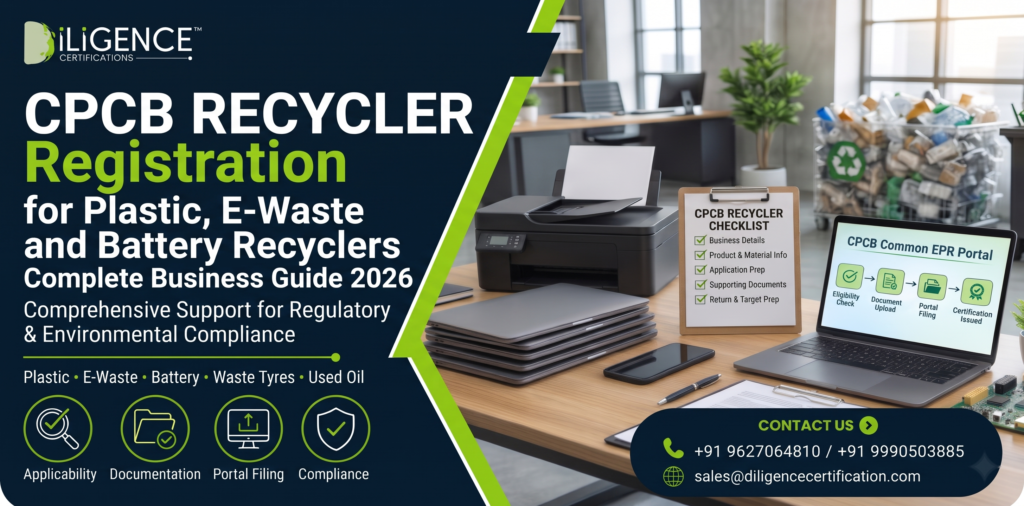
- Understand CPCB recycler registration requirements for plastic, e-waste, battery, and other waste recyclers.
- Prepare essential documents, including company registration, PAN, GST details, site records, and pollution-control permissions, where applicable.
- Follow the correct online registration process through the relevant CPCB, SPCB, or PCC portal.
- Avoid common application mistakes by verifying documents, processing capacity, machinery details, and the applicable Standard Operating Procedure (SOP).
- Maintain waste-processing records, submit applicable returns, and follow EPR certificate requirements and environmental compliance rules after registration.
Introduction
Starting a recycling business involves more than purchasing machinery and arranging a regular supply of waste. A business owner must also understand the environmental permissions, registration requirements and records needed to run the facility legally. This is where CPCB recycler registration becomes important.
Consider a business owner planning to establish a plastic recycling unit. The machinery is installed, workers are ready, and local suppliers can provide plastic waste. However, when the owner starts preparing the registration application, questions arise about plant capacity, pollution-control permissions, process details and the documents required by the concerned authority.
Such situations are common when businesses begin the registration process without checking the applicable rules first.
CPCB recycler registration requirements depend on the type of waste a facility handles and the activity it performs. Plastic waste processors, e-waste recyclers and battery recyclers do not necessarily follow the same registration procedure. Some applications are submitted through centralised online systems, while the relevant State Pollution Control Board (SPCB) or Pollution Control Committee (PCC) also has a role under the applicable framework.
For businesses planning to establish a new facility or regularise an existing operation, understanding these differences can prevent avoidable mistakes. This guide explains the registration process, important documents, applicable waste categories and compliance responsibilities in simple English.
What Is CPCB Recycler Registration?
CPCB recycler registration is the paperwork that waste-processing businesses in India must complete if they want to legally handle certain types of waste. This registration helps government agencies keep track of recycling centers check what they’re doing and make sure they’re following laws.
The Central Pollution Control Board or CPCB. Oversees many of these registration systems along with Extended Producer Responsibility (EPR) programs.. The right authority depends on the type of waste. For some waste you may need to register with the CPCB. For others you might need to go through your state’s Pollution Control Board (SPCB) or Pollution Control Committee (PCC). Sometimes you need to register with both.
Take plastic waste for example. Businesses that recycle plastic must follow the Plastic Waste Management Rules, 2016 including any updates to those rules. E-waste recyclers must follow the E-Waste (Management) Rules, 2022 and any changes, after that. Battery recyclers have to stick to the Battery Waste Management Rules, 2022 and the latest amendments.
Here’s the key thing: there’s no one registration that covers all kinds of recycling. Each waste type has its rules and registration process.
Before you even start the application you should clearly know what kind of waste your business will handle. You also need to figure out which registration category fits your work, which agency you need to register with and what other permits or approvals your facility might need.
Who Needs CPCB Recycler Registration?
The registration requirement depends on the waste material, the processing activity and the rules applicable to the business.
1. Plastic waste recyclers
Plastic waste recyclers process discarded plastic into reusable materials such as flakes, granules or other recovered products. Depending on the activity, they may fall under the Plastic Waste Processor category.
Eligible Plastic Waste Processors must follow the applicable Plastic Waste Management Rules and the registration procedure prescribed for their activity. Registration is also important in the plastic packaging EPR framework because eligible processors participate in the system used to document waste processing and support EPR obligations.
A business should confirm whether its activity falls under recycling, waste-to-energy processing, plastic-to-oil processing, industrial composting or another recognised category before applying.
2. E-waste recyclers
E-waste recyclers process discarded electrical and electronic equipment to recover useful materials. Their work may involve dismantling, mechanical separation and the recovery of metals or other materials.
The E-Waste (Management) Rules, 2022, and their amendments govern the applicable registration framework. Eligible recyclers must follow the official CPCB registration procedure, provide the prescribed information and meet the relevant operating and reporting requirements.
The official CPCB E-Waste Management System provides registration information, recycler SOPs, annual-return guidance and other relevant resources.
3. Battery waste recyclers
Battery recyclers collect materials from batteries. Depending on the technology and the type of battery their methods can include processing, sorting and chemical extraction.
The Battery Waste Management Rules, 2022 as updated provide the guidelines. Recyclers need to look at the CPCB battery EPR portal the correct recycler registration standard operating procedure and the rules from the SPCB/PCC.
Companies should not begin an application just because they have the same documents as another kind of recycler. Battery waste can have safety and environmental dangers, which means the actual process, at the facility and the proper approvals are very important.
4. Used-oil and waste-tyre recyclers
Used-oil and waste-tyre businesses may also have registration and EPR-related obligations under their respective regulatory frameworks.
The requirements depend on the activity being performed, such as recycling, processing or another recognised operation. Applicants should check the official system and rules for the specific waste category instead of assuming that the plastic or e-waste procedure applies.
5. Other waste-processing businesses
Facilities that handle construction and demolition waste or other regulated waste streams might need to follow registration and reporting rules.
For example the Environment (Construction and Demolition) Waste Management Rules, 2025 have their online system, for people involved in this work.
Businesses should check which rules apply to their waste and operations before doing anything. This helps avoid mistakes and keeps things on track.
Documents Required for CPCB Recycler Registration
Document preparation is a part of the application process. If a business has all the needed equipment and setup missing papers or mixed-up information can cause delays. You might get asked to explain or fix things later.
The list below is a guide to help you get ready.. Be sure to check the most recent Standard Operating Procedure and portal instructions, for your specific waste type. That’s the way to be sure you have everything right.
| Document | Purpose |
| Company registration documents | Establish the legal identity of the applicant |
| PAN details | Support business identification |
| GST registration details, where applicable | Provide relevant tax and business information |
| Authorised person’s details | Identify the person responsible for the application |
| Factory address and site documents | Establish the location of the facility |
| Land or premises documents | Support the applicant’s right to use the site |
| Consent to Establish (CTE), where applicable | Demonstrate the required pre-establishment permission |
| Consent to Operate (CTO), where applicable | Demonstrate the required operating permission |
| Process flow diagram | Explain the steps followed during waste processing |
| Machinery list and specifications | Describe the equipment installed or proposed |
| Processing-capacity details | Explain the facility’s intended or approved capacity |
| Pollution-control information | Describe relevant emission, wastewater and waste-management measures |
| Site and machinery photographs | Support facility information or verification, where required |
| Safety documents | Support assessment of operational risks |
| Other declarations and authorisations | Meet category-specific requirements |
Not every document applies to every recycler. For example the supporting information requested for an e‑waste recycler may differ from the information required for a waste processor.
I think applicants should also ensure that the document tells a story. The facility address in the document must match the records on file. The processing capacity stated in the application must be supported by the machinery and, by the details.
How to prepare your documents properly
Start by creating a folder for the business registration documents. Create a folder for the facility permissions. Create a folder for the details. Create a folder for the category- records.
Check the validity of existing approvals. Make sure that the company name is correct. Make sure that the address is correct. Make sure that the authorised-person details are correct. Prepare a clear process flow diagram. Prepare a clear process flow diagram showing how waste enters the facility. Prepare a clear process flow diagram showing how it is processed. Prepare a clear process flow diagram showing what materials or residues leave the plant.
A common mistake is to focus on uploading files. A common mistake is to focus on uploading files without checking whether the information, inside them matches the application. Reviewing the details before submission can help. Reviewing the details before submission can help reduce queries.
CPCB Recycler Registration Process: Step by Step
Although the exact procedure changes by waste category the following steps give a way to prepare an application for waste.
Step 1: Identify the registration category
First decide what waste the facility will process and what activity the facility will perform. A business that recycles packaging may need to apply as a Plastic Waste Processor. A facility recovering materials from discarded equipment will need to check the e‑waste registration framework. If a facility handles than one type of waste assess each activity separately. Do not select a category simply because it appears similar to the facility business name.
Step 2: Review the environmental permissions
Before submitting the registration application check the permissions required for the facility. Depending on the activity these may include Consent to Establish, Consent to Operate hazardous‑waste authorisation or other approvals from the authority. The requirements depend on the waste category the location and the nature of the operation. CPCB recycler registration should not be treated as a substitute, for all environmental permissions.
Step 3: Prepare business and technical details
Gather the company information, authorised person details, site records, machinery specifications and process information that the registration procedure asks for.
Pay attention to the proposed processing capacity. That number must match the equipment the layout of the facility and the technical information that you have supplied.
If the application asks for details, about the quantity of waste that you receive, process or recover make sure you have the records ready before you fill out the form.
Step 4: Access the official portal
Use the official portal that matches the waste category you are dealing with.
For packaging the CPCB Common EPR Portal is the place to go for new updates and registration activities.
The old plastic EPR portal stopped working on 28 June 2026. The notice says that all user data was moved to the Common EPR Portal.
Businesses must check their migrated information. Follow the most recent official instructions.
E-waste recyclers should look at the CPCB E-Waste Management System and battery recyclers should use the CPCB battery EPR portal.
For waste streams confirm the right registration system before you continue.
Step 5: Complete the application form
Enter the information requested by the portal. Make sure to check the business name the registered address, the facility address, the authorised person, the processing activity and the capacity details.
Upload the supporting documents in the format. If the form asks for details, about different processes or waste categories make sure to provide them in the correct sections.
Do not enter information just to complete a field. If a requirement is unclear check the SOP or reach out for clarification through the official support mechanism.
Step 6: Pay the applicable fee and submit
If a registration fee is required, use the fee schedule and the specified payment method.
Before you submit check the application again. Keep the acknowledgement the application reference number, the payment confirmation and a copy of the documents you sent.
Submitting the form does not mean that registration is approved. The application still needs to be processed according to the procedure.
Step 7: Respond to verification and clarification requests
The person in charge of reviewing may look at the papers that were sent ask for details or do checks when needed according to the rules that are in place.
If someone asks a question give the information and any proof that goes with it. Do not change the number of things that can be processed or the details of the place unless you check the records first.
For people who deal with waste the rules, from CPCB say how to register and check things using SPCBs or PCCs. Those applying should look at the steps to know exactly what to do.
After the certificate is given, check the activity that is allowed the details of the place how much can be handled and any rules that come with the approval.
Important Rules and Regulatory Updates for 2026
Waste-management compliance is not static. Rules, portal instructions, reporting procedures and amendments can change, so businesses should avoid relying entirely on old blog posts or downloaded application guides.
Plastic waste. The Common EPR Portal
The old plastic EPR portal was stopped on 28 June 2026. The official message from the portal says that user information that was already there was moved to the Common EPR Portal.
Companies need to use the portal for new information check the information that was moved and follow the steps that are needed for their type of registration.
E-waste registration and reporting
The CPCB E-Waste Management System gives access to the E-Waste (Management) Rules, 2022 changes to those rules procedures for recyclers and guidance, for returns.
The website also shares messages. People who want to apply or report should look at the messages before they start their application or reporting work especially if they have a problem when they are trying to register.
Battery waste registration
The battery EPR portal offers the rules that apply the operating procedure, for recycler registration and manuals that give guidance. Businesses should read these materials to learn what information is needed for their application and what conditions apply to their operations.
Other waste categories
Waste tyres, construction and demolition waste and other regulated materials may have portals and different reporting rules. The right route depends on the type of waste that is being processed.
Common Mistakes That Can Delay Registration
Selecting the category
The word “recycler” can mean different things. It might mean sorting waste, shredding materials or processing them for reuse. If you pick the category your application won’t match what your facility actually does. That can cause delays or rejections.
First think about what materials you handle. Then figure out what you do with them. Crush, cut, clean or sort? Get that right before you choose your category.
Submitting documents
If you forget to include consent forms your application will get stuck. If machinery details are vague or technical info is missing the reviewers will ask for more.
Of using a random list use the official checklist from the current SOP. That way you cover everything needed. Double-check before you send it in.
Providing inconsistent capacity information
Suppose an application states that a plant can process a particular quantity of waste each day, but the machinery details and supporting records do not explain how that capacity will be achieved. The reviewing authority may need further information.
Keep the stated capacity realistic and supported by evidence.
Ignoring pollution-control requirements
A registration application does not remove the need to meet applicable environmental conditions. Review the facility’s pollution-control arrangements and required permissions before assuming that the unit is ready to operate.
Using outdated portal instructions
Old guides may contain discontinued links or superseded application steps. Always use the current official portal and relevant instructions.
Treating registration as the final step
After registration, the business may still need to maintain processing records, submit applicable returns, meet certificate-generation conditions and update its details when required.
Plan for these responsibilities before the facility begins operations.
What Happens After CPCB Recycler Registration?
Obtaining registration is a step but it is not the final part of the compliance journey.
Keep records for waste processing.
Write down the kind and amount of waste received how much was handled what materials were recovered and any leftovers that were created. Keep documents, like bills, weight records and delivery records when needed.
These records help the company show what it is really doing and back up the details given through the online system.
Submit applicable returns
The reporting schedule depends on the waste category and the applicable rules. Some systems require annual returns, while others may also require periodic reporting.
Check the prescribed deadlines and retain proof of submission. Do not assume that every recycler follows the same reporting schedule.
Follow EPR certificate requirements
Where the rules allow eligible recyclers to generate EPR certificates, the process must follow the applicable registration, verification and certificate-generation requirements.
For plastic waste processors, the relevant framework includes registration and applicable facility validation requirements. E-waste and battery recycling have their own procedures.
The quantities reported should be supported by actual processing records. A business should never claim processing volumes that it cannot substantiate.
Keep registration and consent details updated
Changes in the facility address, authorised person, processing capacity or machinery may require an update or approval under the relevant procedure.
Review the certificate conditions and applicable consent validity regularly. If an update is required, follow the prescribed process.
Maintain a compliance calendar
Assign responsibility for monitoring applicable return deadlines, approval validity, portal updates and other regulatory obligations.
A simple spreadsheet can track the requirement, responsible person, due date, completion status and supporting documents. This is particularly useful when a business has multiple facilities or handles more than one waste stream.
How CPCB Recycler Registration Supports a Recycling Business
Registration is not a regulatory requirement where it applies. It also leads to an organized way of handling waste and keeping proper records. When a facility keeps detailed documentation it can clearly show what materials it takes in what processes it uses and how much it handles. This helps with planning meeting reporting rules and talking with business partners.
For example a plastic recycling unit that tracks waste how much it processes and how much granule it recovers can better see where production losses happen and how well it recovers materials. It can also notice any gaps between what waste was bought what was actually processed and what was sent out.
Likewise an e-waste recycler that keeps records of processing and reporting is more ready to answer questions, about how it operates. The real benefit comes from keeping records and following the right rules. It’s not about having a certificate.
CPCB Recycler Registration Checklist Before Applying
Use the following checklist to review your preparation:
- Identify the waste stream and correct registration category.
- Check the applicable rules and current official SOP.
- Confirm the registration authority and portal.
- Collect business identity and authorised-person details.
- Prepare facility, land and site information.
- Review applicable pollution-control consents and authorisations.
- Prepare process flow diagrams, machinery details and capacity information.
- Check the completeness and consistency of all supporting documents.
- Review the fee and submission procedure, where applicable.
- Save the application acknowledgement and supporting records.
- Plan for applicable returns and continuing compliance after registration.
Completing this review before submitting the form can help identify gaps early. It does not guarantee approval, because the authority must assess the application under the applicable rules.
Why Choose Diligence Certifications for CPCB Recycler Registration Certification?
Businesses that are getting ready to set up a recycling facility and need to register it may need help figuring out the rules that apply. They may also need help organizing paperwork and finding the way to submit their application.
Diligence Certifications is a company that can be contacted for help with understanding the rules and the process of getting registered.
The type of help will depend on the kind of waste the business deals with, where the facility is located and what environmental rules apply. Before working with a consultant ask what exactly they will do what papers the business needs to provide how they will handle questions about the application and what responsibilities will still be the job of the person who owns the facility.
More information, about the company can be found on the Diligence Certifications website. There you can look at the services they offer to see what help is available. Remember that the official government department is the one that decides whether the registration is approved. No consultant can promise that the application will be accepted or take over the job of making sure the business follows the rules.
Conclusion
CPCB recycler registration is an important step for eligible recycling businesses that want to operate in accordance with India’s environmental requirements. The correct procedure depends on the waste material, the activity performed and the rules that apply to the facility.
Before applying, confirm the registration category, prepare accurate business and technical documents, check the required permissions and use the latest official portal instructions. After registration, maintain processing records, submit applicable returns and follow the conditions attached to the approval.
If you are setting up a recycling facility or preparing an application, take time to review the requirements before submission. Getting the category and documentation right at the beginning can help you avoid preventable delays and build a more organised compliance process.
Frequently Asked Questions
1. What is CPCB recycler registration?
CPCB recycler registration is the applicable regulatory registration for eligible waste-processing businesses under India's waste-management rules. The process depends on the material being processed and the category of activity performed by the facility.
2. Who needs CPCB recycler registration?
Eligible plastic waste processors, e-waste recyclers, battery recyclers and certain other waste-processing businesses may need registration under the rules applicable to their activities. Applicants should confirm their category and the relevant authority before applying.
3. What documents are required for CPCB recycler registration?
Depending on the waste category, documents may include company registration proof, PAN and GST details where applicable, authorised-person information, site records, pollution-control consents, machinery details, process flow diagrams and other technical records. Check the current official SOP for the complete list.
4. How can I apply for CPCB recycler registration online?
Identify the applicable waste category, prepare the required documents and access the relevant official portal. Complete the form, upload the supporting information, pay the applicable fee if required and submit the application. Follow up on clarification or verification requests until an official decision is issued.
5. Is CPCB recycler registration mandatory for plastic waste recyclers?
Eligible Plastic Waste Processors must follow the applicable Plastic Waste Management Rules and registration procedure. The exact requirements depend on the activity and the current rules and instructions.
6. How long does CPCB recycler registration take?
The processing time depends on the waste category, completeness of the application, verification requirements and the authority's review. Applicants should consult the current SOP and avoid assuming that registration will be completed within a fixed number of days.
7. Can a registered recycler generate EPR certificates?
Eligible recyclers may generate EPR certificates when permitted under the relevant rules and after meeting the applicable registration, verification and reporting conditions. Certificate generation is not automatic for every waste-processing activity.