BIS Certification
 CDSCO
 PESO
 CPCB
 LMPC
 WPC Approval
 Global Approvals
 TEC
 ARAI
 BEE
 ISO Certification
 DGCA Certification
 NOC For Steel
 APEDA Registration























 Business Registration
 FSSAI Mark Certification












 (32).jpg)
 Legal Services
 Trademark Registration
 Copyright Registration
 Patent Registration
 By
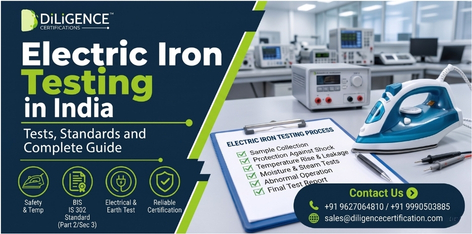
- Electric iron testing checks the electrical safety, heating performance, construction and reliability of an electric iron.
- The applicable product-specific Indian Standard is IS 302 (Part 2/Sec 3):2024, aligned with IEC 60335-2-3:2022.
- Electric irons are covered under mandatory BIS certification through the ISI Mark Scheme.
- Testing includes protection against electric shock, temperature rise, leakage current, electric strength, moisture resistance and abnormal operation.
- Dry irons, steam irons, spray irons and cordless models have different product features that must be considered during testing.
Introduction
Electric irons are commonly used in homes, hotels, laundries, garment manufacturing units and commercial establishments. They help remove wrinkles from clothes by applying controlled heat and pressure to the fabric. Although an electric iron looks like a simple household appliance, it contains several electrical and heating components that must work safely together.
In India, electric irons are covered by the applicable BIS certification requirements. Manufacturers must ensure that their products meet the relevant Indian Standard before placing covered products in the Indian market.
The main product-specific standard is IS 302 (Part 2/Sec 3):2024, which covers safety requirements for electric irons. It is used along with the applicable general requirements of IS 302 (Part 1).
This guide explains the importance of electric iron testing, applicable standards, major laboratory tests, BIS certification requirements, documentation, testing procedures and common reasons for failure.
What Is Electric Iron Testing?
Electric iron testing is the process of evaluating an electric iron against applicable safety and performance requirements. It checks whether the appliance can operate under its intended conditions without creating unacceptable risks for the user.
The testing process examines the complete appliance, including its electrical connections, heating system, temperature-control mechanism, insulation, enclosure, handle, soleplate, power cord and other relevant components.
The main purpose is to confirm that:
- The appliance provides adequate protection against electric shock.
- Electrical insulation remains effective during operation.
- The heating system operates within the applicable safety limits.
- The appliance does not create dangerous temperatures.
- The power cord and internal wiring are properly designed.
- The construction can withstand relevant mechanical stresses.
- Steam and water-related functions operate safely where applicable.
- Product markings and instructions provide the required information.
Electric iron testing is not limited to checking whether the iron heats up. A product may heat correctly and still fail important electrical safety tests.
For this reason, manufacturers should evaluate the complete appliance according to the relevant clauses of the applicable Indian Standard.
Which Indian Standard Applies to Electric Iron Testing?
The main product-specific safety standard for electric irons in India is:
IS 302 (Part 2/Sec 3):2024 / IEC 60335-2-3:2022 - Household and Similar Electrical Appliances - Safety, Part 2: Particular Requirements, Section 3: Electric Irons.
This is the second revision of the electric iron safety standard.
Electric irons must also meet the applicable general safety requirements under IS 302 (Part 1). The particular standard and general standard should be read together, including their applicable national requirements.
Important Update: IS 302 (Part 2/Sec 3):2024
The earlier standard was IS 302 (Part 2/Sec 3):2007. BIS published the revised 2024 version, and the concurrent-running period ended on 23 February 2025.
After this date, the old 2007 standard was withdrawn for the relevant certification requirements. Manufacturers should therefore use the revised 2024 standard for current electric iron certification.
The revised standard introduced or clarified several important requirements, including:
- Additional provisions for DC-supplied and battery-operated appliances.
- External accessible surface temperature requirements.
- Changes to product marking and user instructions.
- Requirements relating to charging metal-ion batteries.
- Additional mechanical strength requirements for irons.
- Changes to safeguards against excessive pressure.
- Updated requirements for protective devices.
These changes make it important for manufacturers to review their product designs and testing arrangements before applying for certification.
Standards Used for Electric Iron Safety
| Standard | Purpose |
|---|---|
| IS 302 (Part 1):2024 / IEC 60335-1:2020 | General safety requirements for household and similar electrical appliances |
| IS 302 (Part 2/Sec 3):2024 / IEC 60335-2-3:2022 | Particular safety requirements for electric irons |
Important: Always confirm the latest applicable amendments, BIS implementation guidelines and product manual before beginning testing or certification. A standard number alone does not establish that every product model is covered by the same testing scope.
Types of Electric Irons Covered Under Testing
Electric irons are available in different designs. Their operating methods and internal construction may vary, so manufacturers must identify the correct product type before preparing for testing.
The BIS product manual identifies several varieties within the scope of the electric iron licence.
1. Dry Iron
A dry iron uses an electrical heating element to heat the soleplate. It does not use a built-in steam-generation system.
Its main components include:
- Heating element
- Thermostat
- Temperature-control knob
- Soleplate
- Handle
- Electrical insulation
- Power cord and plug
Electric iron testing for dry irons focuses on electrical safety, temperature control, heating performance, insulation and mechanical construction.
2. Steam Iron
A steam iron uses water to produce steam, which helps remove wrinkles from clothes.
It generally contains a water tank, heating chamber, steam channels and steam-control mechanism.
Testing may cover additional aspects relating to moisture resistance, steam generation, pressure protection and the safe operation of water-handling components.
3. Spray Iron
A spray iron releases a controlled amount of water onto fabric through a spray mechanism.
The spray function adds water-handling components that must be evaluated as part of the complete appliance.
The manufacturer must ensure that water does not create an electrical safety hazard during normal use or applicable testing conditions.
4. Vented Steam Iron
A vented steam iron releases steam through openings in its soleplate. It uses an internal water and heating arrangement to generate steam.
Its design requires attention to steam distribution, water leakage, heating and electrical insulation.
5. Pressurised Steam Iron
A pressurised steam iron uses a pressurised steam-generation arrangement.
Its construction must incorporate appropriate safeguards against excessive pressure and other relevant hazards.
6. Instantaneous Steam Iron
An instantaneous steam iron produces steam through an arrangement that heats water as it passes through the appliance.
The water flow, heating arrangement and electrical safety must be considered during evaluation.
7. Cordless Electric Iron
A cordless iron can be removed from its charging or heating base for use.
Depending on its design, the appliance may include rechargeable batteries, detachable batteries or a separate power base.
The applicable standard includes provisions relevant to battery-operated designs, where applicable.
Note: The final licence scope depends on the manufacturer’s declared models, product varieties, ratings, construction and testing capabilities. Not every model is automatically covered simply because it belongs to the same brand.
Why Is Electric Iron Testing Important?
Electric iron testing is important because the appliance operates at high temperatures and is directly handled by users.
A small manufacturing defect can affect product safety, reliability and consumer confidence.
Here are the main reasons why manufacturers should take testing seriously.
1. Protection Against Electric Shock
An electric iron contains live electrical components. If insulation is damaged or protective arrangements are inadequate, users may be exposed to electric shock.
Testing helps evaluate insulation, accessibility of live parts and relevant earthing arrangements.
2. Prevention of Overheating
An electric iron must generate sufficient heat for ironing without exceeding applicable safety limits.
A faulty thermostat, heating element or temperature-control mechanism can result in overheating.
Temperature-related tests help identify these problems.
3. Safe Steam Generation
Steam irons use water and heat to produce steam. Improper construction can result in leakage, excessive pressure or unsafe operation.
Testing evaluates the applicable requirements for the appliance’s steam-related design.
4. Electrical Insulation and Reliability
The insulation system protects users from dangerous electrical contact.
Testing checks whether the insulation can withstand the relevant electrical and environmental stresses.
5. Mechanical Strength
An iron may experience accidental impacts, pressure and regular handling during use.
Mechanical strength testing helps evaluate whether the appliance can withstand the relevant mechanical conditions without creating hazards.
6. Better Product Quality
Testing can identify design and manufacturing defects before products reach consumers.
This helps manufacturers improve product consistency, reduce complaints and strengthen their quality-control systems.
7. BIS Certification Compliance
Electric irons are covered by mandatory BIS certification requirements.
Manufacturers must obtain the applicable BIS licence and use the Standard Mark according to the licence conditions before marketing covered products in India.
Major Tests Performed During Electric Iron Testing
Electric iron testing involves several electrical, thermal, mechanical and construction-related evaluations.
The exact test programme depends on the appliance type, construction, declared ratings and applicable standard.
The following are important tests referenced in the BIS product manual and relevant safety requirements.
1. Protection Against Electric Shock Test
This test checks whether users are adequately protected from contact with live electrical parts.
During testing, relevant accessibility probes and measuring arrangements are used to evaluate whether dangerous live parts can be reached.
The appliance enclosure, handle, openings and other accessible areas are examined.
The design must therefore provide suitable protection under the applicable standard.
2. Power Input and Current Test
The power input and current test checks whether the appliance operates within the applicable electrical rating requirements.
The iron is operated under specified conditions, and the electrical input is measured using suitable instruments.
The evaluation considers:
- Rated voltage
- Rated frequency
- Power input
- Current consumption
- Applicable permissible variations
3. Temperature Rise Test
The temperature rise test evaluates the heating behaviour of the iron and the temperature of relevant parts during operation.
The appliance is operated under specified conditions, and temperatures are measured at the locations required by the standard.
The evaluation may include accessible surfaces, handles, internal components and other relevant points.
Why is it important?
An electric iron is designed to become hot, but its accessible surfaces and other components must remain within the applicable limits.
Excessive temperature can damage insulation, affect components or create a risk of burns.
4. Leakage Current Test
Leakage current testing checks whether unwanted electrical current flows through accessible conductive parts or other relevant paths.
The appliance is operated under the prescribed conditions, and leakage current is measured using appropriate instruments.
Why is it important?
Excessive leakage current can indicate an insulation problem or an unsafe electrical design.
This test is especially important for appliances that combine electrical heating with water or steam functions.
5. Electric Strength Test
The electric strength test, also called a high-voltage or dielectric strength test, evaluates the ability of the insulation system to withstand the specified electrical stress.
A prescribed test voltage is applied between relevant parts of the appliance.
The test checks whether the insulation withstands the applied voltage without unacceptable breakdown.
6. Insulation Resistance Test
Insulation resistance testing evaluates the electrical resistance between relevant conductive parts.
An insulation resistance meter is used under the conditions prescribed by the applicable standard.
The result helps determine whether the insulation system provides the required electrical separation.
7. Moisture Resistance Test
Moisture resistance testing evaluates whether the appliance remains electrically safe after exposure to the moisture conditions specified by the standard.
This test is particularly relevant to steam irons and spray irons because they contain water-related components.
The appliance is subjected to the prescribed moisture conditioning or testing procedure, followed by relevant electrical safety checks.
8. Abnormal Operation Test
The abnormal operation test evaluates how the iron behaves under specified abnormal conditions.
The testing procedure may involve relevant simulated fault conditions or operating conditions described by the standard.
The objective is to verify that the appliance does not create unacceptable hazards when it is not operating under normal conditions.
9. Stability and Mechanical Hazards Test
This test evaluates whether the appliance remains stable under the applicable test conditions and whether its construction creates mechanical hazards.
The design of the base, soleplate, handle and other relevant components may be examined.
The test helps identify risks caused by instability or unsafe construction.
10. Mechanical Strength Test
Mechanical strength testing checks whether the appliance can withstand the specified mechanical stresses.
The relevant test arrangements may include impact or other mechanical assessments.
The purpose is to ensure that the appliance does not develop dangerous defects when subjected to the conditions specified by the standard.
The 2024 revision includes an additional mechanical strength requirement for the iron.
11. Construction Test
The construction test evaluates whether the internal and external design of the appliance meets the applicable requirements.
The examination may cover:
- Electrical component positioning
- Insulating barriers
- Protective enclosures
- Heating element arrangement
- Handle construction
- Steam-related components
- Protective devices
- Internal connections
- Mechanical assembly
A properly designed construction reduces the possibility of electrical, thermal and mechanical hazards.
12. Internal Wiring Test
Internal wiring is evaluated to check whether wires are correctly selected, routed, secured and protected.
The testing considers the applicable requirements relating to insulation, mechanical protection and connections.
Poor internal wiring may cause short circuits, overheating or insulation damage.
13. Supply Cord and Cord Grip Test
The external power cord must withstand the relevant mechanical stresses associated with regular use.
The cord grip is evaluated to check whether the cable is properly secured and protected against excessive pulling or movement.
The relevant cord and supply connection requirements are particularly important because electric irons are frequently moved during operation.
14. Earthing Test
Earthing provisions are evaluated where applicable to the appliance’s electrical protection class and construction.
The earth continuity test checks the electrical continuity of the protective earthing path.
For applicable Class I appliances, proper earthing helps provide a safe path for fault current.
Class II and Class III designs have different protection arrangements, so the applicable requirements must be assessed according to the declared appliance class.
15. Screws and Connections Test
This evaluation checks whether screws, terminals and electrical connections are properly designed and secured.
Loose or unsuitable connections can lead to overheating, arcing or mechanical failure.
16. Resistance to Heat, Fire and Tracking
Relevant non-metallic materials and insulating components may be assessed for their resistance to heat, fire and tracking according to the applicable requirements.
The test programme can include glow-wire, ball-pressure or other prescribed methods.
These evaluations help determine whether materials can maintain safe performance under relevant conditions.
17. Resistance to Rusting Test
Metallic parts that may be exposed to moisture or other relevant environmental conditions are evaluated for resistance to rusting.
This is important for maintaining the reliability of the appliance’s metal components and electrical connections.
18. Transient Overvoltage Test
The applicable requirements may include evaluation of insulation and electrical components under specified transient overvoltage conditions.
This helps assess whether the product can withstand the relevant electrical stresses.
19. Marking and Instructions Test
Product markings and user instructions are checked against the applicable standard.
The assessment may include:
- Manufacturer identification
- Rated voltage
- Rated frequency
- Rated power input
- Appliance identification
- Required safety warnings
- Operating instructions
- Applicable symbols
- Relevant product information
Incorrect or incomplete markings can create confusion for users and may lead to non-compliance.
20. Charging of Metal-Ion Batteries
For applicable battery-operated electric iron designs, the revised requirements include a specific provision relating to charging of metal-ion batteries.
The assessment depends on the battery arrangement and the applicability of the relevant standard clauses.
Manufacturers should not assume that a cordless model is exempt from battery-related safety requirements.
Important: The tests listed above are not a substitute for the complete Indian Standard. The BIS product manual identifies test equipment, test clauses and inspection requirements. The laboratory must determine the complete applicable test programme for the particular model.
Electric Iron Testing Requirements: Quick Reference Table
| Test | Main Purpose |
|---|---|
| Protection against electric shock | Checks protection from accessible live parts |
| Power input and current | Evaluates electrical input and consumption |
| Temperature rise | Checks temperature behaviour |
| Leakage current | Evaluates unwanted current leakage |
| Electric strength | Checks insulation withstand capability |
| Insulation resistance | Evaluates electrical insulation |
| Moisture resistance | Checks safety under specified moisture conditions |
| Abnormal operation | Evaluates behaviour under abnormal conditions |
| Stability and mechanical hazards | Checks stability and mechanical safety |
| Mechanical strength | Evaluates resistance to specified mechanical stresses |
| Construction | Checks design and component arrangement |
| Internal wiring | Evaluates internal electrical connections |
| Cord grip | Checks supply cord security |
| Earthing | Evaluates protective earth arrangements where applicable |
| Resistance to heat and fire | Evaluates relevant material safety |
| Resistance to rusting | Checks corrosion resistance |
| Marking and instructions | Verifies product information and safety instructions |
Special Testing Considerations for Steam Irons
Steam irons require additional attention because they combine electrical heating with water storage and steam generation.
The manufacturer must consider the complete water-handling system rather than focusing only on the heating element.
Water Tank Design
The water tank must be designed to withstand the relevant conditions of use.
Its material, construction, connections and placement should be evaluated for applicable safety requirements.
Water Leakage
Water leakage can affect electrical components and insulation.
The product design should prevent water from entering areas where it could create an electrical hazard.
Steam Generation
The heating arrangement must produce steam under the intended operating conditions.
The relevant design must also account for the safety requirements applicable to steam outlets and internal passages.
Pressure Protection
Where pressure-related requirements apply, suitable safeguards must be incorporated into the appliance.
The revised electric iron standard includes modified requirements intended to ensure adequate protection against excessive pressure.
Moisture-Related Electrical Safety
Steam and water may affect electrical insulation.
Manufacturers should ensure that relevant electrical safety requirements remain satisfied after the prescribed moisture-related testing.
Electric Iron Testing Procedure: Step-by-Step Process
A systematic testing procedure helps manufacturers understand the requirements before submitting products to a laboratory.
The following steps explain a typical approach.
Step 1: Identify the Product Type
First, identify the exact type of electric iron.
Determine whether it is:
- Dry iron
- Vented steam iron
- Pressurised steam iron
- Instantaneous steam iron
- Spray iron
- Cordless iron
- Battery-operated iron
The product type affects the applicable requirements and licence scope.
Step 2: Review the Applicable Indian Standard
Identify the current applicable edition of IS 302 (Part 2/Sec 3) and the relevant general requirements of IS 302 (Part 1).
Review the applicable clauses, amendments, BIS implementation guidelines and product manual.
This step helps avoid using an outdated standard or an incomplete test programme.
Step 3: Review Product Design and Technical Specifications
Prepare the product’s technical information.
This should include:
- Product model number
- Rated voltage
- Rated frequency
- Rated power
- Appliance class
- Supply type
- Heating element details
- Thermostat specifications
- Soleplate material and coating
- Power cord specifications
- Water tank capacity, where applicable
- Battery details, where applicable
The information should match the actual sample submitted for testing.
Step 4: Conduct Pre-Compliance Checks
Before sending the product to the laboratory, manufacturers should review its electrical and mechanical construction.
Check insulation, wiring, heating performance, temperature-control operation, product markings and safety arrangements.
This helps identify common design problems at an early stage.
Step 5: Submit Samples to the Laboratory
The product samples are submitted for the applicable testing programme.
The BIS product manual specifies a sample quantity of four for its certification reference.
The actual sampling and testing arrangements should be confirmed with BIS and the relevant laboratory according to the application and current guidelines.
Step 6: Perform Laboratory Testing
The laboratory carries out the applicable tests using suitable equipment.
The tests may include electrical safety, temperature rise, moisture resistance, mechanical strength, abnormal operation and other relevant evaluations.
Step 7: Review the Test Results
After testing, the results are evaluated against the applicable requirements.
If a sample fails, the manufacturer should identify the root cause and make suitable corrections.
A revised or corrected sample may need to undergo the relevant testing again.
Step 8: Prepare for BIS Factory Assessment
For certification, BIS may assess the manufacturer’s production facilities, quality-control arrangements, testing capabilities and manufacturing processes.
The manufacturer should ensure that its production system can consistently manufacture products that conform to the applicable standard.
Step 9: Complete BIS Certification Requirements
The manufacturer must complete the applicable BIS application, inspection, testing and other certification requirements.
The licence is granted only after BIS is satisfied that the relevant conditions have been met.
Step 10: Maintain Product Quality After Certification
Obtaining an ISI licence is not the end of the compliance process.
Manufacturers must continue to follow the applicable Scheme of Inspection and Testing, maintain records, control production quality and meet the conditions of their BIS licence.
BIS Certification for Electric Irons in India
BIS certification is an important regulatory requirement for electric irons sold in India.
Electric irons are covered under mandatory certification through the applicable ISI Mark Scheme.
The relevant product-specific certification standard is IS 302 (Part 2/Sec 3):2024.
The applicable general safety requirements must also be considered.
Under the mandatory certification framework, manufacturers of covered electric irons must obtain the appropriate BIS licence before manufacturing or selling products in the Indian market, subject to the applicable legal requirements and exemptions, if any.
What Is BIS Certification?
The Bureau of Indian Standards (BIS) is India’s national standards body.
It develops Indian Standards and operates conformity assessment schemes for products.
BIS certification confirms that a product covered by a certification scheme has been assessed against the applicable requirements and is authorised to carry the relevant Standard Mark under a valid licence.
For electric irons, the applicable route is the ISI Mark Scheme under Scheme-I.
Why Is BIS Certification Mandatory for Electric Irons?
Electric irons operate using electrical power and heating elements.
Defects in their design or construction can create risks such as electric shock, overheating, fire and mechanical hazards.
Mandatory certification helps ensure that covered products meet the applicable safety requirements before entering the market.
ISI Mark for Electric Irons
The ISI Mark is the Standard Mark used under the relevant BIS licence.
Manufacturers must not apply the ISI Mark merely because their product has passed a laboratory test.
The mark can be used only after BIS grants the appropriate licence and according to its terms.
The manufacturer must also ensure that only products covered by the licence are marked.
BIS Certification Process for Electric Irons
The following is a general overview of the ISI certification process.
1. Application Preparation
The manufacturer identifies the product category, standard, model details and intended licence scope.
The application must contain accurate technical and manufacturing information.
2. Documentation
The required documents are prepared, including company details, factory information, product specifications, manufacturing process information and quality-control records.
3. Testing Arrangements
Product samples are tested according to the applicable Indian Standard through the relevant BIS-recognised laboratory or other permitted arrangements.
4. Factory Inspection
BIS evaluates the manufacturing facility, production arrangements, quality-control system and testing capabilities as applicable.
5. Compliance Review
The test reports and inspection findings are reviewed.
The manufacturer may need to address any non-conformities identified during the assessment.
6. Grant of Licence
If the applicable certification requirements are fulfilled, BIS may grant the licence for the declared product scope.
7. Use of ISI Mark
After receiving the licence, the manufacturer can use the Standard Mark on the covered products and packaging according to BIS requirements.
8. Ongoing Compliance
The manufacturer must maintain quality-control procedures, conduct prescribed tests and comply with applicable surveillance and licence conditions.
Note: The above steps are a practical overview, not a guarantee of approval or a fixed certification timeline. The actual process depends on the application, product scope, laboratory results and BIS assessment.
Documents Required for Electric Iron BIS Certification
Proper documentation is essential for a smooth certification process.
The exact document list may vary depending on the applicant, manufacturing location, product design and BIS requirements.
Commonly required documents and information include:
Company Documents
- Company registration certificate
- Business address proof
- Manufacturing unit address
- Authorised signatory details
- Identity and contact details of the applicant
- Relevant business registration documents
Manufacturing Documents
- Factory layout
- Manufacturing process flow chart
- List of production machinery
- List of testing equipment
- Details of manufacturing facilities
- Quality-control arrangements
- Details of in-house laboratory, where applicable
Product Documents
- Product technical specifications
- Model numbers
- Product drawings
- Circuit diagrams
- Electrical ratings
- Component details
- Bill of materials
- Product photographs
- User instruction manual
- Product labels and packaging details
Testing Documents
- Relevant laboratory test reports
- Component test certificates, where applicable
- In-house test records
- Calibration certificates
- Quality-control inspection records
Other Documents
- Trademark authorisation, where applicable
- Authorisation letter for the signatory
- Factory and production details
- Any declarations or undertakings required by BIS
Manufacturers should verify the current BIS application requirements before submitting documents. A complete document set reduces avoidable queries and delays.
Electric Iron Testing Equipment Used in Laboratories
Electric iron testing requires specialised equipment to evaluate electrical, thermal and mechanical safety.
The BIS product manual provides an indicative list of major testing equipment.
Some commonly required equipment includes:
| Equipment | Purpose |
|---|---|
| Voltmeter | Measures electrical voltage |
| Ammeter | Measures electrical current |
| Wattmeter | Measures power input |
| Finger test apparatus | Checks accessibility of hazardous live parts |
| Insulation resistance meter | Measures insulation resistance |
| High-voltage tester | Performs electric strength testing |
| Humidity chamber | Provides controlled moisture conditions |
| Temperature measurement equipment | Measures relevant temperatures |
| Test corner | Supports specified temperature and abnormal operation tests |
| Spring hammer | Used for applicable mechanical impact assessments |
| Flexing test apparatus | Evaluates relevant flexible cable or wiring requirements |
| Cord grip test apparatus | Evaluates power cord retention |
| Earth continuity testing panel | Measures protective earth continuity |
| Torque screwdriver | Checks relevant screw and connection requirements |
| Glow-wire apparatus | Evaluates applicable material resistance to heat and fire |
| Pressure test apparatus | Supports relevant construction and pressure assessments |
The exact equipment depends on the test clauses and the type of electric iron being evaluated.
A laboratory must have suitable facilities, competent personnel and appropriate measurement arrangements to carry out the required tests.
BIS Product Manual for Electric Iron Testing
The BIS product manual is an important reference for manufacturers and laboratories.
The relevant document is:
PM/IS 302 (Part 2/Sec 3)/IEC 60335-2-3/2/October 2024.
It provides guidance on:
- Product scope
- Sampling guidelines
- Grouping guidelines
- Test equipment
- Scheme of Inspection and Testing
- Quality assurance arrangements
- Marking requirements
- Possible tests in a day
The manual identifies four samples as the stated sample quantity in its sampling section.
It also lists several varieties that may be covered within the licence scope, including dry irons, vented steam irons, pressurised steam irons, instantaneous steam irons and spray irons, with corded or cordless arrangements.
The manufacturer must declare the relevant technical parameters for each model.
Aesthetic changes such as colour or visual design may not necessarily constitute a separate model. However, model grouping and testing must follow the product manual and BIS assessment requirements.
Quality Control Requirements for Electric Iron Manufacturers
Product safety must be maintained throughout the manufacturing process.
A manufacturer cannot depend only on the initial laboratory test report. It must also establish suitable quality-control procedures.
The BIS product manual expects manufacturers to implement a Quality Assurance Plan.
1. Incoming Material Inspection
Components and materials should be checked before they enter production.
Important components include:
- Heating elements
- Thermostats
- Electrical wires
- Power cords
- Plugs
- Insulating materials
- Protective devices
- Soleplates
- Switches and terminals
2. In-Process Quality Control
Manufacturers should monitor important production stages.
This may include heating element assembly, internal wiring, electrical connections, insulation arrangements and final product assembly.
3. Routine Testing
Applicable routine tests should be performed according to the approved quality plan and Scheme of Inspection and Testing.
The BIS product manual identifies earth continuity, electric strength and functional testing among the routine checks.
4. Periodic Testing
Other tests must be carried out at the frequencies specified by the applicable quality plan.
The frequency may differ according to the test, model and manufacturing arrangement.
5. Test Records
The manufacturer should maintain records of relevant inspections and tests.
These records help demonstrate continued compliance and support BIS assessment.
6. Equipment Calibration
Testing instruments should be maintained and calibrated according to the applicable quality system.
Incorrect measurements can result in unreliable quality decisions.
Manufacturers should follow a structured pre-testing checklist.
Product Design Checklist
- Confirm the correct product type.
- Review the heating element specification.
- Check thermostat operation.
- Verify electrical insulation.
- Review the internal wiring layout.
- Check protective earthing where applicable.
- Review the power cord and plug.
- Evaluate the handle and enclosure.
- Check the water tank and steam channels where applicable.
- Review pressure protection where applicable.
Documentation Checklist
- Prepare complete product specifications.
- Verify model numbers.
- Check rated voltage, frequency and power.
- Prepare electrical diagrams.
- Prepare product photographs.
- Verify product markings.
- Prepare the user instruction manual.
- Keep component information available.
Laboratory Readiness Checklist
- Confirm the applicable Indian Standard.
- Identify the complete testing scope.
- Confirm sample requirements with the laboratory.
- Ensure samples match the declared product specifications.
- Check that test instruments and records are available.
- Address identified design defects before formal testing.
Difference Between Electric Iron Testing and BIS Certification
These two terms are related, but they do not mean the same thing.
| Electric Iron Testing | BIS Certification |
|---|---|
| Evaluates the product against applicable requirements | Provides formal certification under a BIS scheme |
| Conducted by a suitable testing laboratory | Granted by BIS |
| Produces test results or a test report | Authorises use of the applicable Standard Mark under a licence |
| Focuses on product conformity | Covers product conformity and applicable certification conditions |
| Does not independently authorise ISI marking | Allows marking within the approved licence scope |
For example, a manufacturer may receive a successful electric iron test report. However, the manufacturer cannot automatically apply the ISI Mark based only on that report.
The applicable BIS certification process must be completed and the licence must be granted.
Role of an Electric Iron Testing Laboratory
A testing laboratory plays an important role in evaluating electric iron safety.
It must have suitable testing facilities, competent technical staff and the capability to perform the applicable test methods.
A laboratory may be involved in:
- Reviewing product samples
- Checking technical specifications
- Conducting electrical safety tests
- Performing temperature-related evaluations
- Checking mechanical construction
- Evaluating relevant steam-related safety requirements
- Preparing test reports
- Recording test observations
For BIS certification, manufacturers should ensure that the laboratory and testing arrangement are acceptable under the applicable BIS requirements.
Not every laboratory report is automatically acceptable for every certification purpose. The laboratory’s recognition, accreditation and scope must be checked for the relevant tests.
Role of Diligence Certifications in Electric Iron BIS Certification
Diligence Certifications provides compliance and certification consultancy support to manufacturers and businesses seeking to understand and complete applicable BIS certification requirements.
The role of a certification consultant is different from that of a physical testing laboratory.
Diligence Certifications does not perform physical electric iron laboratory testing. Instead, it can help businesses understand the certification requirements and prepare for the applicable process.
Support may include:
1. Standard Identification
Helping manufacturers identify the applicable electric iron standard and understand the relevant BIS certification requirements.
2. Documentation Assistance
Helping organise company information, product specifications, manufacturing details and other documents required for the application.
3. Product Compliance Guidance
Helping businesses understand the relevant safety requirements and identify potential documentation or product-compliance gaps.
4. Laboratory Coordination Guidance
Helping manufacturers understand the testing process and the importance of selecting a suitable laboratory with the required scope.
5. BIS Application Assistance
Providing guidance on the applicable application and certification procedure.
6. Factory Assessment Preparation
Helping manufacturers understand the documentation, quality-control arrangements and manufacturing information that may be reviewed during BIS assessment.
7. Certification Process Support
Providing assistance throughout the applicable certification process, including responding to procedural queries and understanding compliance requirements.
For more information, visit the Diligence Certifications website.
Frequently Asked Questions
Conclusion
Electric iron testing is an important part of ensuring the safety, quality and regulatory compliance of household electrical appliances. An electric iron must do more than heat up properly. It must also provide adequate protection against electric shock, overheating, insulation failure, mechanical hazards and other risks covered by the applicable Indian Standard.
In India, electric iron manufacturers should follow IS 302 (Part 2/Sec 3):2024 / IEC 60335-2-3:2022 along with the applicable general safety requirements of IS 302 (Part 1). Testing may include temperature rise, leakage current, electric strength, moisture resistance, abnormal operation, mechanical strength, construction and other relevant evaluations.
Manufacturers must also complete the applicable BIS certification requirements and obtain a valid licence before using the ISI Mark on covered products.
Proper product design, laboratory testing, accurate documentation and regular quality control can help businesses reduce compliance problems and improve product reliability.