BIS Certification
 CDSCO
 PESO
 CPCB
 LMPC
 WPC Approval
 Global Approvals
 TEC
 ARAI
 BEE
 ISO Certification
 DGCA Certification
 NOC For Steel
 APEDA Registration























 Business Registration
 FSSAI Mark Certification












 (32).jpg)
 Legal Services
 Trademark Registration
 Copyright Registration
 Patent Registration
 By
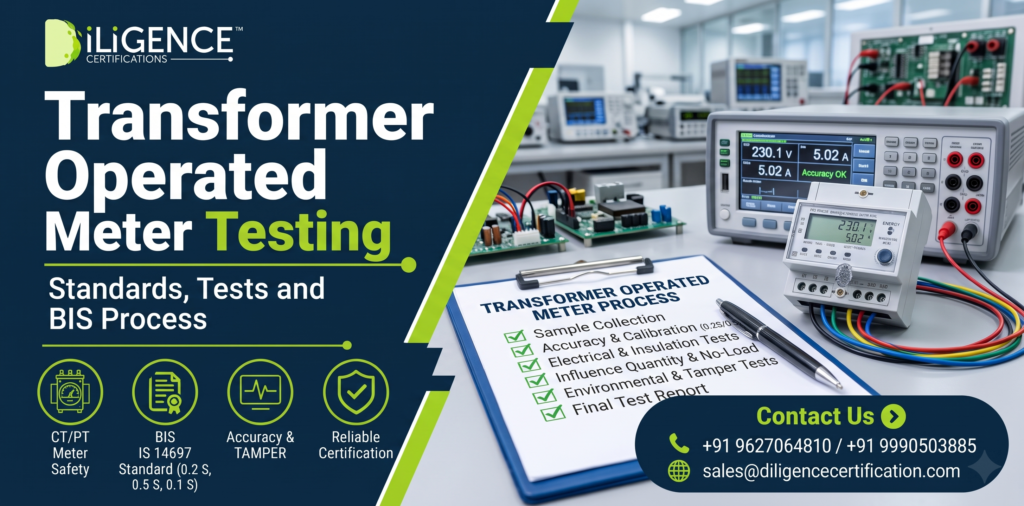
- Transformer operated meters (CT operated and CT-PT operated meters) are used where the load is too big to connect the meter directly, like factories, malls and substations.
- In India, these static meters are tested as per IS 14697, which covers accuracy classes 0.2 S and 0.5 S for watthour meters and 0.2 S, 0.5 S and 1 S for var-hour meters. A recent amendment adds class 0.1 S.
- Testing mainly checks accuracy, but it also checks safety, heat, surge and tamper-related behaviour, marking and routine production quality.
- Tests happen at two levels: your own factory lab for routine checks and a recognised lab for type testing.
- Most failures come from small drifts in accuracy at low current, weak insulation and wrong marking.
- Rules and dates can change, so always confirm the latest notification on the BIS and CEA websites before you plan your samples.
Introduction
That’s exactly why the meter used for big consumers is treated very seriously. It is not a simple household meter. It is connected through current transformers and, in many cases, voltage transformers too.
Think of it like a weighing scale at a big grain market. You can’t just trust the shopkeeper’s word. The scale has to be checked and stamped again and again. A transformer operated meter is that scale, and transformer operated meter testing is the checking and stamping.
In this blog, we’ll understand the whole thing in very simple words: what these meters are, which standard applies, what tests are done, how the process works and what mistakes you should avoid.
What Is Transformer Operated Meter Testing?
A transformer operated meter is a static (electronic) energy meter that does not take the full line current directly. Instead, a current transformer (CT) steps the current down to a small value, usually 1 A or 5 A, and the meter measures that. In high voltage systems, a voltage transformer (PT) is also used.
Transformer operated meter testing means checking this meter in a laboratory against the requirements of the standard. The lab checks things like:
- Does the meter measure energy within the allowed error?
- Does it stay accurate when voltage, frequency, temperature or load changes?
- Does it start measuring at a very small current?
- Does it stay safe and working under high voltage, surge and heat?
- Is the marking clear and correct?
It’s not a single test. It’s a full set of checks, done on a fixed number of samples, in a fixed order.
Whole Current Meter vs Transformer Operated Meter
People mix these two. Here’s the quick table.
| Point | Whole current meter | Transformer operated meter |
|---|---|---|
| Connection | Directly in the line | Through CT, and sometimes PT also |
| Typical use | Homes, shops, small units | Factories, malls, substations, large buildings |
| Typical accuracy classes | Class 1 and 2 | Class 0.1 S, 0.2 S and 0.5 S |
| Main standard in India | IS 13779 | IS 14697 |
The letter S means the meter is designed for a special wider measuring range, mainly for use with S-type CTs. For example, a class 0.5 S meter is normally used with a matching class CT, so the whole metering chain stays accurate.
Which Standards Apply to Transformer Operated Meter Testing?
The main standard is IS 14697. Its full title is a.c. static transformer operated watthour and var-hour meters. It is based on the international standard IEC 62053-22 for the active energy part.
| Standard | What it covers |
|---|---|
| IS 14697:2021 (first revision) | Watthour meters class 0.2 S and 0.5 S, var-hour meters class 0.2 S, 0.5 S and 1 S. Covers type tests, routine tests and acceptance tests. |
| IS 14697 amendments (including Amendment No. 2, 2024) | Adds class 0.1 S and updates some tables and limits. |
| IS 13779 | Whole current static meters, class 1 and 2 (not transformer operated) |
| IS 16444 | Smart meters, a different product with its own standard |
| IS 15959 | Data exchange for metering, relevant for communication and reading |
| IS 11448 | Application guide for a.c. electricity meters |
A simple example: suppose you make a three-phase four-wire, class 0.2 S meter that works with CT only. Your product is tested against IS 14697 for accuracy, insulation, climatic behaviour and marking, and the licence scope will mention the class, phase, wiring type, voltage and current ratings.
Important note: BIS has issued amendments and guidelines for this standard. Utilities also have their own technical specifications on top, and CEA metering regulations apply for installation. Always confirm the latest version and any transition date on the BIS website before you start.
Why Is Transformer Operated Meter Testing Important?
- Billing accuracy: Big consumers pay very high bills. Small errors become big money.
- Fair for both sides: The utility doesn’t lose, and the consumer doesn’t overpay.
- Grid and energy accounting: Meters are also used for energy audits and for settling accounts between utilities.
- Safety: A meter with weak insulation or poor heat behaviour can become a fire risk on a live panel.
- Legal need: Where a product is covered under compulsory certification, selling without the ISI mark is not allowed. Check the current scope with BIS.
- Tender needs: Most utilities and large buyers ask for test reports and BIS licence before they accept a meter.
- Fewer disputes: A properly tested meter means fewer complaints and fewer site visits.
What Tests Are Conducted in Transformer Operated Meter Testing?
IS 14697 divides tests into type tests, routine tests and acceptance tests. The lab goes group by group.
| Test group | What the lab checks | In simple words |
|---|---|---|
| Marking and construction | Name plate, class, constant, ratings, case, terminals, display | Is everything clear and built safely? |
| Power consumption | Burden of voltage and current circuits | How much power does the meter itself use? |
| Starting current | Meter should begin recording at a very low current | Does it catch even tiny loads? |
| No-load condition | Meter should not creep when there is no load | Does it stay still when nothing is connected? |
| Accuracy at different currents | Error limits at different loads and power factors | Is the reading correct at low, normal and high load? |
| Influence quantities | Voltage variation, frequency variation, temperature, harmonics, phase reversal and more | Does accuracy hold when conditions change? |
| Repeatability | Same test repeated several times | Does the meter give the same result every time? |
| Meter constant | Relation between display and test output | Is the pulse constant correct? |
| Insulation and high voltage | Impulse voltage and AC high voltage tests | Can insulation take a high voltage stress? |
| Electromagnetic compatibility | Electrostatic discharge, fast transients, radio frequency interference and surge | Will it survive electrical noise and disturbances? |
| Climatic tests | Dry heat, cold, damp heat cycle, solar radiation | Will it work in Indian summer, winter and monsoon? |
| Mechanical tests | Vibration, shock, spring hammer | Can it survive transport and rough handling? |
| Fire and heat resistance | Heat and glow wire tests on case and terminal block | Will the plastic catch fire or melt? |
| Self heating | Change of error due to heating at maximum current | Does accuracy drift when the meter gets warm? |
Accuracy Test, the Heart of the Whole Process
This is the most important part. The meter is compared against a reference standard at different current points and power factors. For example, at unity power factor and a current between five percent of basic current and maximum current, the allowed error is about plus or minus 0.2 percent for class 0.2 S, and plus or minus 0.5 percent for class 0.5 S (as per the standard tables). At the lower current band, the limits are wider.
The lab checks these points with balanced loads, unbalanced loads and different power factors (lagging and leading). The reference equipment must be calibrated and traceable. If the meter goes outside the limit even at one point, that point fails.
Accuracy Classes Explained in Simple Words
| Class | What it means | Where it is generally used |
|---|---|---|
| 0.1 S | Very high accuracy, newer class added by amendment | Reference and special metering points |
| 0.2 S | High accuracy | Grid and inter-utility metering, large industries |
| 0.5 S | Good accuracy for commercial use | Industrial and commercial consumers |
| 1 S (var-hour meters) | Used for reactive energy | Reactive energy measurement |
The smaller the number, the smaller the allowed error. Choose the class based on your buyer’s tender and the CT class used along with it.
Parts of the Meter That Get Checked Closely
| Part | Why the lab looks at it |
|---|---|
| Measuring element and ADC | Decides the basic accuracy |
| Power supply | Must work across voltage variation and surges |
| Display and register | Reading must be clear and must not reset or jump |
| Real time clock and memory | Needed for time-of-day tariff and data storage |
| Test output (pulse LED) | Used by the lab for accuracy testing, must be steady |
| Terminal block and cover | Needs heat resistance and proper contact |
| Communication port | Must work properly if provided |
A quick tip from the field: weak power supply design is one of the most common reasons for failure in surge and fast transient tests. Fix this early.
Two Kinds of Testing: Factory Lab vs Recognised Lab
Simple and important.
| Point | Factory lab | BIS-recognised lab |
|---|---|---|
| Who runs it | Your own team | An independent lab |
| Purpose | Routine and acceptance checks on production | Type testing for licence and surveillance |
| Equipment | Calibrated test bench, reference standard meter, high voltage tester | Full set including EMC and climatic chambers |
| Records | You must keep daily records | Lab issues the test report |
BIS checks both. During the factory visit, the officer looks at whether you have the needed test setup and whether records are properly maintained. Some heavy tests, like EMC and climatic tests, are usually done at the recognised lab. The BIS product manual and scheme of testing and inspection list what is expected.
Step-by-Step Process for Testing and BIS Certification
- Check the standard and scheme. Confirm the current IS 14697 version, amendments and any notification for your product.
- Finalise your models. List class, phases, wiring type, voltage, basic current and maximum current for each model.
- Prepare the factory. Set up production line, quality control plan and in-house test bench.
- Get your documents ready. See the list below.
- Pick a recognised lab. Make sure the lab has IS 14697 in its scope, including the amended version.
- Send samples. Give the exact number and type of samples asked for.
- Receive the test report. The lab issues it after all tests are done.
- Apply to BIS. Submit the application with the test report and documents on the BIS portal.
- Factory inspection and grant. BIS inspects the factory, may draw samples and then decides on the licence.
After the licence is granted, surveillance continues. So testing is not a one-time job.
Which BIS Registration Is Needed?
| Business type | What it generally needs |
|---|---|
| Indian manufacturer | BIS licence for the standard mark as per IS 14697 |
| Importer | The imported product must meet the Indian requirement, the foreign manufacturer route applies |
| Overseas manufacturer | Licence under the foreign manufacturers certification scheme |
| Private label brand | Work out the licence arrangement with the actual manufacturer |
| Utility or EPC buyer | Ask for valid licence and test reports from the supplier |
A licence scope normally mentions the class, phase and wiring, voltage and current ratings, and whether the meter connects through CT only or CT and PT. If you add a new rating or class later, check whether the licence scope needs to be extended.
Documents Required
Company documents
- Proof of business registration
- Factory address and layout
- Authorised signatory details
Product documents
- Product drawings and circuit diagram
- Bill of materials
- Rating and class details of each model
- Marking details and sample label
Testing and quality records
- Quality control plan
- Calibration certificates of reference standard and test equipment
- In-house test records
- Type test report from a recognised lab
A small tip: keep the calibration certificate of your reference standard meter always valid. An expired certificate can stop the whole inspection.
How Long Does Transformer Operated Meter Testing Take?
There is no fixed number of days that fits everyone. It depends on how ready your design is, how many models you have, the lab’s queue and how fast you answer queries. Climatic and EMC tests take time because they run in sequences. If a sample fails, you need to fix the issue and send fresh samples for that part.
So please plan early. Don’t wait till the tender submission date is near.
Cost of Transformer Operated Meter Testing
We are not giving any amounts here because the cost changes from lab to lab and from model to model. What decides the cost is:
- Number of models and classes
- Number of samples
- Whether you need EMC and climatic tests or only some
- Whether you need re-testing after a failure
- Whether all tests are done at one lab or split
- Licence and application related fees
Best way is to ask the lab for a clear breakup before you send samples.
Common Failures and Easy Fixes
| Failure | Likely reason | Easy fix |
|---|---|---|
| Error at low current | Weak calibration or noise in the measuring circuit | Improve calibration and board layout |
| Error shifts with temperature | Poor component stability | Use better reference and stable components |
| Meter creeping at no load | Noise or wrong threshold setting | Tune the no-load logic |
| Surge or fast transient failure | Weak power supply protection | Improve protection and filtering |
| Self-heating drift | Heat near the measuring element | Redesign the layout and use better material |
| Glow wire failure | Wrong plastic grade | Switch to proper flame-retardant grade |
| Marking remarks | Missing constant, class or symbol | Follow the marking clause word by word |
| Insulation failure | Low spacing or poor material | Improve clearance and creepage |
Common Mistakes to Avoid
- Testing as per an old version when an amendment or newer version applies.
- Ignoring class 0.1 S changes if you plan to offer it.
- Sending too few samples or wrong ratings.
- Using a reference meter with expired calibration.
- Leaving marking for the last day.
- Changing a component after type testing without informing anyone.
- Assuming one report covers all models without checking the grouping rules.
- Thinking that testing ends once the licence is granted.
Who Needs Transformer Operated Meter Testing?
- Meter manufacturers: You need type testing and routine testing for your range.
- Importers and traders: Check that the product you bring in has valid certification before you sell.
- Private label brands: If your name is on the meter, you carry the responsibility.
- Overseas manufacturers: You may need to apply through the foreign manufacturer route.
- Utilities and EPC contractors: You need valid reports from suppliers for your own acceptance process.
- Industries buying meters: Ask for test reports before you accept a batch.
Why Choose Diligence Certifications for transformer operated meter testing Certification?
The whole topic can look heavy at first. Classes, CT and PT, test sequences, amendments, factory readiness. Too many moving parts. That’s where a guide helps.
At Diligence Certifications, the focus is on keeping the process clear and practical. The team can help you with:
- Understanding the right standard, amendments and current position
- Checking documents before submission so basic mistakes are caught early
- Planning samples and coordinating with the recognised lab
- Supporting you during application and BIS queries
- Preparing for factory inspection
You can read about the support available on the BIS registration service page. Please note that final approval always depends on BIS and the recognised lab, and no consultant can promise a result.
After Registration: Market Checks and Surveillance
Getting the licence is not the end. BIS can pick samples from the factory or the market and test them again. If a product fails, action can be taken on the licence. So keep production quality steady, keep records updated and don’t change materials without checking.
Tips to Pass in the First Attempt
- Do pre-testing in your own lab before sending samples.
- Read the standard clause by clause, especially accuracy tables and marking.
- Test at low current points carefully, because errors show up there first.
- Keep the reference meter and all equipment calibrated.
- Protect the power supply well for surge and transient tests.
- Send production samples, not specially hand-made ones.
- Talk to the lab about sample count and grouping beforehand.
- Keep a record of every design change.
Quick Checklist Before Sending Samples
- Latest standard version and amendments confirmed
- Model list with class and ratings finalised
- Marking and name plate checked
- Pre-testing done in-house
- Correct number of samples packed
- Lab scope matches the standard version
- Documents and drawings ready
- Calibration certificates valid
Conclusion
Transformer operated meter testing is not just a formality. It decides whether a meter that handles very large loads can be trusted with the bill, the audit and the grid account.
If you remember only a few things, remember these. Use the right version of IS 14697 with its amendments, test properly in both your own lab and a recognised lab, keep calibration and records clean, and don’t ignore small errors at low current. Do that and the process becomes much smoother.