BIS Certification
 CDSCO
CDSCO
 PESO
PESO
 CPCB
CPCB
 LMPC
LMPC
 WPC Approval
 Global Approvals
 TEC
TEC
 ARAI
ARAI
 BEE
BEE
 ISO Certification
 DGCA Certification
 NOC For Steel
 APEDA Registration























 Business Registration
 FSSAI Mark Certification












 (32).jpg)
 Legal Services
 Trademark Registration
 Copyright Registration
 Patent Registration
 By
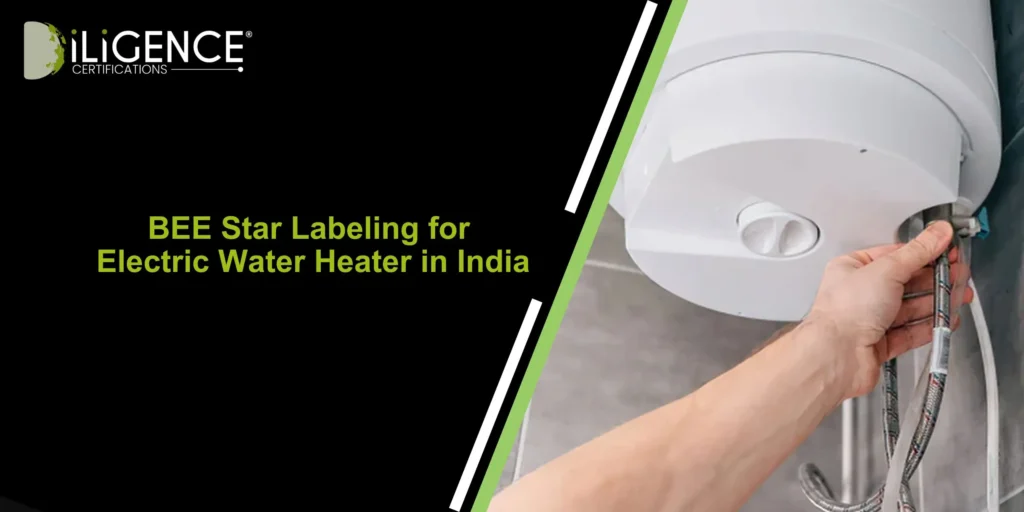
By - Electric Water Heaters (Geysers) fall under mandatory energy efficiency and safety compliance in India due to high electricity consumption and safety risks.
- Compliance is governed under EC Act, 2001 along with BEE Appliance Labeling Regulations and IS/IEC safety standards.
- Manufacturers and importers must ensure product conformity with updated amendments before sale or import in India.
- Bureau of Energy Efficiency (BEE) labeling is mandatory under 14(d) Appliance Labeling Regulations for energy rating disclosure.
- Non-compliance leads to penalties, import clearance delays, product seizure, and market rejection.
Introduction | Electric Water Heater
Electric Water Heaters (commonly known as geysers) are widely used household appliances in India. Due to increasing electricity consumption and safety concerns, the Government of India regulates these products under the Energy Conservation Act, 2001 (EC Act) and Bureau of Energy Efficiency (BEE) framework.
For manufacturers, importers, and exporters, compliance is not optional. It is a mandatory legal requirement before market entry. The regulations ensure that only energy-efficient, safe, and standardized products are sold in the Indian market.
This compliance also aligns with India’s broader energy conservation goals and consumer safety standards.
What is Electric Water Heater (Geyser) Compliance under EC Act?
Electric Water Heater compliance refers to adherence to Indian energy efficiency regulations and safety standards defined under:
- EC Act, 2001
- BEE Appliance Labeling Regulations
- IS/IEC Safety Standards
This ensures that geysers meet minimum energy performance standards (MEPS) and safety benchmarks before being sold or imported in India.
The product must comply with BIS IS standards and carry valid BEE star labeling where applicable.
Regulatory Notification & Standards Reference (Mandatory Table)
| Clause | Notification / Regulation / Amendment | Date / Reference | IS / IEC Standards |
| 14 (b) | S.O. 2901(E) | 7th September, 2016 | IS 2082:1993 and IS 302-2-21:2011 (with amendments) |
| 14 (a) | S.O. 2902(E) | 7th September, 2016 | IS 2082:1993 and IS 302-2-21:2011 |
| 14 (a) Amendment I | S.O. 1385(E) | 2nd May, 2017 | Same IS standards |
| 14 (a) Amendment II | S.O. 6308(E) | 24th December, 2018 | Updated IS compliance |
| 14 (a) Amendment III | S.O. 4486(E) | 10th December, 2020 | IS 302-2-21:2011 |
| 14 (a) Amendment IV | S.O. 5776(E) | 9th December, 2022 | IS 2082 / IEC aligned updates |
| 14 (a) Amendment V | S.O. 5970(E) | 23rd December, 2022 | Latest compliance update |
| 14 (d) | No. BEE/S&L/Water Heater/3/2015-16 | Energy Labeling Framework | BEE Star Labeling Rules |
| 14 (d) Amendment I | No. BEE/S&L/WaterHeater/3/2022-23 | Updated labeling norms | Energy Performance Standards |
| Appliance Labeling Regulation | No. 5506/BEE/S&L/AL/2025-26 | 26th December, 2025 (w.e.f. 1st Jan 2026) | Latest BEE labeling compliance |
Why This Certification is Important
Electric Water Heater (Geyser) certification under the EC Act and BEE framework is not just a regulatory formality-it directly impacts product approval, market entry, and long-term business credibility in India. With strict energy efficiency and safety norms, compliance ensures that only reliable and standardized products reach consumers while protecting businesses from legal and operational risks.
keypoints:
- Mandatory legal requirement under EC Act, 2001 and BEE regulations
- Ensures product safety and energy efficiency compliance
- Required for BIS approval and BEE star labeling eligibility
- Prevents penalties, product bans, and legal action
- Avoids import clearance delays and customs rejection
- Enhances brand trust and market competitiveness
- Supports sustainable energy usage and government compliance initiatives
Importance & Benefits
| Benefit | Explanation | Business Impact |
| Legal Compliance | Meets EC Act and BEE requirements | Avoids penalties and bans |
| Energy Efficiency Certification | Ensures reduced power consumption | Lower operational cost for users |
| Market Access | Required for sale in India | Enables PAN India distribution |
| Brand Credibility | Improves product trust | Higher consumer acceptance |
| Regulatory Approval | Needed for BIS & labeling | Faster import clearance |
Step-by-Step Process
- Identify Applicable Regulations
Determine compliance requirements under EC Act, 2001, BEE labeling regulations, and relevant IS/IEC standards (IS 2082, IS 302-2-21). - Product Design Compliance
Ensure the electric water heater is designed as per Indian safety and energy efficiency standards. - Testing in Approved Laboratory
Get the product tested in a BIS-recognized laboratory for safety and performance parameters. - Prepare Technical Documentation
Compile documents such as product specifications, test reports, manufacturing details, and quality control records. - Apply for BIS Certification (if applicable)
Submit application for ISI mark certification to ensure product safety compliance. - BEE Registration Application
Register the product under the BEE Star Labeling Scheme (Clause 14(d)). - Submission of Test Reports to BEE
Provide verified lab reports and energy performance data for approval. - Grant of BEE Star Label
Receive approval and star rating based on energy efficiency performance. - Labeling and Marking Compliance
Affix BEE label and required markings on the product before sale or import. - Post-Approval Compliance & Renewal
Maintain compliance with updated amendments and renew certifications as required.
Challenges Without a Consultant
Managing Electric Water Heater (Geyser) compliance independently can be complex due to frequent regulatory updates, technical standards, and multi-step approval processes. Businesses often face delays, rejections, or compliance gaps when they lack proper regulatory understanding and documentation accuracy.
keypoints:
- Misinterpretation of IS/IEC standards leading to non-compliant products
- Incomplete or incorrect documentation causing application rejection
- Delays in BIS and BEE approvals due to procedural errors
- Lack of awareness about latest amendments and regulatory updates
- Difficulty in coordinating with testing laboratories and authorities
- Risk of product detention or rejection at customs for imports
- Incorrect or non-compliant BEE labeling leading to penalties
- Increased time, cost, and operational inefficiencies
- Higher chances of repeated application corrections and delays
Why Choose Diligence Certification
Diligence Certification provides structured and compliance-driven support for Electric Water Heater approvals under EC Act and BEE regulations. The focus is on accuracy, speed, and minimizing regulatory risk for manufacturers and importers.
keypoints:
- End-to-end handling of BIS, BEE, and EC Act compliance processes
- Strong expertise in Electric Water Heater (Geyser) regulations and standards
- Accurate documentation preparation to reduce rejection risks
- Up-to-date knowledge of latest amendments (2016-2026 regulatory changes)
- Coordination with BIS-approved laboratories for smooth testing
- Faster approval timelines through process optimization
- Dedicated compliance support for manufacturers, importers, and exporters
- Assistance in BEE star labeling registration and renewal
- Transparent process with clear timelines and status updates
- Cost-effective compliance solutions with minimal operational burden
Conclusion
Electric Water Heater compliance under the EC Act and BEE regulations is mandatory for all manufacturers and importers in India. With multiple amendments and strict IS/IEC standards, regulatory adherence is critical for market access, safety, and energy efficiency.
Proper compliance ensures smooth business operations, avoids legal risks, and supports sustainable energy usage in India.
Frequently Asked Questions (FAQs)
Is BEE certification mandatory for electric water heaters?
Yes, it is mandatory under Appliance Labeling Regulations for energy efficiency labeling.
Which IS standard applies to geysers in India?
IS 2082:1993 and IS 302-2-21:2011 with amendments.
What is EC Act compliance?
It refers to adherence to Energy Conservation Act, 2001 regulations.
Who issues BEE certification?
Bureau of Energy Efficiency (BEE), Government of India.
Is BIS certification required for water heaters?
Yes, BIS certification is required for safety compliance.
How long does approval take?
Typically 4-8 weeks depending on documentation and testing.
What happens if compliance is not met?
Penalties, product rejection, and import clearance issues.
Are amendments mandatory to follow?
Yes, latest amendments must always be complied with.
Can imported geysers be sold without BEE label?
No, BEE labeling is mandatory for sale in India.
Is consultant support required?
Not mandatory, but strongly recommended for smooth approval and compliance accuracy.