 BIS Certification
 CDSCO
 PESO
 CPCB
 LMPC
 WPC Approval
 Global Approvals
 TEC
 ARAI
 BEE
 ISO Certification
 DGCA Certification
 NOC For Steel
 APEDA Registration














 Business Registration
 FSSAI Mark Certification












 (32).jpg)
 Legal Services
 Trademark Registration
 Copyright Registration
 Patent Registration
 By
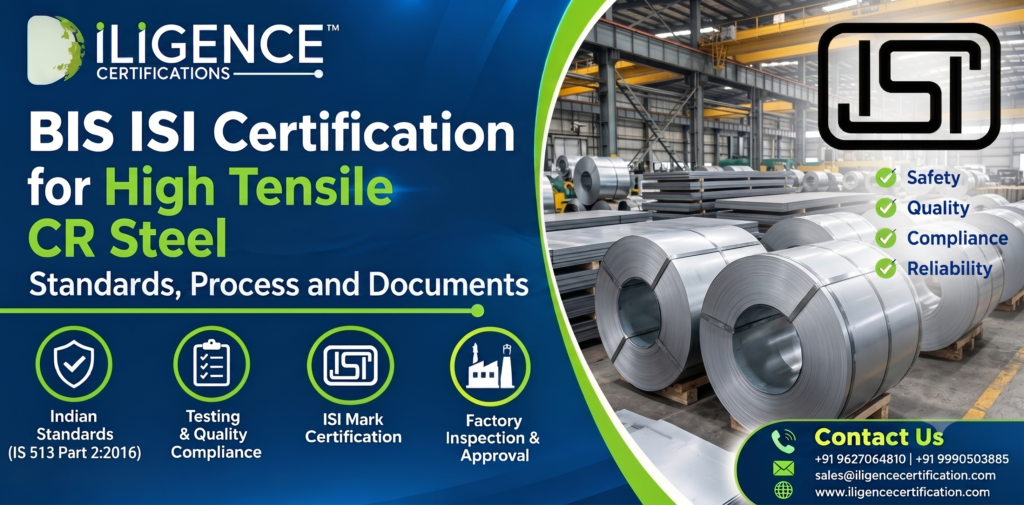
- High Tensile CR Steel is covered under IS 513 (Part 2):2016.
- The standard covers cold-reduced carbon steel sheets and strips made from high-tensile and multi-phase steel.
- BIS certification is required under the applicable Steel and Steel Products Quality Control Order.
- Manufacturers must demonstrate compliance with chemical composition, mechanical properties and other product requirements.
- Testing, factory inspection and manufacturing quality control are important parts of the BIS certification process.
- A valid BIS licence is required to use the ISI Standard Mark on covered products.
BIS Certification Mandatory for High Tensile CR Steel?
BIS Certification for High Tensile CR Steel Yes. BIS certification is mandatory for High Tensile CR Steel products covered under IS 513 (Part 2):2016 and the applicable Steel and Steel Products Quality Control Order.
Manufacturers must obtain a BIS licence under Scheme-I of the BIS Conformity Assessment Regulations, 2018. The certification confirms that the manufactured cold-reduced steel sheets and strips meet the applicable Indian Standard requirements.
Importers and manufacturers should also verify the product description and applicable ITC (HS) classification before manufacturing, importing or selling the material in India.
What Is High Tensile CR Steel?
High Tensile CR Steel refers to high-strength cold-rolled steel sheets and strips manufactured through a controlled rolling and processing procedure.
CR stands for Cold Rolled. During manufacturing, hot-rolled steel is processed through cold rolling to achieve the required thickness, surface finish, dimensional accuracy and mechanical properties.
High tensile grades are designed to provide higher strength while maintaining suitable formability and performance for their intended applications.
Unlike ordinary cold-rolled steel, high-tensile CR steel is available in different grades and metallurgical categories, including high-strength low-alloy steel, dual-phase steel, complex-phase steel and transformation-induced plasticity (TRIP) steel.
These materials are used in applications where manufacturers need a combination of strength, weight reduction, durability and forming performance.
Which BIS Standard Applies to High Tensile CR Steel?
The applicable Indian Standard is:
| Particular | Details |
|---|---|
| Indian Standard | IS 513 (Part 2):2016 |
| Standard Title | Cold Reduced Carbon Steel Sheet and Strip |
| Part | Part 2 |
| Product Category | High Tensile and Multi-Phase Steel |
| Certification Scheme | Scheme-I |
| Certification Mark | ISI Mark |
| Certification Authority | Bureau of Indian Standards (BIS) |
IS 513 (Part 2):2016 specifies the requirements for high-tensile and multi-phase cold-reduced carbon steel sheets and strips.
The standard establishes requirements for chemical composition, mechanical properties, surface condition, dimensions, tolerances and other relevant product characteristics.
Manufacturers must ensure that their products comply with the applicable grade-specific requirements rather than relying on a general claim of high tensile strength.
BIS Certification Mandatory Under the Steel Quality Control Order?
Yes. High Tensile and Multi-Phase Cold Reduced Steel covered under IS 513 (Part 2):2016 is included in the Steel and Steel Products Quality Control framework.
The Ministry of Steel has included this product standard in the applicable Quality Control Order.
The relevant entry identifies IS 513 (Part 2):2016 for high-tensile and multi-phase cold-reduced steel products. The applicable entry specifies enforcement with immediate effect.
Therefore, manufacturers and importers dealing with products within the notified scope must comply with the applicable BIS certification requirements.
Important Compliance Requirements
Businesses should consider the following requirements:
- The product must comply with IS 513 (Part 2):2016.
- The manufacturer must obtain the applicable BIS licence.
- Product testing must be conducted according to the relevant standard.
- Manufacturing facilities must maintain suitable quality-control arrangements.
- The ISI Standard Mark must only be used on products covered by the valid licence.
- Importers must verify the certification status of the actual manufacturer and product.
Important: The applicability of a Quality Control Order depends on the notified product description, relevant ITC (HS) codes and applicable exemptions. Not every steel product described commercially as high-tensile CR steel automatically falls under the same certification requirement.
Types of High Tensile CR Steel Covered Under IS 513 (Part 2)
IS 513 (Part 2):2016 covers multiple grades and metallurgical categories of high-strength cold-reduced steel.
The BIS product manual identifies the following categories:
| Steel Category | Examples of Grade Designations |
|---|---|
| High Strength Low Alloy Steel | ISC310LA, ISC350LA, ISC410LA, ISC590LA, ISC700LA |
| Carbon-Manganese Steel | ISC490W, ISC540W, ISC590W |
| Dual Phase Steel | ISC450Y, ISC590Y, ISC780Y, ISC980Y |
| Dual Phase High Yield Steel | ISC590YH, ISC780YH, ISC980YH |
| TRIP Steel | ISC590T, ISC690T, ISC780T |
| Complex Phase Steel | ISC600C, ISC780C, ISC980C |
| Martensitic Steel | ISC900M, ISC1100M, ISC1300M, ISC1500M |
These are examples of grade designations identified in the BIS product manual. The applicable grade selection and certification scope must be determined according to the current standard and BIS grouping guidelines.
Why Is BIS Certification Important for High Tensile CR Steel?
High Tensile CR Steel is used in applications where mechanical strength, dimensional accuracy and material consistency are important.
Poor-quality steel can create problems during forming, fabrication and final product manufacturing.
BIS certification helps manufacturers demonstrate that their products meet the applicable Indian Standard requirements.
1. Product Quality Assurance
BIS certification establishes a framework for checking the chemical and mechanical properties of steel products.
It helps ensure that the material meets the requirements of its declared grade.
2. Mechanical Strength Verification
High-tensile steel must provide the specified strength and mechanical performance.
Testing helps verify whether the material meets the requirements of the relevant grade.
3. Improved Manufacturing Consistency
Regular inspection, production monitoring and quality-control records help manufacturers maintain consistent product quality.
4. Regulatory Compliance
Manufacturers and importers must comply with applicable Quality Control Orders. BIS certification helps businesses meet the relevant regulatory requirements.
5. Market Acceptance
A valid BIS licence and authorised ISI marking demonstrate conformity with the applicable Indian Standard and support customer confidence.
Important Testing Requirements for High Tensile CR Steel
Testing is one of the most important parts of BIS certification.
Under IS 513 (Part 2):2016, the material is evaluated for different chemical, mechanical, dimensional and surface-related characteristics.
The exact tests and their frequency depend on the applicable grade, product requirements, inspection scheme and relevant provisions of the standard.
1. Chemical Composition Test
Chemical composition testing determines the percentage of different elements present in steel.
Elements such as carbon, manganese, sulphur, phosphorus, silicon and nitrogen are considered according to the applicable grade requirements.
The test helps verify whether the material’s chemical composition complies with the standard.
2. Tensile Strength Test
The tensile test evaluates how the steel behaves when subjected to a pulling force.
It helps determine important mechanical properties, including:
- Tensile strength
- Yield strength or proof stress
- Percentage elongation
The results must satisfy the requirements specified for the relevant grade.
3. Bend Test
The bend test evaluates the ability of steel to withstand bending without developing unacceptable cracks or defects.
It helps assess the material’s suitability for applications involving forming and bending operations.
The BIS product manual identifies this test as applicable according to the specified requirements and purchaser agreement.
4. Tensile Strain Hardening Component Test
This test evaluates the strain-hardening behaviour of the material.
It is relevant to the mechanical performance of high-strength steel grades and helps establish compliance with the applicable requirements.
5. Surface Condition Inspection
The surface of cold-rolled steel sheets and strips must be checked for defects that may affect product quality or intended use.
Inspection may include checking for:
- Scratches
- Surface cracks
- Rolling defects
- Irregularities
- Other unacceptable surface imperfections
The acceptance requirements depend on the relevant standard provisions.
6. Surface Finish Test
Surface finish is an important characteristic of cold-rolled steel, especially when the material is used in applications requiring controlled surface quality.
The test evaluates whether the product meets the specified surface-finish requirements.
7. Dimensional and Tolerance Inspection
Steel sheets and strips must comply with the specified dimensions and dimensional tolerances.
The inspection covers relevant characteristics such as:
- Thickness
- Width
- Length
- Dimensional consistency
8. Freedom from Defects
The material must be free from unacceptable defects that can affect its intended performance.
The inspection helps ensure that the finished steel product meets the relevant quality requirements.
BIS Certification Process for High Tensile CR Steel
Obtaining BIS certification involves several stages. Manufacturers must demonstrate that their manufacturing facilities and products comply with the applicable Indian Standard.
Here is the general process.
Step 1: Identify the Applicable Indian Standard
The first step is to identify the correct product category and applicable Indian Standard.
For High Tensile CR Steel, the relevant standard is IS 513 (Part 2):2016.
The manufacturer must also identify the applicable grades, dimensions, surface finishes and product scope.
Step 2: Submit the BIS Application
The manufacturer must submit an application through the BIS certification system.
The application should contain the required information about the manufacturing unit, product, production process and quality-control arrangements.
Step 3: Prepare the Manufacturing Facility
Before inspection, the manufacturer should ensure that the factory has suitable manufacturing facilities and quality-control arrangements.
The preparation may include:
- Production machinery and equipment
- Testing facilities
- Qualified technical personnel
- Calibration records
- Raw material inspection arrangements
- Product inspection procedures
- Quality-control documentation
Step 4: Factory Inspection by BIS
BIS officials inspect the manufacturing facility to evaluate its ability to produce steel products according to the applicable standard.
The inspection may include reviewing manufacturing processes, testing arrangements, production controls and quality records.
Step 5: Product Sample Collection and Testing
Product samples are collected according to the applicable BIS procedures.
The samples are tested to determine whether the steel complies with the requirements of IS 513 (Part 2):2016.
Testing includes the relevant chemical and mechanical properties, surface characteristics and dimensional requirements.
Step 6: Evaluation of Test Results
BIS evaluates the factory inspection findings, test results and submitted documentation.
If any non-conformity is identified, the manufacturer may need to take corrective action according to BIS requirements.
Step 7: Grant of BIS Licence
Once BIS is satisfied that the manufacturer and product meet the applicable requirements, the licence may be granted.
The manufacturer receives authorisation to use the ISI Standard Mark within the approved scope of the licence.
Step 8: Maintain Compliance
Obtaining a BIS licence is not the end of the process.
The manufacturer must continue to maintain product quality, conduct prescribed testing, maintain records and comply with BIS surveillance and renewal requirements.
Documents Required for BIS Certification for High Tensile CR Steel
Manufacturers generally need to prepare the following documents for their BIS application.
| Document | Purpose |
|---|---|
| Factory registration certificate | Establishes the legal identity of the manufacturing unit |
| Company incorporation documents | Provides company details |
| Manufacturing process flow chart | Explains the production process |
| Product details | Identifies the steel grades and product specifications |
| Raw material details | Provides information about input materials |
| Machinery list | Identifies manufacturing equipment |
| Testing equipment list | Provides details of testing facilities |
| Calibration certificates | Demonstrates equipment calibration |
| Factory layout plan | Shows the manufacturing facility arrangement |
| Quality-control documents | Explains inspection and production controls |
| Test reports | Provides evidence of product conformity |
| Technical personnel details | Identifies responsible technical staff |
| Trademark authorisation, where applicable | Supports brand-related requirements |
| Authorisation letter, where applicable | Establishes the authorised representative |
The final document list may vary depending on the manufacturing arrangement, application category and BIS requirements.
BIS Product Manual Requirements for High Tensile CR Steel
The BIS product manual for IS 513 (Part 2):2016 provides important guidance for manufacturers applying for certification.
It includes sampling guidelines, product grouping, testing equipment and the Scheme of Inspection and Testing.
Product Sampling Guidelines
The product manual specifies the following sample requirements:
| Test Category | Sample Requirement |
|---|---|
| Mechanical Tests | Two samples of 0.5 m × 0.5 m |
| Chemical Tests | Five pieces of 5 cm × 5 cm or 50 g drillings |
Actual sample collection must follow the applicable BIS sampling procedure.
Product Grouping Guidelines
The BIS product manual divides grades into different groups based on their quality and metallurgical characteristics.
For example, the grouping includes:
- High Strength Low Alloy Steel
- Carbon-Manganese Steel
- Dual Phase Steel
- TRIP Steel
- Complex Phase Steel
- Martensitic Steel
The manual provides guidance on sample selection and grade coverage. Testing a higher-strength grade may allow coverage of lower-strength grades within the same eligible group, subject to the prescribed grouping conditions.
Control Unit Requirements
According to the BIS product manual, 50 tonnes of material or part thereof may constitute one control unit when it represents the same cast, grade quality, thickness and identical processing conditions, including heat treatment where applicable.
The manufacturer must maintain appropriate inspection and test records for each control unit.
Factory Laboratory Requirements
The manufacturer must maintain a suitably equipped laboratory with trained personnel to conduct the tests required by the standard.
Testing equipment must be maintained and calibrated according to the applicable requirements.
ISI Marking Requirements for High Tensile CR Steel
After receiving a valid BIS licence, the manufacturer can use the ISI Standard Mark on products covered by the approved licence.
The marking must comply with the requirements of IS 513 (Part 2):2016 and the licence conditions.
The relevant marking information includes:
- BIS Standard Mark
- BIS licence number (CM/L number)
- Applicable product identification details
- Other marking particulars required by the standard
The manufacturer must ensure that only conforming products covered by the licence carry the ISI Mark.
Using the ISI Mark without proper BIS authorisation is not permitted.
Common Challenges Faced by Manufacturers During BIS Certification
Manufacturers may face several difficulties while applying for BIS certification.
Understanding these challenges early can help reduce unnecessary delays.
1. Incorrect Product Classification
Some manufacturers confuse ordinary cold-rolled steel with high-tensile and multi-phase steel.
Selecting the wrong Indian Standard can result in application complications.
2. Incomplete Testing Facilities
Manufacturers may not have all the necessary equipment for chemical and mechanical testing.
The factory must maintain suitable testing arrangements as required by the applicable inspection scheme.
3. Incorrect Grade Selection
Different high-tensile grades have different mechanical and chemical requirements.
The manufacturer must identify the correct grades before applying for certification.
4. Poor Documentation
Incomplete manufacturing records, missing calibration certificates and inadequate quality-control documents can create difficulties during the certification process.
5. Non-Conforming Test Results
If the product fails to meet the relevant standard requirements, the manufacturer may need to investigate the reason, correct the manufacturing process and demonstrate conformity.
Difference Between High Tensile CR Steel and Ordinary CR Steel
High Tensile CR Steel and ordinary cold-rolled steel are different in terms of their mechanical characteristics and intended applications.
| Parameter | Ordinary CR Steel | High Tensile CR Steel |
|---|---|---|
| Strength | Generally lower | Generally higher |
| Material Category | Conventional cold-rolled steel | High-strength and multi-phase steel |
| Formability | Depends on grade | Depends on grade and metallurgical design |
| Applications | General fabrication and forming | Automotive and high-strength engineering applications |
| Relevant Standard | IS 513 (Part 1):2016, where applicable | IS 513 (Part 2):2016 |
| BIS Requirements | Based on applicable QCO | Based on applicable QCO |
Both product categories require the correct standard identification and compliance with the applicable regulatory requirements.
Applications of High Tensile CR Steel
High-tensile cold-rolled steel is used in several industrial and manufacturing applications.
Some common applications include:
1. Automotive Industry
High-strength steel is used in vehicle body structures, reinforcement components and other automotive parts where strength and weight considerations are important.
2. Automobile Components
It is used in manufacturing structural and formed components that require specific mechanical properties.
3. Industrial Equipment
High-tensile steel can be used in equipment housings, structural components and engineering applications.
4. Engineering and Fabrication
Manufacturers use suitable high-strength grades in components requiring controlled strength and forming performance.
5. Consumer Durables
Selected grades may be used in products and components where strength, thickness and dimensional accuracy are important.
The suitability of a particular grade depends on its mechanical properties, forming requirements and the final application’s specifications.
Why Choose Diligence Certifications for BIS Certification?
Obtaining BIS certification requires proper understanding of the applicable Indian Standard, product testing requirements, documentation and factory inspection procedures.
Diligence Certifications provides consultancy support to manufacturers, importers and businesses seeking BIS certification for their products.
Our assistance can include:
- Identifying the applicable BIS standard.
- Understanding product-specific certification requirements.
- Preparing the required application documents.
- Coordinating certification-related activities.
- Providing guidance on factory inspection preparation.
- Understanding applicable testing requirements.
- Assisting with queries and documentation during the certification process.
Our objective is to help businesses understand the BIS certification procedure and manage the application process more effectively.
Important: Diligence Certifications provides certification consultancy and coordination support. We are not a physical testing laboratory and do not issue BIS licences. The BIS licence is granted only by the Bureau of Indian Standards after the prescribed evaluation.
For more information, visit Diligence Certifications.
Frequently Asked Questions (FAQs)
What is IS 15914:2011?
IS 15914:2011 stands for an Indian Standard, which defines the one chemical and mechanical properties, as well as the features of welding, of high tensile strength (up to 6 mm) flat rolled steel for the fabrication of welded gas cylinders.
Why is BIS Certification necessary for steel as per IS 15914:2011?
BIS Certification is necessary in order to make sure that first-rate steel is utilized, and that the safety is observed during the making of LPG and industrial gas cylinders, and as a result, there should not be any failure, leakage, or accidents.
Who is the target audience of the BIS Certification?
Manufacturers of steel plates, sheets, or strips up to six mm in thickness for the fabrication of welded gas cylinders who are willing to sell or supply their products in India are the target audience of BIS Certification.
What tests are conducted as per IS 15914:2011?
Under the mentioned regulation, it is also specified that tests in the areas of tensile tests, bend tests, impact tests, and flattening tests shall be undertaken with the purpose to a prediction of metal behavior under high pressure.
How long does it take to get a BIS Certification?
The total time that is usually taken is around 20 to 30 days, out of which 7 to 15 days are reserved for product testing, and the rest of the time is for documentation and BIS approval.
Which documents are required to obtain a BIS Certification?
The documents being factory registration, process flowchart, factory details, product standards, test reports from labs that are BIS-certified, and authorization letters are among those required.
Is there a factory inspection involved in the certification process?
Yes, factory inspection is planned when the BIS intends to verify production, testing, and quality control before it issues the license, if all of these are found to be satisfactory.
How long is the BIS license valid?
BIS Certification is, in general, valid for two years and after it should be renewed by the submission of the new papers and test reports.
What happens if a product fails a BIS test?
If the product does not fulfill the requirements, the manufacturer is obliged to fix the problem and send back the sample for testing.
Can foreign manufacturers get BIS Certification under IS 15914:2011?
Foreign manufacturers may submit an application only if they designate an Authorized Indian Representative (AIR) and comply with all the BIS instructions as regards documentation and testing.