



 BIS Certification
 CDSCO
CDSCO
 CPCB
CPCB
 LMPC
LMPC
 WPC Approval
 Global Approvals
 TEC
TEC
 ARAI
ARAI
 BEE
BEE
 ISO Certification
 DGCA Certification
 NOC For Steel
 APEDA Registration

















 Business Registration
 FSSAI Mark Certification











 Legal Services
 Trademark Registration
 Copyright Registration
 Patent Registration
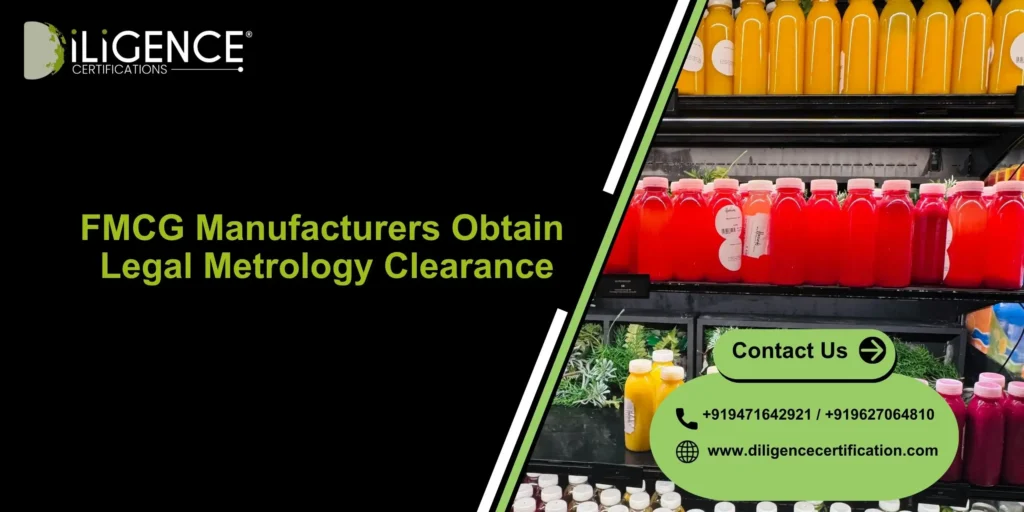
- Legal Metrology clearance is mandatory for FMCG products sold in packaged form in India.
- Legal Metrology for FMCG ensures correct weight, quantity, and labeling for consumer protection.
- Manufacturers must comply with the Legal Metrology Act, 2009 and Packaged Commodities Rules, 2011.
- Proper labeling, registration, and declarations are key to approval.
- Non-compliance can lead to penalties, product seizure, and business disruption.
Introduction | Legal Metrology for FMCG
India’s fast-moving consumer goods (FMCG) sector is one of the largest and most competitive industries, dealing with products like food items, cosmetics, household goods, and personal care products. Since these products are sold in packaged form, maintaining transparency in quantity, pricing, and labeling becomes critical.
This is where Legal Metrology for FMCG clearance plays an essential role. It ensures that consumers receive accurate information about the product they purchase and that manufacturers follow standardized measurement systems. For FMCG manufacturers, obtaining Legal Metrology clearance is not just a legal requirement but also a step toward building trust and credibility in the market.
In this blog, we will explain everything FMCG manufacturers need to know about Legal Metrology for FMCGclearance, including its importance, process, benefits, and challenges.
What is Legal Metrology for FMCG Clearance?
Legal Metrology for FMCG refers to the laws and regulations related to weights and measures in India. It governs how products are measured, labeled, and sold in the market to ensure fairness in trade and consumer protection.
Legal Metrology clearance for FMCG manufacturers means obtaining approval or registration from the relevant authority to manufacture, pack, distribute, or sell packaged goods in compliance with legal standards.
The Legal Metrology for FMCG framework in India is governed by:
- Legal Metrology Act, 2009
- Legal Metrology (Packaged Commodities) Rules, 2011
Under these rules, FMCG manufacturers must ensure that every packaged product carries specific declarations such as:
- Name and address of manufacturer
- Net quantity (weight/volume)
- Maximum Retail Price (MRP)
- Date of manufacture/packing
- Consumer care details
Why Legal Metrology for FMCG Clearance is Required
1. Consumer Protection It helps in protecting the consumer from being fooled on grounds of quantity, price, or any form of false labeling.
2. Legal Conformity The FMCG industry has to adhere to national laws to avoid facing fines, charges, and legal suits.
3. Standardization ensures uniformity in measurement, weights, and packages throughout the country.
4. Market Credibility Legal conformity helps in building credibility in the market.
5. Penalty Avoidance Non-conformity leads to legal penalties and fines.
Importance and Benefits of Legal Metrology for FMCG Clearance
| Importance | Benefits |
| Ensures accurate product quantity | Builds consumer trust |
| Mandatory legal compliance | Avoids legal penalties |
| Regulates fair trade practices | Enhances brand reputation |
| Standardizes packaging norms | Smooth market operations |
| Prevents misleading claims | Increases customer satisfaction |
Process to Obtain Legal Metrology Clearance for FMCG Manufacturers
Getting Legal Metrology clearance involves multiple steps. Here is a simplified process:
Step 1: Business Registration
Before applying, the FMCG manufacturer must have a registered business entity such as a company, LLP, or proprietorship.
Step 2: Identify Applicable License
Depending on business activities, manufacturers may need:
- Manufacturer License
- Packer Registration
- Importer Registration (if applicable)
Step 3: Prepare Documentation
Common documents required include:
- Business registration certificate
- PAN and GST registration
- Address proof of manufacturing unit
- Identity proof of applicant
- Product details and packaging information
Step 4: Application Submission
Submit the application to the State Legal Metrology Department or Central Authority (in case of importers).
Step 5: Inspection by Authorities
Authorities may inspect the manufacturing or packaging unit to verify compliance with standards.
Step 6: Approval and Certification
Once verified, the department issues the Legal Metrology certificate or registration.
Step 7: Product Label Compliance
Ensure all packaged products comply with labeling requirements before market distribution.
Step 8: Renewal and Ongoing Compliance
Licenses must be renewed periodically, and continuous compliance is required to avoid penalties.
Challenges of Getting Legal Metrology Clearance Without a Consultant
1. Complicated Regulations It may be difficult for new companies to understand Legal Metrology legislation and regulations.
2. Poor Documentation Errors in documentations may cause rejections or delays in applications.
3. Lengthy Procedures Time can be wasted on obtaining government approvals and inspections.
4. Changing Regulations The regulations keep changing, causing a lot of difficulties.
5. Non-Compliance Risks Any small mistake may result in serious penalties.
6. No In-House Experts Most FMCG companies do not have in-house legal experts.
Why Choose Diligence Certification for Legal Metrology Clearance
Choosing the right consultant can simplify the entire process. Diligence Certification provides end-to-end support for FMCG manufacturers.
1. Experts’ Help A group of experts ensures proper implementation of Legal Metrology regulations.
2. Document Assistance Assists in document preparation and checking for rejection prevention.
3. Quick Process Helps in quick processing and certification of documents.
4. Complete Service Offers complete assistance from application to certificate issue.
5. Compliance Help Guarantees compliance with labeling requirements for your product packaging.
6. After Certificate Help Helps in renewal of certificates after the expiration of period.
Conclusion
Legal Metrology for FMCG is a crucial requirement for FMCG manufacturers in India. It not only ensures compliance with government regulations but also builds trust among consumers by guaranteeing accurate product information.
While the process may seem complex, proper understanding and expert guidance can make it smooth and efficient. By obtaining Legal Metrology clearance, FMCG businesses can avoid legal risks, improve brand credibility, and operate confidently in a competitive market.
Partnering with professionals like Diligence Certification can further simplify the process and ensure complete compliance without delays.
Frequently Asked Questions (FAQs)
What is Legal Metrology clearance?
It is government approval ensuring that packaged goods comply with weight, measurement, and labeling laws.
Is Legal Metrology mandatory for FMCG products?
Yes, it is mandatory for all packaged FMCG products sold in India.
Who needs Legal Metrology registration?
Manufacturers, packers, and importers of packaged goods need registration.
What happens if a company does not comply?
Non-compliance can lead to fines, penalties, or product seizure.
How long does it take to get clearance?
It usually takes a few weeks, depending on documentation and approval speed.
What details must be printed on FMCG products?
MRP, net quantity, manufacturer details, and manufacturing date are mandatory.
Can a small business apply for Legal Metrology?
Yes, even small FMCG businesses must comply with Legal Metrology rules.
Is renewal required for the license?
Yes, Legal Metrology licenses must be renewed periodically.
Do imported FMCG products need compliance?
Yes, importers must also follow Legal Metrology rules in India.
Can consultants help in faster approval?
Yes, consultants help avoid errors and speed up the approval process.