BIS Certification
 CDSCO
CDSCO
 PESO
PESO
 CPCB
CPCB
 LMPC
LMPC
 WPC Approval
 Global Approvals
 TEC
TEC
 ARAI
ARAI
 BEE
BEE
 ISO Certification
 DGCA Certification
 NOC For Steel
 APEDA Registration























 Business Registration
 FSSAI Mark Certification












 (32).jpg)
 Legal Services
 Trademark Registration
 Copyright Registration
 Patent Registration
 By
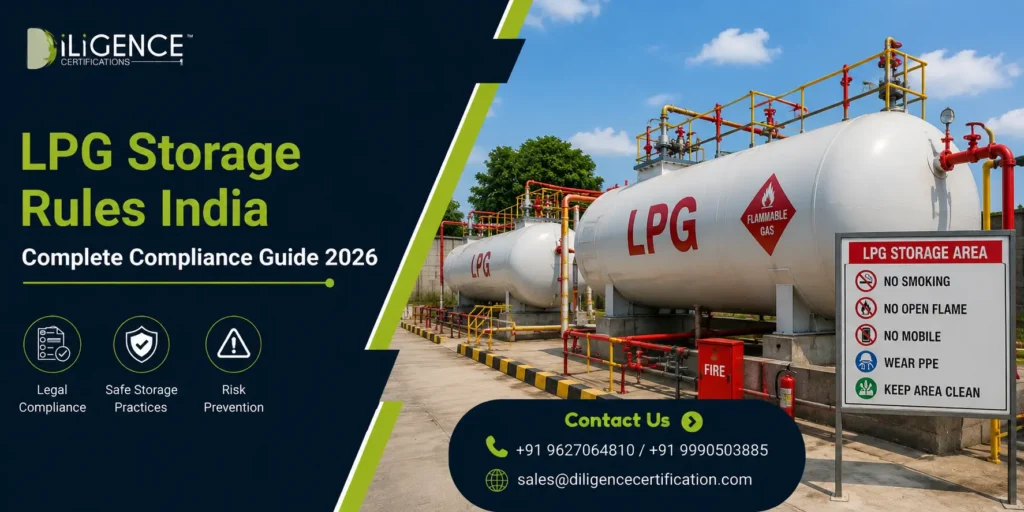
By - Rules for the Storage of LPG in India revolve around safety in storage, proper equipment/cylinder usage, ventilation, firefighting equipment, and licensing conditions by PESO.
- Companies engaging in LPG storage above permissible exempted quantities or conducting LPG activities regulated by law will be required to get their license/permission from the Gas Cylinders Rules, 2016, among other relevant rules.
- Proper planning of the site before installation can save companies from expensive redesigns and approvals.
Introduction
An organization in Uttar Pradesh was planning to set up LPG storage at its manufacturing plant. It had already got the tank made, construction work had commenced and the organization thought that the remaining part of the compliance process would be just a routine process.
In the process of the regulatory review, the organization came to know that the installation plan, site design and storage arrangement required a study according to the petroleum and gas cylinder regulations. Re-designing of the installation layout in the middle of construction work would result in engineering work, delays and unnecessary costs.
This is a very common mistake.
Installation of LPG storage should be viewed as an engineering project from the very beginning, rather than an equipment installation task.
The LPG Storage Rules India scheme requires certain considerations like whether the LPG is stored as a liquid or vapor form, volume, cylinder/tank structure, purpose of storage, sale/usage of the LPG, installation of the plant etc.
As far as the installation of cylinders is concerned, it requires compliance with the Gas Cylinders Rules, 2016. The PESO website contains the rules. (PESO)
What Are The LPG Storage Rules In India?
The LPG Storage Rules in India are not provided in a single requirement which is applicable for all enterprises.Rather, it could require different regulations, rules, standards, and approvals based on the installation.
In terms of LPG cylinders, the Gas Cylinders Rules, 2016 cover aspects such as possession, filling, transport, storage and handling of compressed gases. LPG is clearly mentioned as one of the gas cylinders and liquefied petroleum gas under the Rules. (Indian Kanoon)
The compliance requirement therefore boils down to the following questions:
- What are you storing?
- How much are you storing?
- Where are you storing it?
- For what purpose?
Who Needs to Follow LPG Storage Rules India?
Some of the organizations that may require LPG storage could be:
- LPG distributors and dealers
- LPG godowns
- LPG bottling plants
- Industrial manufacturing companies
- Hotels and commercial kitchens
- Restaurants
- Warehouses
- Chemical and process industries
- Pharmaceutical manufacturing companies
- Food processing companies
- Auto LPG plants
- Organizations utilizing bulk LPG tanks
- LPG importers and distributors
- Companies utilizing LPG manifolds and cylinder banks
It is the proposed quantity and type of installation which decides whether there will be any need for obtaining approval and not all installations of LPG require the same license.
There is a guide issued by Diligence Certifications on [PESO License for LPG in India] which gives further insight into the various activities which involve LPG requiring regulatory approval.
LPG Cylinder Storage Regulations India - Gas Cylinders Rules, 2016
The most relevant document related to the LPG cylinder storage regulations is the Gas Cylinders Rules, 2016.
According to the Rules, the cylinders shall be stored in a cool, dry, and well-ventilated place under cover away from boilers, fires, steam pipes and any source of heat. The storage places or sheds should have fire-resisting construction. (Indian Kanoon)
Moreover, the Rules include special provisions with regard to LPG cylinders.
Such essential storage practices as:
- To store cylinders in a cool and dry place.
- To ensure adequate ventilation.
- To keep the storage area away from ignition sources.
- Fire-resisting construction where necessary.
- Not to store LPG cylinders horizontally if such prohibition exists in the respective rule.
- To separate filled and empty cylinders.
- To prevent corrosion.
- Not to store cylinders with any combustible material.
- To keep cylinder valves closed.
- Safe access to the storage place.
This is not a list of mere housekeeping tips. This is part of the safety requirements on LPG cylinder storage.
Is the PESO Licence Necessary for LPG Storage?
The necessity of PESO licence or approval for LPG storage would depend upon the quantity, kind of storage, purpose and regulatory requirement.
For instance, Rule 43 of the Gas Cylinders Rules, 2016 mandates licensing for filling and possession of gas cylinders, but there are exceptions as per Rule 44. (Indian Kanoon)
There is an exception in regard to LPG.
For use, distribution or sale of LPG from a sales room owned by the dealer or distributor of the concerned oil marketing company, an exception applies where the aggregate quantity of LPG does not exceed 100 kg at any point of time. (Indian Kanoon)
Such an exception is important.
Just because a company has “only a few cylinders”, it would not mean that “PESO is not necessary”. The purpose of storage, quantity, installation design and exception must be taken into consideration.
In a commercial project, it is always safe to get a regulatory classification before making any purchase.
Storage of LPG Cylinders: Safety Requirements
Physical layout is the first area that may come under consideration when it comes to ensuring safety compliance.
1. Ventilation
Since LPG is heavier than air, in case of leakage, there is a possibility that gas will collect in any low-lying areas.
Thus, storage facilities must be such that appropriate ventilation would prevent the accumulation of leaking LPG.
2. Control of Ignition Sources
There could be several potential ignition sources around LPG, such as smoking, naked flames, unsuitable electrical installation, and so on.
The rules governing the use of gas cylinders have special provisions regarding the electrical installations in premises where filling and storage of flammable gases in cylinders is carried out. (Indian Kanoon)
3. Fire protection
There must be a proper fire protection system depending on the type of installation.
This depends on the type of facility and may entail suitable fire extinguishing equipment, hydrant system, water spray systems, emergency measures and other safety measures.
It would be best if the final decision on this requirement was made after considering the codes, site plan, and the requirements of the authorities concerned and not just because firefighting equipment was convenient.
4. Segregation of Cylinders
Filled and empty cylinders must be segregated.
The Rules also provide that flammable and toxic gas cylinders must be segregated properly from other gas cylinders by distance or partitioning. (Indian Kanoon)
5. Protection against damage
Cylinder storage must be made in such a way that it minimizes the risk of:
- damage by vehicles
- flying objects
- handling by unauthorised personnel
- heat
- corrosion
- damage
This is especially important in industries where forklifts, trucks and material handling equipment are working around.
Storage of LPG Tank Rules in India
Bulk LPG storage is different from cylinder storage rules.An establishment using bulk LPG tanks, pressure vessels or any other such type of installation will have to ensure that apart from the general guidelines for LPG safety, there are additional laws relating to pressure vessels and hazardous installations.
The engineering drawing can include:
- Tank design details
- Volume
- Material of construction
- Pressure
- Safety valves
- Pipeline system
- Isolation valves
- Pressure gauge
- Emergency shutoffs
- Earthing
- Fire protection
- Safety distances
- Layout drawing
- Foundation details
- Test & inspection data
Diligence Certification also offers a specific guide on LPG Storage Tank Licence under PESO covering documentation, process and technical requirements. (Diligence Certifications)
Layout Safety Distances for LPG Storage: What You Need to Understand
One of the costliest blunders in LPG works is when the business takes the layout drawing as just another formal procedure.
Not at all.
The location of the LPG cylinders, tanks, structures, boundaries, roads, sources of ignition and other facilities will affect the safety assessment process.A layout that is created after construction work has been started could lead to many complications.Hence, the businesses should prepare the proposed layout as part of their project planning.
The LPG compliance layout usually includes:
- LPG storage area
- Location of cylinder shed/tank
- Boundary of property
- Adjacent buildings
- Roads
- Electrical installations
- Firefighting facilities
- Approach roads
- Emergency exits
- Filling/transfer points
- Piping
- Manifold
- Safety facilities
- Other hazardous installations
The specific distance should not be copied from any random internet table as the particular requirement will depend on the configuration of the installation.This is why professional technical review will save both your time and money.
List of Documents Required for LPG Storage Authorization
The list of documents differs depending on the license type and the installation but some of the common documents required by companies include the following:
Company Documents
- Certificate of incorporation or registration
- PAN
- GST details where necessary
- Authorization documents
- Details of applicant
- Property Documents
- Owner’s documents
- Lease or rent documents where necessary
- Evidence of possession of the site
- Land documents
Technical Documents
- Site plan
- Site layout
- Arrangement for storage
- Equipment data
- Data of tank
- Cylinder data
- Piping drawings
- Safety system data
- Arrangement for firefighting
- Technical calculations where necessary
Compliance Documents
- Test certificates
- Inspection certificates
- Safety certificates
- NOCs where necessary
- Manufacturer’s certificates
- Approvals where necessary
- Other documents as prescribed by the licensing authority
The checklist must be finalized after the identification of the right license and the law applicable to the installation.
Process for Applying for Licence for LPG Storage
The compliance process typically follows a sequence of six steps.
Step 1: Identify the Storage Type
Initially identify the nature of the project to see whether it falls into one of the following categories:
- LPG cylinders
- LPG godown
- Bulk LPG tank
- Bottling
- Industrial LPG manifold
- Auto LPG
- Storage for sale
- Storage for own use
- The identification is critical.
Step 2: Identify the Rules
Next step is the determination of the applicable regulation.Wherever the activity is related to the cylinder, one must take into account the Gas Cylinders Rules, 2016. Additional regulations might come into play depending upon the installation.
Step 3: Prepare the Site Layout
Prepare the site layout based on the site itself rather than some generic design.It is at this step that one can identify any distance, access, capacity, and safety system related problems.
Step 4: Prepare Documentation
Technical drawings, ownership documents, equipment information, certificates and other supporting records should be assembled according to the applicable application category.
Step 5: Application Submission
The application is made via the prescribed regulatory process and directed to the proper authority.
The Gas Cylinders Rules have special provisions with regard to the applications for licences and approvals. (Indian Kanoon)
Step 6: Inspection and Compliance
Depending upon the type of licence and installation, an inspection or technical verification could be necessary.
An objection should be sorted out by providing corrected documents/drawing or site level compliance.
Why Do LPG Storage Approvals Get Delayed?
From a project management point of view, most of the delays in obtaining LPG storage approvals are preventable.
Applying For The Incorrect Licence Category
An enterprise could obtain a licence without knowing if the installation is cylinder storage, bulk storage, filling, dispensing or any other category that requires a licence.
Site Drawing Is Not Accurate
Even though the installation could be technically feasible, if the drawing does not match the actual installation site.
Quantity Of Storage In Documents Does Not Match
The quantity in documents must match the actual quantity planned.
Poor Safety Arrangement
Fire protection, ventilation, earthing, emergency access and ignition-source control should be considered during design, not after an inspection objection.
Construction Before Approval Review
This is perhaps the most expensive approach.
If a tank foundation, cylinder shed or piping system is already constructed incorrectly, correcting it may require civil and mechanical modifications.
LPG Storage Guidelines India for Hotels, Restaurants & Factories
Whereas an LPG cylinder-based cooking facility for a hotel or restaurant could be in a completely different situation in terms of its compliance compared to an LPG distribution business having a commercial godown,
Similarly, a factory using LPG for process heating should not assume that the compliance checklist for LPG storage warehouses would apply equally well to them.
In the case of an industrial user, the project team needs to check:
- Number & capacity of cylinders.
- Whether the LPG is stored or directly connected to a manifold.
- Whether there is separate LPG storage room.
- Whether it is a sale or consumption only.
- Whether there is a bulk tank.
- Exemption limits applicable.
- Fire safety issues.
- Electrical classification.
- Applicable standards & local approvals.
The Gas Cylinder Rules India also provides for a special case of workplace manifold installation where LPG cylinders are directly connected to the manifold based on the prescribed conditions & IS 6044 Part 1 requirements. (Indian Kanoon)
This is a nice illustration of why simply counting cylinders is not sufficient.
LPG Godown Regulations in India
The LPG godown is completely distinct from having a few cylinders kept inside for internal industrial use.
While setting up an LPG godown for distribution or business purposes, one needs to consider the following:
- Storage capacity
- Site location
- Design of the storage shed
- Ventilation
- Fire-resistant structure
- Cylinder placement
- Arrangement of filled/empty cylinders
- Accessibility
- Emergency arrangements
- Electrical safety
- Licensing regulations
- Requirement at the district level if any
While deciding upon land and building plans for LPG distributors, one needs to conduct a regulatory review.
What is the Cost of an LPG Storage License?
There is no fixed cost for getting the LPG storage license.The total project cost may vary based on:
- LPG storage capacity
- Installation type
- License category
- Engineer Drawings
- Inspection requirements
- Testing
- Fire safety system
- Tank/Cylinder structure
- Civil works
- Consultancy services
- Fees paid to government
- Requirement of modifications, etc.
Here, it should be noted that the government fee in itself is not the total cost of the project.
For example, the fee slabs as per Schedule V of the Gas Cylinders Rules will differ based on LPG quantity for some LPG storage licenses. The Rules contain different slabs of fee for LPG quantity more than 100 kg and increasing storage quantities. (High Court of Tripura)
How Diligence Certification Will Assist in LPG Compliance
LPG certification is more than just filling out forms.A qualified compliance expert should have an understanding of the relationship between the site, engineering drawing, equipment, storage volume and regulation.Some assistance that Diligence Certification will provide to companies include:
- LPG storage compliance review
- PESO licence documentation
- Technical documentation
- Site/layout coordination
- Applications
- Inspection coordination
- Objectivity management
- Approval of LPG storage tank
- LPG bottling and storage licence
- LPG approval renewal and compliance
For companies reviewing the approval process, Diligence Certification’s guide for PESO Certification will provide more information about PESO licensing and regulated hazardous materials operations.
Conclusion
Understanding LPG Storage Rules India is essential for any business planning to store, handle, distribute or use LPG. Compliance is not limited to obtaining a licence; it also involves choosing the right storage arrangement, maintaining required safety measures, preparing accurate technical drawings and ensuring that the installation meets the applicable regulatory requirements.
For manufacturers, LPG dealers, hotels, restaurants, warehouses and industrial facilities, addressing compliance at the planning stage can prevent costly modifications and unnecessary approval delays. The correct storage capacity, site layout, equipment, documentation and safety systems should be reviewed before installation begins.
If you are planning a new LPG storage facility or need assistance with an existing installation, Diligence Certification can help you understand the applicable requirements and navigate the PESO approval process.
Frequently Asked Questions
Is PESO licence required for LPG storage in India?
It can be required depending on the quantity, purpose and type of LPG storage. The Gas Cylinders Rules, 2016 provide licensing requirements as well as specific exemptions. Businesses should determine their exact applicability before starting storage operations.
What is the LPG storage limit without a licence?
The applicable exemption is not simply a universal cylinder-count rule. Under Rule 44, an exemption is provided for certain LPG possession situations where the total quantity does not exceed 100 kg at a time, subject to the conditions stated in the Rules.
Which rules apply to LPG cylinder storage?
The Gas Cylinders Rules, 2016 are a key regulatory reference for LPG cylinders. Depending on the installation, additional regulations, standards, fire-safety requirements and local approvals may also apply.
What documents are required for LPG storage approval?
Documents can include the application, site and layout drawings, ownership/lease documents, equipment specifications, safety-related documents, test certificates, NOCs and other technical records depending on the licence category.
Is LPG tank storage different from cylinder storage?
Yes. Bulk LPG tank installations involve pressure-vessel and installation considerations that differ from ordinary cylinder storage. The correct regulatory route should be established before purchasing or installing the tank.
Can a factory store LPG for its own use?
A factory may be able to store LPG for its own use subject to the applicable quantity, installation and regulatory requirements. Certain exemptions exist, but they should not be assumed without checking the precise conditions of the applicable Rules.