BIS Certification
 CDSCO
 PESO
 CPCB
 LMPC
 WPC Approval
 Global Approvals
 TEC
 ARAI
 BEE
 ISO Certification
 DGCA Certification
 NOC For Steel
 APEDA Registration























 Business Registration
 FSSAI Mark Certification












 (32).jpg)
 Legal Services
 Trademark Registration
 Copyright Registration
 Patent Registration
 By
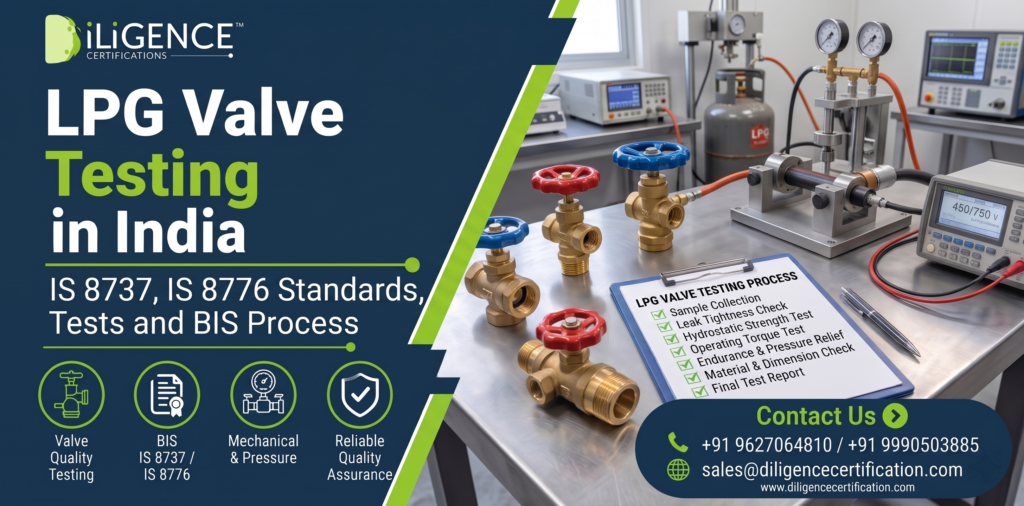
- LPG valve testing checks whether the valve on a gas cylinder is safe, leak-proof and easy to operate.
- In India, valve fittings for LPG cylinders of more than 5 litre capacity are covered by IS 8737. Smaller cylinders have a separate standard, IS 8776.
- Tests include leak tightness, strength under pressure, operating torque, repeated opening-closing cycles, pressure relief function, material checks and marking.
- BIS also checks valve batches through lot inspection, so testing is not a one-time job.
- Most rejections happen because of poor machining, weak sealing material, wrong marking or incomplete records.
- Prepare early, test in-house first, and keep your documents ready before you send samples to a recognised lab.
Introduction
Think about the brake of your scooter. You never notice it when it works. You only remember it when it fails. LPG valve is exactly like that. If it is made well, nobody talks about it. If it is made badly, the result can be very serious.
This is why LPG valve testing is so important. Before a valve goes into the market, it has to pass a set of tests that check strength, leakage, smooth working and safety.
In this blog, we will explain LPG valve testing in very simple words. You will learn which standard applies, what tests are done, how the process works, and how to avoid common mistakes.
What Is LPG Valve Testing?
LPG valve testing means checking a cylinder valve in a laboratory against the requirements of the Indian Standard. The lab takes sample valves, puts them through different tests, and records the results in a test report.
The idea is simple. A valve has three jobs:
- Keep LPG inside the cylinder without any leakage.
- Open and close smoothly when the user turns it.
- Release extra pressure safely if the cylinder gets too hot or overfilled.
Testing proves that your valve can do all three, again and again, in real conditions.
In India, the standard for these valves is made by the Bureau of Indian Standards (BIS). Manufacturers need the ISI mark to sell such valves, and testing is a big part of getting and keeping that mark. Please check the latest BIS notification for your exact product, because rules and deadlines can change.
Valve, Regulator and Pressure Relief Device: What Is the Difference?
People often mix these three up. Here is a quick table.
| Part | Where it sits | What it does |
|---|---|---|
| Cylinder valve | On top of the cylinder | Opens and closes the gas flow from the cylinder |
| Regulator | Fixed on the valve outlet | Brings the gas to a safe, low pressure for the stove |
| Pressure relief device | Built into the valve | Releases gas safely if the pressure goes too high |
This blog is about the cylinder valve, which includes the built-in pressure relief device. Regulators have their own standard and their own tests.
Which Standards Apply to LPG Valve Testing?
The main standards are given below.
| Standard | What it covers |
|---|---|
| IS 8737 | Valve fittings for LPG cylinders of more than 5 litre water capacity |
| IS 8776 | Valve fittings for LPG cylinders up to and including 5 litre water capacity |
| IS 9798 | Low pressure regulators for LPG (used with the valve) |
IS 8737 is based on the international standard ISO 14245, which talks about self-closing LPG cylinder valves. Self-closing means the valve shuts by itself when the regulator or the connection is removed. This is a safety feature, and the older type of valve without it has been replaced.
Simple example: A company makes brass valves for the 14.2 kg domestic cylinder. This cylinder is more than 5 litre water capacity, so IS 8737 applies. A company making valves for a small 5 kg cylinder will look at IS 8776 instead.
Note: BIS revises standards from time to time. Always download the latest version from the BIS website before you start testing, so you do not test against an old copy.
Why LPG Valve Testing Is Important
- Safety first: A leaking valve can cause fire and explosion. Testing reduces this risk.
- Legal need: Valves must meet the Indian Standard to carry the ISI mark.
- Customer trust: Gas companies, dealers and cylinder makers prefer tested and certified valves.
- Fewer returns: Faults caught in the lab are cheaper to fix than faults found in the market.
- Better design: Test results show weak points in your design and material.
- Smooth BIS audits: Good testing records make factory inspections much easier.
What Tests Are Conducted in LPG Valve Testing?
The exact list and limits are given in the standard, so please read the latest copy. In simple words, the lab checks the following.
| Test group | What the lab checks | In simple words |
|---|---|---|
| Leak tightness | Valve body, spindle seal, outlet and seat | Does any gas come out when the valve is closed or open? |
| Hydrostatic strength | Valve body under high water pressure | Will the body crack or swell under pressure? |
| Operating torque | Force needed to open and close | Can a normal person turn it easily? |
| Endurance | Many opening and closing cycles | Does it still work and seal after heavy use? |
| Pressure relief | Opening and closing of the relief device | Does it release pressure at the right time and reseal? |
| Self-closing function | Spring action of the valve | Does it shut by itself when the connection is removed? |
| Material checks | Brass, rubber and other parts | Are the materials right and safe with LPG? |
| Corrosion resistance | Coating or plating on parts | Will it rust or corrode in humid weather? |
| Dimensions | Threads, outlet size and neck fit | Will it fit the cylinder and the regulator properly? |
| Marking | Details on the valve | Is the required information clearly marked? |
1. Leak Tightness Test
This is the most important test. The valve is fitted on a test setup and gas or air pressure is applied. The lab checks for leakage with the valve closed, and also with the valve open and the outlet blocked. Even a tiny leak is a failure.
Things that cause failure here are rough machined surfaces, damaged seat rubber and loose spindle seal.
2. Hydrostatic Strength Test
The valve body is filled with water and pressurised well above the normal working level. The lab checks that there is no cracking, no leakage and no permanent damage. This test shows if the brass casting or forging is sound.
Poor casting with tiny holes inside, called porosity, is a very common reason for failure.
3. Operating Torque Test
The lab measures how much turning force is needed to open and close the valve. If it is too hard, a user may not be able to close it properly. If it is too loose, it may open by accident. The standard gives the limits.
4. Endurance Test
A valve is opened and closed many times in a row. After that, the lab repeats the leak test. The valve must still seal well. This test finds wear on spindle threads, seat rubber and seals.
5. Pressure Relief Device Test
The built-in relief device is checked for its opening pressure and for reseating after it opens. It should not open too early, and it should not open too late. After release it should close and stop the leak.
6. Self-Closing Test
The lab checks whether the valve closes by itself when the regulator or connector is removed, and whether the valve stays shut with no leakage. This is the feature that protects a home when someone pulls out the regulator by mistake.
7. Material and Coating Checks
The lab checks the material of the valve body, usually brass, and the non-metallic parts like seals and seat. The rubber must stay stable when it touches LPG. It should not swell, harden or crack. Plated or coated parts are checked for corrosion resistance, often with a salt spray test.
8. Dimension and Marking Checks
Thread sizes, outlet shape, valve stem fit and overall dimensions are measured with gauges. The valve must also carry the marking asked for in the standard, such as manufacturer name or mark, and the ISI mark after licence. Marking must be clear and long lasting.
Materials Used in LPG Valves and What the Lab Looks At
| Part | Common material | What the lab looks at |
|---|---|---|
| Valve body | Brass | Soundness, no porosity, strength |
| Spindle | Brass or similar | Thread quality, smooth movement |
| Seat and seals | Synthetic rubber | Compatibility with LPG, ageing, hardness |
| Spring | Corrosion resistant steel | Spring force, no breakage |
| Pressure relief parts | Brass and spring | Opening pressure, reseating |
| Handwheel or cap | Plastic or metal | Strength, no cracks |
A small tip. Many manufacturers test only the finished valve. Smart manufacturers also test raw material before production. It saves time and money later.
Two Kinds of Testing: Factory Lab and Recognised Lab
Factory lab (in-house): This is the lab inside your plant. It is used for routine checks on every batch. BIS expects a manufacturer to have the needed testing equipment and a trained person to run it.
Recognised or independent lab: This is an outside lab that BIS accepts. Samples are tested here for type testing and for confirming that your valves meet the standard. Reports from this lab carry more weight during licensing.
Both are needed. In-house testing keeps daily quality in check. Independent testing proves the quality to BIS.
Step-by-Step Process for LPG Valve Testing and BIS Certification
- Read the standard. Get the latest IS 8737 or IS 8776 and understand every clause that applies to your valve.
- Check your design and drawings. Make sure dimensions, materials and thread details match the standard.
- Make trial samples. Produce a small lot using the same process you will use in regular production.
- Test in-house. Run leak, torque and strength tests yourself first. Fix problems before going outside.
- Select a recognised lab. Choose a lab that is accepted for this product.
- Send samples with a request letter. Share drawings, material details and sample quantity as asked by the lab.
- Get the test report. Check every result carefully. If anything fails, find the root cause, fix it and test again.
- Apply to BIS. File the application with the test report, factory details and other documents on the BIS portal.
- Factory inspection and licence. BIS officers visit your factory, check the process and testing set-up, and then grant the licence if everything is in order.
After the licence, BIS also carries out lot inspection for these valves. BIS has issued guidelines for lot inspection of valve fittings made as per IS 8737, and batches are released along with a test certificate after inspection. Please confirm the current procedure with BIS before you plan your dispatch.
Which BIS Registration Is Needed?
| Business type | What is needed |
|---|---|
| Indian manufacturer | BIS licence under the ISI mark scheme |
| Foreign manufacturer exporting to India | BIS licence under the Foreign Manufacturers Certification Scheme |
| Importer or trader | Valves bought must already carry a valid ISI mark from the manufacturer |
| Private label seller | Must work with a licensed manufacturer and follow BIS marking rules |
When the licence needs a change: if you change the valve design, material, plant location or product range, tell BIS and check if fresh testing is needed. Do not wait for the audit to find it.
Documents Required
Company documents
- Business registration and address proof
- Factory layout and list of machines
- Details of authorised signatory
- Organisation chart and quality manual
Product documents
- Drawings and bill of materials
- Raw material details and supplier information
- Manufacturing process flow chart
- Brand name and marking details
Testing records
- Test report from a recognised lab
- In-house test records and calibration certificates
- List of testing equipment
- Qualification details of the testing staff
Keep all of these in a neat file. A messy file creates doubt, even if the product is good.
How Long Does LPG Valve Testing Take?
The time depends on the lab load, number of samples, and whether any test fails. Endurance and strength tests take more time than a simple dimension check. Most of the delay comes from retesting after failure. So the better your in-house testing, the faster the whole process moves. Ask your lab for a realistic schedule before you send the samples.
What Is the Cost?
There is no single price for LPG valve testing. The cost depends on these factors:
- Number of samples and valve models
- Which standard and which tests are required
- Lab charges and sample handling
- Retesting charges if a test fails
- BIS fees and inspection charges
- Travel and documentation work
Ask the lab and your consultant for a full breakup in writing. This avoids surprises later.
Common Failures and Easy Fixes
| Common failure | Usual reason | Easy fix |
|---|---|---|
| Leakage at seat | Rough seat surface or damaged rubber | Improve machining and use good quality seat material |
| Body leakage in strength test | Porosity in brass casting | Control casting process, check raw material |
| High operating torque | Tight threads or poor lubrication | Correct thread tolerance and finish |
| Failure after endurance cycles | Wear of spindle or seal | Use better material and check hardness |
| Relief device opens at wrong pressure | Wrong spring setting | Calibrate spring and recheck |
| Corrosion on plated parts | Weak plating | Improve plating thickness and process |
| Wrong marking | Missing or unclear details | Follow marking clause and use durable marking |
Common Mistakes to Avoid
- Testing against an old version of the standard.
- Sending hand-picked perfect samples that are not like regular production.
- Skipping in-house testing and going straight to the lab.
- Ignoring raw material quality, especially brass and rubber.
- Using testing equipment that is not calibrated.
- Keeping weak or incomplete records.
- Changing the design after testing and not informing anyone.
- Treating the ISI mark as a one-time task and not planning for lot inspection and market checks.
Who Needs LPG Valve Testing?
- Valve manufacturers: They need testing for licensing and for regular quality control.
- Cylinder manufacturers: They need to confirm that the valves they buy are tested and certified.
- Importers: They need to confirm that the valves they bring in are from a licensed source.
- Private label brands: They need to make sure the manufacturer holds a valid licence.
- Overseas manufacturers: They need testing and registration if they want to supply valves to the Indian market.
Why Choose Diligence Certifications for LPG valve testing Certification?
BIS paperwork looks simple on the surface, but small mistakes can cost weeks. A wrong drawing, a missing document or a sample sent to the wrong lab can slow everything down.
At Diligence Certifications, our team guides you through the full process in plain language. We help you understand the standard, prepare your documents, plan your testing and handle BIS communication. You can also read about our work on our BIS certification services page.
We do not promise approvals, because only BIS can grant them. What we promise is clear guidance, honest timelines and careful follow-up, so you can focus on making good valves.
After Registration: What Happens Next?
Getting the licence is not the end. BIS continues to watch the quality in the following ways:
- Regular factory surveillance visits
- Lot inspection of valve batches before release
- Collection of samples from the factory or the market for testing
- Review of your testing records and calibration
If valves from the market fail, BIS can take action, which may include warnings, suspension or cancellation of the licence. So keep the same quality in every batch, not only in the first one.
Tips to Pass in the First Attempt
- Study the latest standard line by line.
- Use good quality brass and approved seal material.
- Check every casting for porosity before machining.
- Run your own leak and torque tests on every sample.
- Calibrate gauges and test benches regularly.
- Send samples that are made through the regular production line.
- Keep batch records, material certificates and test data together.
- Take expert help before applying, not after a rejection.
Quick Checklist Before Sending Samples
- Latest version of the standard downloaded
- Drawings match the sample
- Raw material certificates ready
- In-house leak, torque and strength tests done
- Marking done as per the standard
- Equipment calibrated
- Request letter and documents ready
- Lab confirmed for this product
Conclusion
LPG valve testing is not just paperwork. It is the process that makes sure a small brass part can protect a family kitchen every single day.
If you understand the standard, test early, keep your records clean and take help when needed, the process becomes much easier. Start with the latest IS 8737 or IS 8776, test in-house, pick a recognised lab and follow the steps above.
Good testing today means fewer problems tomorrow.
Frequently Asked Questions
1. What is LPG valve testing?
It is the testing of a cylinder valve in a lab to confirm that it is leak-proof, strong, easy to operate and safe as per the Indian Standard.
2. Which standard is used for LPG valve testing in India
IS 8737 covers valve fittings for LPG cylinders of more than 5 litre water capacity. IS 8776 covers cylinders up to and including 5 litre. Always check the latest version on the BIS website.
3. What is a self-closing LPG valve?
It is a valve that closes by itself when the regulator or connector is removed. It stops gas from escaping.
4. What are the main tests done on an LPG valve?
Leak tightness, hydrostatic strength, operating torque, endurance, pressure relief, self-closing function, material and coating checks, dimensions and marking.
5. Why is the leak test so important?
Because even a small leak of LPG can cause fire. A valve that leaks in the lab can never be accepted.
6. Is BIS certification needed for LPG valves?
Valves for LPG cylinders are covered under the ISI mark scheme. Please check the latest BIS notification for the exact requirement for your product.
7. What is lot inspection for LPG valves?
BIS inspects batches of valves before release and issues a test certificate for the batch. Check with BIS for the current procedure.