BIS Certification
 CDSCO
 PESO
 CPCB
 LMPC
 WPC Approval
 Global Approvals
 TEC
 ARAI
 BEE
 ISO Certification
 DGCA Certification
 NOC For Steel
 APEDA Registration























 Business Registration
 FSSAI Mark Certification












 (32).jpg)
 Legal Services
 Trademark Registration
 Copyright Registration
 Patent Registration
 By
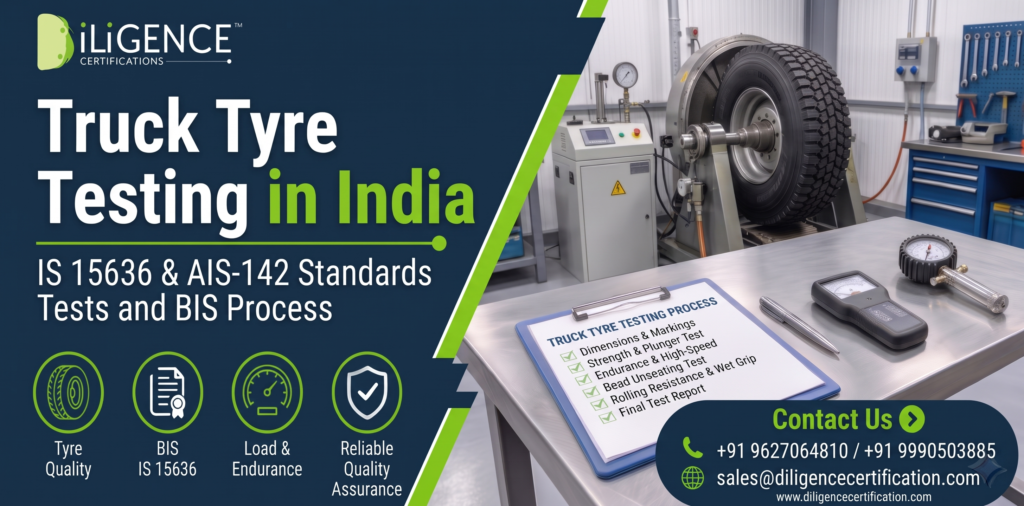
- Truck tyre testing means checking a tyre in a recognised lab against the Indian Standard, so that it stays safe under heavy load and long running.
- For truck and bus tyres, the main standard is IS 15636. The current edition is IS 15636:2022, which replaced the 2012 edition.
- Main lab checks are dimensions, markings, strength, endurance, high-speed running and bead unseating (for tubeless tyres).
- Rolling resistance, wet grip and rolling sound are also part of the rules for truck and bus (C3) tyres. Check the latest notification and dates before you plan.
- Testing is done per tyre type and size group. So planning your sample list early saves a lot of time and money.
- Good records, correct markings and a working factory lab help you pass in the first attempt. No one can promise approval, though. The result always depends on the actual test report.
Introduction
Think of a truck tyre like the shoes of a porter who carries heavy loads all day. The shoes must not tear, must not slip and must not give up in the middle of the road. A truck tyre does the same job, only with much more weight, much more heat and many more kilometres.
That is why truck and bus tyres are tested before they reach the market. In India, this testing is linked to BIS certification and the ISI mark.
In this blog, we explain truck tyre testing in very simple words. You will learn which standard applies, what tests are done, how the process works, which documents you need, and what mistakes to avoid. Manufacturers, importers, private label brands and fleet owners can all use this guide.
What Is Truck Tyre Testing?
Truck tyre testing is a set of lab and factory checks done on a tyre to see if it meets the rules of the Indian Standard. The tyre is measured, marked, loaded, run on a drum, pressed with a plunger and checked again. If it survives all this within the limits, the test report says it conforms.
Simple points to remember:
- Legal base: BIS certification is compulsory for truck and bus tyres covered under the government’s quality control order. Always check the latest order for the exact scope.
- Licence: A manufacturer needs a BIS licence to use the ISI mark on these tyres. Testing is a big part of getting that licence.
- Surveillance: After the licence, BIS keeps checking through factory visits and market samples. So testing is not a one-time job.
The word “truck tyre testing” is also used by fleet owners for field checks like pressure, tread depth and wear. We cover that in a separate section below.
Truck Tyre vs Other Tyres: Simple Difference
People often mix up tyre types. This table makes it easy.
| Tyre type | Used on | Main focus | Common standard |
|---|---|---|---|
| Truck and bus tyre | Trucks, buses, trailers | Heavy load, long life, heat resistance | IS 15636 |
| Light truck tyre | Pick-ups, small goods vehicles | Medium load, mixed roads | Separate standard for that category |
| Passenger car tyre | Cars | Comfort, grip, low noise | Separate standard for cars |
| Retreaded truck tyre | Trucks and buses (second life) | Safe reuse of a good casing | IS 15704:2018 |
So if your product is a new tyre for a truck or bus, IS 15636 is the one to look at. If it is a retreaded tyre, the retread standard applies.
Which Standards Apply to Truck Tyres?
Here are the main documents you should know.
| Standard | What it covers |
|---|---|
| IS 15636:2022 | Pneumatic tyres for commercial vehicles, diagonal and radial ply: dimensions, load and speed details, strength, endurance, markings |
| IS 15704:2018 | Retreaded pneumatic tyres for commercial vehicles |
| AIS-142 | Rolling resistance, wet grip and rolling sound emissions (C1, C2 and C3 tyre classes) |
| IS/ISO 28580 | Test method for measuring rolling resistance (single point test) |
A simple example: Suppose a company makes a radial tyre in size 295/80R22.5 for long-haul trucks. It will be tested under IS 15636 for the main safety and performance checks. For rolling resistance, wet grip and rolling sound, the AIS-142 route is followed as per the current government notification.
Note on the revised version: IS 15636:2022 is the second revision and it replaced the 2012 edition. An amendment has also changed some tyre size tables. So always download the latest copy from the BIS website and read the amendment too. Do not use an old copy from your folder.
Why Is Truck Tyre Testing Important?
Trucks run long hours, carry full loads and sometimes cross bad roads in summer heat. A weak tyre can burst, shed its tread or fail near the bead. The result can be a serious accident. Testing helps because:
- It checks if the tyre can carry the load it claims on the sidewall.
- It shows how the tyre behaves under heat and long running.
- It protects drivers, cargo and other road users.
- It is a legal need for tyres covered by the quality control order.
- It helps a brand build trust with fleet owners and dealers.
- It reduces returns, claims and downtime for transporters.
- It helps buyers compare tyres on facts, not only on price.
What Tests Are Conducted in Truck Tyre Testing?
The exact list and limits are in the standard. This table gives the idea in simple words.
| Test group | What the lab checks | In simple words |
|---|---|---|
| Dimensions | Section width, overall diameter, rim fitment | Is the tyre the size it says it is? |
| Markings | Size, load index, speed symbol, ply rating, tubeless or tube type, date code, manufacturer details, ISI mark | Is everything printed correctly and clearly? |
| Strength test | A plunger is pushed into the tread to see how much energy the tyre can take | Can it handle a sharp hit without breaking? |
| Endurance test | Tyre runs on a drum under load for a fixed time, with load steps | Can it keep going for long under heavy weight? |
| High-speed test | Tyre runs at rising speed steps on a drum | Does it stay safe at higher speeds and heat? |
| Bead unseating | Force needed to push the bead off the rim (tubeless tyres) | Will the tyre stay on the rim in a hard turn? |
| Physical checks after tests | Cuts, cracks, separation, chunking, bead damage | Any damage after the tough runs? |
Before sending samples, a good practice is to run your own pre-checks in the factory lab. Even a quick check of markings and size can save one full round of testing.
Performance Parameters Explained in Simple Words
These terms confuse many people, so here they are in plain language.
| Term | What it means | Why it matters |
|---|---|---|
| Load index | A number that tells the maximum load one tyre can carry | Wrong load index can overload the tyre |
| Speed symbol | A letter that tells the maximum speed the tyre is rated for | Keeps drivers within safe limits |
| Ply rating | Strength grade of the tyre body | Shows how heavy-duty the tyre is |
| Rolling resistance | Energy the tyre loses while rolling | Lower resistance can help save fuel |
| Wet grip | How well the tyre grips a wet road | Helps in braking on rain-soaked highways |
| Rolling sound | Noise made by the tyre on the road | Matters for noise rules and driver comfort |
For the rolling resistance, wet grip and noise limits, always read the current AIS-142 stage and the government notification. Implementation dates were given in phases, and the details can be amended. So confirm the latest position before you plan your launch.
Two Kinds of Testing: Factory Lab and Recognised Lab
This point confuses many first-time applicants.
Factory lab (in-house testing): Your own lab checks the tyres during production. It must have calibrated machines, trained staff and proper records. BIS officers look at this lab during inspection.
Recognised lab (third-party testing): An independent lab recognised for this product tests the sample. BIS also draws samples and sends them to such labs during the licence process and later during surveillance.
You need both. The factory lab shows that you can control quality every day. The recognised lab proves that your tyres match the standard on paper. Think of it like cooking at home and then getting a food inspector’s report.
Step-by-Step Process for Truck Tyre Testing and BIS Certification
- Confirm the scope. Check that your tyre type falls under IS 15636 and the current quality control order.
- Download the latest standard. Get IS 15636:2022 with its amendments, and the BIS product manual for this standard.
- Group your tyre sizes. BIS allows grouping of sizes and types for testing. Plan your groups smartly so that you do not test every single size.
- Set up your factory lab. Keep machines calibrated and keep a test plan, so that your in-house results are reliable.
- Do pre-testing. Check markings, dimensions and key tests in your own lab first.
- Apply to BIS. Submit the application with documents and fee through the BIS portal.
- Factory inspection and sampling. A BIS officer visits, checks your process and lab, and draws samples.
- Test in a recognised lab. Samples go for testing against IS 15636. Wait for the report.
- Grant of licence and ISI marking. If reports and inspection are fine, the licence is granted and you can start marking tyres with the ISI mark.
Note: For overseas factories, the process has extra steps and takes longer.
Which BIS Registration Is Needed?
| Business type | What is usually needed |
|---|---|
| Indian manufacturer | BIS licence under the product scheme, with factory inspection |
| Foreign manufacturer | BIS licence under the Foreign Manufacturers Certification Scheme, with an Authorised Indian Representative |
| Importer | Imported tyres must come from a BIS-licensed maker. Importer needs to follow customs and labelling rules |
| Private label brand | Tyres must be made by a licensed factory, and the brand details must match the licence and marking rules |
| Retreader | Separate standard (IS 15704:2018) applies to retreaded tyres |
If you change your factory, add a new tyre family or change a key design, you may need to update the licence or test again. Check with BIS before making such changes.
Documents Required
Keep these ready before you apply.
Company documents
- Business registration proof (certificate or incorporation papers)
- Factory address proof and ownership or rent papers
- PAN and GST details
- Authorised signatory details and board resolution, if needed
Product documents
- List of tyre sizes, types and ply ratings with the grouping plan
- Tyre drawings, tread pattern and mould details
- Raw material list with suppliers
- Manufacturing process flow chart
- Sample of the ISI marking layout and sidewall marking details
Testing and quality records
- Factory lab details with calibration certificates
- In-house test records for the last few batches
- Quality control plan and inspection checklists
- Previous test reports, if any
Clean and matching documents make the whole process smoother. Mismatch between papers is a very common reason for delay.
How Long Does It Take?
There is no fixed number of days that suits everyone. The timeline depends on your readiness, the lab’s schedule, the number of tyre groups and whether your factory is in India or abroad. Foreign factories usually take longer than Indian ones. Delays mostly come from missing documents, failed tests and slow replies to queries. So reply fast and keep your records ready.
What About Cost?
We are not giving fixed amounts here, because the cost changes from case to case. The main factors are:
- Number of tyre sizes and groups to be tested
- Lab testing charges for each sample
- BIS application and licence fees
- Cost of sample tyres sent to the lab
- Factory lab setup or calibration cost
- Travel and inspection cost for overseas factories
- Consultant support, if you take it
Ask every provider for a written breakup, so that you can compare properly.
Common Failures and Easy Fixes
| Common problem | Why it happens | Easy fix |
|---|---|---|
| Marking errors | Wrong load index, missing date code or unclear ISI mark | Check the marking layout against the standard before moulds are cut |
| Size outside limits | Mould or inflation issues | Measure sample tyres on the right rim and at the right pressure |
| Endurance test failure | Weak construction or poor bonding between layers | Review compound, ply and curing process before sending samples |
| High-speed test failure | Heat build-up in the tyre | Check design, materials and curing control |
| Bead unseating failure | Bead design or rim mismatch | Verify bead and rim details together |
| Documents mismatch | Different names or addresses on papers | Make one master data sheet and use it everywhere |
Common Mistakes to Avoid
- Using an old edition of the standard instead of IS 15636:2022 with amendments.
- Sending samples without a pre-test in the factory lab.
- Printing markings from memory and not from the standard.
- Not grouping tyre sizes properly and ending up with extra testing.
- Keeping calibration certificates out of date.
- Ignoring the AIS-142 requirements for rolling resistance, wet grip and noise.
- Changing materials or moulds after sampling and not telling anyone.
- Waiting till the last week to start the process.
Field Testing: Simple Truck Tyre Checks for Fleet Owners
If you run trucks, you do not send tyres to a lab. But you can still do simple checks every week. These save money and prevent breakdowns.
- Air pressure: Check when the tyres are cold. Low pressure means heat and fast wear. High pressure means a hard ride and uneven wear.
- Tread depth: Look at the wear indicators in the grooves. Change the tyre before the tread becomes too thin, as per your fleet policy and local rules.
- Wear pattern: One-sided wear can mean wheel alignment problems. Centre wear can mean overinflation. Edge wear can mean underinflation.
- Cuts and bulges: Any bulge on the sidewall is a warning. Take the tyre out of service and get it checked.
- Matching tyres on duals: Keep similar size and wear on twin wheels, because a smaller tyre carries less load and a bigger one carries more.
- ISI mark and date code: Check the sidewall for the ISI mark and the manufacturing date before buying.
A small notebook with pressure and wear readings for each truck can show you patterns within a month.
Why Choose Diligence Certifications for truck tyre testing Certification?
Getting through BIS for tyres means handling standards, documents, factory readiness, sampling and follow-ups. Many first-time applicants lose time on small things. This is where a good consultant helps.
At Diligence Certifications, we support manufacturers, importers and private label brands with a simple and clear approach:
- We read the latest standard and notifications first, so you start on the right base.
- We help you plan tyre grouping, documents and pre-testing.
- We guide you on factory lab readiness and records.
- We coordinate the application and follow-up with the concerned offices.
- We keep you updated in plain language, without confusing jargon.
We do not promise approval, because the final decision depends on the factory inspection and the test reports. What we promise is a clean process and honest guidance. You can explore our BIS certification services to know more.
After Registration: What Happens Next
Getting the licence is not the end. BIS can visit your factory again and draw samples from the factory or from the market. Keep your lab running, keep your records updated and keep the markings correct on every tyre. Pay the licence fees on time and inform BIS about any major change. Companies that treat the licence as a daily habit rarely face problems later.
Tips to Pass in the First Attempt
- Start with the latest edition of IS 15636 and its amendment.
- Make a one-page checklist of all test groups and keep it with the production team.
- Run your own endurance and high-speed checks before official sampling, if your lab allows.
- Check the sidewall marking on a trial tyre against the standard.
- Keep raw material records and batch numbers ready.
- Choose representative sizes for each group, as per the BIS product manual.
- Keep calibration certificates and staff training records in one file.
- Plan extra time. A rushed application is a risky application.
Quick Checklist Before Sending Samples
- Latest IS 15636 and amendment downloaded
- Tyre groups and sizes finalised
- Markings checked and approved
- Factory lab machines calibrated
- Pre-test results reviewed
- Raw material and batch records ready
- Company and product documents matched
- AIS-142 requirements understood
Conclusion
Truck tyres carry heavy loads, human lives and a lot of money on every trip. Testing is the way to prove that a tyre is fit for that job. For manufacturers, it means following IS 15636:2022, preparing the factory lab, planning samples and keeping every record clean. For fleet owners, it means choosing tyres with the ISI mark and checking them regularly.
Start early, read the latest rules, keep your papers matching and take expert help where needed. That is the simplest path to a smooth truck tyre testing and certification process.
Frequently Asked Questions
1. What is truck tyre testing?
It is a set of checks on a truck or bus tyre in a lab to confirm that it meets the Indian Standard for size, markings, strength, endurance and high-speed running.
2. Which standard applies to truck tyres in India?
IS 15636 covers pneumatic tyres for commercial vehicles, both diagonal and radial ply. The current edition is IS 15636:2022.
3. Is BIS certification compulsory for truck tyres?
Truck and bus tyres covered under the government's quality control order need BIS certification. Please check the latest order for the exact scope.
4. What tests are done on a truck tyre?
Common tests include dimension checks, marking checks, strength, endurance, high-speed performance and bead unseating for tubeless tyres.
5. What is AIS-142?
t is an automotive industry standard that deals with rolling resistance, wet grip and rolling sound emissions for tyre classes C1, C2 and C3. Truck and bus tyres fall in class C3.
6. Do retreaded truck tyres have a separate standard?
Yes. Retreaded tyres for commercial vehicles are covered by IS 15704:2018.