BIS Certification
 CDSCO
CDSCO
 PESO
PESO
 CPCB
CPCB
 LMPC
LMPC
 WPC Approval
 Global Approvals
 TEC
TEC
 ARAI
ARAI
 BEE
BEE
 ISO Certification
 DGCA Certification
 NOC For Steel
 APEDA Registration























 Business Registration
 FSSAI Mark Certification












 (32).jpg)
 Legal Services
 Trademark Registration
 Copyright Registration
 Patent Registration
 By
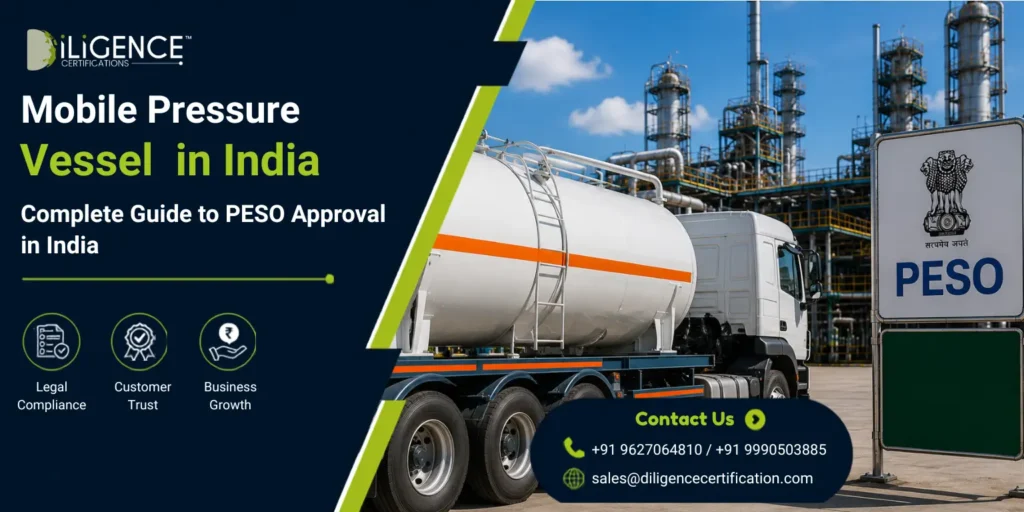
By - Mobile Pressure Vessel Approval is compulsory for the safe transportation of compressed gases and dangerous liquids in road tankers, cryogenic tanks, and other mobile pressure vessels as per Static and Mobile Pressure Vessels (Unfired) Rules, 2016 (SMPV Rules).
- The Mobile Pressure Vessel Approval from PESO confirms that the vehicle, pressure vessel, and safety devices meet the necessary technical and operational requirements.
- Diligence Certifications provides assistance to manufactures, transporters, and industries with documentations, testings, inspections, and complete Mobile Pressure Vessel Approval services.
Introduction
Recently, a logistics company providing transportation services for liquefied petroleum gas (LPG) contacted our compliance department after having purchased a set of new road tankers. The purchase was made, the contracts were already signed, and operations were due to start within a week. While doing the final compliance check, it was found out that the tanker trucks were not allowed to transport hazardous goods without getting Mobile Pressure Vessel Approval from the Petroleum and Explosives Safety Organisation (PESO).
Such situations are quite frequent in industries dealing with compressed gases, cryogenic liquids, and petroleum products since the violation of any single compliance issue may result in delays of the whole project.
The Mobile Pressure Vessel Approval is much more than just the statutory paperwork; it guarantees that the pressure vessel, the design of the vehicle, its safety features, and transportation process will be in compliance with Indian safety laws, thus minimizing the risks of any accidents while delivering the cargo.
What is Mobile Pressure Vessel Approval?
Mobile Pressure Vessel Approval is an approval issued by the Petroleum and Explosives Safety Organisation (PESO) for pressure vessels permanently attached to vehicles transporting compressed gases and dangerous liquids.
This approval is based on the Static and Mobile Pressure Vessels (Unfired) Rules, 2016 (SMPV Rules), following an assessment of the compliance of the pressure vessel, the vehicle, fabrication standards, testing, and safety systems with the prescribed norms.
In contrast to static pressure vessels used in industries, mobile pressure vessels are meant for transportation of materials. As these pressure vessels function on public roads while containing dangerous materials, special engineering considerations are required for these pressure vessels.
Products commonly transported through mobile pressure vessels are:
- LPG - Liquefied Petroleum Gas
- LNG - Liquefied Natural Gas
- LOX - Liquid Oxygen
- LIN - Liquid Nitrogen
- Liquid Argon
- Ammonia
- Carbon Dioxide
- Cryogenic liquids
- Industrial gases
- Petroleum products
Before approval is granted, PESO evaluates:
- Pressure vessel design
- Mounting of equipment on vehicles
- Welding quality
- Material specifications
- Safety valves
- Emergency shut-off devices
- Hydrostatic testing
- Non destructive testing (NDT)
- Fire safety measures
- SMPV Rules
Only after successfully meeting these technical requirements can the mobile pressure vessel be approved for transporting hazardous materials.
Why is Mobile Pressure Vessel Approval Important?
There are a lot of safety risks associated with moving harmful gases and liquids in transit.
The approval process for Mobile Pressure Vessels enables companies to mitigate such risks by adhering to all the relevant laws and technical requirements.
Compliance With the Applicable Law
Approval guarantees compliance with the law of Static and Mobile Pressure Vessels (Unfired) Rules, 2016.
Safety of the General Public
Because mobile pressure vessels move on public roads, higher engineering standards ensure a smaller risk of leakage, fire, and explosion.
Enables Safe Transit
Approved mobile pressure vessels go through all the necessary inspection and tests prior to being put into use.
Increases Client Confidence
It is common practice for oil companies, industrial gas producers, EPC contractors, and governmental organizations to ask for proof of compliance with relevant legislation prior to awarding any transportation contract.
Prevents Operational Disruption
Getting approval before commissioning will prevent disruptions of any inspections or audits.
For those companies which move hazardous cargo in India, compliance is an absolute must.
Who Needs Mobile Pressure Vessel Approval?
A vast number of industries need Mobile Pressure Vessel Approval while moving hazardous gases or liquids.
These industries can be listed as follows:
LPG Distributors
Industries that move LPG via road tankers.
LNG Carriers
Industries engaged in the movement of liquefied natural gas.
Industrial Gas Producers
Industries moving oxygen, nitrogen, argon, helium, hydrogen, and carbon dioxide.
Cryogenic Liquid Suppliers
Industries engaged in the movement of cryogenic liquids for industry and medical uses.
Chemical Manufacturers
Industries moving hazardous chemicals under pressure from their manufacturing units to clients.
Oil Marketing Companies
Oil companies that move petroleum products by using pressure vessels.
Gas Cylinder Filling Plants
Industries moving gases in bulk to distribution centers.
Engineering & EPC Contractors
Pressure vessel manufacturers supplying transport systems for industrial projects.
Types of Mobile Pressure Vessels Covered
PESO approval applies to several categories of mobile pressure vessels depending on the product being transported and the vessel design.
Common examples include:
- LPG Tankers
- LNG Tanker Trucks
- Cryogenic Tankers
- Tankers for Liquid Oxygen
- Tankers for Liquid Nitrogen
- Tankers for Liquid Argon
- Ammonia Tankers
- Tankers for Carbon Dioxide Transportation
- Industrial Gas Tankers
- Insulated Vessels for Cryogenic Liquids
- Transportation Vehicles with Pressure Vessels
Each type of mobile pressure vessel is subject to specific engineering standards, inspection procedures, and testing requirements before approval is granted.
Eligibility Criteria for Mobile Pressure Vessel Approval
For attaining the approval of Mobile Pressure Vessel, it is important that businesses follow the regulations laid down under Static and Mobile Pressure Vessels (Unfired) Rules, 2016 (SMPV Rules).
As these pressure vessels are used to carry hazardous and flammable substances on public roads, PESO conducts an elaborate assessment process before approving the mobile pressure vessel.
Some of the requirements that one needs to fulfill in order to become eligible are the following:
Business Registration
The application seeking approval should be made by a registered business entity, LLP, partnership firm, proprietor or Government organization authorized to manufacture, own and operate the mobile pressure vessel.
Approval of Pressure Vessel Design
The pressure vessel should be of an engineering design following recognized standards like Indian Standards, ASME code etc.
Certification of Fabrication
The mobile pressure vessel should be fabricated by an approved manufacturer following approved processes of fabrication including welding.
Approval of Vehicle Chassis
The chassis to be mounted with the pressure vessel should conform to the relevant transportation and safety standards.
Safety Equipment Required
All safety equipment needs to be fitted on the mobile pressure vessel, which includes pressure relief valves, emergency shutdown valves, excess flow valves, level gauge, pressure gauge, and fire extinguisher equipment.
Passes Inspection and Tests
The pressure vessel is expected to pass hydrostatic test, non-destructive test (NDT), leak test, and other tests as per the PESO.
Compliance with SMPV Rules
The entire pressure vessel, vehicle mounting, and transport system should be in accordance with the Static and Mobile Pressure Vessels (Unfired) Rules, 2016.
Documents Required for Mobile Pressure Vessel Approval
Submitting complete and accurate documentation significantly reduces approval delays. Missing technical records are among the most common reasons for regulatory observations.
Business Documents
- Certificate of Incorporation / Business Registration
- PAN Card
- GST Registration Certificate
- Factory License (if any)
- Authorisation Letter
- Proof of Identity & Address of Authorised Signatory
Technical Documents
- Design Drawing of Pressure Vessel
- General Arrangement (GA) Drawing
- Engineering Design Calculation
- Material Specification
- Welding Procedure Specification (WPS)
- Procedure Qualification Record (PQR)
- Fabrication Details
Vehicle Documents
- Vehicle Chassis Details
- Chassis Manufacturer Certificate
- Drawings for Mounting System
- Vehicle Registration Papers (if any)
- Certificate of Vehicle Fitness
Testing and Inspection Reports
- Report on Hydrostatic Test
- Report on Radiographic Test (RT)
- Report on Ultrasonic Test (UT)
- Certificates of Non Destructive Tests (NDT)
- Material Test Certificates
- Leak Test Certificate
- Certified Pressure Relief Valves Test
- Calibration Certificates
- Third Party Inspection Reports (if any)
Compliance Documents
- Quality Assurance Certification of Manufacturer
- Operation and Maintenance Manuals
- Fire Safety Compliance Certificates
- Previous Approval Certificates (if any)
- Compliance with Relevant Standards
Step-by-Step Mobile Pressure Vessel Approval Process
Knowing the entire process of getting approval can assist companies in fulfilling all the regulatory requirements prior to embarking on transportation activities.
Step 1: Project Planning
The applicant specifies the product that will be transported, size of the vessel, pressure level, configuration of the vehicle and statutory requirements.
Step 2: Engineering
Engineers design pressure vessel drawings, design calculations, fabrication drawings, mounting and safety system layout.
Step 3: Fabrication of Pressure Vessel
The pressure vessel is fabricated to meet the engineered standards by use of certified materials and welding processes.
Inspection is done during the fabrication process.
Step 4: Testing and Quality Inspection
Prior to mounting on the vehicle, the pressure vessel is subjected to inspection tests which include:
- Hydrostatic Pressure Test
- Radiography
- Ultrasonic
- Leak Test
- Dimensional Inspection
- Pressure Relief Valve Test
- Visual Inspection
Step 5: Vehicle Mounting
Upon successful testing, the pressure vessel is properly mounted on the approved vehicle chassis along with all required safety components.
Proper mounting is very important for safe transport.
Step 6: Application Submission
The applicant applies to PESO for approval with the approval application along with engineering drawings, test reports, vehicle details, and government fees.
Step 7: Technical Scrutiny
PESO scrutinizes the following:
- Calculations of design
- Engineering drawings
- Manufacturing details
- Test reports
- Vehicle details
- Safety features
- Documentation for compliance
- Any other documentation which may be required.
Step 8: Physical Inspection
A physical inspection by PESO or a designated inspection agency is carried out to confirm the following:
- Installation of the pressure vessel
- Mounting on the vehicle
- Safety systems
- Emergency equipment
- Drawing compliance
- Any observations need to be corrected before approval.
Step 9: Issuance of Mobile Pressure Vessel Approval
After the successful evaluation of technical and safety standards, the Mobile Pressure Vessel Approval is issued by PESO which enables the vehicle to transport hazardous gases or substances as per the guidelines laid down.
Inspection and Testing Requirements
Inspection and testing guarantee the ability of the mobile pressure vessel to operate in transportation conditions without jeopardizing public safety.
There are several types of inspections, including:
Hydrostatic Test
Tests the ability of the vessel to operate at pressures higher than its operating one safely.
Radiographic Testing (RT)
It tests internal welding flaws using X-rays and gamma rays.
Ultrasonic Testing (UT)
Used for the detection of flaws hidden inside the material of the vessel.
Magnetic Particle Inspection (MT)
Helps detect surface and subsurface cracks in the ferromagnetic materials.
Liquid Penetrant Inspection (LPI)
Helps detect small defects on the surfaces of the welds and fabricated items.
Leak Test
Make sure there is no leakage of the gas or fluid in the vessel and the connected piping.
Pressure Relief Valve Test
Tests the proper operation of the safety relief valves at certain pressures.
Dimensional Inspection
Measures the vessel dimensions, shell thickness, and nozzle positions according to the approved drawings.
Applicable Rules and Regulations
The approval procedure for Mobile Pressure Vessels involves a number of statutes and codes which guarantee the safe transport of dangerous goods.
These include the following:
- Static and Mobile Pressure Vessels (Unfired) Rules, 2016 (SMPV Rules)
- Explosives Act, 1884
- Petroleum Act, 1934
- Petroleum Rules, 2002
- Central Motor Vehicles Rules, 1989
- Indian Standard Codes (IS Codes)
- ASME Boiler & Pressure Vessel Code (where applicable)
- PESO Circulars and Technical Guidance Notes
- Notifications from Department for Promotion of Industry and Internal Trade (DPIIT)
Common Reasons for Application Rejection
Many applications are delayed because of avoidable documentation or compliance issues.
Some common reasons include:
- Incomplete application forms
- Incorrect engineering drawings
- Missing design calculations
- Invalid test reports
- Non-compliance with SMPV Rules
- Improper vehicle mounting arrangements
- Inadequate safety equipment
- Defective welding documentation
- Delayed response to regulatory observations
- Failure during inspection
Carefully reviewing the application before submission can improve the likelihood of first-time approval.
Processing Time for Mobile Pressure Vessel Approval
The approval timeline depends on several factors, including:
- Type of pressure vessel
- Product being transported
- Capacity of the vessel
- Completeness of technical documentation
- Inspection schedules
- Response to regulatory observations
Applications with complete documentation and valid inspection reports are generally processed more efficiently.
Government Fees
There is no fixed government fee applicable to every Mobile Pressure Vessel Approval application.
The fee depends on:
- Type of mobile pressure vessel
- Capacity
- Nature of compressed gas or hazardous liquid
- Number of vehicles
- Inspection requirements
- Applicable statutory charges
Applicants should also consider engineering, testing, inspection, and consultancy expenses while planning the overall project budget.
Validity and Renewal of Mobile Pressure Vessel Approval
The validity of Mobile Pressure Vessel Approval depends on the category of approval issued and the applicable provisions of the SMPV Rules.
To maintain compliance, businesses should:
- Conduct periodic inspections and maintenance.
- Test safety valves and protective devices at prescribed intervals.
- Report any structural modifications to the competent authority.
- Renew approvals before expiry.
- Maintain complete inspection and maintenance records.
Timely renewal and ongoing compliance help ensure uninterrupted operations and continued adherence to PESO safety regulations.
Benefits of Mobile Pressure Vessel Approval
Getting Mobile Pressure Vessel Approval is more than an obligation. The process guarantees safety in transporting dangerous cargo and protects the business from any legal, operational and financial risks.
1. Guarantees Compliance with Law
Mobile Pressure Vessel Approval assures that the transportation equipment is in compliance with the Static and Mobile Pressure Vessels (Unfired) Rules, 2016 and the PESO regulation.
2. Provides Safe Transporting Process
The design of the approved mobile pressure vessel, along with its inspection and testing process, reduces chances of any leaks, fire or explosion of the vessel.
3. Minimizes Operational Risks
Compliance with laws protects the company from any transportation delays, fines and other operational risks.
4. Helps to Gain Customers’ Trust
Oil companies, gas industry, chemical plants and governmental bodies prefer working with transporters that have PESO-approved transport vehicles.
5. Facilitates Business Growth
The availability of approved transport vehicles gives an opportunity to extend the logistics process and take part in various government and industrial projects.
6. Eases Insurance Process
Insurance companies and governmental bodies require PESO approval during their investigations and audits.
Common Compliance Challenges
Even though the process of approval is well-known, companies still face many problems due to compliance issues that can be avoided.
Technical Documentation Not Provided
Lack of drawings, calculations or inspection documentation often leads to regulatory observations.
Wrong Vehicle Installation
Improper installation may influence the stability of the pressure vessel and slow down the approval process.
Incomplete Reports
Incomplete hydrostatic or non-destructive testing reports will make you wait longer for an approval.
Safety Valves and Gauges Not Provided
Lack of safety valves or gauges will lead to refusal in obtaining the approval.
Absence of Knowledge of Requirements
Many people are not aware of the recent SMPV Rules and requirements by PESO.
Why Choose Diligence Certifications?
Obtaining Mobile Pressure Vessel Approval involves technical documentation, engineering compliance, inspections, and coordination with regulatory authorities. Managing these requirements without expert guidance can delay your project.
Diligence Certifications provides complete assistance throughout the approval process, including:
- Eligibility assessment
- Documentation support
- Engineering compliance review
- Application filing
- Coordination with inspection agencies
- Assistance during PESO inspections
- Query resolution
- Renewal and compliance support
Our experienced consultants work closely with manufacturers, transport operators, industrial gas suppliers, LPG companies, and engineering firms to ensure a smooth approval process.
Conclusion
Safety and compliance go hand-in-hand when it comes to transportation of hazardous gases and liquids. Mobile Pressure Vessel Approval ensures that your vehicle, pressure vessel and safety system complies with all the PESO regulations prior to commencing commercial operation.
Early acquisition of approval during planning can prevent any future problems which will help in ensuring safety for employees as well as the general public. For those operating LPG road tankers, LNG transport, cryogenic tanker and industrial gas transport systems, obtaining such approval is very important for smooth running of the operations.
Diligence Certifications provides professional support and advice for obtaining Mobile Pressure Vessel Approval.
Looking for help with Mobile Pressure Vessel Approval? Contact Diligence Certifications now.
Frequently Asked Questions
What is Mobile Pressure Vessel Approval?
Mobile Pressure Vessel Approval is a PESO approval required for transporting compressed gases and hazardous liquids using pressure vessels mounted on vehicles.
Who needs Mobile Pressure Vessel Approval?
Manufacturers, LPG transporters, industrial gas suppliers, cryogenic liquid transporters, and chemical companies generally require this approval.
Which authority issues Mobile Pressure Vessel Approval?
The Petroleum and Explosives Safety Organisation (PESO) issues the approval under the SMPV Rules, 2016.
What documents are required for Mobile Pressure Vessel Approval?
Business registration documents, engineering drawings, test reports, vehicle details, and safety compliance certificates are commonly required.
How do I apply for Mobile Pressure Vessel Approval?
Submit the application with technical documents to PESO and complete the required inspections and testing.
How long does it take to obtain Mobile Pressure Vessel Approval?
The approval timeline depends on documentation, technical scrutiny, inspections, and regulatory processing.
Can Mobile Pressure Vessel Approval be renewed?
Yes. Renewal should be completed before expiry by submitting the required documents and inspection reports.
What happens if a mobile pressure vessel operates without approval?
Operating without approval may result in penalties, legal action, suspension of transport operations, and safety risks.
What is the validity of Mobile Pressure Vessel Approval?
The validity depends on the approval category and applicable PESO regulations
Why choose Diligence Certifications for Mobile Pressure Vessel Approval?
Diligence Certifications provides complete support with documentation, application filing, compliance, inspections, and PESO approval.