BIS Certification
 CDSCO
CDSCO
 PESO
PESO
 CPCB
CPCB
 LMPC
LMPC
 WPC Approval
 Global Approvals
 TEC
TEC
 ARAI
ARAI
 BEE
BEE
 ISO Certification
 DGCA Certification
 NOC For Steel
 APEDA Registration























 Business Registration
 FSSAI Mark Certification












 (32).jpg)
 Legal Services
 Trademark Registration
 Copyright Registration
 Patent Registration
 By
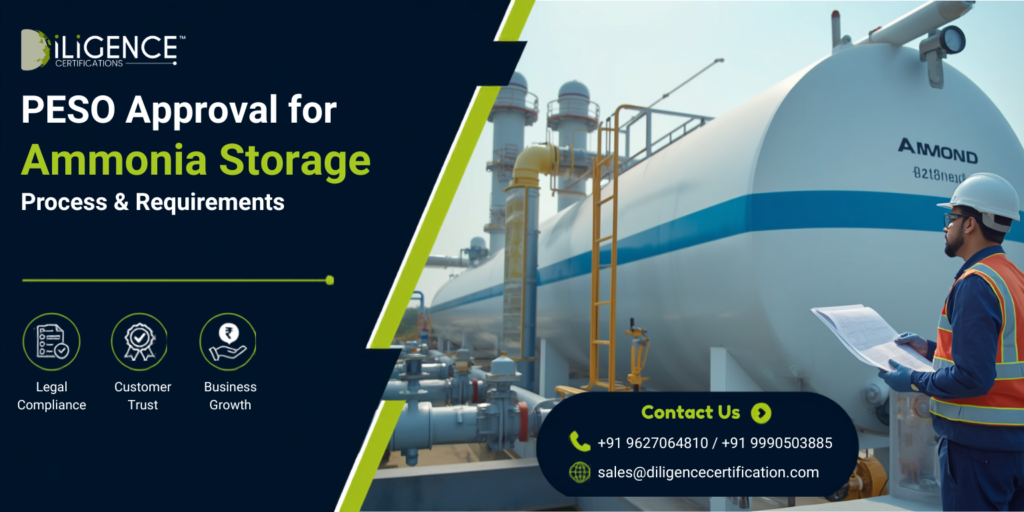
By - PESO Approval for Ammonia Storage which covers ammonia storage facilities which are regulated according to the applicable pressure vessel and gas storage guidelines regulated by PESO.
- These approvals may consist of applicability analysis, technical drawings, pressure vessel documents, site plan, safety arrangements, NOC, application review and inspection.
- Special considerations will be accorded to ammonia as it is both toxic and corrosive. According to PESO, ammonia pressure vessels have a two-year testing period.
Introduction
One company involved in the chemical business recently turned to the compliance department following the purchase of a significant ammonia tank. Documents related to the tank had been supplied by the equipment vendor, while the engineering department had already began preparing the site for installation.
However, when all regulatory documents were analyzed simultaneously, it became clear that there was some inconsistency between the details of the vessel, the site layout and planned installation and information to be prepared for the licensing process. While correcting documentation was relatively easy, modifying the installation site after civil work and piping had been done was much more costly.
That is the typical lesson of industrial compliance: PESO approval needs to be taken into account at the stage of project planning, rather than after installation of the equipment has already been doneThis is especially true of companies working with ammonia, which is poisonous and corrosive.
The Static and Mobile Pressure Vessels (Unfired) Rules, 2016, commonly known as SMPV (U) Rules, form an integral component of the regulatory regime under PESO’s purview. According to PESO, these rules relate to the storage and transport of compressed gases, including cryogenic liquids, in pressure vessels.
What Is PESO Approval for Ammonia Storage?
PESO License for Ammonia Storage Installation is the license that must be obtained by an ammonia storage installation that comes within the scope of PESO.
The Petroleum and Explosives Safety Organisation is known as PESO, which is run by the Department for Promotion of Industry and Internal Trade of the Ministry of Commerce and Industry in the Government of India.
For ammonia storage installations, the type of regulatory approach will depend on:
- Physical form of ammonia
- Storage capacity
- Operating pressure
- Vessel type
- Vessel water capacity
- Static or mobile application
- Storage location
- Intended industrial use
- Filling and unloading arrangements
- Applicable rules and licence category
A company should therefore avoid assuming that every ammonia installation follows exactly the same approval procedure.
The first practical step is an applicability assessment.
Why Is PESO Approval Important for Ammonia Storage?
Ammonia storage is not just about storing the chemicals within the tanks.
An ammonia system requires planning and designing around containment, pressure management, leaks, safe handling, and emergency response systems. Any lapse in any of these factors will pose both health and environmental risks in the workplace.
This means that PESO compliance should be factored in during the design phaseAn ammonia storage facility will generally require synchronized data on the pressure vessel, pipe lines, valves, safety apparatus, site layout, and associated safety systems According to PESO FAQ, the ammonia pressure vessels fall under their purview. They indicate that the testing interval of the hydrostatic test is two years They also state that the safety relief valve installed in the pressure vessels is tested for proper functioning once a year This brings us to an important realization that PESO compliance doesn’t end with getting the initial license.
Which Ammonia Storage Systems May Require PESO Approval?
The exact applicability should be established from the equipment and operating arrangement.
Ammonia Storage Vessels
Large stationary ammonia storage tanks may be subject to SMPV(U) where they fit within the definition and requirements of the Regulations According to PESO’s 2024 SOP, the SMPV(U) Regulations apply to both static and portable pressure vessels for storage and transport of compressed gases and certain cryogenic liquids.
Ammonia Storage for Industrial Plants
Ammonia may be used in:
- Fertiliser manufacturing
- Chemical production
- Industrial refrigeration
- Cold-storage facilities
- Food processing
- Pharmaceutical manufacturing
- Water-treatment applications
- Other industrial processes
The purpose of the ammonia does not by itself determine the PESO route. The physical storage arrangement and applicable regulatory requirements need to be examined.
Ammonia Storage in Refrigeration Systems
Ammonia can be used in large refrigeration systems as a refrigerant In case ammonia is to be stored in a pressure vessel, the regulatory issue needs to be addressed at the design phase and not assumed that since the refrigeration system is generally considered safe it satisfies the requirement of pressure vessel licensing.
PESO Approval for Ammonia Storage: Regulatory Framework
The SMPV(U) Rules, 2016 represent one of the key sources regulating pressure vessel storage of compressed gases.
The SMPV(U) Rules, 2016 are published on the official website of PESO.
- The regulations cover issues related to pressure vessels, storage installations, transportation, inspections, tests, and licensing.
- PESO has a formal SOP on approvals and licences granted according to the SMPV(U) Rules, 2016.
- In general, the key message for a project developer is to prepare the application according to the current rules and procedures of PESO, not some old consultant checklist.
Static and Mobile Pressure Vessels (Unfired) Rules, 2016
The SMPV(U) Rules represent one of the key regulatory acts governing pressure vessel storage According to PESO’s 2024 SOP, the rules cover both static and mobile pressure vessels and compressed gases stored or transported in pressure vessels.
Gas Cylinder Rules, 2016
The Gas Cylinder Rules, 2016 may apply to the ammonia storage when ammonia is stored in cylinders, but not in fixed pressure vessel installation The Gas Cylinder Rules, 2016 are published on the PESO website separately from the SMPV(U) Rules Thus, it is necessary to determine the equipment configuration first in order to choose the proper regulatory route.
PESO Approval for Ammonia Storage Process
The process begins with understanding the proposed installation and ends with the grant of the applicable licence after regulatory scrutiny and, where required, inspection.
Applicability Assessment
First, the project should be reviewed for:
- Ammonia storage capacity
- Type of vessel
- Design pressure
- Working pressure
- Specifications for the vessels
- Number of vessels
- Static or mobile installation
- Installation location
- Use of the ammonia storage
- Filling/unloading facilities
- PESO regulations applicable
This step prevents the project team from preparing an application under an unsuitable category.
Technical Documentation
The engineering team should prepare drawings and technical documents that accurately represent the proposed installation.
These may include:
- General arrangement drawings
- Pressure vessel drawings
- Design calculations
- Process flow diagram
- P&ID
- Equipment datasheets
- Material specifications
- Pressure requirements
- Safety relief device data
- Test certificates
- Inspection certificates
- Site layout
- Fire safety arrangements
- Emergency systems
- Hazardous area information if applicable
Site and Layout Review
Review of the proposed site for the ammonia storage tank must precede the installation process The site plan must indicate the storage tank, piping, access route, adjacent structures, facilities for filling or unloading of the facility and other related safety features This is one area where the compliance review at the initial stages can save from costly changes in future.
NOC and Supporting Documents
In some cases, supporting permissions or NOC may be required based on the particular license and installation involved The requirement for NOC or permission must be determined based on the specific storage facility design instead of being derived from other ammonia storage projects.
Filing of Application
Form AS-1 has been issued by PESO for filing applications regarding the grant, amendment or renewal of a license for storing compressed gas in vessels or vessels under the SMPV(U) Rules, 2016.
Technical Scrutiny
PESO reviews the submitted information against the applicable regulatory requirements If discrepancies are identified, the applicant may need to submit clarification, revised drawings or additional documents.
Inspection and Approval
Where inspection is applicable, the physical installation is checked against the submitted documents and regulatory requirements Once the applicable requirements have been satisfactorily completed, the relevant licence or approval can be issued.
Documents Required for PESO Approval for Ammonia Storage
The actual list may vary according to the specific installation, however, the applicant should be prepared for the following documents.
Company Documents
- Incorporation certificate
- PAN
- GST
- Letter of authorisation
- Applicant’s details
- Company address
Land and Installation Documents
- Land ownership/ lease papers
- Site plan
- Location plan
- Layout drawing
- Coordinates of installation if applicable
- Surrounding facilities details
Technical Documents
- Drawings of pressure-vessels
- Calculations
- Documents from the manufacturer
- Certificates of material
- Certificates of testing
- Inspection report
- P&ID
- Equipment datasheets
- Safety valves details
- Pressure and temperature details
Safety Documents
Depending on the specific installation the project may need:
- Fire-protection details
- Emergency shutdown arrangements
- Ammonia leak detection system
- Emergency response arrangements
- Safety equipment
- Details of hazardous areas if applicable
- Safety distances
- Emergency access arrangements
The most important thing here is that all these documents should be consistent. The certificate, drawing, layout, and application should reflect the same installation.
What Does PESO Check in an Ammonia Storage Installation?
One useful method for the inspection would be to consider the installation as one comprehensive system, rather than just one tank.
Integrity of Pressure Vessel
The pressure vessel needs to have proper documentation for its design, construction, testing, and inspection.
Pressure Relief System
A pressure relief system is an essential aspect of safety, and it must be adequately designed, maintained, and tested According to PESO, safety relief valves in pressure vessels need to be tested for their proper functioning at least once in a year.
Prevention of Ammonia Leakage
Connections, valves, flanges, piping, and transfer points must be designed and maintained in such a way as to reduce the chances of any ammonia leakage.
Corrosion Control
The system using ammonia requires proper material compatibility and corrosion control measures.
Emergency Response
There must be adequate provisions for emergency response to the detection and handling of ammonia leakages.
Site Arrangements
The site arrangement of the vessel is an integral part of the installation.
Ammonia Storage Vessel Testing Requirements
However, compliance with ammonia storage does not cease once the PESO licence is obtained. Pressure vessels and their safety systems need to comply with testing and inspection requirements even while they are operated According to the PESO’s official FAQ regarding ammonia pressure vessels, their inspection must be performed every two years. This means the operator must have an appropriate testing schedule that makes sure required inspections are completed in the specified time.
There is another requirement - the safety relief valve attached to pressure vessels needs to be tested for the appropriate performance at least once a year with the relevant certificate retained by the operator In relation to the plant operator, this means there should be three pieces of documentation properly kept: pressure vessel testing report, safety relief valve testing certificate and relevant inspection reports.
The best way to keep track of these deadlines would be to use a compliance calendar rather than rely on a licence renewal period. Violation of any testing deadlines becomes a compliance issue even if the licence itself remains valid Consequently, ammonia storage compliance can be considered an ongoing obligation, including both the licence and operational safety conditions of the storage facility.
Common Mistakes in PESO Approval for Ammonia Storage
Installation of the Vessel Prior to Regulation Examination
- A storage vessel must never be installed first and then documented subsequently.
- Site arrangement needs to be checked during the planning stage.
- Assuming that Vessel and Its Installation is the Same Approval Process
- Technical documentation on a vessel does not automatically mean that the entire storage installation is compliant.
Using Old Requirements of PESO
The regulatory process may change PESO issues revised rules, SOPs, forms and circulars on its official website, therefore it is advised to check the latest requirements prior to applying.
Drawing Discrepancies
A frequent practical mistake is that of vessel drawing, site arrangement and application For instance, when the storage capacity and/or the vessel location changes during construction and the application is not revised accordingly, this results in an unnecessary regulatory observation.
Failure to Conduct Periodic Testing
Ammonia pressure vessel testing is not a single time process PESO sets up a two-year test period for ammonia pressure vessels.
PESO Approval for Ammonia Storage: Timeline and Cost
There is no single timeline or fixed cost that applies to every ammonia storage project.
The overall duration can depend on:
- Storage capacity
- Vessel specifications
- Site readiness
- Technical-document completeness
- NOC requirements
- Testing requirements
- Inspection
- Regulatory observations
- Modifications required after scrutiny
The total project cost can similarly include statutory fees as well as engineering drawings, testing, inspection, consultancy, documentation and any modifications required for compliance.
For this reason, a project-specific assessment is more useful than relying on a generic online “PESO licence cost”.
Validity of PESO Ammonia Storage Licence
The validity of the PESO licence is determined by the licence in question and the regulatory requirements.
For an ammonia storage facility, license renewal needs to be done before the expiry date, and all documentation of test results must be updated accordingly.
This is especially crucial in light of the requirement for testing of ammonia pressure vessels. The periodicity for testing ammonia pressure vessels, according to PESO, is every two years A compliance schedule that includes licence renewal, testing of the vessels, and testing of the safety valves would ensure regulatory compliance.
How Diligence Certifications Can Help
For an ammonia storage project, regulatory compliance and engineering documentation need to work together.
At Diligence Certifications, the focus is on helping businesses organise the approval process from applicability assessment through documentation and regulatory coordination.
Support can include:
- PESO applicability assessment
- Document checklist preparation
- Application assistance
- Technical-document coordination
- Site-layout review
- NOC guidance
- Inspection coordination
- Regulatory observation support
- Licence amendment assistance
- Renewal support
The objective is not simply to submit an application. The aim is to ensure that the application, engineering documents and actual installation tell the same story.
Conclusion
Storage of ammonia involves much more than just having the right storage tank and having filled out the right application form. Pressure vessel, site layout, piping, safety systems, testing records, and regulatory documents must all come together.
Companies that are installing or upgrading their ammonia storage facilities must consider obtaining PESO approval for Ammonia Storage from the very start of their planning phase. This way, there will be less chance of missing any documentation, having to make alterations to the site, or creating delays in the scrutiny or inspection processes.
The regulatory information available from PESO, such as SMPV(U) Rules, SOPs, and application forms, should be evaluated before applying Should your company be planning the installation of an ammonia storage facility or require assistance with existing PESO licensing, Diligence Certifications can provide you with guidance in the process Contact Diligence Certifications for PESO Ammonia Storage compliance review.
Frequently Asked Questions
Is PESO Approval required for ammonia storage in India?
Yes, applicable ammonia storage installations must comply with the relevant PESO licensing and safety requirements.
What is PESO Approval for Ammonia Storage?
It is the applicable PESO approval or licence required for regulated ammonia storage installations.
Which rules apply to ammonia storage vessels?
The SMPV(U) Rules, 2016 are relevant to applicable ammonia pressure-vessel storage installations.
What documents are required for PESO Approval for Ammonia Storage?
Documents may include vessel drawings, design calculations, site plans, testing certificates, company documents and safety details.
What is the process for obtaining PESO Approval for ammonia storage?
The process generally involves applicability assessment, documentation, application, scrutiny, inspection and licence issuance.
How often does an ammonia pressure vessel require testing?
PESO's official FAQ specifies a two-year testing periodicity for ammonia pressure vessels.
How often should ammonia safety relief valves be tested?
Safety relief valves fitted to pressure vessels should be tested for correct operation at least once every year.
Is an NOC required for ammonia storage?
An NOC may be required depending on the installation, location and applicable PESO requirements.
What factors affect the cost of PESO Approval for ammonia storage?
Cost depends on the storage system, vessel specifications, statutory fees, testing, documentation and compliance requirements.
Can Diligence Certifications help with PESO Approval for Ammonia Storage?
Yes, Diligence Certifications can assist with applicability assessment, documentation, application, compliance and inspection coordination.