BIS Certification
 CDSCO
CDSCO
 PESO
PESO
 CPCB
CPCB
 LMPC
LMPC
 WPC Approval
 Global Approvals
 TEC
TEC
 ARAI
ARAI
 BEE
BEE
 ISO Certification
 DGCA Certification
 NOC For Steel
 APEDA Registration























 Business Registration
 FSSAI Mark Certification












 (32).jpg)
 Legal Services
 Trademark Registration
 Copyright Registration
 Patent Registration
 By
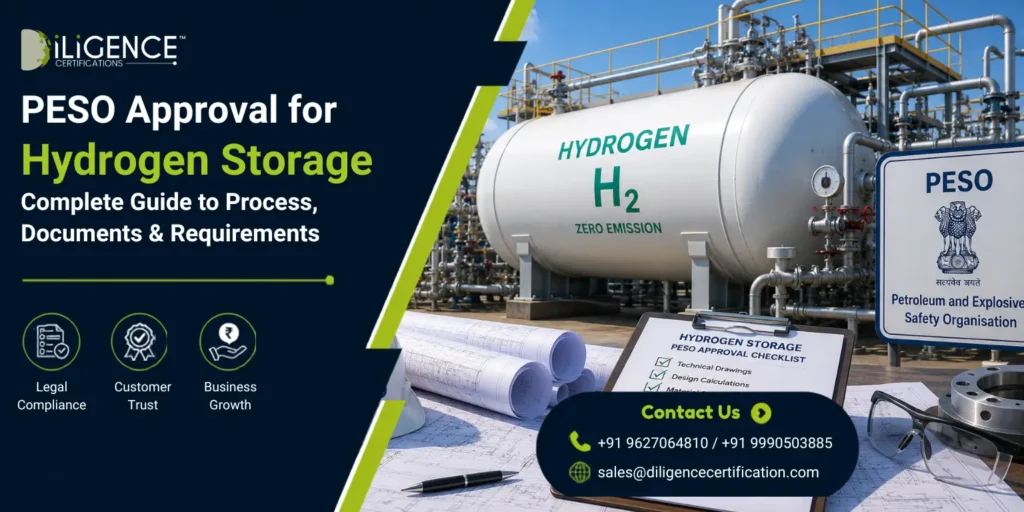
By - PESO Approval for Hydrogen Storage will be needed when the hydrogen storage facility comes under the relevant PESO legislation, especially the Static and Mobile Pressure Vessels (Unfired) Rules, 2016.
- The approval process normally consists of technical drawings, vessel details, plot plan, safety systems, test papers, NOCs, and inspection before issuance of the license.
- As hydrogen storage may have high pressure, flammable qualities, and special equipment, having the project classified and design approved beforehand will save on project modifications.
Introduction
A hydrogen project may appear ready for approval well before it becomes truly ready.
In the normal course of a project, an industrial company will have finalised its hydrogen source, acquired storage tanks and completed almost all civil works when the date of commissioning is already being discussed. But during the compliance assessment, the team finds that the storage arrangement, pressure vessel data or safety arrangement does not comply with the applicable regulations.
That is where the issue becomes not merely one of paperwork. A change in vessel location impacts the piping system. A change in the piping system impacts the classification of the hazardous area. Changes in safety arrangement impacts the electrical installations and emergency systems.
Therefore, PESO Approval for Hydrogen Storage should be planned in the design phase, not after the storage system is installed.
Hydrogen has unique safety considerations. It is highly inflammable, has a large flammability limit, and is normally stored either in form of compressed hydrogen gas or liquid hydrogen in special applications. That makes the choice of regulatory path extremely dependent on the kind of hydrogen, manner of storage, capacity, pressure and installation arrangements and application.
The PESO in India is responsible for regulating the installation and use of pressure vessels and installations with compressed gases and other hazardous materials. The functions of the PESO according to the SMPV are that of granting approval concerning pressure vessel manufacturing and designing and licensing compressed gas installations, transportation, inspection, and testing.
The practical take-home message from the hydrogen case is that PESO approval should not be considered the final phase documentation task. It is an integral part of the engineering and commissioning process.
What Is PESO Approval for Hydrogen Storage?
Hydrogen Storage PESO Approval means the approval or license which is required in connection with the hydrogen storage system under the respective Indian safety regulations governed by the Petroleum and Explosives Safety Organisation.
In relation to pressure vessel systems, the most relevant framework would be the Static and Mobile Pressure Vessels (Unfired) Rules, 2016, also known as SMPV(U) Rules The PESO Official material specifies the functions performed by PESO under the SMPV Rules which include design and fabrication shop approvals of pressure vessels, licenses for gas storage and transportation facilities, as well as competence of individuals and inspection bodies The specific regulation may not be the same for all hydrogen facilities.
For instance, it can be different between:
- Compressed hydrogen gas storage
- Liquefied hydrogen storage
- Hydrogen cylinder storage
- Hydrogen tube trailers
- Hydrogen storage cascades
- Hydrogen dispensing facilities
- Hydrogen production and storage plants
- Hydrogen storage integrated with refuelling infrastructure
- Industrial hydrogen storage systems
Specifically, the definition and provision regarding hydrogen were added to the SMPV regulations in 2025, including the Compressed Hydrogen Gas (CHG) and Bulk Liquefied Hydrogen System.
This becomes crucial especially for the corporations that build infrastructure based on hydrogen, since the regulatory regime changes along with the hydrogen economy.
Why Is PESO Approval Important for Hydrogen Storage?
Hydrogen storage is not at par with regular storage in a warehouse.
The storage system may require high pressures, pressure vessels, pressure relief, valves, pipe work, instrumentations, hazardous area and gas detectors along with emergency shut-down.
A good technical installation for hydrogen storage needs to resolve several queries before start-up:
- Is the pressure vessel suitable for hydrogen service?
- Is the design based on an accepted code?
- Are the material specifications appropriate?
- Are the pressure-relief devices correctly selected?
- Is the site layout suitable?
- Are separation and safety distances adequate?
- Are hazardous-area requirements addressed?
- Are electrical installations appropriate for the classified area?
- Is emergency isolation provided?
- Are testing and inspection records available?
- Has the required NOC and licensing documentation been arranged?
PESO’s current competent-person examination syllabus itself includes hydrogen storage in the plant-layout portion and covers pressure-vessel testing, safety devices, fire protection and hazardous-area classification.
That gives a useful indication of how technical the subject is.
Which Hydrogen Storage Systems May Require PESO Approval?
The first step is always an applicability assessment.
Hydrogen Compressed Gas Storage
Compressed hydrogen gas storage typically involves cylinders, tube assemblies, cascades or fixed pressure vessels In such facilities, the relevant PESO regulations that will apply can be based on the type of vessel used, volume stored, pressure, location and general design of the system This means that a project could involve more than just the purchase of an approved vessel.
Storage of Liquefied Hydrogen
Liquefied hydrogen has to be stored at cryogenic temperatures and has a different engineering design compared to compressed hydrogen The revision in 2025 of the SMPV defines what a Bulk liquefied hydrogen system is, which includes a liquefied hydrogen system with storage capacity of more than 1,000 liters but not beyond the maximum set by the regulations, including cryogenic pressure vessels, cryogenic unloading stations, cryogenic pumps, and vaporizers.
Hydrogen Dispensing & Refuelling Facilities
Hydrogen storage can be an integral part of the dispensing or refuelling facility for vehicles An online module for granting licenses for Compressed Hydrogen Dispensing Stations under the Gas Cylinder Rules, 2016, in Form H, has been brought out by PESO in May 2025 Hence, a hydrogen refueling facility cannot be considered just a storage facility.
The storage, dispensing facility, and other equipment will have their own compliance parameters.
PESO Approval for Hydrogen Storage: Regulatory Framework
Several regulatory instruments can become relevant depending on the project.
Static and Mobile Pressure Vessels (Unfired) Rules, 2016
The SMPV(U) Rules are central to pressure-vessel storage of compressed gases and certain liquefied gases.
PESO’s official website currently identifies the SMPV Rules, 2016 as part of its statutory regulatory framework.
For hydrogen projects, this framework can cover areas such as:
- Pressure-vessel design
- Fabrication
- Testing
- Inspection
- Storage installation
- Safety fittings
- Licensing
- Competent-person certification
- Periodic examination
Gas Cylinder Rules, 2016
Where hydrogen is stored or handled in cylinders, the Gas Cylinder Rules, 2016 can also become relevant depending on the installation and activity.
PESO currently lists the Gas Cylinder Rules, 2016 and recent hydrogen-related amendments on its official website.
Petroleum Act and Petroleum Rules
The Petroleum Act, 1934 provides the broader statutory framework under which the Central Government can make rules governing the import, transport and storage of petroleum and related hazardous materials.
The applicability of a particular rule set should therefore be established from the actual substance, equipment and proposed activity rather than assumed from the word “hydrogen” alone.
2025 Hydrogen Storage Regulatory Development
One of the key aspects for companies which plan to develop hydrogen infrastructure concerns the regulation that was revised in 2025.
Namely, the June 2025 SMPV amendment added hydrogen-related definitions such as compressed hydrogen gas and bulk liquefied hydrogen systems, and revised Form AS-1 to include liquefied hydrogen storage and dispensing facilities and compressed hydrogen gas as automotive fuel.
The 2024 amendment had previously expanded wording in Form AS-1 to include liquefied hydrogen and compressed hydrogen gas as automotive fuel and required latitude/longitude data among other things.
It follows from the above that one cannot use old checklists for developing hydrogen infrastructure projects.
PESO Approval for Hydrogen Storage : Process
The procedure of getting PESO Approval for Hydrogen Storage starts with finding out what regulations apply for the facility. This will depend on the state of the hydrogen, its storage volume, pressure, vessel types, location and use of the facility.
Applicability Assessment
First, the hydrogen storage facility should be evaluated in order to establish what PESO regulations apply and what type of licence is required. It is necessary to consider parameters like storage volume, working pressure, vessel configuration, whether it is static or mobile installation, whether there will be dispensing and whether the equipment is imported or made locally.
Technical Documentation
The applicant has to provide accurate technical and site documentation, which may include drawings of the pressure vessel, general arrangement drawings, design calculations, piping and instrument diagrams, equipment specifications, materials, testing certificates, safety devices information, site arrangement and hazardous areas.
Application and NOC
When necessary, the NOC and all other documents required should be prepared prior to making an application. The appropriate PESO application, along with the technical documents and form AS-1 when required, is then made.
Scouring and Inspection
PESO considers the documents submitted and makes any technical observations. In case inspection is required, the installed installation is scrutinized as per the documents submitted The appropriate PESO license/approval is then issued on successful scrutiny/inspection as required.
Site and Layout Review
Hydrogen storage cannot be approved based only on the vessel certificate The location of the storage equipment, access, nearby structures, pipelines, electrical equipment, fire protection and emergency arrangements must be considered as part of the overall installation This is where an early regulatory review can save considerable money.
NOC and Supporting Approvals
For applicable compressed-gas storage installations, PESO states that an NOC from the District Authority is required under Rule 46(a) of the SMPV(U) Rules for storage of compressed gases other than non-flammable, non-toxic gases Hydrogen is flammable, so this requirement deserves particular attention during project planning.
Application Submission
The application and technical documents pertaining to the application are lodged using the PESO process applicable to the case According to PESO application materials, Form AS-1 is the application form for granting, amending, transferring or renewing applications of licenses for storage of compressed gas in pressure vessels and for some hydrogen-based applications.
Technical Evaluation
The submitted documents can be reviewed for consistency between:
- Vessel design
- Site layout
- Equipment specifications
- Storage capacity
- Pressure
- Safety provisions
- Standards
- Test records
- Application data
Even one inconsistency will generate an observation.
Inspection
Physical inspection shall be undertaken where appropriate in order to ascertain whether there is conformity between what is actually installed and the documents approved This is the reason why the “approved drawings” and “installed facility” should not diverge into two different things.
Licence / Approval
After successful fulfillment of the requirements, the relevant licence or approval can be granted upon fulfilling the stipulated conditions.
Documents Required for PESO Approval for Hydrogen Storage
The checklist varies according to the project, but businesses should be equipped with the following list of documents.
Company Documents
- Certificate of Incorporation
- PAN
- GST registration
- Authorisation letter
- Details of the applicant/occupier
- Registered office details
Land & Site Documents
- Document of ownership or registered lease
- Site plan
- Location plan
- Latitude & longitude
- Plot details
- Details of the surrounding area
PESO’s SOP mentions legal physical possession of the land as one of the documents to be submitted for application under the SMPV regime.
Technical Documents
- Pressure vessel drawing
- General arrangement drawing
- Design calculations
- Data sheets of the equipment
- Certificates of the material used
Welding documents
- Test certificates
- Inspection reports
- Details of safety relief devices
- Pipe drawing
- P&ID
- Pressure and temperature details
Safety Documents
According to the facility requirements, this can include:
- Fire protection details
- Emergency shutdown philosophy
- Gas detection systems
- Hazardous area classification
- Details of electrical equipment
- Earthing & bonding arrangements
- Emergency arrangements
- Safety distance and layouts
- On-site emergency plans wherever required
The 2025 amendment of SMPV refers to preparing on-site emergency plan under the MSIHC regime and conducting mock drills at applicable sites.
What Does PESO Check in a Hydrogen Storage Installation?
An effective approach to interpreting the approval involves looking at the situation from the inspector’s point of view The issue isn’t whether there is hydrogen containment, rather something along the lines of:Is this entire system capable of safely storing, transporting, isolating, and controlling the hydrogen within the proposed operating parameters?
Some examples of key considerations might be:
Pressure Vessel Integrity
The vessel must be adequately documented in terms of design, construction, materials, and testing.
Pressure Relief
Pressure relief is extremely important because an uncontrolled pressure build up poses an immediate danger.
Hydrogen Compatible Materials
Materials are important in that the use of hydrogen brings about specialized materials and integrity considerations.
Leak Protection
Connections, valves, fittings, joints, and pipework should be properly designed and maintained.
Emergency Isolation
There should be proper isolation methods for hydrogen in abnormal situations.
Hazardous Area
Electrical equipment and installation practices should be suitable for the hazardous area classification of the facility.
Fire and Gas Safety
Fire and gas safety precautions should be considered based on the type of facility.
PESO Approval for Hydrogen Storage: Common Mistakes
Installation of Equipment Prior to Reviewing Regulations
This is one of the costliest errors to make While the equipment itself may meet technical standards, its proposed position may not meet criteria for full installation.
Approval of Vessel Equated with Approval of Installation
It is important to note that approval of a pressure vessel document does not mean the entire installation is approved.
Vessels and installations have different concerns.
Usage of Old Drawing Hydrogen projects tend to change while implementing the project With changes in piping, vessel configuration, capacity, or equipment location, the regulatory documents must be reviewed.
Not Meeting NOC Requirements
NOC requirements for hydrogen installations are outlined in the PESO regulations.
Submission of Generic Documents
For hydrogen installation, there is a need for project-specific engineering documents. Use of generic drawing from another installation is not good practice.
PESO Approval for Hydrogen Storage: Timeline and Cost
There is no responsible single timeline or fixed cost that applies to every hydrogen storage project.
The duration can depend on:
- Storage capacity
- Hydrogen form
- Vessel type
- Site readiness
- Drawing quality
- Documentation completeness
- NOC status
- Inspection requirements
- Import documentation
- Authority observations
- Changes required after scrutiny
Similarly, the overall cost can include more than the government fee. Engineering drawings, inspection, testing, consultant support, equipment modification and site-level compliance can all influence the project budget.
For this reason, businesses should obtain a project-specific commercial assessment rather than relying on an online “PESO approval cost” figure.
Validity of PESO Hydrogen Storage Licence
Validity of the PESO licence for Hydrogen Storage will depend on the relevant licence requirement under SMPV(U) Rules. If the licence comes under such rules, the PESO usually issues the licence valid for three years, with its expiry date being 31 March.
It is important for the owners of hydrogen storage facility to seek renewal of the licence before its expiry while ensuring compliance of storage vessels and other facilities with PESO requirements.
To continue with unhindered operations, it is recommended to initiate the process of renewal of the licence well in advance of its expiry date.
How Diligence Certifications Can Help
Hydrogen compliance involves a combination of regulatory interpretation and engineering documentation.
At Diligence Certifications, the practical focus is to help businesses organise these two sides together.
Support can include:
- Applicability assessment
- Document checklist preparation
- PESO application assistance
- Technical-document coordination
- Site-layout review
- Pressure-vessel documentation support
- NOC documentation guidance
- Inspection coordination
- Query and observation support
- Renewal and amendment assistance
For businesses already working with EPC contractors or equipment manufacturers, this support can also help identify documentation gaps before they become approval-stage problems.
Conclusion
With the emergence of hydrogen as a key component of Indian industry and energy sector, there is need for its regulation as well.
Therefore, PESO Approval for Hydrogen Storage should always be envisaged during the design phase, especially when the project incorporates pressure vessels, pressurized hydrogen gas, liquid hydrogen gas, storage cascade, dispensing system, or large industrial projects.
Since the amendments in 2024 and 2025 have added clarity to the hydrogen related provisions in the PESO regulations, it has become necessary for companies to comply with the prevailing regulatory requirements and not old checklists.
In case of a new project, a logical way would be to first ascertain its applicability, evaluate the site and storage concept, prepare the technical documents as per regulatory requirements, obtain NOCs and testing, make an application, and undergo scrutiny and inspection.
Frequently Asked Questions
Is PESO Approval required for hydrogen storage in India?
Yes, depending on the storage type, capacity, pressure, vessel and intended use.
What is PESO Approval for Hydrogen Storage?
It is the applicable PESO licence or approval required for regulated hydrogen storage installations.
Which rules apply to hydrogen storage?
The SMPV(U) Rules, 2016 are particularly relevant to pressure-vessel-based hydrogen storage.
What documents are required for PESO Approval?
Documents generally include drawings, vessel details, design calculations, testing records, site plans and company documents.
What is the process for PESO Approval?
The process generally includes assessment, documentation, application, scrutiny, inspection and licence issuance.
Is an NOC required for hydrogen storage?
An NOC may be required depending on the storage installation and applicable PESO requirements.
Does PESO approval cover compressed hydrogen?
Yes, applicable PESO requirements can cover compressed hydrogen storage systems.
Does PESO approval cover liquefied hydrogen?
Yes, specific provisions may apply to bulk liquefied hydrogen storage systems.
What is the validity of a PESO hydrogen storage licence?
Licences covered under the SMPV(U) Rules are generally granted or renewed for up to three years.
Can Diligence Certifications help with PESO Approval?
Yes, Diligence Certifications can assist with documentation, application, compliance and inspection coordination.