BIS Certification
 CDSCO
CDSCO
 PESO
PESO
 CPCB
CPCB
 LMPC
LMPC
 WPC Approval
 Global Approvals
 TEC
TEC
 ARAI
ARAI
 BEE
BEE
 ISO Certification
 DGCA Certification
 NOC For Steel
 APEDA Registration























 Business Registration
 FSSAI Mark Certification












 (32).jpg)
 Legal Services
 Trademark Registration
 Copyright Registration
 Patent Registration
 By
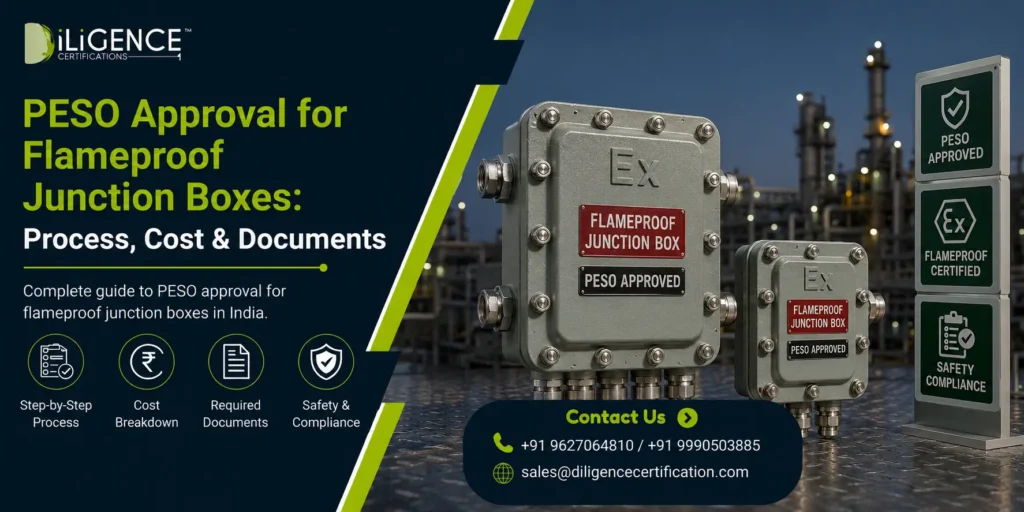
By - Getting PESO Approval for Flameproof Junction Boxes is really important for Ex equipment that is meant to be used in areas that are hazardous as per the rules set by India for petroleum safety.
- The approval for PESO depends on how the product’s made the concept of protection, the standards that apply the evidence from tests, the drawings, the details of the manufacturer and other documents that are required by the law.
- Manufacturers and people who import these things can save time by making sure the technical file is correct before they send in the PESO application for PESO Approval, for Flameproof Junction Boxes.
Introduction
A company that makes things can have a good flameproof junction box but they can still have a problem when someone who is building a big project asks for the papers that show it is approved by PESO.
This happens a lot more often than the people who make these products think it will. The box itself might be made correctly, the cables might be put in the way and it might even have a special certificate from another country. But the papers that show it is safe can still be missing some things: the certificate might be old, the model number might be wrong, the drawings might not be complete, the details about the parts might not be clear or there might not be proof that it is okay to use in India.
For a junction box that is going to be used in a place where things can catch on fire easily, just saying “it is flameproof” is not enough to make it safe.
PESO is the group that says what equipment is safe to use in places where things can catch on fire easily. They have rules that say what equipment needs to be approved and these rules apply to equipment made in India and equipment made in countries.
That is why getting PESO Approval for Flameproof Junction Boxes is a project that needs to be done carefully; it is not just something you can do online.
What is PESO approval for flameproof junction boxes?
PESO approval for flameproof junction boxes is an approval for electrical apparatus that are designed to be used in areas where there are hazardous materials like flammable gases or vapors that can cause explosions.
A flameproof junction box is a box that has an enclosure around connections. The main idea of this box is that if something inside the box catches fire it will not ignite the atmosphere around it.
PESO has guidelines that say what standards these boxes have to meet. They say that the boxes have to meet the IS/IEC 60079-1:2014 standard, which’s a standard for equipment that is protected by flameproof enclosures.
PESO approval is not about saying that the box is made of metal or that it is strong.The people at PESO look at the evidence to see if the equipment is suitable for use in areas with hazardous materials.
Is PESO approval required for flameproof junction boxes?
Yes PESO approval is required for flameproof junction boxes that are used in areas with materials.
The Petroleum Rules say that electrical equipment that is used in these areas has to be approved by the Chief Controller of Explosives.This also applies to equipment that is made in countries.The process for getting approval depends on the equipment, how it is protected, where it will be used and what the regulations are.
PESO approval is necessary for flameproof junction boxes that are used in areas with materials and the approval process is important to make sure that the equipment is safe to use.PESO approval for flameproof junction boxes is a step in making sure that the equipment is safe and meets the regulations.
Why do flameproof junction boxes need PESO approval?
The main reason is to control ignition.In an industrial area there can be flammable vapors, gases or petroleum products.If there is a fault or a spark or the temperature gets too high it can cause a fire.
A flameproof junction box is designed to stop a fire from spreading to the surrounding area if there is an explosion inside the box.PESO. Approves flameproof electrical equipment, including equipment made in India and equipment that is imported.
For a manufacturer this is very useful because it means:
- The equipment is accepted by the government
- It is safer to use in areas
- EPC contractors are more likely to accept it
- Industrial customers can easily evaluate it
- It is easier to document for tenders
- There is risk of problems with the project
- Plant owners and safety teams have more confidence in the equipment
In industries like oil and gas petrochemicals and chemicals a junction box is not just a regular electrical box.It has to be special because it is used in areas.
In which areas are flameproof junction boxes employed?
They are employed where an electrical connection needs to be made in some location.They are as follows:
- Oil Refineries
- Oil Terminals
- Oil and Gas Plants
- Chemical Manufacturing Plants
- Areas where solvents are handled
- Facilities where fuel is stored
- Gas Processing Plants
- Petrochemical Plants
- Hazardous Process Areas
- Storage and Transfer Facilities
Suitability of a flameproof junction box depends upon the kind of hazardous area it will be employed in and the Ex rating of the equipment.For instance, a flameproof junction box certified for certain kinds of gases and temperatures cannot be used in some other application.
That is because of the wrong assumption of manufacturers: they assume that “flameproof” implies “can be used anywhere”. This is wrong; flameproof junction boxes are manufactured for certain hazardous environments only.
Which Standard is Relevant for the Flameproof Junction Box?
With respect to flameproof protection, the most important standard cited under the PESO’s current Ex-equipment approval guidance is the IS/IEC 60079-1:2014 which corresponds to the IEC 60079-1 for equipment protection by flameproof enclosures “d”. The general requirements are covered under IS/IEC 60079-0:2017 under the PESO system.
It would always be necessary to confirm the relevant standard for the particular product/application before testing/application filing.The BIS standards also indicate that the flameproof enclosures fall under the product groups consisting of empty enclosures, junction boxes, switchgear and control gear, process instruments and associated equipment.
Why the standard is significant
The relevant standard will affect the technical evaluation in the following areas:
- Flameproof joints
- Construction of the enclosure
- Resistance to pressure
- Transmission of flame
- Clearances and dimensions
- Entries of cables
- Construction (mechanical)
- Material
- Temperature dependent requirements
- Marking
- Components
Therefore, it is necessary for the manufacturer to finalize the product design before the testing.
What Documents Are Required for PESO Approval?
The documents you need to get PESO approval are different depending on the product and where it comes from.
1. Manufacturer Details
You have to give PESO information about the company that makes the product, what the factory’s like and what kind of technology they use.PESO says you need to tell them about the equipment and facilities they use to make the product and how they test it to make sure it is good.
2. Product Drawings
You need to send PESO drawings of the product.These drawings can include things like:
- How all the parts fit together
- What the outside of the product looks like
- How the parts are put together
- What the inside of the product looks like
- How the product is put together with things
- Where the cables go in
- How the terminals are set up
- Where all the parts are
- What is written on the product
The drawings should match the product you are testing.
3. Technical Catalogue
The catalogue should have all the details about the product like:
- What the product is called
- The model number
- What kind of electricity it uses
- What kind of protection it has
- What kind of gas it is made for
- How hot it can get
- How well it is protected from water and dust
- How big it is
- What it is made of
- How to use it
- How to put it in
4. Test Certificate or Test Report
You need to show PESO that the product has been tested.PESO wants to see proof that the product was tested by a company they trust and that it is safe to use.
5. BIS Licence
If the product is made in India and is flameproof you need to have a licence from BIS.This licence shows that the company making the product is following all the rules for quality control.Do not forget to get this licence when you are planning.
6. Component Details
If the product has parts inside you may need to give PESO details about these parts.PESO has rules that say you need to give more information about the parts, like who made them and what kind of safety markings they have.
7. Manufacturer Authorisation
If the product is imported the company bringing it into India may need to show that they have permission from the company that made the product.PESO wants to see proof that the company bringing the product into India is allowed to do so and that they have all the right documents.
PESO Approval Process for Flameproof Junction Boxes
The PESO approval process for Flameproof Junction Boxes is a process but it can be managed if you follow the correct order of steps.First you need to understand what the PESO approval process for Flameproof Junction Boxes is about.
The PESO approval process for Flameproof Junction Boxes becomes manageable when you handle it in the order.
Step 1: Confirm Applicability of PESO Approval for Flameproof Junction Boxes
You need to determine if the Flameproof Junction Box requires PESO approval based on its intended application and use in areas.Do not start with the paperwork for PESO approval for Flameproof Junction Boxes.Begin with checking the applicability of PESO approval for Flameproof Junction Boxes.
Step 2: Freeze the Product Design of Flameproof Junction Boxes
You need to confirm the details of the Flameproof Junction Box, including:
- Model numbers of Flameproof Junction Boxes
- Enclosure dimensions of Flameproof Junction Boxes
- Materials used in Flameproof Junction Boxes
- Flamepaths in Flameproof Junction Boxes
- Cable entries in Flameproof Junction Boxes
- Terminals in Flameproof Junction Boxes
- Components of Flameproof Junction Boxes
- Electrical ratings of Flameproof Junction Boxes
- Ex marking on Flameproof Junction Boxes
This helps prevent changes after testing the Flameproof Junction Boxes.
Step 3: Identify the Applicable Standards for PESO Approval of Flameproof Junction Boxes
You need to determine the standard, such as BIS or IEC or EN for the PESO approval of Flameproof Junction Boxes.For flameproof protection the standard IS/IEC 60079-1 is a standard in the PESO published approval framework for Flameproof Junction Boxes.
Step 4: Obtain Appropriate Test Evidence for PESO Approval of Flameproof Junction Boxes
The prototype of the Flameproof Junction Box must be tested against the requirements through an accepted testing route for PESO approval.The BIS laboratory information for IS/IEC 60079-1 shows that testing can include pressure-related assessment, flameproof joint examination and other technical checks for PESO approval of Flameproof Junction Boxes.
Step 5: Prepare the Technical File for PESO Approval of Flameproof Junction Boxes
You need to compile the certificate, drawings, catalogue, manufacturer information, component information and other supporting documents for the PESO approval of Flameproof Junction Boxes.This is where many applications for PESO approval of Flameproof Junction Boxes either become easy to review or difficult to defend.
Step 6: File the PESO Application for Flameproof Junction Boxes
The current published procedure of PESO includes a scrutiny fee of ₹2,000 per type or model or safety marking with a maximum of five equipment types with test certificates allowed in one online application under the stated procedure for PESO approval of Flameproof Junction Boxes.The fees and procedures for PESO approval of Flameproof Junction Boxes can change so you should check the PESO requirements before filing the application.
Step 7: Technical Scrutiny of PESO Application for Flameproof Junction Boxes
PESO reviews the submitted information for the PESO approval of Flameproof Junction Boxes.Queries may arise regarding the drawings, test certificates, product models, component certificates, Ex marking, standards, manufacturer information and application details of the Flameproof Junction Boxes.
Step 8: Respond to Queries for PESO Approval of Flameproof Junction Boxes
A good query response should address the technical issue instead of simply resubmitting the same document for PESO approval of Flameproof Junction Boxes.Where necessary revised drawings, declarations or additional evidence may be submitted for the PESO approval of Flameproof Junction Boxes.
Step 9: Approval of PESO Application for Flameproof Junction Boxes
After scrutiny and compliance with applicable requirements the approval can be granted for the PESO approval of Flameproof Junction Boxes.
Step 10: Maintain Product Consistency of Flameproof Junction Boxes
This final step is often underestimated for the PESO approval of Flameproof Junction Boxes.If the manufacturer changes the enclosure, flamepath, terminal arrangement, cable entry, component or model designation of the Flameproof Junction Boxes the effect, on the approval should be assessed before production or market supply of the Flameproof Junction Boxes.
How Much Does PESO Approval for a Flameproof Junction Box Cost?
There is no single universal “PESO junction box certification price.”
The total cost depends on the technical scope.
Important cost factors include:
| Cost Factor | Why It Matters |
| Product design | Complex designs may require more technical work |
| Testing | Test scope and laboratory charges vary |
| Number of models | Multiple models can increase testing/documentation work |
| Certification route | Indian and imported products may have different requirements |
| Drawings | Engineering corrections may add cost |
| Components | Additional certified components may need review |
| Consultant support | Professional fees vary by scope |
| Application fees | Government scrutiny fees apply as prescribed |
PESO’s current published Ex-equipment procedure specifies a scrutiny fee of ₹2,000 per type/model/safety marking. This is only one component of the overall compliance cost; testing and technical preparation are separate considerations.
Therefore, manufacturers should avoid comparing quotations based only on the government fee.
The bigger financial risk is often re-testing caused by a design or documentation mismatch.
Common Reasons PESO Applications Get Delayed
A good product can still get delayed if the papers do not match the test certificate.The model number on the application and the certificate and drawing and catalogue should all be the same.
If the drawing shows something from the actual product that was tested this can cause problems.
For example if the drawing shows one way of putting in cables but the product that was tested has done it another way we need to clarify this.
We also need proof that the parts used in the product’re okay.
The markings on the product like what kind of gas it can handle and how hot it can get should match the papers we have.
If a product is made outside of India the company needs to have someone in India who can represent them and give us the papers.Just because a product has a certificate from another country does not mean it is okay to use in India.
We also have to be careful when we make changes to a product after it has been tested.
This is a problem that can be avoided.
For example if we change the way cables are put into a product to make a customer happy but the test we did was on a version this can cause problems when we are trying to get everything ready to ship.
The PESO applications can get delayed because of these things.
- Model Number Mismatch is an issue
- Drawing Does Not Match Tested Construction is another issue
- Missing Component Evidence can also cause delays
- Incorrect Ex Marking is something we need to watch out for
- Incomplete Imported-Manufacturer Documentation’s a problem, for products made outside of India
- Using an Unverified Certificate can cause issues
Design Changes After Testing can also delay the PESO applications.
PESO Approval for Indian vs Imported Flameproof Junction Boxes
The basic safety objective remains the same, but the documentation route can differ.
Indian Manufacturers
Indian manufacturers may need to demonstrate manufacturing infrastructure, technical capability, quality controls, test evidence and BIS licensing requirements applicable to flameproof equipment.
PESO’s FAQ expressly lists BIS licensing as mandatory for flameproof-type equipment manufactured domestically.
Foreign Manufacturers and Importers
For imported equipment, PESO’s published requirements include manufacturer profile, Indian agent/subsidiary details, authorisation, technical documentation and appropriate certification evidence.
The Indian representative should therefore be involved early rather than being added only when the application is ready.
What Should Manufacturers Check Before Applying?
Before filing, conduct a simple technical-document reconciliation.
Check whether:
- The model number is identical across documents.
- The drawing represents the tested construction.
- The certificate covers the proposed product.
- The Ex marking is consistent.
- Gas group and temperature class are correctly stated.
- Cable-entry arrangements are documented.
- Internal components have appropriate supporting certificates.
- Manufacturer details are consistent.
- BIS documentation is available where required.
- Imported products have the required Indian representation.
- The application information matches the technical file.
- Any product variants are clearly identified.
This exercise takes much less time than correcting a technically weak application after submission.
Frequently Asked Questions
1. Is PESO approval mandatory for flameproof junction boxes?
Where the junction box is electrical apparatus intended for hazardous areas falling under the applicable Petroleum Rules/PESO jurisdiction, approval is required according to the applicable regulatory requirements. PESO’s official FAQ states that electrical equipment used in such hazardous areas requires approval.
2. Which standard is used for flameproof junction boxes?
IS/IEC 60079-1:2014 is the key BIS standard identified in PESO’s published Ex-equipment approval guidance for protection by flameproof enclosures “d”. General requirements are addressed through IS/IEC 60079-0:2017.
3. Can imported flameproof junction boxes obtain PESO approval?
Yes. PESO’s published guidance provides a route for imported Ex electrical equipment and requires appropriate manufacturer, Indian-agent, authorisation and technical certification documentation.
4. Is BIS certification required for a flameproof junction box?
For domestically manufactured flameproof equipment, PESO’s official FAQ identifies a BIS licence covering the manufacture under a quality-control scheme as a mandatory requirement in the stated approval process.
5. What documents are needed for PESO approval?
Typical documentation includes technical drawings, product specifications, test reports/certificates, manufacturer details, component information, applicable BIS documentation, declarations and authorisation documents where applicable. The exact requirement depends on the product and approval route.
6. How much does PESO approval cost?
The total cost depends on testing, number of models, technical documentation, consultancy and other factors. PESO’s current published procedure specifies a scrutiny fee of ₹2,000 per type/model/safety marking, subject to the procedure’s stated conditions.
7. How long does PESO approval take?
There is no reliable universal timeline. It depends on document readiness, testing status, product complexity, PESO scrutiny and how quickly technical queries are resolved.
8. Can the junction box be modified after approval?
Any significant modification should be assessed before implementation. Changes to flamepaths, enclosure construction, cable entries, internal components or other certified characteristics can affect the approved configuration.
9. Does an IECEx or ATEX certificate automatically give PESO approval?
No. International certification can provide important technical evidence, but PESO approval is a separate Indian regulatory process with its own documentation and applicability requirements.
10. Can Diligence Certification help with PESO Approval for Flameproof Junction Boxes?
Yes. Diligence Certification supports manufacturers, importers and industrial businesses with PESO applicability assessment, documentation, technical review, application filing and query handling.
Why Choose Diligence Certification?
Choosing the right certification consultant can make the approval process much smoother, especially when the application involves technical drawings, testing reports, product specifications and regulatory documentation.
Diligence Certification helps manufacturers, importers and businesses manage the certification process with a practical, documentation-focused approach.
- Expert Regulatory Guidance: Support in understanding applicable PESO requirements and certification procedures.
- End-to-End Assistance: From initial applicability assessment and document preparation to application filing and query handling.
- Technical Document Review: Cross-checking drawings, certificates, specifications and product details to identify potential gaps.
- Support for Manufacturers & Importers: Assistance for both Indian manufacturers and overseas product suppliers entering the Indian market.
- Testing Coordination: Guidance on applicable testing requirements and coordination with appropriate testing facilities.
- Reduced Compliance Delays: Early identification of documentation or technical inconsistencies can help avoid unnecessary application queries.
- Industry-Focused Approach: Practical support for hazardous-area and industrial products where regulatory compliance is critical.
For PESO Approval for Flameproof Junction Boxes, having the technical and regulatory documentation aligned before submission can save considerable time and avoid preventable complications.
Conclusion
Getting a PESO Approval for Flameproof Junction Boxes is not about filling out a form and getting a certificate.It is about putting a lot of things like the design of the product the results of the tests the drawings, the parts that are used the way things are made and the papers that need to be done.
All these things need to be put in a file that makes sense.
For the people who make these boxes it is an idea to check if there are any problems with the certification before they even do any tests.
This way they can avoid problems that might come up later when a customer asks for the approval.
The same thing is true for the people who bring these boxes into the country and the contractors who use them.
They should check things before they use the boxes in a place that might be dangerous.
They should check what the certificate says it is okay to use the box for, the type of box, the markings on the box and the papers that go with it.
The people at PESO are still saying that they want to see proof that the boxes are safe, that they follow the rules and that they have the right papers.
So if your company is getting ready to sell flameproof junction boxes in India, Diligence Certification can help you figure out if you have everything you need to get your papers in order to set up the tests and do the PESO application.
Frequently Asked Questions
Is PESO approval mandatory for flameproof junction boxes?
Where the junction box is electrical apparatus intended for hazardous areas falling under the applicable Petroleum Rules/PESO jurisdiction, approval is required according to the applicable regulatory requirements. PESO's official FAQ states that electrical equipment used in such hazardous areas requires approval.
Which standard is used for flameproof junction boxes?
IS/IEC 60079-1:2014 is the key BIS standard identified in PESO's published Ex-equipment approval guidance for protection by flameproof enclosures "d". General requirements are addressed through IS/IEC 60079-0:2017.
Can imported flameproof junction boxes obtain PESO approval?
Yes. PESO's published guidance provides a route for imported Ex electrical equipment and requires appropriate manufacturer, Indian-agent, authorisation and technical certification documentation.
Is BIS certification required for a flameproof junction box?
For domestically manufactured flameproof equipment, PESO's official FAQ identifies a BIS licence covering the manufacture under a quality-control scheme as a mandatory requirement in the stated approval process.
What documents are needed for PESO approval?
Typical documentation includes technical drawings, product specifications, test reports/certificates, manufacturer details, component information, applicable BIS documentation, declarations and authorisation documents where applicable. The exact requirement depends on the product and approval route.
How much does PESO approval cost?
The total cost depends on testing, number of models, technical documentation, consultancy and other factors. PESO's current published procedure specifies a scrutiny fee of ₹2,000 per type/model/safety marking, subject to the procedure's stated conditions.
How long does PESO approval take?
There is no reliable universal timeline. It depends on document readiness, testing status, product complexity, PESO scrutiny and how quickly technical queries are resolved.
Can the junction box be modified after approval?
Any significant modification should be assessed before implementation. Changes to flamepath, enclosure construction, cable entries, internal components or other certified characteristics can affect the approved configuration.
Does an IECEx or ATEX certificate automatically give PESO approval?
No. International certification can provide important technical evidence, but PESO approval is a separate Indian regulatory process with its own documentation and applicability requirements.
Can Diligence Certification help with PESO Approval for Flameproof Junction Boxes?
yes. Diligence Certification supports manufacturers, importers and industrial businesses with PESO applicability assessment, documentation, technical review, application filing and query handling.