BIS Certification
 CDSCO
CDSCO
 PESO
PESO
 CPCB
CPCB
 LMPC
LMPC
 WPC Approval
 Global Approvals
 TEC
TEC
 ARAI
ARAI
 BEE
BEE
 ISO Certification
 DGCA Certification
 NOC For Steel
 APEDA Registration























 Business Registration
 FSSAI Mark Certification












 (32).jpg)
 Legal Services
 Trademark Registration
 Copyright Registration
 Patent Registration
 By
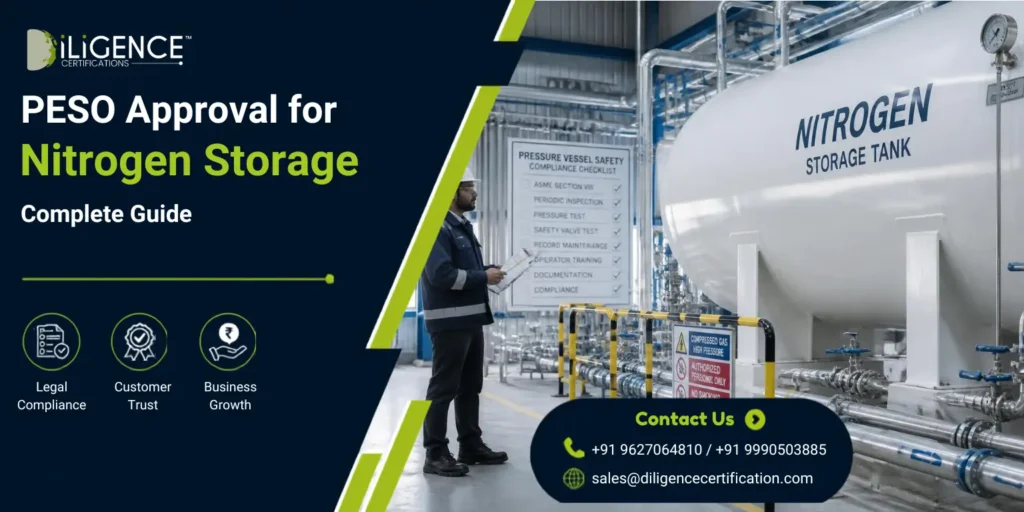
By - PESO Approval for Nitrogen Storage may be necessary based on the type of nitrogen to be stored, type of storage container, capacity, and method of storage.
- The storage of bulk compressed nitrogen in pressure vessels may come under the Static and Mobile Pressure Vessels (Unfired) Rules 2016, while the storage or handling of nitrogen in cylinders comes under the Gas Cylinders Rules 2016.
- Diligence Certifications help companies in determining the correct PESO approval pathway for their requirement and also in preparing the necessary documentation.
Introduction
Manufacturing organizations usually begin by asking themselves a technical question while designing a nitrogen storage facility: What capacity of tank would suit us?
The question of compliance arises slightly earlier: What kind of nitrogen storage setup are we installing, and what is its compliance requirement?
Think of a factory in Gujarat installing a nitrogen tank of bulk capacity used in inerting operations. Another organization could be using nitrogen cylinders in its laboratories, and a hospital might have cylinders of nitrogen storage for special purposes. A pharmaceutical firm may need a large scale cryogenic setup of nitrogen storage with piping equipment.
Gas in all cases is nitrogen, but the storage system differs The difference is significant while considering PESO Approval for Nitrogen Storage.
Petroleum and Explosives Safety Organisation (PESO) oversees safety standards for compressed gases, pressure vessels, and gas cylinders as per various regulations.
According to the citizen charter of the Petroleum and Explosives Safety Organisation (PESO), the rules and regulations regarding static and mobile pressure vessels (unfired) relate to the licensing and regulation regarding the storage and transport of compressed gases in pressure vessels, whereas the gas cylinders rules relate to the storage of compressed gases in cylinders.
This implies that there is no uniform nitrogen storage approval for all installations.
What Is PESO Approval for Nitrogen Storage?
The abbreviation PESO means Petroleum and Explosives Safety Organisation. In PESO Approval for Nitrogen Storage, one must be referring to the relevant licensing, inspection, and compliance requirements for the storage of nitrogen in cylinders, pressure vessels, or cryogenic storage systems based on the relevant Indian safety regulations.
Nitrogen gas has several industrial applications, including manufacturing, pharmaceuticals, food processing, electronics, laboratories, chemical industry, among others. Purging, inerting, blanketing, and pressure testing are some of the uses of nitrogen.
While nitrogen gas itself does not have flammability characteristics, the storage process can pose hazards of pressure and cryogenics. Nitrogen gas is stored under pressure in compressed form, whereas in liquid form, it is kept in low temperature conditions.
For bulk storage of nitrogen in the relevant pressure vessels, Static and Mobile Pressure Vessels (Unfired) Rules, 2016 [SMPV(U) Rules, 2016] might apply. For nitrogen gas stored in cylinders, the Gas Cylinders Rules, 2016 could apply.
Therefore, companies need to identify the nature of nitrogen storage facility, capacity, pressure, temperature, and intended application to establish the relevant PESO approval or license.
Why Is PESO Approval Important for Nitrogen Storage?
Nitrogen storage consists of two major considerations: pressure safety and safety of handling the gas.
High-pressure nitrogen can be stored at high pressure. Low-temperature nitrogen, on the other hand, is stored at cryogenic temperatures. It is thus necessary to design, inspect and operate the storage facility in an appropriate way.
From the perspective of a company, an appropriate regulatory assessment will help to find answers to questions like:
- Which PESO rules apply?
- Is a licence required?
- Is the storage vessel covered by SMPV(U) Rules?
- Does cylinder storage fall under GCR?
- What drawings are required?
- What testing is necessary?
- What inspection is applicable?
- What separation and safety provisions are required?
- What documentation should be maintained?
- What approvals are required before commissioning?
PESO’s statutory functions include approval, grant, amendment and renewal of licences relating to pressure vessels, compressed gases and gas cylinders This is why compliance should be considered during the design stage rather than after the tank or cylinder bank has already been installed.
Is PESO Approval Required for Nitrogen Storage?
The answer depends on how nitrogen is stored and handled.
Bulk Compressed Nitrogen
In cases where nitrogen gas is kept in the form of a compressed gas in a pressurized vessel in excess of the threshold, Static and Mobile Pressure Vessels (Unfired) Rules, 2016 gain more significance.
The pressure vessel as per PESO’s SOP is described as any closed metallic vessel that has been designed for storing or transporting compressed gas under pressure with its water capacity greater than 1,000 litres It should be noted that certain exceptions are made in the rules.
Nitrogen Cylinders
Where nitrogen is stored in cylinders, the Gas Cylinders Rules, 2016 could be applicable.
The PESO explicitly mentions Form-C as an application for grant, amendment or renewal of a licence to fill and/or store compressed gas in cylinders.
Cryogenic Nitrogen
Liquid nitrogen is stored in cryogenic conditions and calls for a distinct technical evaluation as compared to regular compressed nitrogen cylinders.
The SMPV(U) Rules explicitly mention the evaluation of pressure vessels that are related to compressed gases and cryogenic liquids.
This is why a liquid nitrogen storage tank needs to be evaluated based on its design and operating conditions and not as a standard nitrogen cylinder.
PESO Rules Applicable to Nitrogen Storage
Two regulatory frameworks are particularly relevant when assessing nitrogen storage.
Static and Mobile Pressure Vessels (Unfired) Regulations, 2016
SMPV (U) Regulations, 2016, apply to static and mobile pressure vessels that store compressed gases and cryogenic liquids.
The current PESO forms have the AS-1 Form, which is the form for the application of a license for the storage of compressed gases in vessels This is important for business organizations that want to install bulk storage tanks for nitrogen.
Gas Cylinder Rules, 2016
The Gas Cylinder Rules, 2016 provide for the safety measures that apply to the design, manufacturing, testing, filling, storage and transportation of gas cylinders.
The official website of PESO has the updated rules on Gas Cylinders It is important to select the right regulatory framework based on the storage pattern.
Types of Nitrogen Storage Covered in Industrial Applications
Nitrogen may be stored in several forms depending on the consumption requirement.
Nitrogen Cylinders
Individual or manifolded cylinders are common where consumption is relatively limited.
Typical users include:
- Laboratories
- Small manufacturing units
- Hospitals
- Testing facilities
- Workshops
- Research institutions
The applicable cylinder requirements should be assessed before installation.
High-Pressure Cylinder Banks
A group of cylinders may be connected through a manifold to provide a continuous nitrogen supply Such installations require careful consideration of cylinder storage, manifold arrangements, piping, ventilation and operational safety.
Bulk Nitrogen Storage
Large industrial consumers may use stationary pressure vessels for nitrogen storage.
Examples include:
- Steel plants
- Chemical plants
- Pharmaceutical facilities
- Food-processing units
- Electronics manufacturing
- Industrial gas facilities
Liquid Nitrogen Storage
Liquid nitrogen is stored cryogenically and requires specialised tanks, valves, piping and safety arrangements A cryogenic installation should not be treated as simply a larger version of a conventional gas-cylinder installation.
PESO Approval for Nitrogen Storage: Step-by-Step Process
Step 1: Identify the Storage System
Begin by establishing exactly what is being installed.
Record:
- Nitrogen form
- Storage capacity
- Pressure
- Temperature
- Vessel type
- Cylinder type
- Number of cylinders
- Piping arrangement
- Installation location
- Intended use
This information determines the regulatory assessment.
Step 2: Determine Relevant PESO Regulations
In the next stage, one needs to find out whether the installation is subject to the SMPV(U) Rules, 2016, the Gas Cylinders Rules, 2016, or some other relevant regulation. Never choose the relevant form prior to making this decision.
Step 3: Create Engineering Documentation
Engineering documentation to be submitted will depend upon the type of installation, but may include:
- Site plan
- Drawing of storage vessel
- Piping plan
- Equipment specifications
- Safety arrangements
- Pressure data
- Capacity data
- Foundation data
- Fire and safety data
- Distance data
- Manufacturer’s data
- Test certificates
This list will differ according to the installation and regulations used.
Step 4: Submit the Application
PESO suggests that, in case of bulk compressed-gas storage regulated by SMPV(U) Regulations, the application for obtaining or amendment of the licence for storing compressed gas in vessels can be found in Form AS-1.
For cylinder installations, PESO suggests Form-C of the Gas Cylinders Rules, 2016 Use of the form will depend upon the installation.
Step 5: Technical Review
The documentation provided can be reviewed according to relevant technical and safety requirements.
If there are gaps in the drawings, specifications or site plans, the applicant may have to provide clarification or additional documentation.
Step 6: Inspection and Testing
- In cases where this is required, inspection and testing is a critical step in the application process.
- Inspection and testing of pressure vessels and gas cylinders is one of the core activities of PESO’s mandate.
Step 7: Respond to the Observations
It is important for any technical and documentation observations to be answered thoroughly.
One of the main problems here is providing an answer which contradicts the approved drawing or specification for the equipment. Always ensure that your response corresponds to the technical documentation.
Step 8: Acquire the Appropriate Licence or Approval
Upon meeting the necessary conditions, the appropriate licence or approval may be issued.
The appropriate documentation will depend on the regulatory regime and activity type.
Step 9: Maintain Compliance
PESO compliance does not end with obtaining the initial approval.
Businesses should maintain:
- Inspection records
- Test certificates
- Equipment records
- Maintenance records
- Licence documents
- Safety procedures
- Approved drawings
- Modification records
Any major change to the installation should be reviewed from a regulatory perspective before implementation.
Documents Required for PESO Approval for Nitrogen Storage
There is no universal document list for every nitrogen installation.
However, businesses may need documents such as:
Company Documents
- Certificate of incorporation
- PAN
- GST details
- Authorisation letter
- Address proof
- Applicant details
Technical Documents
- Site layout
- Storage vessel drawings
- Design specifications
- Capacity details
- Pressure and temperature information
- Piping and instrumentation drawings
- Equipment specifications
- Safety arrangements
- Foundation drawings
- Manufacturer certificates
- Test reports
Installation Documents
- Installation details
- Inspection certificates
- Competent-person certification, where applicable
- Previous licence or approval, for amendment or renewal cases
- Supporting declarations
- Other documents prescribed by PESO
The exact document set should be confirmed against the current PESO procedure applicable to the installation.
Technical Requirements to Consider Before Installing Nitrogen Storage
Compliance is easier when engineering decisions are made correctly from the beginning.
Storage Vessel Design
The vessel should be appropriate for the intended pressure, temperature, gas and operating conditions.
Location and Layout
The storage location should be planned with appropriate access, safety arrangements and prescribed separation considerations.
Pressure Protection
Appropriate pressure-relief and safety devices should be provided as required by the applicable design and regulatory framework.
Piping
Piping and fittings should be compatible with the operating conditions and designed according to the applicable engineering requirements.
Ventilation
Adequate ventilation is particularly important in enclosed areas.
Nitrogen is not flammable, but it can displace oxygen. An uncontrolled nitrogen release in an enclosed space can therefore create an asphyxiation hazard.
Safety Signage
The installation should have appropriate identification and safety signage based on the applicable requirements.
Emergency Planning
Personnel working around nitrogen storage should understand isolation procedures, leak response and emergency controls.
PESO Approval for Nitrogen Storage for Different Industries
Pharmaceutical Industry
- Nitrogen is frequently used in pharmaceutical plants for inerting and blanketing purposes and as a process gas.
- Due to the complex structure of such facilities, having many utilities and process units, nitrogen storage must fit in the general picture.
Food Processing
- Nitrogen can be used in packaging and processing operations.
- The storage system design should be considered separately from the application involving contact with food as the nitrogen storage system can be regulated by different rules.
Chemical Industry
- Chemical industry plants may use nitrogen for purging and inerting of reactors, storage tanks and pipes.
- Bulk storage can, thus, be very important as an auxiliary utility in terms of safety.
Steel and Metal Industry
- Large industrial facilities can consume considerable amounts of nitrogen for different process operations.
- Bulk nitrogen storage is preferable in case of high consumption rate and continuous operation.
Hospitals and Laboratories
- Cylinder nitrogen storage is usually utilized in smaller establishments.
- Gas Cylinders Rules have to be evaluated before starting to build a cylinder storage place.
Electronics and Semiconductor Manufacturing
- Nitrogen can be used for controlled atmospheres and manufacturing processes
- These facilities often require high-purity nitrogen and carefully controlled supply systems.
Common Mistakes Businesses Make
Treating Nitrogen as Risk-Free
Nitrogen does not burn, but that does not mean its storage is free from hazards Pressure, cryogenic temperatures and oxygen displacement can create serious safety concerns.
Choosing the Tank Before Checking Regulations
A business may purchase a tank based solely on capacity and process requirements If the vessel or installation does not fit the applicable regulatory requirements, expensive changes can follow.
Using the Wrong PESO Application
A cylinder storage installation and a bulk pressure-vessel installation should not automatically be handled through the same application route.
Incomplete Drawings
Missing dimensions, piping details or safety information can lead to observations and delays.
Ignoring Future Expansion
A plant may initially plan one nitrogen vessel but later add another tank Expansion should be considered during the original site and compliance planning wherever possible.
Assuming the Initial Approval Covers Every Modification
Changes to capacity, equipment, location or installation configuration may require regulatory review.
Timeline, Cost and Validity of PESO Approval for Nitrogen Storage
The timeline, cost and validity cannot be given as one fixed figure for every nitrogen storage installation.
| Timeline | Cost | Validity |
| Depends on the applicable PESO licence and technical review. | Depends on the storage system, testing and applicable government fees. | Depends on the specific licence or approval issued. |
| Site inspection and technical queries may affect processing. | Engineering changes can increase project expenditure. | Renewal or continuing compliance may apply according to the applicable rules. |
| Incomplete documentation may cause additional processing time. | Professional and inspection costs vary by project. | Amendments may be necessary when approved particulars change. |
The correct budget should be prepared only after the storage configuration and applicable PESO route have been identified.
Benefits of PESO Compliance for Nitrogen Storage
Proper compliance provides practical benefits beyond obtaining a licence.
| Compliance benefit | Business value |
| Regulatory alignment | Reduces avoidable compliance risk |
| Approved technical documentation | Improves project control |
| Proper inspection and testing | Supports safer operation |
| Organised records | Simplifies audits and renewals |
| Planned installation | Reduces expensive modifications |
For a plant manager, this can make a real difference.
A nitrogen tank is not an isolated piece of equipment. It connects to piping, process equipment, safety systems, foundations and operating procedures. Regulatory planning should therefore happen alongside engineering planning.
Current PESO Regulatory Updates
PESO continues to update its online systems and procedures.
For example, its current circulars include updates during 2026 relating to cylinders, gas infrastructure, cryogenic gas cylinders and online regulatory modules.
PESO also maintains current forms and certificates for the SMPV(U) Rules, 2016 and Gas Cylinders Rules, 2016 This matters because an application prepared from an old checklist may not reflect the current filing procedure For the latest official requirements, businesses should consult and the applicable rules before submitting an application..
Why Choose Diligence Certifications for PESO Approval for Nitrogen Storage?
Diligence Certifications offers consultancy services for businesses facing Indian certification and approvals.
For nitrogen storage installations, the value of consultancy is in the coordination of the regulatory process with the technical data provided by the engineering department.
The consultancy must be capable of understanding inquiries like:
- What is the gas?
- How is it stored?
- What is the vessel capacity?
- What is the working pressure?
- Is it compressed or cryogenic?
- Where is the equipment installed?
- What is the intended use?
- Which PESO rules apply?
- What licence or approval is relevant?
This is more useful than simply offering a standard “PESO certificate” package.
Diligence Certifications can help businesses prepare the application around the actual installation and support them through the applicable regulatory process.
Conclusion
Approvals under PESO for Nitrogen Storage is not about getting a generic approval. The right approach will depend on the type of storage method, the vessel or cylinder, capacity, pressure, temperature and application.
In case of bulk compressed nitrogen, it could be the Static and Mobile Pressure Vessels (Unfired) Rules, 2016. In case of storage through cylinders, it could be the Gas Cylinders Rules, 2016. There will be cryogenic nitrogen installations that would require their own assessment.
It is always better to know the exact method of storage, determine the right regulatory route, prepare the technical documents and apply for the PESO approval as per the route selected.
For businesses who are planning nitrogen storage tanks, cylinder banks or liquid nitrogen installations, Diligence Certifications can provide assistance in understanding PESO approvals.
Contact Diligence Certifications for project specific PESO Compliance Assessment for your nitrogen storage system.
Frequently Asked Questions
Is PESO Approval required for nitrogen storage?
It depends on the storage arrangement. Bulk compressed gas in applicable pressure vessels can fall under the SMPV(U) Rules, 2016, while cylinder storage can fall under the Gas Cylinders Rules, 2016.
Which PESO rules apply to bulk nitrogen storage?
The Static and Mobile Pressure Vessels (Unfired) Rules, 2016 are particularly relevant to applicable pressure vessels used for storing compressed gases and cryogenic liquids.
Which form is used for compressed gas storage in pressure vessels?
PESO lists Form AS-1 for an application for the grant, amendment or renewal of a licence to store compressed gas in vessels or vessels under the SMPV(U) Rules, 2016.
Which PESO form applies to nitrogen cylinders?
PESO lists Form-C under the Gas Cylinders Rules, 2016 for the grant, amendment or renewal of a licence to fill and/or store compressed gas in cylinders.
Does liquid nitrogen require a different assessment?
Yes. Liquid nitrogen is cryogenic, so its storage vessel, operating conditions and installation should be assessed under the applicable requirements rather than being treated as ordinary compressed-gas cylinder storage.
What documents are needed for PESO nitrogen storage approval?
Documents depend on the installation but may include site layouts, vessel drawings, technical specifications, piping details, testing certificates, company documents and prescribed declarations.
Is nitrogen dangerous to store?
Nitrogen is non-flammable, but compressed nitrogen involves pressure hazards and released nitrogen can displace oxygen. Cryogenic nitrogen also presents extremely low-temperature hazards.
Can Diligence Certifications help with PESO nitrogen storage approval?
Yes. Diligence Certifications can assist with regulatory assessment, documentation, application preparation, query handling and other applicable PESO compliance activities.
Does PESO approval have to be renewed?
Renewal requirements depend on the specific licence or approval and applicable rules. Businesses should monitor the validity and renewal conditions of their particular approval.
Can the nitrogen storage installation be modified after approval?
Changes to the approved installation should be reviewed against the applicable PESO requirements. Depending on the change, amendment or further approval may be necessary.