BIS Certification
 CDSCO
CDSCO
 PESO
PESO
 CPCB
CPCB
 LMPC
LMPC
 WPC Approval
 Global Approvals
 TEC
TEC
 ARAI
ARAI
 BEE
BEE
 ISO Certification
 DGCA Certification
 NOC For Steel
 APEDA Registration























 Business Registration
 FSSAI Mark Certification












 (32).jpg)
 Legal Services
 Trademark Registration
 Copyright Registration
 Patent Registration
 By
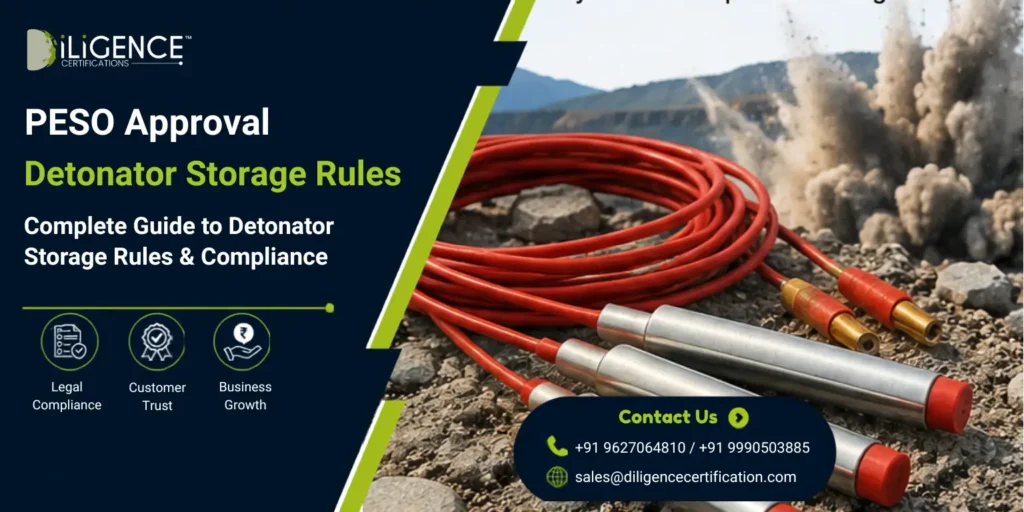
By - Includes all details on Detonator Storage Rules that need to be followed by industries, explosion stores, mines, construction projects, contractors, manufacturers, suppliers, and other organizations who handle detonators and explosives.
- Includes all details about the qualifications, application procedure, documentation, safety guidelines, storage premises, inspection, license, handling, and all other regulatory details relating to detonator storage.
- This guide includes all details about the process and regulations relating to Detonator Storage Rules.
Introduction
Detonators are extremely sensitive explosive devices which are used for controlled blasting works, mining, construction, quarrying, infrastructure development, and other applications. As detonators are intended to be used for initiating an explosive charge, safe, secured, segregated, supervised, and regulated storage of such devices is necessary.
Unlike any other industrial raw material, the storage of detonators is not a routine affair. Storage premises, construction, location, security, access control, fire prevention, handling, records, and other operations related to storage of such explosive devices should be arranged in accordance with the applicable explosives safety requirements.
Thus, business entities working with detonators should be well aware of the applicable rules of Detonator Storage before setting up or conducting such activities. Compliance with such requirements will minimize the probability of initiating, unauthorized access, mishandling, theft, fire, and many other accidents.
Petroleum and Explosives Safety Organisation, popularly known as PESO, is the organization which administers several safety regulations concerning explosives, petroleum, compressed gases, and other hazardous materials in India. Depending upon the nature of the detonators, storage arrangements, quantity, storage premises, and other activities, the required approval/license/authorization is necessary.
What are Detonator Storage Rules?
Detonator Storage Requirements refers to those regulatory, technical, safety, security, and operational requirements pertaining to the storage of detonators and other explosive articles subject to regulation by the Petroleum and Explosives Safety Organisation (PESO).
This is aimed at ensuring that detonators are stored in an environment that is appropriate and secure such that the risk of any accidental ignition, unauthorised access, mishandling, fire, impact, or other hazardous circumstances is minimised.
The relevant requirements may include the suitability of the storage premises, location, construction, arrangement, separation, access control, security, fire protection, emergency planning, record keeping, inspection and licensing.
The regulatory authority will evaluate whether the proposed premises, storage arrangement, safety provisions, security arrangements, documentation, and operation procedures are appropriate for the intended storage of detonators.
It is particularly crucial for proper storage since detonators are sensitive explosive articles and may react adversely in unsafe situations.
The services included in Detonator Storage Rules compliance are:
- PESO Registration
- Detonator Storage License Assistance
- Explosives Safety Compliance
- Licensing Assistance
- Documentation Support
- Technical Compliance
- Regulatory Advisory
- Application Filing
Following the appropriate Detonator Storage Rules helps eligible businesses maintain a controlled storage environment while complying with applicable explosives safety and regulatory requirements.
Applications of Detonator Storage Rules
Rules for Detonator Storage could be used for different companies or organizations that store, handle, supply, transport, or use detonators for legal purposes.
The specific regulation requirements will vary depending on the activity type, detonator type, storage site, storage method, relevant license, and many other safety factors.
In certain cases, there is a need for the proper authorization from the relevant company or organization. These are:
- Mining Companies
- Quarrying Companies
- Blasting Contractors
- Infrastructure Companies
- Construction Companies
- Road Construction Projects
- Tunnel Construction Projects
- Dam Construction Projects
- Explosive Suppliers
- Detonator Suppliers
- Explosive Storage Facilities
- Authorized Explosive Dealers
- Industrial Blasting Companies
- Mining Contractors
- Businesses Handling Regulated Explosive Articles
Following applicable Detonator Storage Rules allows businesses to establish a safer and more organized system for storing detonators while maintaining the necessary regulatory discipline.
Who Needs Detonator Storage Rules?
Organizations that store or handle detonators as part of an authorized business or industrial activity may need to comply with the applicable Detonator Storage Rules and explosives safety requirements.
The businesses that may need applicable approval or authorization include:
- Mining Companies
- Quarrying Units
- Blasting Contractors
- Construction Companies
- Infrastructure Companies
- Tunnel Construction Companies
- Road Construction Companies
- Explosive Manufacturers
- Explosive Suppliers
- Detonator Dealers
- Authorized Explosive Storage Facilities
- Industrial Blasting Units
- Mining Contractors
- Businesses Handling Regulated Explosives
- Other Organizations Engaged in Authorized Explosive Activities
And Other Businesses eligible for applicable Detonator Storage Rules compliance
Proper compliance enables eligible organizations to maintain detonator storage facilities in accordance with applicable safety, security, technical, and regulatory requirements.
Types of Compliance Under Detonator Storage Rules
The compliance requirements for detonator storage may depend on several factors, including the type of detonators, storage premises, storage capacity, location, construction, security arrangements, handling procedures, fire safety provisions, and applicable explosives regulations.
Compliance is extremely important because detonators require controlled storage conditions and restricted access.
Storage Premises & Infrastructure Compliance
The storage facility must be adequate to store the detonators safely and meet relevant technical and safety requirements.
The storage facility must be properly designed and maintained so as to protect the detonators from any threats of access, environment, ignition, damage, and others.
The storage premises and infrastructure compliance issues that exist include:
- Approved Storage Premises
- Suitable Storage Structure
- Safe Location
- Secure Storage Area
- Appropriate Access Control
- Safety Arrangements
- Fire Prevention Measures
- Electrical Safety Measures
- Proper Maintenance
- Restricted Entry
Useful for:
- Mining Companies
- Quarrying Companies
- Blasting Contractors
- Explosive Storage Facilities
- Infrastructure Companies
- Industrial Explosive Users
Proper storage premises and infrastructure compliance helps create a safer environment for detonator storage and reduces the possibility of accidental incidents or unauthorized access.
Storage & Handling Compliance
Detonators have to be handled with care in compliance with the necessary safety precautions. This is because detonators are made to cause an explosion and therefore inappropriate handling might pose potential dangers.
Handling should be aimed at avoiding any unnecessary physical contact, friction, heat exposure, ignition sources, and the safe movement of explosive items.
Compliance with safe storage and handling includes:
- Secure Storage Arrangements
- Restricted Access
- Proper Segregation
- Safe Handling Practices
- Ignition Source Control
- Fire Safety Precautions
- Safe Internal Movement
- Emergency Safety Arrangements
- Regular Safety Monitoring
Useful for:
- Mining Companies
- Blasting Contractors
- Explosive Storage Facilities
- Quarrying Businesses
- Detonator Suppliers
- Authorized Explosive Users
Following appropriate storage and handling practices helps businesses maintain safer working conditions and minimizes the risks associated with detonator storage and handling.
Documentation & Inspection Compliance
Documentation and inspection are important components of Detonator Storage Rules compliance.
Organizations should maintain accurate records related to their storage facility, explosive materials, authorized personnel, inspections, safety arrangements, movement, and other regulatory requirements.
Documentation generally includes:
- Storage Records
- Inspection Records
- Safety Records
- Explosive Details
- Technical Documents
- Premises Documents
- License Documents
- Security Records
- Regulatory Documents
Maintaining complete and updated records helps businesses demonstrate compliance during inspections, assessments, audits, regulatory reviews, and other verification procedures.
Documents Required for Detonator Storage Rules
The documents required for compliance with Detonator Storage Rules depend on the nature of the activity, type of detonators, proposed storage premises, storage arrangements, business structure, and applicable regulatory requirements.
Generally, the required documents may include:
- PAN Card
- GST Registration Certificate
- Business Registration Certificate
- Identity Proof of Authorized Signatory
- Address Proof
- Site Plan
- Storage Layout Plan
- Organization Details
- Technical Specifications
- Storage Details
- Safety Arrangement Details
- Fire Safety Details
- Security Arrangement Details
- Inspection and Testing Documents
- Authorization Letter, if applicable
- Digital Signature Certificate, if applicable
- Other documents required under applicable explosives regulations
The exact documentation requirements may vary according to the nature of the detonator storage activity and the approval or license being sought.
Preparing accurate and complete documents helps make the Detonator Storage Rules compliance process more organized and reduces the possibility of avoidable queries or delays.
Step-by-Step Process for Detonator Storage Rules
Compliance with the Detonator Storage Regulations will be made easy if the applicant is well versed with the relevant regulations and fills the appropriate documents.
The compliance process involves such procedures as the assessment of eligibility, documentation, application, verification, inspection, licensing, approval and compliance.
It becomes easy to comply with regulations through having a system.
Step 1: Eligibility Assessment
The first stage in the Detonator Storage Rules process is determining the regulatory requirements applicable to the proposed storage activity.
Eligibility is determined by:
- Nature of Business Activity
- Type of Detonators
- Storage Activity
- Storage Premises
- Storage Arrangement
- Handling Procedures
- Security Infrastructure
- Technical Infrastructure
- Applicable Explosives Regulations
Proper eligibility assessment helps businesses understand whether they require a license, approval, authorization, or other regulatory permission for their proposed detonator storage activity.
Step 2: Gathering All Required Documents
Upon identification of the requisite criteria, the applicant must proceed to assemble the relevant documents necessary for detonator storage authorization or licensing.
This is crucial since the presented documents will enable the regulatory agency to gain an understanding of the proposed premises, the storage facilities, security measures, safety systems, and operations.
The common documents may include:
- Business Registration Certificate
- PAN Card
- GST Registration Certificate
- Identity and Address Proof
- Site and Layout Plans
- Storage Details
- Technical Documents
- Safety Arrangement Details
- Security Arrangement Details
- Inspection and Testing Documents
Proper documentation provides the authority with a clear understanding of the proposed storage facility and supports a smoother application review.
Step 3: Filling Out the Application
Once the appropriate paperwork is prepared, the application for the appropriate detonator storage approval or licensing must be made using accurate information with regard to the business, facilities, storage method, detonators, safety and security measures, among other important information.
The information in the application must match the information contained in the documentation.
The application generally covers:
- Business Information
- Applicant Information
- Premises Information
- Storage Activity Details
- Technical Information
- Safety Information
- Security Information
- Contact Information
- Compliance Information
Careful preparation of the application helps ensure consistency and clarity throughout the regulatory process.
Step 4: Verification of the Application
After submission of the application, the relevant details and documents may be evaluated to determine whether the proposed detonator storage facility satisfies the applicable safety, security, technical, and regulatory requirements.
The verification procedures may include:
- Business Verification
- Documentation Verification
- Technical Documentation Verification
- Property Verification
- Storage Premises Verification
- Safety Arrangement Verification
- Security Arrangement Verification
- Compliance Verification
In some cases, an inspection or technical review may be required.
If the authority requests additional information, clarification, modification, or supporting documents, the applicant should provide the required response within the applicable requirements.
Step 5: Grant of Detonator Storage Approval
Once the applicable requirements have been successfully fulfilled, the concerned detonator storage license, approval, authorization, certification, or other applicable permission may be issued by the competent authority.
The benefits of obtaining applicable approval under Detonator Storage Rules include the following:
- Safety Standards Compliance
- Secure Detonator Storage
- Regulatory Recognition
- Efficient Operation
- Credibility in Business
The grant of the applicable approval indicates that the proposed storage activity has been considered in accordance with the requirements applicable to the particular facility and operation.
Step 6: Ongoing Compliance
Obtaining approval for detonator storage is not the end of the compliance responsibilities.
Businesses must continue to follow the applicable safety, security, operational, inspection, and regulatory requirements throughout their storage activities.
These obligations may consist of:
- Inspection
- Safety Monitoring
- Maintenance of Records
- Regulatory Reporting
- Maintenance of Storage Premises
- Security Monitoring
- Updating of Business Information
- Storage Facility Monitoring
- Compliance Monitoring
Regular monitoring helps businesses identify potential compliance gaps and maintain a safer storage environment.
Timeline, Cost & Validity of Detonator Storage Rules
The timeline, cost, and validity of compliance or applicable approval under Detonator Storage Rules depend on several factors, including the nature of the storage activity, document preparation, technical requirements, inspection, application review, premises verification, and applicable regulatory requirements.
| Timeline | Cost | Validity |
| The approval timeline depends on document verification, technical assessment, inspection, and application processing. | The cost depends on the applicable government fee and professional service charges, if any. | Detonator storage approval or license remains valid as per the applicable regulations, license conditions, and approval requirements. |
| Proper documentation helps reduce processing delays. | Additional charges may vary depending on the nature of detonator storage activities and compliance requirements. | Businesses should comply with applicable renewal, inspection, or update requirements whenever necessary. |
| Processing time may vary based on the completeness of the application and regulatory verification. | Proper planning helps manage the licensing cost efficiently. | Maintaining updated business, storage, safety, and security information helps support continued regulatory compliance. |
Importance & Benefits of Detonator Storage Rules
| Importance | Benefits |
| Helps organizations comply with applicable explosives regulations and detonator storage safety requirements. | Enhances business credibility and demonstrates commitment to explosive storage safety. |
| Supports safe storage, handling, security, and management of detonators and related explosive articles. | Improves confidence among customers, business partners, workers, and regulatory authorities. |
| Encourages responsible storage and safety practices. | Enables smoother compliance with applicable explosives and fire safety requirements. |
| Promotes long-term operational safety and regulatory discipline. | Reduces compliance risks and improves operational efficiency. |
| Helps businesses fulfill their legal and regulatory responsibilities. | Strengthens long-term business growth and industry reputation. |
Why are Detonator Storage Rules Important?
Importance of Detonator Storage Rules is due to the delicate nature of the detonators themselves as well as potential dangers related to their unsafe storage or handling.
Detonators are explosive substances used for exploding explosive charges. Hence, their storage without any precautions, control measures, appropriate locations, and regulatory compliance can lead to some risks for the employees, facilities, vicinity, and business in general.
Companies engaged in such activities as mining, quarrying, construction, development, blasting, and other licensed activities have to know about relevant regulations before storing detonators.
In this connection, the relevant detonator storage license, authorization, or certification will be useful for such companies.
Good compliance will also help the companies to keep proper storage facility, control access, technical setup, fire protection, security, records, and contingency planning.
It is important to understand that good compliance not only relates to getting the approval. It is also concerned with keeping safe storage of the company during its operation.
Good compliance with the regulations can contribute positively to the professional reputation of the business among its clients, vendors, business partners, and other parties involved.
The importance of Detonator Storage Rules includes:
- Regulatory Compliance
- Industrial Safety
- Secure Detonator Storage
- Operational Reliability
- Industry Recognition
- Risk Reduction
- Responsible Explosive Management
Detonator Storage Rules help businesses establish safer storage practices while supporting regulatory compliance and responsible management of detonators.
Consequences of Non-Compliance with Detonator Storage Rules
Non-compliance with applicable explosives safety requirements may create serious challenges for organizations involved in detonator storage.
Detonators require controlled storage because inappropriate storage, handling, security, or access arrangements can increase the possibility of accidents and unauthorized incidents.
Some of the consequences include:
Regulatory Non-Compliance
Organizations may face regulatory issues when they store, handle, or manage detonators without following applicable licensing, safety, security, and operational requirements.
Action by the Competent Authority
The competent authority may take appropriate action when organizations fail to comply with applicable explosives safety and regulatory requirements.
Operation Restrictions
Businesses may face restrictions on certain storage or related operations until the applicable compliance requirements have been fulfilled.
Business Activities Time Lags
Non-compliance may result in delays in obtaining approvals, expanding storage facilities, modifying premises, commencing regulated activities, or undertaking other business operations.
Suspension or Withdrawal of Approval
Serious or continued non-compliance may result in suspension, cancellation, or withdrawal of an approval or authorization, depending on the applicable regulations and circumstances.
Safety Hazards Risks
Failure to maintain proper storage and safety arrangements may increase the possibility of accidental incidents, unsafe handling, unauthorized access, or other hazardous situations.
Reputation of the Business
Failure to follow applicable standards may negatively affect the reputation of businesses among customers, suppliers, workers, industry partners, and regulatory authorities.
Risk of Bad Reputation
Long-term non-compliance can create concerns about the organization’s commitment to safety, security, responsible operations, and regulatory discipline.
Growing the Business
Non-compliance may make it difficult for businesses to expand their operations, storage facilities, services, contracts, or other regulated activities.
Adherence to applicable Detonator Storage Rules enables businesses to conduct their operations in a more organized, responsible, secure, and compliant manner.
Renewal of Detonator Storage License
The renewal or update of the applicable detonator storage license or approval may be important for businesses involved in activities regulated under explosives and safety requirements.
Organizations should regularly review their approval or license to identify whether there have been changes in their business activity, storage premises, security arrangements, storage conditions, management, technical personnel, operational practices, or other relevant information.
Reviewing the license and related compliance requirements helps businesses identify regulatory obligations in advance and avoid unnecessary disruption to their operations.
The common steps involved in updating or renewing a detonator storage license include:
- Updating Business Information
- Reviewing License Details
- Updating Premises Information
- Updating Storage Information
- Updating Operational Information
- Submitting Required Documents
- Maintaining Safety Compliance
- Checking Regulatory Requirements
Keeping the Detonator Storage License information updated helps businesses continue their regulated activities efficiently while maintaining applicable safety, security, and regulatory compliance.
How Professional Assistance Helps in Detonator Storage Rules?
It may be difficult for business to understand issues relating to explosives legislation, storage, technical standards, documentation, security, applications, inspections, and compliance.
Detonator storage includes safety-critical materials, hence any slight discrepancy in documentation or compliance will raise questions and may create operational difficulties.
Professional help may assist business to understand regulatory requirements and documentations, applications, storage and compliance needs.
Professional assistance generally includes:
- Understanding Detonator Storage Rules Requirements
- Eligibility Assessment
- Documentation Preparation
- Application Filing Assistance
- Technical Compliance Guidance
- Safety Compliance Guidance
- Security Compliance Guidance
- Regulatory Advisory
- Application Status Tracking
- Query Resolution
- Post-Approval Compliance Support
The professional services generally cover:
- Eligibility Verification
- Documentation Assistance
- Online Application Support
- Regulatory Compliance Guidance
- Technical Documentation Support
- Inspection Preparation Assistance
- End-to-End License Assistance
- Ongoing Compliance Advisory
With suitable professional guidance, businesses dealing with detonators can organize their licensing and compliance requirements more efficiently while focusing on their core industrial operations.
Why Choose Diligence Certifications for Detonator Storage Rules?
Rules of Detonator Storage are about understanding explosives regulations, documentation, storage, security, technical needs, safety, inspections, and regulations.
Professional assistance may help to add more structure to this process and make it easier for organizations to deal with issues of documentation, applications, technical requirements, storage, safety, and regulations.
Diligence Certifications may be helpful for companies to get certifications related to their activities with explosives, industrial safety, hazardous substances, storage, and other regulated activities.
The advantages of choosing Diligence Certifications include:
- Documentation Assistance
- Application Filing Support
- Regulatory Compliance Guidance
- Approval Query Resolution
- Technical Documentation Assistance
- End-to-End License Assistance
- Continuous Compliance Support
- Regulatory Guidance
- Process Management
With professional support from Diligence Certifications, managing Detonator Storage Rules becomes a more structured process, helping businesses handle applicable documentation, application, technical, safety, security, and compliance requirements efficiently.
Conclusion
Detonator Storage Rules are applicable to companies and organizations which are engaged in activities that require storing of detonators and other regulated explosive articles.
As detonators are sensitive explosive articles, then correct storage, secure premises, controlled access, suitable facilities, safety precautions, fire protection, documentation, inspection and regulation are of importance.
The particular license, approval, authorization or certification for detonator storage needed is defined by the character of activity of storing, type of explosive article, intended premises, storage arrangements and regulatory requirements.
Correct compliance goes beyond mere satisfaction of a regulatory requirement. It is important for companies working with detonators as correct compliance will ensure safer storage, reduced risk and more reliable business operations.
Secure storage, suitable premises, proper handling, controlled access, technical documentation, safety management, recordkeeping, inspection and regulation are among the main issues related to proper and safe detonator storage.
It is necessary to know the particular rules of detonator storage applicable to your company in case you currently store detonators or have plans to create a detonator storage.
Frequently Asked Questions
What Are Detonator Storage Requirements?
Detonator storage requirements refer to the various rules of safety, security, operations, technology, and regulation in regards to storing and handling detonators and other explosive devices.
Which Organizations Require Compliances of Detonator Storage Requirements?
Organizations involved in mining, quarrying, blasting, infrastructure, explosion device storage, and authorized explosive dealers among other qualified organizations who handle detonators might require compliance of relevant storage requirements.
Is Detonator Storage Permit Compulsory?
A detonator storage permit might be compulsory where the detonator storage activity is subject to regulations on explosives licensing and regulation.
What Documentation Should Be Submitted for Detonation Storage?
It includes business documentation, identification and address documents, premises information, storage arrangement, technical information, safety documentation, security documentation, inspection report, and other documents as required by the relevant regulatory system.
How Long Will Take to Get Detonation Storage License?
It depends on many things, including documentation, processing of application, technical evaluation, inspection, verification of premises, inspection, and others.
What is the Validity of the Detonation Storage License?
Validity will depend on the type of license or approval required and conditions provided by the relevant regulation.
Is There Any Role of Detonator Storage in Mining and Construction Industries?
Yes. Detonators can be used for blasting operations in relation to mining, quarrying, infrastructure development, construction, tunnels, and other industrial activities that require regulation.
Why Is It Important to Be Compliant with Detonator Storage Rules?
Being compliant will ensure eligible organizations have controlled, secure, and regulated storage of detonators in accordance with explosive safety rules.
Can Compliance with Detonator Storage Rules Enhance Safety?
Yes. Compliance with proper storage, safety, inspection, security, and handling will ensure reduced risks and control over storage operations.
How Can Detonator Storage Licenses Be Acquired with Help of Consultants?
Professional consultants will help organizations assess their eligibility, prepare documentation, and ensure compliance with all necessary requirements.