 BIS Certification
 CDSCO
 PESO
 CPCB
 LMPC
 WPC Approval
 Global Approvals
 TEC
 ARAI
 BEE
 ISO Certification
 DGCA Certification
 NOC For Steel
 APEDA Registration























 Business Registration
 FSSAI Mark Certification












 (32).jpg)
 Legal Services
 Trademark Registration
 Copyright Registration
 Patent Registration
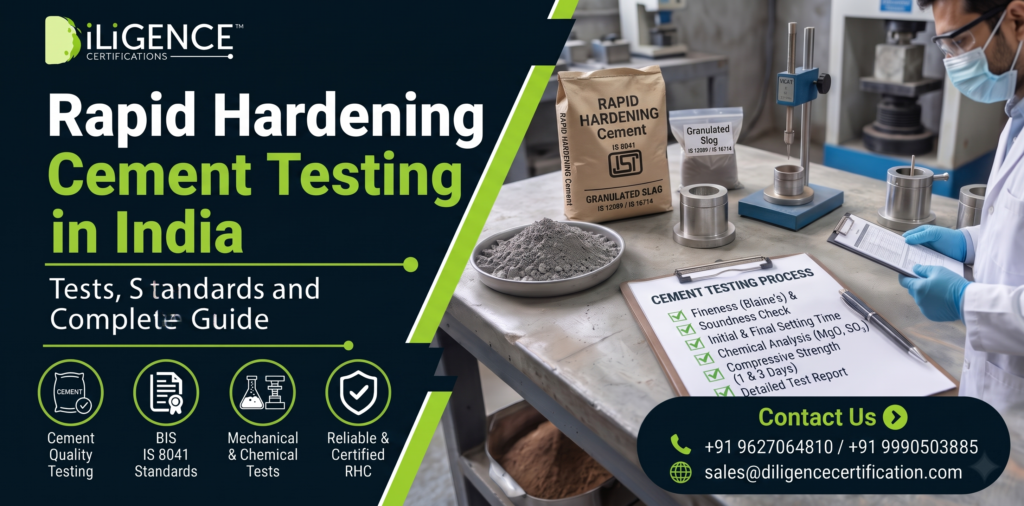
 By
- Rapid hardening cement gains strength much faster than normal cement, so its testing is stricter on early strength.
- The main Indian standard for this cement is IS 8041. Test methods mostly come from IS 4031 and IS 4032.
- Core tests cover fineness, setting time, soundness, early compressive strength and chemical limits.
- Testing is done in two places: your own factory lab and a recognised lab.
- Most failures come from bad sampling, wrong storage and weak process control, not from the test itself.
- Check the latest standard and BIS notifications before you start.
Introduction
Think of a pressure cooker and a normal pot. Both cook rice. But the cooker does it in much less time, and it needs more care while using. Rapid hardening cement is like that cooker. It gains strength quickly, so slabs, roads and precast items can be used earlier.
But speed brings risk. If the cement is not tested properly, early strength can look fine on paper and still fail later at the site. That is why rapid hardening cement testing matters so much.
In this blog, we will keep things simple. We will see what this cement is, which standard applies, which tests are done, and how the process works step by step.
What Is Rapid Hardening Cement Testing?
Rapid hardening cement testing means checking a cement sample in a lab to see if it meets the limits of the Indian standard for rapid hardening Portland cement.
This cement is finer than ordinary cement and usually has more tricalcium silicate. Because of this, it gains strength in the first one to three days much faster.
The lab checks things like:
- how fine the cement is
- how quickly it sets
- whether it expands after setting
- how much strength it gives at one day and three days
- whether the chemical content stays within limits
As far as we know, cement in India is covered under BIS certification. So a manufacturer needs a valid licence and regular testing to sell it with the standard mark. Please confirm the current notification before you plan anything.
Rapid Hardening Cement vs Ordinary Cement
| Point | Rapid hardening cement | Ordinary Portland cement |
| Early strength | Gains strength quickly | Gains strength slowly |
| Fineness | Finer grinding | Less fine |
| Heat during setting | Usually higher | Usually lower |
| Common use | Precast, quick repairs, roads, cold weather work | General construction |
| Main focus in testing | Early strength and fineness | Overall strength grades |
| Care needed | More careful handling and curing | Normal handling |
Which Standard Applies?
The main product standard is IS 8041 for rapid hardening Portland cement. The test methods come from other standards that cover all cement types.
| Standard | What it covers |
| IS 8041 | Requirements for rapid hardening Portland cement |
| IS 4031 (various parts) | Physical tests such as fineness, consistency, setting time, soundness and compressive strength |
| IS 4032 | Chemical analysis of hydraulic cement |
| IS 3535 and IS 3535 related practice | Sampling of hydraulic cement |
A simple example: Suppose a plant makes rapid hardening cement. The lab takes a sample as per the sampling method. Then it checks fineness as per IS 4031, strength as per IS 4031, and chemical limits as per IS 4032. The final result is compared with the limits written in IS 8041.
Note: Standards get revised from time to time. Always download the latest version, and check BIS notifications for any changes in dates or requirements.
Why Is Rapid Hardening Cement Testing Important?
- Safety: Early strength decides when formwork can be removed. Wrong data can lead to unsafe structures.
- Quality control: Fine grinding and quick reaction need tight control in the plant.
- Legal compliance: Cement sold with the standard mark must meet the standard.
- Customer trust: Contractors and precast makers depend on the early strength claim.
- Fewer rejections: Regular testing catches problems before bags leave the factory.
- Durability: Soundness and chemical limits protect the structure in the long run.
What Tests Are Conducted?
| Test group | What the lab checks | In simple words |
| Fineness | Specific surface by air permeability method | How finely the cement is ground |
| Standard consistency | Water needed to make a paste of standard thickness | Base value for other tests |
| Setting time | Initial and final setting time | How long before the paste starts and finishes hardening |
| Soundness | Le Chatelier test, and autoclave test where needed | Does the cement swell or crack after setting |
| Compressive strength | Mortar cubes tested at early ages such as 1 day and 3 days | How much load the cement can take early |
| Chemical analysis | Magnesia, sulphur trioxide, loss on ignition, insoluble residue, chloride | Is the chemical balance correct |
Let us understand the main ones a little better.
1. Fineness
Fineness is checked with the Blaine air permeability method. Rapid hardening cement needs a higher fineness than ordinary cement. More surface area means faster reaction with water.
But too fine is also a problem. It can raise water demand and heat. So the plant keeps grinding in a controlled range.
2. Setting Time
The Vicat apparatus is used here. The lab notes the time when the needle stops penetrating fully (initial set) and when it leaves no mark (final set).
Temperature and humidity of the lab must stay as per the standard. Small changes can shift results.
3. Soundness
The Le Chatelier method measures expansion. If free lime or magnesia is high, the cement can expand later and crack the concrete. That is why this test is never skipped.
4. Compressive Strength
This is the heart of rapid hardening cement testing. Mortar cubes are made, cured and crushed at set ages. The early age results show how fast the cement really is.
Cube making needs trained hands. Even slight changes in mixing time or compaction can change the number.
5. Chemical Tests
The lab checks magnesia, sulphur trioxide, loss on ignition, insoluble residue and chloride content. These show if the raw mix, gypsum addition and storage are under control.
Special Focus: Early Strength and Heat
Since this cement reacts fast, two things need extra attention.
| Area | Why it matters | What to watch |
| One day strength | Decides early formwork removal | Cube casting, curing water temperature |
| Heat of reaction | Fast reaction gives more heat | Mass concrete should be planned carefully |
| Storage age | Strength drops if cement absorbs moisture | Use fresh samples, sealed bags |
| Grinding control | Fineness changes early strength | Check mill output often |
Tip before sending samples: Take samples from the packing line or silo as per the sampling method. Seal them in airtight containers right away. Do not keep them in an open area.
Two Kinds of Testing: Factory Lab vs Recognised Lab
| Point | Factory lab | Recognised lab |
| Who runs it | Your own plant team | Independent, recognised lab |
| Purpose | Daily process control | Third party proof of conformity |
| Frequency | Regular, often every shift or batch | Samples as required by the scheme |
| Equipment | Must be calibrated and in working order | Must be recognised and calibrated |
| Records | Must be kept neatly | Test reports issued |
Both are important. The factory lab keeps the plant on track. The recognised lab gives an outside view.
Step-by-Step Process
- Check the standard and scheme. Confirm the latest IS 8041 and current BIS requirement for cement.
- Set up the plant lab. Keep calibrated equipment and trained staff.
- Plan the sampling. Decide who will draw samples, how and how often.
- Draw samples. Follow the standard sampling method. Label each sample clearly.
- Run in-house tests. Fineness, setting time, soundness and strength at the required ages.
- Send samples to a recognised lab. Pack airtight and send quickly.
- Collect the test report. Compare each value with the limits in the standard.
- Fix gaps if any. Check grinding, gypsum, clinker quality and storage. Then retest.
- Apply and maintain. Submit the application with the reports. After the licence, continue regular testing and keep records.
Which BIS Licence Is Needed?
As far as we know, cement manufacturers need a BIS licence under the product certification scheme. Importers and overseas makers have their own routes.
| Business type | Likely route |
| Indian manufacturer with own plant | BIS product certification licence for the plant |
| Overseas manufacturer | Foreign manufacturer certification route |
| Importer | Needs the supplier to hold a valid licence |
| Private label seller | Depends on the licence of the actual manufacturer |
A licence may need changes when you change the plant location, product range or major process. Please confirm with the latest BIS rules.
Documents Required
Company documents
- Business registration proof
- Factory address proof
- Authorisation letter or contact person details
Product and plant documents
- Plant layout and process flow chart
- List of machines and testing equipment
- Calibration records
- Raw material details
Testing records
- Factory lab test records
- Recognised lab test reports
- Sampling and storage records
Exact lists can change. Always check the current BIS checklist.
How Long Does It Take?
There is no fixed time that suits everyone. It depends on how ready your plant lab is, how soon the samples reach the lab, and whether the first results meet the limits. Early strength tests also take a few days by themselves, since cubes must be cured to the required age. Plan your timeline with some buffer.
Cost
We will not give a single number here, since fees keep changing. The cost depends on these things:
- number of tests and samples
- recognised lab charges
- BIS application and licence fees
- equipment calibration
- travel and inspection
- consultant support, if taken
Ask the lab and your consultant for a clear breakup before you start.
Common Failures and Easy Fixes
| Problem | Likely cause | Easy fix |
| Low one day strength | Weak grinding control or poor cube curing | Check mill settings and curing tank temperature |
| Setting time out of range | Gypsum level or sample moisture | Review gypsum dosing and sample storage |
| Soundness failure | High free lime or magnesia | Check raw mix and clinker quality |
| Chemical result off | Wrong sampling or raw material change | Retest with a fresh sample |
| Results not repeatable | Equipment not calibrated | Calibrate and train the staff |
Common Mistakes
- Using old or lumpy cement for testing
- Keeping samples in open bags
- Not following the sampling method
- Skipping calibration of equipment
- Mixing cubes by hand without a standard routine
- Ignoring temperature and humidity of the lab
- Not keeping neat test records
- Waiting till the last minute for the licence process
Who Needs This?
- Manufacturers: Plants making rapid hardening cement in India.
- Importers: Those who bring this cement from other countries.
- Private label sellers: Brands that sell under their own name.
- Overseas manufacturers: Plants outside India that want to supply to the Indian market.
- Buyers and contractors: To check that a supplier’s claims are backed by proper test reports.
Why Choose Diligence Certifications for rapid hardening cement testing Certification?
Getting a licence and handling lab work together can feel heavy. That is where support helps.
At Diligence Certifications, the team explains the process in simple language and helps you prepare step by step. This usually includes:
- checking which standard and scheme apply to your product
- guiding you on sampling, lab selection and test reports
- helping you organise documents before applying
- supporting you in sorting out gaps found in the first test
You can see the related support on the certification services page. Final approval always depends on BIS and on your product meeting the standard. No consultant can promise that.
After Getting the Licence
The work does not stop after approval. BIS can check the plant and take market samples. So keep up your routine tests, calibration and records. Good habits make later audits much easier.
Quick Checklist Before Sending Samples
- Latest standard downloaded
- Samples drawn as per the sampling method
- Samples sealed airtight and labelled
- Equipment calibrated
- Factory test records ready
- Lab recognition confirmed
Conclusion
Rapid hardening cement testing is about trust. The cement is built for speed, so the early strength numbers must be correct and repeatable.
Know the standard, test properly in your own lab, confirm the results in a recognised lab, and keep your records neat. Do that, and the licence process becomes much smoother.
Standards and rules change, so please verify the latest details before you apply.
Frequently Asked Questions
1. What is rapid hardening cement
It is a Portland cement that gains strength faster than ordinary cement, mainly because it is ground finer and has a different chemical balance.
2. Which standard covers rapid hardening cement in India?
IS 8041 is the product standard. Test methods come from IS 4031 and IS 4032.
3. Which tests are done on rapid hardening cement?
Fineness, consistency, setting time, soundness, early compressive strength and chemical analysis.
4. Why is early strength tested so carefully?
Because users depend on early strength to remove formwork and start the next work.
5. Is BIS certification needed for this cement?
As far as we know, cement comes under BIS certification. Please confirm the current notification.
6. Can I test the cement in my own lab?
Yes, for process control. But a recognised lab is needed for third party proof.