BIS Certification
 CDSCO
 PESO
 CPCB
 LMPC
 WPC Approval
 Global Approvals
 TEC
 ARAI
 BEE
 ISO Certification
 DGCA Certification
 NOC For Steel
 APEDA Registration























 Business Registration
 FSSAI Mark Certification












 (32).jpg)
 Legal Services
 Trademark Registration
 Copyright Registration
 Patent Registration
 By
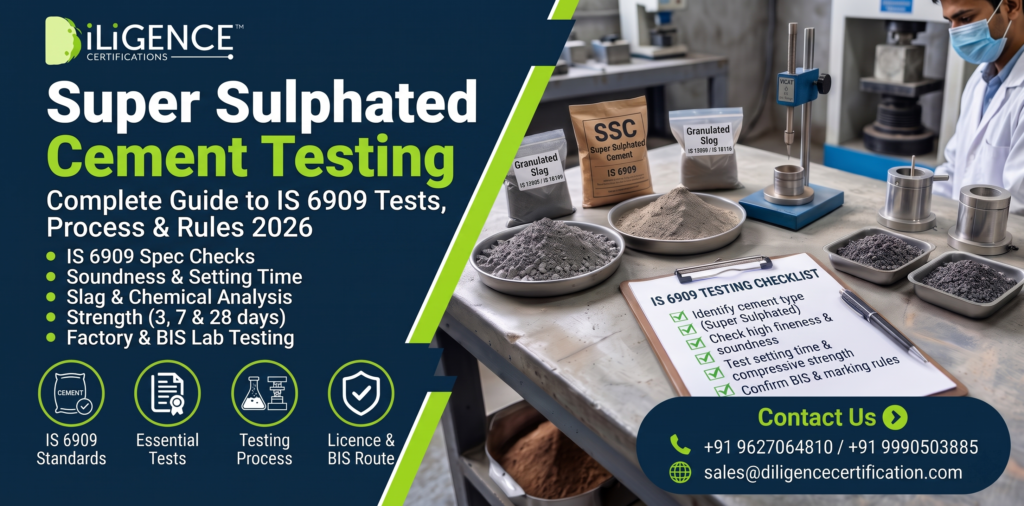
- Super Sulphated Cement Testing is made mostly from granulated blast furnace slag, with calcium sulphate and a small amount of clinker or lime.
- The Indian standard for it is IS 6909:1990. Testing is done as per this standard.
- Main tests are fineness, setting time, soundness, compressive strength and chemical analysis.
- Samples are tested by IS 4031 and IS 4032 methods, so the lab must follow them properly.
- Mix ratio, grinding and curing control decide most of the results. Fix them before sending samples.
- Always check the latest copy of the standard and BIS rules before you start.
Introduction
Think of a raincoat. A normal raincoat is fine for city rain. But if you are working near the sea or in a chemical plant, you need something made for that. Super sulphated cement is like that special raincoat. It is made for places where sulphates, sea water and aggressive chemicals can damage normal concrete.
But a special cement is only special if it passes the test. That is why super sulphated cement testing matters. A bag that says “super sulphated” but fails in the lab can cause cracks and weak structures later.
In this blog, we will go step by step. We will see what the cement is, which standard applies, what tests are done, the process, documents, and the mistakes people make most often.
What Is Super Sulphated Cement?
Super sulphated cement is a hydraulic cement. It is not made like normal Portland cement. The main ingredient is granulated blast furnace slag, a by-product from steel plants. Calcium sulphate (gypsum or anhydrite) is added in a good quantity, and a small portion of Portland cement clinker or lime works as the activator.
Because of this mix, the cement has some useful qualities:
- Low heat of hydration, so it suits mass concrete.
- Good resistance against sulphates and sea water.
- Lower clinker use, which is better for the environment.
The Indian standard IS 6909:1990 covers the composition, manufacture and testing of this cement. So when someone says super sulphated cement testing, they mean checking the cement against this standard.
Super Sulphated Cement vs Other Common Cements
| Point | Super Sulphated Cement | Ordinary Portland Cement | Portland Slag Cement |
|---|---|---|---|
| Main ingredient | Slag (very high share) | Clinker | Clinker plus slag |
| Heat of hydration | Low | Higher | Moderate |
| Sulphate resistance | Very good | Normal | Better than OPC |
| Typical use | Marine and chemical exposure, mass concrete | General construction | General and moderate exposure |
Which Standard Applies?
| Standard | What it covers |
|---|---|
| IS 6909:1990 | Specification for supersulphated cement (composition, manufacture, requirements) |
| IS 4031 (various parts) | Methods of physical tests for hydraulic cement |
| IS 4032 | Method of chemical analysis of hydraulic cement |
| IS 4905 | Methods for random sampling (used for sampling plans) |
Simple example: A manufacturer makes a batch of super sulphated cement. The lab will check fineness using IS 4031 Part 2, setting time using Part 5, and chemical limits using IS 4032. The results are then compared with the limits written in IS 6909.
Note: Standards get amended and revised from time to time. Before you start, check the latest version and any amendments on the BIS portal. Do not depend on old notes.
Why Is Super Sulphated Cement Testing Important?
- It proves the cement really meets the standard.
- It protects concrete from early damage in sulphate-rich soil, sea water and industrial areas.
- It keeps batch quality consistent, so site engineers do not face surprises.
- It builds buyer trust, mostly for big infrastructure and marine projects.
- It helps you catch production problems early, before the full lot is made.
- It supports your BIS licence and regular surveillance checks.
What Tests Are Conducted?
| Test | What the lab checks | In simple words |
|---|---|---|
| Fineness | Specific surface by Blaine air permeability method | How fine the cement powder is. The standard asks for high fineness |
| Setting time | Initial and final setting by Vicat apparatus | How long the paste takes to start and finish hardening |
| Soundness | Expansion by Le Chatelier method | Whether the cement will swell and crack later |
| Compressive strength | Mortar cubes at 3, 7 and 28 days | How much load the hardened cement can take |
| Transverse strength | Strength of mortar prisms | Bending strength of the hardened mortar |
| Chemical analysis | Sulphate content, magnesia, loss on ignition, insoluble residue | Whether the chemical make-up is within limits |
Please note: the exact limits are written in IS 6909. For example, the standard sets a high minimum fineness and a maximum final setting time, along with minimum strengths at 3, 7 and 28 days. Always take the numbers from the latest official copy, not from blogs.
Tests Are Only Half the Story: Composition and Curing
In super sulphated cement, the mix matters a lot. Too little calcium sulphate or wrong slag quality, and the strength drops. Curing also matters. This cement likes moist curing, and poor curing can hurt the results.
So before testing, many labs and manufacturers also check:
- Slag quality and glass content
- Calcium sulphate form and quantity
- Grinding fineness of each ingredient
- Storage condition of the cement (it should not take moisture)
Two Kinds of Testing
| Type | Where it happens | Why it is done |
|---|---|---|
| In-house factory lab testing | At the manufacturer’s own plant | Daily batch control and quick checks |
| Recognised or independent lab testing | NABL-accredited or BIS-recognised lab | Official reports for certification and audits |
Factory testing keeps your production on track. Recognised lab testing is what the authorities and customers trust.
Step-by-Step Process
- Check the standard. Download the latest IS 6909 and the related IS 4031 and IS 4032 parts.
- Plan the sampling. Take samples as per the sampling method in the standard, from different bags or silos.
- Prepare the samples. Keep them in airtight containers. Moisture can spoil the results.
- Run in-house trials. Test fineness, setting time and strength once before the official round.
- Choose a recognised lab. Make sure the lab is capable of testing this exact cement.
- Send the samples with details. Mention batch number, date of manufacture and the standard.
- Lab testing. The lab runs all physical and chemical tests. The 28-day strength takes time, so plan ahead.
- Review the report. Compare every value with IS 6909. If something is off, find the root cause.
- Keep records. File the reports, batch details and calibration records safely for audits.
Which BIS Registration Is Needed?
| Business type | What usually applies |
|---|---|
| Manufacturer in India | BIS licence process (ISI Mark) for the product, subject to current BIS rules |
| Foreign manufacturer | Foreign manufacturer certification scheme, if the product is covered |
| Importer | Needs the product to comply with BIS rules and a valid certificate where required |
| Trader or private label | The licence belongs to the actual manufacturer. Check labelling rules |
BIS lists and rules for cement products keep changing. Please confirm the current status of super sulphated cement on the BIS portal before applying.
Documents Required
Company documents
- Business registration proof and GST details
- Factory address and layout
- Authorisation letter for the contact person
Product documents
- Product details and brand name
- Raw material details (slag, calcium sulphate, clinker)
- Manufacturing flow chart
- Packing and marking details
Testing records
- Test reports from a recognised lab
- Lab equipment list and calibration records
- Quality control plan and batch records
How Long Does It Take?
There is no single answer. It depends on how ready your plant and your lab are. The 28-day strength test alone needs a month. Add sample preparation, report writing and any retest. So plan with some buffer, and do not promise dates to customers early.
What About the Cost?
We are not giving a fixed figure, because cost changes with a few things:
- Number of tests and samples
- Lab you choose
- Whether retesting is needed
- Licence and inspection requirements
- Consultant support, if taken
Share your product details and plant location, and you can get a proper breakup.
Common Failures and Easy Fixes
| Problem | Likely reason | Easy fix |
|---|---|---|
| Low early strength | Weak slag activation or low fineness | Improve grinding and check the activator share |
| Setting too fast or too slow | Wrong calcium sulphate balance | Re-check the mix and gypsum quality |
| Soundness failure | Excess free lime or magnesia | Check raw material chemistry |
| Chemical limits off | Poor raw material control | Test each raw material lot |
| Results vary batch to batch | Weak process control | Fix blending and sampling method |
Common Mistakes to Avoid
- Using an old version of the standard.
- Sending samples that absorbed moisture.
- Skipping in-house trial runs.
- Taking samples from one bag only.
- Ignoring curing conditions for the strength cubes.
- Choosing a lab that has never tested this cement.
- Not keeping calibration and batch records.
- Starting production changes after testing without telling anyone.
Who Needs This?
- Cement manufacturers making super sulphated cement.
- Importers bringing the cement into India.
- Brands that sell under their own name from another plant.
- Overseas manufacturers selling to Indian buyers.
- Contractors and project teams who want to check supplier quality.
Why Choose Diligence Certifications for Super Sulphated Cement Testing Certification?
If you are new to BIS work, the paperwork and lab coordination can feel heavy. Diligence Certifications helps you understand the process in plain language. Visit the Diligence Certifications homepage to know more about our work. For product-specific help, you can read our BIS certificate for supersulphated cement service page.
What the team can do for you:
- Explain the applicable standard and current rules.
- Guide you on documents and testing records.
- Help you coordinate with recognised labs.
- Support you during the application and follow-up.
Final approval always depends on BIS and on your product meeting the standard. No consultant can promise it.
After Registration
Getting the licence is not the end. BIS does regular surveillance, takes market samples and checks your records. So keep your in-house testing running. Keep batch records. And if you change your raw material source, review it before production, not after.
Tips to Pass in the First Attempt
- Read the latest IS 6909 fully, not only the summary.
- Run your own trial tests first.
- Control fineness of each ingredient.
- Keep slag and gypsum quality steady.
- Store samples airtight.
- Follow moist curing for cubes.
- Pick an experienced lab.
- Keep every record ready.
Quick Checklist Before Sending Samples
- Latest standard downloaded
- Samples taken as per sampling plan
- Samples sealed and labelled
- In-house trial results available
- Lab confirmed for this cement
- Batch details and documents ready
Conclusion
Super sulphated cement is a smart choice for tough exposure conditions. But the quality has to be proven. Proper super sulphated cement testing under IS 6909 shows that the cement is safe, consistent and ready for real projects.
Keep your process tight, use a good lab, and always check the latest rules. If you do that, testing becomes a routine job and not a headache.
Frequently Asked Questions
1. What is super sulphated cement testing?
It is the set of physical and chemical tests done on super sulphated cement to check it against IS 6909.
2. Which standard covers super sulphated cement in India?
IS 6909:1990 covers it. Testing methods come from IS 4031 and IS 4032.
3. What are the main tests?
Fineness, setting time, soundness, compressive strength, transverse strength and chemical analysis.
4. What is super sulphated cement made of?
Mostly granulated blast furnace slag, calcium sulphate and a small portion of clinker or lime.
5. Why is it used in marine and chemical areas?
It resists sulphates and sea water attack better than normal cement.
6. Does it have low heat of hydration?
Yes, which is why it suits mass concrete work.