BIS Certification
 CDSCO
CDSCO
 PESO
PESO
 CPCB
CPCB
 LMPC
LMPC
 WPC Approval
 Global Approvals
 TEC
TEC
 ARAI
ARAI
 BEE
BEE
 ISO Certification
 DGCA Certification
 NOC For Steel
 APEDA Registration























 Business Registration
 FSSAI Mark Certification












 (32).jpg)
 Legal Services
 Trademark Registration
 Copyright Registration
 Patent Registration
 By
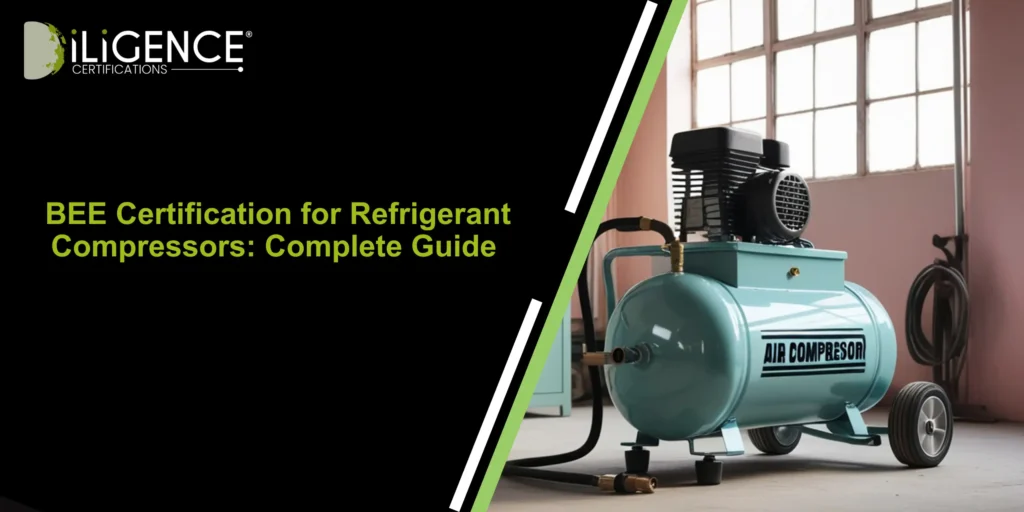
By - BEE Certification for Refrigerator Compressor guarantees energy efficiency as per the guidelines of Bureau of Energy Efficiency.
- For manufacturers, it is essential to enhance the credibility of their products and comply with mandatory labeling standards.
- Some important documents are specifications, reports, details of the manufacturer, and NABL-approved laboratories.
- Steps involved in the process are testing, online registration, submitting the necessary documents, and final certification by BEE.
- Advantages of certification are energy savings, market acceptance, and compliance with Indian regulations.
Introduction
Refrigerant compressors have an important place in the functioning of cooling applications like air conditioning systems, refrigerators, and industrial chiller units. But without any energy efficiency guidelines, these compressors can use up unnecessary amounts of electricity, thereby increasing their cost of operation and environmental footprint. Another major problem faced by compressor manufacturers is that they find it difficult to adhere to the rules set out by the government agencies and win the trust of consumers due to the absence of any certification process. This is where the BEE Bureau of Energy Efficiency Certification for Refrigerant Compressors comes into the picture.
What is BEE Certification?
The BEE Certification is a mandatory certification scheme that is officially provided by the Bureau of Energy Efficiency, which is a government agency affiliated with the Ministry of Power in India. The scheme verifies that the electric devices and apparatuses comply with certain energy efficiency criteria prescribed by the Indian government.The certification process involves testing and grading the products according to the level of their energy efficiency. The higher the star rating for the electric appliance, the more energy-efficient it is and the less electricity it consumes.
Keypoints:
- BEE Certification is awarded by the Bureau of Energy Efficiency to guarantee that energy efficiency criteria are satisfied by the items.
- It evaluates the energy efficiency of appliances on a scale of one to five stars.
- This certification may either be compulsory or optional, based on the type of item.
- The process involves testing, registering, and labeling the products prior to selling them in the market.
- BEE Certification aids in the reduction of energy consumption and expenses.
What are Refrigerant Compressors?
A refrigerant compressor is an important part of a cooling machine such as an air conditioner, a refrigerator, or other refrigeration equipment. The primary role of a compressor is the compression of refrigerant gas so that it is heated up and pressurized, enabling efficient circulation throughout the device and removal of heat.In a typical refrigeration system, the compressor plays a role of a heart of the machine. In particular, the gas refrigerant from the evaporator is compressed in the compressor to create high-pressure and high-temperature gas, which is further sent to the condenser.
Various types of compressors exist, including the following ones:
- Reciprocating compressors
- Rotary compressors
- Scroll compressors
- Screw compressors
They are used widely for residential, commercial, and industrial cooling purposes. Effective compressors are crucial not only for improved cooling but also for lower energy consumption..
Why BEE Certification for Refrigerant Compressors is Important
- Facilitates compliance with energy efficiency standards prescribed by the Bureau of Energy Efficiency.
- Helps to reduce electricity usage and assists in saving on operational expenses and costs of energy.
- Makes compliance with the law mandatory, as it is necessary for entering the market.
- Establishes consumer trust in terms of ratings and energy-efficient performance.
- Promotes environmental sustainability by reducing carbon footprint.
Who Needs BEE Certification for Refrigerant Compressors?
- The manufacturers who manufacture refrigerant compressors that are sold in India must get their compressors certified by the Bureau of Energy Efficiency.
- Those importers or traders who have compressor units to sell must comply with the Bureau of Energy Efficiency certification requirement.
- The OEMs (Original Equipment Manufacturers) who use compressors in applications such as air conditioners, chillers, or refrigerators should purchase BEE-compliant compressors.
- These distributors should only distribute BEE-compliant compressors.
- The large commercial and industrial customers usually opt for BEE-compliant compressors.
Key Features of BEE Certification for Compressors
- Rating System by Energy Star - Compressor products are classified from one to five stars according to their efficiencies within the rating system prescribed by the Bureau of Energy Efficiency.
- Mandatory/Optional - The certification process may be mandatory or voluntary, depending upon the product category.
- Standardized Testing - The products have to be tested in accredited laboratories by NABL.
- Product Registration and Labeling - Every compressor should have proper registration and an appropriate energy label issued by BEE.
- Validity and Renewal Process - A time-bound validity of certification is there along with the need for its periodic renewal.
- Market Acceptance - Improves market credibility of the certified products.
Documents Required for BEE Certification
| Document Name | Purpose |
| Company Registration Certificate | Confirms legal identity of the business |
| Trademark Certificate | Proof of brand ownership for labeling |
| Product Technical Specifications | Provides details of cooler (capacity, power, type) |
| Test Report from NABL Lab | Validates energy performance as per standards |
| Manufacturing Unit Details | Information about production facility |
| Label Design/Artwork | Required for Bureau of Energy Efficiency star label approval |
Step-by-Step Process to Get BEE Certification
Step 1: Product Testing
Get the compressor tested in a NABL-accredited laboratory as per standards set by the Bureau of Energy Efficiency.
Step 2: Documentation Preparation
Prepare all required documents such as test reports, company registration, and technical specifications.
Step 3: Online Registration
Register the company and product on the official BEE portal.
Step 4: Application Submission
Fill out the application form and upload all necessary documents.
Step 5: Fee Payment
Pay the applicable registration and processing fees.
Step 6: Application Review
BEE authorities verify the submitted details and test reports.
Step 7: Certification & Star Label Grant
Upon approval, the compressor is certified and assigned a BEE star rating label.
Timeline, Cost, and Renewal
| Aspect | Details |
| Timeline | 4-8 weeks total (process via Bureau of Energy Efficiency) |
| Testing Duration | 1-2 weeks (NABL lab testing) |
| Cost | Depends on product type and testing fees |
| Validity | Limited period; renewal required as per Bureau of Energy Efficiency guidelines |
Common Mistakes to Avoid - BEE Certification
- Incomplete documentation - Missing or incorrect documents delay approval from the Bureau of Energy Efficiency.
- Testing from non-NABL labs - Only NABL-accredited lab reports are accepted.
- Incorrect product details - Mismatch in specifications can lead to rejection.
- Wrong label usage - Using unapproved or incorrect star label format is non-compliant.
- Delay in model registration - Late submission can slow down the entire process.
- Ignoring guideline updates - Not following latest BEE norms may cause compliance issues.
- No renewal tracking - Forgetting renewal can stop product sales legally.
Benefits of BEE Certification
- Energy Savings - Energy-efficient compressors use lesser power, hence savings in energy costs.
- Compliance with Legal Requirements - Adheres to legal standards established by BEE.
- Increased Customer Confidence - Star rating ensures trust among customers and enhances branding.
- Competitive Edge - Offers competitive advantage with certified efficiency performance.
- Beneficial for the Environment - Decreases carbon footprint and promotes green cooling technologies.
- Increased Market Reach - Provides access to regulated markets and projects driven by governments.
Why Choose Diligence Certification?
Diligence Certification is a renowned consulting firm that makes it easy to get BEE certification for refrigerant compressors. Several companies find it difficult to deal with complicated issues associated with BEE certification due to testing and other related factors prescribed by the Bureau of Energy Efficiency. Diligence Certification assists in overcoming such difficulties effectively.They have a team of experts who assist in all aspects of the process, including conducting testing of the product and preparing necessary documents.
Conclusion
BEE certification for refrigeration compressor is vital in India for meeting standards of energy efficiency and regulation requirements. Energy efficiency is being emphasized nowadays and manufacturers have to comply with the BEE norms to compete in the market and stay within legal limits.
Frequently Asked Questions (FAQs)
What is the BEE Certification?
It stands for Energy Efficiency Certificate from the Bureau of Energy Efficiency.
BEE Certification: Is it mandatory?
It depends upon the nature of product under either mandatory or voluntary schemes
Who can avail BEE Certification?
The manufacturing company or importer or brand owner.
What does star rating signify?
Star Rating from 1 Star to 5 Stars for energy efficiency.
What time does the process take?
It usually takes 4 to 8 weeks.
Where is product tested for BEE Certification?
At NABL accredited labs.
Documents required?
Test Reports, company details, & product details.
For how long the certificate will be valid?
It usually is valid for a fixed duration & needs renewal.
Can imported compressors get BEE Certification?
Yes, the importer needs to comply first.
What are its major advantages?
Saves energy, complies legally & enhances market acceptance.