BIS Certification
 CDSCO
 PESO
 CPCB
 LMPC
 WPC Approval
 Global Approvals
 TEC
 ARAI
 BEE
 ISO Certification
 DGCA Certification
 NOC For Steel
 APEDA Registration























 Business Registration
 FSSAI Mark Certification












 (32).jpg)
 Legal Services
 Trademark Registration
 Copyright Registration
 Patent Registration
 By
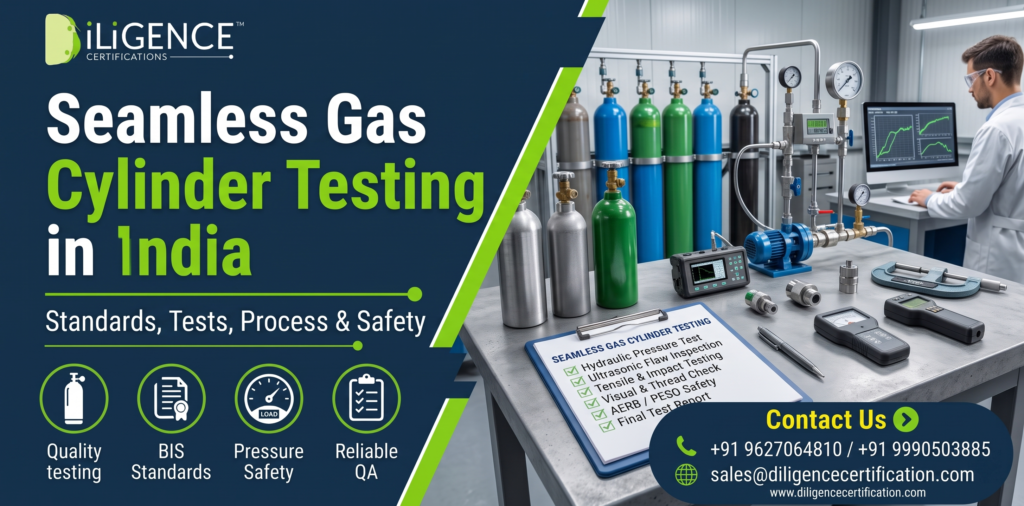
- Seamless gas cylinder testing checks the strength, durability, quality and safety of high-pressure gas cylinders.
- These cylinders are manufactured without welded joints, making material quality and manufacturing control especially important.
- Testing may include hydraulic pressure, tensile strength, impact, hardness, dimensional and burst tests.
- BIS standards provide important technical requirements for applicable seamless gas cylinders.
- Periodic inspection and testing help identify corrosion, cracks, deformation and other defects.
- Manufacturers and testing facilities must follow the applicable Indian standards and regulatory requirements.
- A proper test report helps demonstrate whether a cylinder meets the specified technical requirements.
Introduction
Gas cylinders are widely used in industries, hospitals, laboratories, commercial establishments and other applications. They store gases such as oxygen, nitrogen, hydrogen, argon and compressed air under high pressure. Because these gases are stored at considerable pressure, even a small manufacturing defect or material weakness can create serious safety risks.
This is why Seamless Gas Cylinder Testing is an important part of cylinder manufacturing, quality control and periodic inspection.
Unlike welded cylinders, seamless gas cylinders are manufactured without a welded longitudinal joint. They are generally produced from steel billets or other suitable metal materials through specialised forming processes. Although this construction removes the welded seam, it does not mean that the cylinder is automatically safe. The body must still withstand internal pressure, mechanical stress, temperature variations and regular handling.
Through proper testing, manufacturers and inspection agencies can check whether a cylinder meets the required strength, performance and safety specifications.
In India, applicable BIS standards, Gas Cylinders Rules and other relevant regulatory requirements play an important role in cylinder manufacturing, testing, approval and periodic inspection.
This guide explains seamless gas cylinder testing, applicable standards, important tests, testing procedures, required documents and common mistakes in simple language.
1. What Is Seamless Gas Cylinder Testing?
Seamless gas cylinder testing is a quality and safety evaluation process used to check whether a seamless steel cylinder can safely store and transport compressed gases.
These cylinders are manufactured from a single piece of metal without a welded body seam. They are commonly used in applications where gases need to be stored at high pressure.
The testing process checks different properties of the cylinder, including:
- Mechanical strength of the steel.
- Resistance to internal pressure.
- Thickness and dimensions of the cylinder wall.
- Resistance to cracks and surface defects.
- Ability to withstand repeated pressure cycles.
- Leakage prevention and overall structural condition.
Testing is important during manufacturing as well as when cylinders are due for periodic inspection.
Where Are Seamless Gas Cylinders Used?
Seamless gas cylinders are used in several industries because of their ability to store gases under pressure.
Some common applications include:
- Medical industry: Oxygen cylinders used in hospitals, clinics and emergency services.
- Industrial manufacturing: Cylinders containing oxygen, nitrogen, argon and other industrial gases.
- Automobile industry: High-pressure compressed natural gas (CNG) storage systems.
- Laboratories: Cylinders used for scientific experiments and specialised gas applications.
- Chemical industry: Storage and transportation of different industrial gases.
- Fire and safety applications: Cylinders used in certain breathing apparatus and specialised fire protection systems.
The applicable standard depends on the cylinder design, material, gas type, pressure rating and intended application. Not every gas cylinder follows the same testing requirements.
2. BIS Standards for Seamless Gas Cylinder Testing in India
The Bureau of Indian Standards (BIS) develops Indian Standards that specify product quality, manufacturing and testing requirements.
For refillable seamless steel gas cylinders, two important standards are IS 7285 Part 1 and IS 7285 Part 2.
Important BIS standards
| BIS Standard | Description |
|---|---|
| IS 7285 (Part 1):2018 | Refillable seamless steel gas cylinders - Normalized steel cylinders |
| IS 7285 (Part 2):2017 | Refillable seamless steel gas cylinders - Quenched and tempered steel cylinders with tensile strength below 1,100 MPa |
IS 7285 Part 1 covers normalized steel cylinders, while Part 2 covers a different heat-treated steel cylinder category.
BIS lists both standards under its Scheme-I product certification system. Bureau of Indian Standards+1
Important update: BIS published a new fifth revision of IS 7285 (Part 2):2026 on 4 November 2026. The previous 2017 edition is scheduled to remain in concurrent use until 3 May 2027, according to the notification details. Manufacturers should verify the applicable edition and transition instructions before applying for certification. Gazette Tracker
Why Are BIS Standards Important?
Following the relevant BIS standard helps manufacturers maintain consistent product quality and demonstrate compliance with technical requirements.
The standards provide guidance on:
- Raw material quality.
- Manufacturing requirements.
- Cylinder dimensions and tolerances.
- Mechanical properties.
- Pressure resistance.
- Inspection and testing.
- Marking and identification.
- Sampling and conformity assessment.
Manufacturers should always check the latest applicable standard, amendments and BIS product manual instead of relying on an older test checklist.
3. Important Tests Performed on Seamless Gas Cylinders
Different tests are performed to evaluate the safety, strength and performance of seamless gas cylinders. The exact test requirements depend on the applicable product standard and whether the cylinder is newly manufactured or undergoing periodic inspection.
Here are some important tests.
Hydraulic Pressure Test
The hydraulic pressure test checks whether a cylinder can withstand the specified internal water pressure.
During this test, the cylinder is filled with water and pressure is increased according to the applicable testing procedure.
The test helps identify:
- Structural weakness.
- Leakage.
- Permanent deformation.
- Pressure-related defects.
Water is used instead of compressed gas because it stores much less energy during pressurisation, making the procedure safer.
Hydraulic Burst Test
A hydraulic burst test evaluates the pressure level at which a cylinder fails.
During the test, water pressure is gradually increased until the cylinder reaches its failure point.
The test helps determine:
- Burst pressure.
- Cylinder strength.
- Deformation behaviour.
- Failure characteristics.
This test is generally used for design qualification, manufacturing evaluation or other specified conformity assessments. It is not a routine test that should be performed on every cylinder during periodic inspection.
Tensile Strength Test
The tensile strength test evaluates the mechanical strength of the steel used to manufacture the cylinder.
A test specimen is prepared from the cylinder material and placed in a tensile testing machine. The machine applies a pulling force until the specimen breaks.
The test helps determine:
- Ultimate tensile strength.
- Yield strength or proof strength.
- Percentage elongation.
- Material ductility.
These properties help engineers understand how the cylinder material behaves under mechanical stress.
Impact Test
The impact test checks the ability of the cylinder material to withstand sudden loading.
A prepared specimen is struck by a pendulum impact testing machine under specified conditions.
The test measures the energy absorbed by the material during fracture.
It helps evaluate:
- Material toughness.
- Resistance to sudden impact.
- Behaviour under specified test temperatures.
- Suitability of the steel for the intended application.
Hardness Test
The hardness test measures the resistance of the cylinder material to indentation.
Depending on the applicable standard, testing may use Brinell, Rockwell or another specified method.
The results help evaluate whether the material has the required hardness and whether heat treatment has produced the intended mechanical properties.
Bend Test
A bend test checks the ductility and bending behaviour of the steel.
A prepared sample is bent around a specified mandrel or through a specified angle.
The sample is examined for cracks or other unacceptable defects.
This test helps determine whether the material can withstand the required deformation without failing.
Pressure Cycling Test
A pressure cycling test checks how the cylinder behaves when it is repeatedly pressurised and depressurised.
The cylinder undergoes a specified number of pressure cycles under controlled conditions.
The test helps evaluate resistance to fatigue damage and repeated pressure loading.
It is particularly useful for assessing the long-term performance of cylinder designs.
Leakage Test
The leakage test checks whether gas or fluid can escape from the cylinder or its relevant connections.
The testing method depends on the cylinder type and applicable procedure.
It helps identify leakage caused by:
- Defective valves.
- Damaged connections.
- Cracks or openings.
- Improper sealing.
- Manufacturing defects.
A cylinder with unacceptable leakage must not be considered fit for service.
Dimensional Inspection
Dimensional inspection checks whether the cylinder has been manufactured according to the specified measurements.
Important parameters include:
- Overall cylinder length.
- External diameter.
- Wall thickness.
- Neck dimensions.
- Out-of-roundness.
- Straightness.
- Stability.
- Foot ring and neck ring dimensions, where applicable.
Incorrect dimensions can affect cylinder strength, compatibility and safe handling.
Visual Inspection
Visual inspection is performed to identify visible defects on the internal and external surfaces of a cylinder.
Inspectors look for:
- Cracks.
- Corrosion.
- Dents.
- Bulging.
- Deep scratches.
- Surface damage.
- Signs of overheating.
- Damaged threads.
Visual inspection is an important part of both manufacturing quality control and periodic cylinder examination.
Periodic Inspection and Testing of Seamless Steel Gas Cylinders
Testing is not limited to newly manufactured cylinders. Cylinders that are already in use must also undergo periodic inspection and testing to confirm that they remain safe.
In India, IS 8451:2018 - Periodic Inspection and Testing of Seamless Steel Gas Cylinders - Code of Practice is an important standard for this purpose.
It covers the inspection and testing procedures used to evaluate seamless steel cylinders during their service life. BIS lists it as the third revision and records its review in 2026. BIS
Why Is Periodic Testing Necessary?
A cylinder can develop defects during transportation, storage, filling and regular use.
For example:
- Corrosion can reduce the cylinder wall thickness.
- Repeated pressure changes can cause fatigue damage.
- Accidental impacts can create dents or deformation.
- Damaged threads can affect valve fitting.
- Internal contamination can affect the cylinder’s condition.
Periodic inspection helps identify these problems before the cylinder is returned to service.
What Happens During Periodic Inspection?
The inspection generally includes:
- Checking cylinder identification and previous test markings.
- Safely emptying and preparing the cylinder.
- Removing contamination and foreign material where necessary.
- Conducting external visual inspection.
- Conducting internal visual inspection.
- Checking the neck, shoulder, threads and other critical areas.
- Performing supplementary examinations when required.
- Conducting the prescribed pressure test or approved alternative.
- Inspecting the valve and accessories.
- Drying, marking and documenting the cylinder.
The exact sequence and acceptance criteria must follow IS 8451 and applicable regulatory requirements.
Seamless Gas Cylinder Testing Procedure: Step-by-Step
A proper testing procedure helps ensure that each cylinder is examined systematically. The process may vary depending on whether the cylinder is new or being submitted for periodic inspection.
Here is a general overview.
Step 1: Identification of the Cylinder
The first step is to identify the cylinder and check its technical details.
The inspector may verify:
- Manufacturer’s identification.
- Serial number.
- Manufacturing date.
- Water capacity.
- Working pressure.
- Test pressure.
- Previous inspection markings.
- Applicable manufacturing standard.
This information helps determine which testing requirements apply.
Step 2: Emptying and Cleaning
Before testing, the cylinder must be safely emptied of its contents.
Special precautions are necessary for toxic, flammable, corrosive and other hazardous gases.
The cylinder is then cleaned using suitable methods to remove internal contamination, rust and foreign particles.
Only trained personnel with appropriate facilities should perform this work.
Step 3: External and Internal Inspection
The cylinder is inspected externally and internally, wherever accessible.
The inspector checks for corrosion, cracks, dents, bulges, scratches and other defects.
Special attention is given to the neck, shoulder, base and valve connection areas because these are important parts of the cylinder structure.
Step 4: Dimensional and Weight Checks
The cylinder’s dimensions and weight are checked against the relevant specifications and identification records.
This helps identify excessive material loss, deformation and dimensional irregularities.
Step 5: Mechanical and Supplementary Tests
Mechanical testing may include tensile, impact, hardness and other tests depending on the manufacturing standard and inspection requirements.
Non-destructive testing methods, such as ultrasonic examination, may also be used where required.
Step 6: Hydraulic or Hydrostatic Stretch Testing
The cylinder is subjected to the applicable water-pressure test.
For a hydrostatic stretch test, the pressure and volume changes are measured according to the relevant procedure.
The inspector checks whether the cylinder shows unacceptable permanent expansion, leakage or visible deformation.
Step 7: Leakage Examination
The cylinder and its relevant connections are checked for leakage using the prescribed method.
Any unacceptable leakage must be investigated before the cylinder can be considered fit for use.
Step 8: Final Inspection and Marking
After successful testing, the cylinder is properly drained and dried internally.
The testing details and required identification marks are recorded according to the applicable rules and standards.
A cylinder that fails the required inspection or testing must not be returned to service.
6. Documents Required for Seamless Gas Cylinder Testing
Proper documentation is important for manufacturers, importers, cylinder owners and testing facilities.
The required documents depend on the purpose of testing and the applicable regulatory procedure.
Commonly required documents include:
| Document | Purpose |
|---|---|
| Cylinder manufacturing details | Identifies the cylinder and its manufacturer |
| Raw material test certificate | Provides information about the material used |
| Chemical composition report | Shows the material’s chemical properties |
| Mechanical test reports | Records strength and mechanical test results |
| Manufacturing drawings | Provides design and dimensional details |
| Heat treatment records | Documents the heat treatment process |
| Previous test certificates | Provides the cylinder’s inspection history |
| Cylinder identification details | Confirms serial numbers and markings |
| Quality control records | Shows manufacturing and inspection controls |
| Calibration certificates | Demonstrates the accuracy of testing equipment |
| BIS licence documents, where applicable | Supports product certification and compliance |
For new cylinder certification, BIS may also require factory inspection, product samples, test equipment details and inspection and testing records.
For periodic testing, the documentation will generally focus on cylinder identification, previous test history, inspection findings and current test results.
7. Testing Equipment Used for Seamless Gas Cylinders
Accurate testing requires suitable equipment and trained technical personnel.
Different machines and instruments are used to evaluate different properties of the cylinder.
| Testing Equipment | Application |
|---|---|
| Hydraulic testing machine | Pressure and hydrostatic testing |
| Universal Testing Machine (UTM) | Tensile strength testing |
| Impact testing machine | Impact resistance testing |
| Hardness tester | Material hardness measurement |
| Ultrasonic testing equipment | Detection of internal flaws and wall thickness measurement |
| Dimensional measuring instruments | Checking cylinder dimensions |
| Weighing equipment | Measuring cylinder weight |
| Leakage testing equipment | Checking leakage |
| Borescope | Internal visual examination |
| Pressure gauges | Measuring applied pressure |
All relevant equipment must be maintained and calibrated at the required intervals.
The Gas Cylinders Rules, 2016 also specify equipment and facility requirements for recognised cylinder testing stations. Indian Kanoon+1
8. Common Defects Found During Seamless Gas Cylinder Testing
Testing helps identify defects that may affect cylinder safety and performance.
Some common defects include:
1. Internal corrosion: Rust or chemical contamination inside the cylinder can damage the material.
2. External corrosion: Exposure to moisture and unsuitable storage conditions can cause corrosion on the outer surface.
3. Cracks: Cracks may develop due to manufacturing defects, mechanical damage or repeated stress.
4. Permanent deformation: A cylinder that has undergone unacceptable expansion or bulging may no longer be suitable for service.
5. Wall thickness reduction: Excessive material loss can reduce the cylinder’s pressure-bearing capacity.
6. Damaged threads: Damaged valve connections can lead to improper fitting and possible leakage.
7. Surface defects: Deep scratches, cuts and other imperfections may affect structural integrity.
8. Fatigue damage: Repeated pressure cycles can gradually affect the cylinder material.
A cylinder should not be accepted simply because it looks good from the outside. Proper inspection and the required tests are necessary to assess its condition.
9. Common Mistakes to Avoid During Seamless Gas Cylinder Testing
Manufacturers and testing facilities should follow a systematic quality control process. Small mistakes can result in incorrect test results, delays or safety problems.
Here are some common mistakes to avoid.
1. Using the Wrong BIS Standard
Different cylinder types have different technical requirements. Applying the wrong standard can result in an incorrect testing procedure.
Solution: Confirm the cylinder material, design, gas application and applicable standard before beginning testing.
2. Ignoring Raw Material Quality
Poor-quality steel can affect cylinder strength and durability.
Solution: Verify raw material certificates and conduct the required chemical and mechanical tests.
3. Skipping Internal Inspection
Internal corrosion and contamination may not be visible from the outside.
Solution: Carry out internal inspection using suitable equipment and approved procedures.
4. Using Uncalibrated Equipment
Incorrect pressure readings or measurement errors can affect test results.
Solution: Maintain calibration records and follow the prescribed calibration schedule.
5. Ignoring Heat Treatment Records
Heat treatment plays an important role in achieving the required mechanical properties of seamless steel cylinders.
Solution: Maintain proper temperature, time and process records.
6. Incomplete Documentation
Missing test reports, identification details or inspection records can create compliance difficulties.
Solution: Maintain complete and organised records for each batch and cylinder.
7. Returning Failed Cylinders to Service
A cylinder that fails the prescribed inspection or test should not be used again without an authorised disposition under the applicable requirements.
Solution: Follow rejection and condemnation procedures and maintain records.
Regulatory Requirements for Seamless Gas Cylinders in India
Gas cylinder safety in India is governed by regulatory requirements that cover manufacturing, filling, storage, transportation, inspection and testing.
One important regulation is the Gas Cylinders Rules, 2016, administered through the relevant explosives safety regulatory framework.
These rules establish requirements for the safe handling and testing of gas cylinders.
Important Regulatory Requirements
- Cylinders must meet the applicable technical specifications.
- Manufacturing and testing must follow the relevant standards and approvals.
- Periodic examination and testing must be completed within the applicable intervals.
- Recognised testing stations must maintain the prescribed equipment and facilities.
- Testing personnel must have suitable training and experience.
- Cylinders that fail the required tests must not be filled or returned to service.
Role of PESO
The Petroleum and Explosives Safety Organisation (PESO) is an important regulatory authority for gas cylinder safety in India.
Its responsibilities include administering applicable safety requirements, approvals and regulatory oversight under the relevant rules.
Under Rule 35 of the Gas Cylinders Rules, 2016, cylinders must undergo the prescribed examination and hydrostatic or hydrostatic stretch testing within the applicable period. The rules also specify requirements for testing stations seeking recognition for periodic examination and testing. High Court of Tripura+1
Important: BIS product certification, PESO-related approvals and periodic cylinder testing are different compliance requirements. One should not be treated as a substitute for another.
11. Difference Between Seamless and Welded Gas Cylinder Testing
Seamless and welded gas cylinders are manufactured using different processes. Therefore, their testing requirements and inspection procedures may also differ.
| Basis | Seamless Gas Cylinder | Welded Gas Cylinder |
|---|---|---|
| Manufacturing | Made without welded body joints | Made by joining metal sections through welding |
| Construction | Single-piece body construction | Welded body construction |
| Main inspection focus | Material quality, wall thickness and structural integrity | Weld quality, weld joints and material integrity |
| Common tests | Hydraulic, tensile, impact, hardness and burst tests | Hydraulic, weld examination and mechanical tests |
| Defect concerns | Cracks, corrosion and material defects | Weld defects, cracks and corrosion |
| Standards | IS 7285 series for applicable seamless steel cylinders | Relevant welded cylinder standards |
Both types require appropriate quality control and testing. The exact test methods must be selected according to the applicable product standard.
12. How to Choose the Right Seamless Gas Cylinder Testing Laboratory?
Selecting a suitable testing laboratory is important for obtaining reliable and technically valid test results.
Not every laboratory has the facilities to perform all types of gas cylinder testing.
Before selecting a laboratory, consider the following factors:
1. Relevant testing experience
Choose a laboratory with experience in testing gas cylinders and pressure-containing products.
2. NABL accreditation
Check whether the laboratory has NABL accreditation under ISO/IEC 17025 for the specific testing methods required. Accreditation should cover the relevant tests within its approved scope.
3. Testing equipment
Confirm that the laboratory has suitable equipment for hydraulic testing, mechanical testing, dimensional inspection and other applicable examinations.
4. Qualified technical staff
Testing should be conducted by trained and competent personnel who understand the relevant standards and testing procedures.
5. Proper documentation
The laboratory should provide clear test reports containing sample identification, test methods, observations and results.
6. Regulatory recognition
For periodic testing of gas cylinders, check that the testing station has the required recognition or approval under applicable Gas Cylinders Rules and PESO requirements.
7. Calibration and quality control
Ask about equipment calibration, maintenance and internal quality control procedures.
Choosing the right laboratory helps manufacturers and cylinder owners obtain dependable testing results and maintain product safety.
Diligence Certifications in Seamless Gas Cylinder Testing and Compliance
Manufacturers and businesses dealing with seamless gas cylinders may need technical guidance to understand applicable BIS standards, testing requirements and regulatory procedures.
Diligence Certifications provides compliance consultancy and assistance to businesses working towards relevant product certification and regulatory requirements.
Our support can help businesses understand:
- Applicable BIS standards for their products.
- Product certification requirements.
- Documentation and technical records.
- Testing and inspection procedures.
- BIS application requirements.
- Compliance-related queries.
- Coordination and guidance during the certification process.
It is important to understand that Diligence Certifications is a compliance consultancy, not a physical gas cylinder testing laboratory. Actual product testing must be performed by an appropriately equipped and recognised testing facility.
Our aim is to help manufacturers understand the certification process, prepare the required documentation and manage compliance activities more effectively.
For more information, visit Diligence Certifications.
Frequently Asked Questions About
1. What is seamless gas cylinder testing?
Seamless gas cylinder testing is the process of checking the strength, quality, durability and safety of seamless gas cylinders. It includes different mechanical, dimensional, pressure and inspection tests.
2. Which BIS standard is used for seamless steel gas cylinders?
IS 7285 is an important Indian Standard for refillable seamless steel gas cylinders. Part 1 covers normalized steel cylinders, while Part 2 covers specified quenched and tempered steel cylinders.
3. What is IS 7285 Part 1?
IS 7285 Part 1:2018 specifies requirements for refillable seamless steel gas cylinders made from normalized steel. It covers relevant manufacturing and testing requirements.
4. What is IS 7285 Part 2?
IS 7285 Part 2 covers refillable seamless steel cylinders made from quenched and tempered steel with tensile strength below 1,100 MPa. Its fifth revision was published in November 2026.
5. Which tests are performed on seamless gas cylinders?
Common tests include hydraulic pressure testing, hydraulic burst testing, tensile strength testing, impact testing, hardness testing, bend testing, pressure cycling, leakage examination and dimensional inspection. The applicable standard determines which tests are required.
6. Why is hydraulic testing important for gas cylinders?
Hydraulic testing checks whether a cylinder can withstand the specified internal pressure without unacceptable leakage, deformation or permanent expansion. It helps assess the structural integrity of the cylinder.
7. What is IS 8451?
IS 8451:2018 is the Indian Standard for periodic inspection and testing of seamless steel gas cylinders. It provides a code of practice for examining cylinders already in service.
8. Is BIS certification required for seamless gas cylinders?
Applicable BIS certification requirements depend on the product category, relevant standard and regulatory provisions. Manufacturers should verify the current compulsory certification requirements and applicable approvals before manufacturing or selling cylinders.
9. What happens if a seamless gas cylinder fails testing?
A cylinder that fails the prescribed inspection or testing must not be returned to service. It should be handled according to the applicable rejection, repair or condemnation requirements.
10. What is the difference between seamless and welded gas cylinders?
Seamless cylinders are manufactured without welded body joints, whereas welded cylinders are produced by joining metal sections. Their manufacturing processes, inspection requirements and applicable standards are different.
Conclusion
Seamless gas cylinder testing is an important part of maintaining the safety, quality and reliability of high-pressure gas storage systems. Since these cylinders are used in medical, industrial, automobile and laboratory applications, their structural strength and performance must be checked carefully.
Tests such as hydraulic pressure testing, tensile strength testing, impact testing, hardness testing, burst testing and dimensional inspection help evaluate different aspects of cylinder quality.
In India, manufacturers and cylinder owners should understand the requirements of IS 7285, IS 8451 and the Gas Cylinders Rules, 2016, wherever applicable. They should also keep track of the latest BIS revisions and regulatory updates.
Proper testing, accurate documentation and periodic inspection help businesses maintain product quality, meet applicable compliance requirements and improve gas cylinder safety.
High-Volume and Related SEO Keywords
Use these keywords naturally in the article, headings, image alt text and relevant internal links.
| Primary and secondary keywords | Long-tail keywords |
|---|---|
| Seamless Gas Cylinder Testing | seamless gas cylinder testing in India |
| Gas Cylinder Testing | seamless steel cylinder testing procedure |
| Cylinder Testing | BIS standards for gas cylinders |
| Gas Cylinder Testing Laboratory | IS 7285 gas cylinder testing |
| Seamless Steel Cylinder | IS 8451 periodic cylinder testing |
| Hydraulic Testing | hydraulic pressure testing of gas cylinders |
| Gas Cylinder Inspection | seamless cylinder quality testing |
| BIS Certification | gas cylinder testing requirements |
| PESO Approval | periodic inspection of seamless gas cylinders |
| Hydrostatic Testing | gas cylinder testing and certification |
| Cylinder Burst Test | seamless gas cylinder safety standards |
| Gas Cylinder Standards | seamless steel cylinder inspection |
Recommended SEO Settings
FOCUS KEYWORD
Seamless Gas Cylinder Testing
SEO TITLE
Seamless Gas Cylinder Testing in India: Complete GuideWithin the recommended 60-character limit approximately.
PERMALINK
seamless-gas-cylinder-testing
META DESCRIPTION
Learn about seamless gas cylinder testing in India, BIS standards, important quality tests, safety requirements, testing procedures and documentation.
SUGGESTED IMAGE ALT TEXT
Seamless steel gas cylinder testing and quality inspection