BIS Certification
 CDSCO
 PESO
 CPCB
 LMPC
 WPC Approval
 Global Approvals
 TEC
 ARAI
 BEE
 ISO Certification
 DGCA Certification
 NOC For Steel
 APEDA Registration























 Business Registration
 FSSAI Mark Certification












 (32).jpg)
 Legal Services
 Trademark Registration
 Copyright Registration
 Patent Registration
 By
- X-ray equipment testing checks that your machine gives the right radiation, the right image and safe working conditions.
- In India, AERB (Atomic Energy Regulatory Board) controls radiation equipment, so its rules come first.
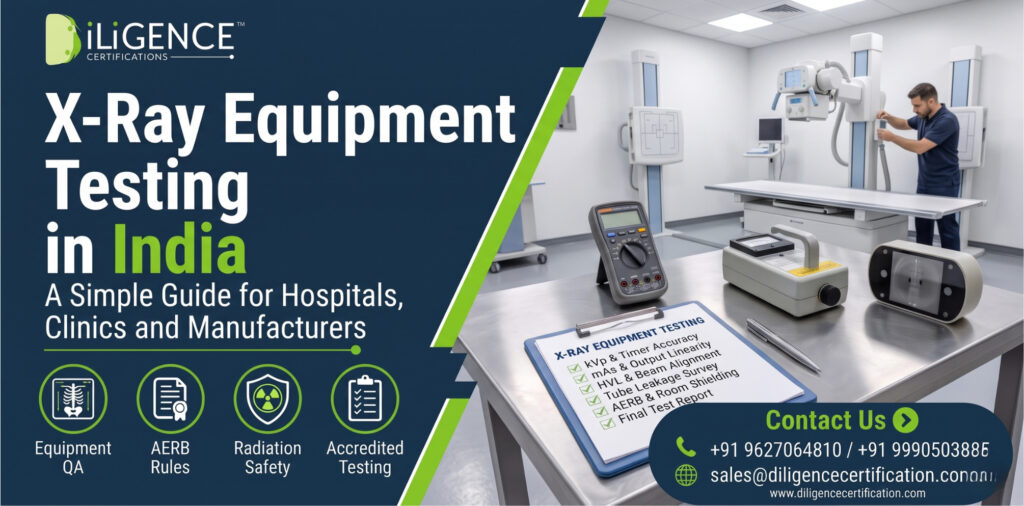
- Common tests cover kVp, timer, mA or mAs, output, beam alignment, filtration, leakage radiation and room safety.
- Testing is done at installation, at regular intervals, and after repair or shifting of the machine.
- Keeping proper records, a Radiation Safety Officer and personal dose badges is part of the same safety system.
- Regular testing protects patients, staff and your licence.
Introduction
Here is a simple way to look at it. Your car may run fine, but you still go for a service so that brakes and tyres stay safe. An X-ray machine is the same. It may produce a picture, but the radiation dose, the beam and the safety parts can slowly drift without anyone noticing.
A small drift can mean a poor image, a repeat X-ray, or extra radiation to the patient and the staff. Nobody wants that.
So in this blog, we will walk through X-ray equipment testing in India in easy words. You will learn what it is, which rules apply, which tests are done and how to go step by step. Don’t worry, we will keep it simple.
What Is X-Ray Equipment Testing?
X-ray equipment testing means checking an X-ray machine with special instruments to see if it works as per set limits. The checks are done on the output, the beam, the image and the safety features.
It applies to many kinds of machines:
- General radiography machines in clinics and hospitals
- Mobile and portable X-ray units
- Dental X-ray units, including OPG machines
- Fluoroscopy and C-arm machines
- Mammography units
- CT scanners
- Industrial and baggage-scanning X-ray systems
The testing is often called Quality Assurance (QA) testing. Its main aim is simple: good image quality with the lowest possible radiation dose.
A test report is not just paperwork. It shows that your machine is safe for use, and officers, hospital boards and insurers may ask to see it.
Which Rules Apply to X-Ray Equipment in India?
Radiation in India is regulated by the Atomic Energy Regulatory Board (AERB). Medical X-ray units, industrial radiography and many other radiation uses come under its safety codes and licensing system.
| Area | What it covers |
|---|---|
| Atomic Energy Act and Radiation Protection Rules | The legal base for using radiation equipment safely |
| AERB safety codes and guides | Design, installation, operation and QA needs for different types of X-ray units |
| AERB licence or registration | Permission to install and use the machine, usually through the AERB online system |
| Radiation Safety Officer (RSO) | A trained person responsible for safety at the facility |
| Personal dose monitoring | Badges for staff to track radiation dose over time |
| Medical device rules | Some X-ray equipment may also come under CDSCO medical device rules |
| Electrical safety standards | Standards for medical electrical equipment, often based on the IEC 60601 series |
A simple example: a small clinic installing a new digital X-ray unit needs to think about the machine, the room shielding, the licence, the RSO and the QA tests, all together. One test report alone does not complete the picture.
Rules and forms get updated from time to time. Before you start, check the latest AERB notifications or ask a consultant to confirm the current process.
BIS and X-Ray Equipment: What Is the Link?
Many people ask if BIS is needed for X-ray machines. Let’s clear it in simple words.
AERB is the main authority for radiation safety. BIS (Bureau of Indian Standards) makes Indian Standards for many products, including standards for medical electrical equipment that follow international ones. These standards help makers design a safe machine, and labs use them as a reference during electrical safety checks.
| Point | AERB | BIS |
|---|---|---|
| Role | Controls radiation safety and licensing | Makes Indian Standards for product quality and safety |
| Focus | Radiation output, room safety, users and records | Electrical, mechanical and general safety of equipment |
| Use for X-ray owners | Must follow | Useful reference for equipment safety |
In simple words, AERB decides how you can use the machine. BIS-style standards help to show the machine itself is built safely. Whether a particular product needs any BIS certification can change with notifications, so always check the latest rules for your exact product.
Why Is X-Ray Equipment Testing Important?
X-rays are very useful, but radiation needs respect. Testing helps you keep control.
- Patient safety: The right dose gives a clear image without extra exposure.
- Staff safety: Leakage and scatter radiation are checked, so your team stays protected.
- Better diagnosis: A drifting machine gives poor images, and a poor image can lead to a wrong or repeated test.
- Legal peace of mind: Regular QA is part of AERB requirements for licensed facilities.
- Fewer repeats: Fewer repeat X-rays save time, cost and radiation.
- Longer machine life: Early detection of drift helps you repair before a major breakdown.
- Trust: Patients and hospital partners feel confident when your records are clean.
What Tests Are Done in X-Ray Equipment Testing?
The exact list depends on the type of machine. A dental unit has fewer tests than a CT scanner. Still, most QA programmes follow these groups.
| Test group | What the tester checks | In simple words |
|---|---|---|
| Tube voltage (kVp) accuracy | Whether the set voltage matches the real voltage | Is the beam strength correct? |
| Timer accuracy | Whether the exposure time matches the set time | Is the exposure as long as it should be? |
| mA or mAs linearity | Whether output changes steadily with current settings | Does output grow evenly with settings? |
| Output consistency | Whether repeat exposures give the same output | Does the machine repeat itself? |
| Total filtration and HVL | Beam quality, using half value layer measurement | Is the beam filtered properly? |
| Beam alignment and collimation | Match between light field and X-ray field | Is the beam going where you point it? |
| Focal spot and image quality | Sharpness, contrast and detail of test images | Is the picture clear? |
| Leakage radiation | Radiation escaping from the tube housing | Is any radiation leaking? |
| Patient dose measure | Entrance surface dose for common exams | Is the patient getting a sensible dose? |
| Radiation survey of the room | Radiation levels outside the room and at the doors | Is the room shielding working? |
| Safety features | Interlocks, warning lights, exposure switch, protective gear | Are the safety parts working? |
A few tests in easy words
kVp accuracy. kVp decides how strong the X-ray beam is. If it drifts, the image contrast changes, and the dose may change too.
Timer accuracy. If the exposure time is off, the image can be too dark or too light, and the patient may get extra dose.
Half value layer (HVL). It tells you about beam quality. A beam with weak filtration adds dose to the skin without helping the image.
Collimator and beam alignment. The light on the patient should match the actual X-ray beam. If it does not, you may expose body parts that did not need it.
Leakage radiation. The tube housing should hold radiation inside, except for the beam you want. This test checks that.
Room survey. A tester measures radiation outside the room, near doors, windows and the control area. It shows if your shielding is doing its job.
When Should X-Ray Equipment Be Tested?
Testing is not a one-time job. These are the usual moments:
- Acceptance testing: When a new machine is installed, before regular use starts.
- Periodic QA testing: At regular intervals as per the applicable AERB code for your machine type.
- After repair: When the tube, generator, collimator or any major part is changed.
- After shifting: When the machine is moved to a new room or building.
- When quality drops: If images start looking poor or repeats increase.
- Before licence renewal: When your documents and records are being prepared.
Ask your consultant or the testing agency for the exact interval for your machine type, as it can differ.
Who Can Do the Testing?
There are two sides to this, and a smart facility uses both.
In-house checks. Your RSO or technologist can do simple daily and weekly checks, like looking at the warning lights, the door interlock, the lead aprons and the image quality of a test object.
Third-party QA testing. Full QA tests need calibrated instruments and trained people. For reports you plan to show to AERB, hospital partners or inspectors, use a qualified agency that follows the accepted method and gives a proper signed report. Confirm that the agency’s instruments are calibrated and that its people meet the requirements in force.
Step-by-Step Process of X-Ray Equipment Testing
- Know your machine. Note the type, make, model, serial number and installation details.
- Check the applicable code. Find the AERB safety code that matches your machine type.
- Prepare the room and machine. Keep the machine in working condition, with the room clean and clear.
- Choose a qualified testing agency. Check its experience, instruments and calibration records.
- Share your documents. Give the licence details, earlier reports and machine information.
- Run the tests. The tester measures output, beam, image quality, leakage and room radiation levels.
- Receive the report. Read every result against the limits given in the code.
- Fix what failed. Repair or adjust the machine, and ask for a re-test of that part.
- Keep your records. Store the reports safely and keep them ready for inspection or renewal.
Documents Usually Needed
Facility documents
- AERB licence or registration details
- Name and details of the Radiation Safety Officer
- Room layout and shielding details
Machine documents
- Make, model, serial number and installation date
- Manufacturer manual and specifications
- Details of any repair, tube change or shifting
Safety records
- Earlier QA reports
- Personal dose badge records of staff
- Calibration records of in-house instruments
How Long Does the Testing Take?
It depends on the machine. A simple dental or general radiography unit can often be tested in a short visit. Fluoroscopy, mammography and CT units have more tests, so they take more time. Room radiation surveys also add some time.
Book your slot early, especially before a licence renewal date. And ask the agency how long the report will take after the visit.
What Decides the Cost?
Cost is not the same for every facility. The main factors are:
- Type and number of machines
- Number of tests needed
- Travel and location
- Whether it is a new installation or a periodic check
- Re-testing after repairs
The easiest way is to ask for a machine-wise breakup, and then plan your yearly QA budget.
Common Mistakes to Avoid
- Skipping periodic QA. Waiting for a problem before testing is a risky habit.
- Using an unqualified agency. The report may not be accepted, and the results may not be reliable.
- Ignoring failed results. A report helps only if you fix the issue and re-test.
- No Radiation Safety Officer. Safety needs a named, trained person.
- Forgetting personal dose badges. Without badges, you have no record of staff exposure.
- Not testing after shifting or repair. Settings can change after any major work.
- Damaged lead aprons. Cracks and holes reduce protection, so check them regularly.
- Messy records. Lost reports can create trouble at inspection or renewal time.
Who Needs X-Ray Equipment Testing?
- Hospitals and diagnostic centres using radiography, fluoroscopy, CT or mammography
- Clinics and dental practices with X-ray or OPG units
- Mobile X-ray and imaging service providers
- Equipment dealers and importers who install machines for customers
- Manufacturers of X-ray systems and parts
- Industrial users of radiography and scanning systems
- Veterinary clinics using X-ray machines
Friendly Tips to Pass Testing in the First Attempt
- Do simple daily checks, so small problems don’t grow.
- Keep your machine’s service history handy.
- Service the machine before the QA visit, not after.
- Check door interlocks, warning lights and exposure switches regularly.
- Inspect lead aprons and shields for cracks or folds.
- Keep your RSO informed about every change in the room or machine.
- Store every report in one safe, easy-to-find folder.
Why Choose Diligence Certifications for X-Ray Equipment Testing Certification?
Radiation rules can feel heavy, especially when you are new. Which code applies? Which tests are needed? Who should do them? Many owners lose time on these questions alone.
At Diligence Certifications, our team explains the rules in simple language and helps you plan the right steps for your machine. We guide you on documents, test planning and report review, so you feel clear at every stage.
You can read more about our work on our services page. We do not promise any approval or result. Our job is to give you honest guidance, so that you can take informed decisions for your facility.
Conclusion
X-ray equipment testing is not a burden. It is a simple habit that protects your patients, your staff and your business.
Start with the basics. Know the rules for your machine type, choose a qualified agency, keep your records tidy and act quickly when a test fails. Every good facility has walked this path, and you can too.
A small test today saves you from a big problem tomorrow.
Frequently Asked Questions
1. What is X-ray equipment testing?
It is the checking of an X-ray machine with special instruments to confirm that its output, beam, image quality and safety features are within set limits.
2. Which authority controls X-ray equipment in India?
The Atomic Energy Regulatory Board (AERB) controls radiation equipment, including medical X-ray units, through its safety codes and licensing.
3. What is QA testing of an X-ray machine?
A means Quality Assurance. It is a set of regular tests to keep the image good and the radiation dose as low as reasonably possible.
4. Which tests are done on an X-ray machine?
Common tests are kVp accuracy, timer accuracy, mA or mAs linearity, output consistency, filtration, beam alignment, leakage radiation, image quality and a room radiation survey.
5. How often should an X-ray machine be tested? I
It is tested at installation, at regular intervals, and after repair or shifting. Ask for the exact interval for your machine type.