


 BIS Certification
 CDSCO
CDSCO
 CPCB
CPCB
 LMPC
LMPC
 WPC Approval
 Global Approvals
 TEC
TEC
 ARAI
ARAI
 BEE
BEE
 ISO Certification
 DGCA Certification
 NOC For Steel
 APEDA Registration










 Business Registration
 FSSAI Mark Certification










 Legal Services
 Trademark Registration
 Copyright Registration
 Patent Registration
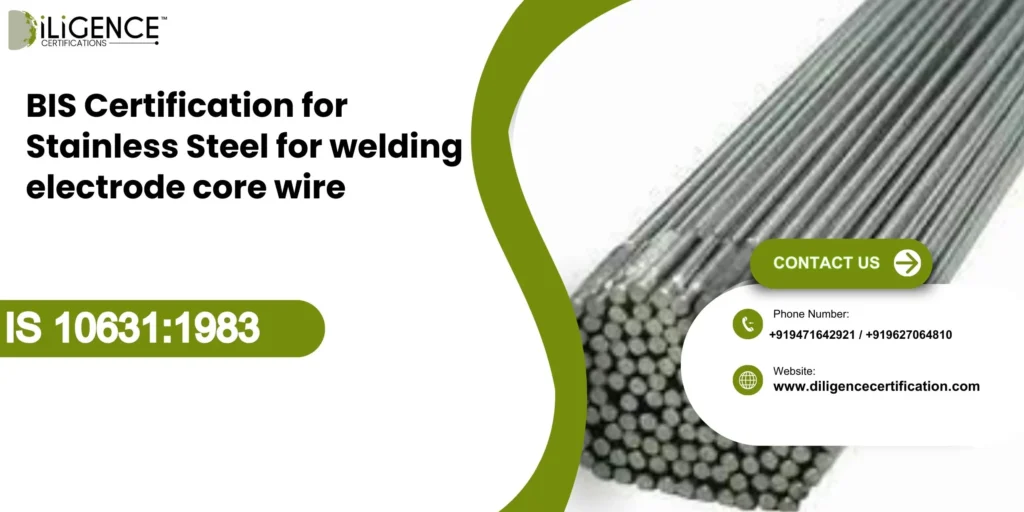
- Authorized BIS certifies that electrode welding stainless steel core wire is in conformity with the standard IS 10631:1983.
- Such a certificate coupled with a quality product is a winning combination which industrial clients and government tenders cannot resist.
- It is an effective means of quality assurance and alloy composition can also be monitored through it during manufacturing.
- Greatly simplifies the process of getting the green light for both local and foreign purchases.
- Increases the value of the brand and creates a positive cycle whereby business keeps expanding.
Introduction
A mid-sized stainless steel welding electrode manufacturer in Pune was struggling to win orders from large industrial clients. Even though the company was making high-quality electrodes, the procurement teams were repeatedly requesting proof that the products complied with Indian standards. Obtaining BIS certification for a stainless steel welding electrode core wire according to IS 10631:1983 completely changed the situation. It was the factor that really helped the company to gain trust, increase the client base, and get both domestic and export contracts, as it gave an unequivocal quality, chemical composition, and mechanical properties assurance. Bureau of Indian Standards
What is IS 10631:1983?
IS 10631:1983 is an Indian standard that defines the necessary requirements of stainless steel electrode welding core wires. It specifies the chemical composition, the mechanical properties, and the manufacturing processes that are required to keep the product quality stable and its performance reliable in the welding applications.
The standard is critical for manufacturers because it ensures:

- Chemical Composition Compliance: The standard details the permissible levels of chromium, nickel, and other alloying elements, which are necessary to make the material resistant to corrosion and durable.
- Mechanical Properties: It specifies tensile strength, elongation, and other major parameters to make sure that the electrode is capable of functioning during the welding process.
- Manufacturing Guidelines: It employs the manufacturing methods of the core wire, dimensional tolerances, and quality control aspects to maintain the consistency of the product throughout the different batches. ISI MARK
- Testing Methods: There are standard procedures detailed in the document, which are used to determine the ease of welding, the amount of slag formed, and the quality of the deposition, which in turn confirm the performance of the batch tested.
Why is BIS Certification Mandatory
- It makes the product comply with the Indian standards regulations and thus, legal problems are avoided.
- Provides the company with the industrial and government procurement business opportunities.
- Assures that quality, chemical composition, and weld performance are maintained at the same level.
- Helps in gaining customer trust and confidence with the ISI mark.
- Helps in risk reduction of operational failures, safety hazards, and money losses.
Importance and Benefits of BIS Certification
| Importance | Benefits |
| Ensures compliance with IS 10631:1983 standards | Builds credibility with clients and industrial buyers |
| Meets legal and regulatory requirements | Enables participation in government and large corporate tenders |
| Guarantees product quality and consistent alloy composition | Reduces product rejections and operational risks |
| Demonstrates commitment to safety and reliability | Enhances brand reputation and market trust |
| Standardizes manufacturing and testing processes | Streamlines procurement approvals and export readiness |
Step-by-Step Process of BIS Certification

Step1:Documentation
- Collect required technical documents
- Prepare product specifications
- Gather company registration details
- Ensure documents follow BIS format
Step2:Product Testing
- Send samples to a BIS-approved lab
- Conduct safety and quality tests
- Receive test reports
- Confirm compliance with BIS standards
Step3:Application Submission
- Fill out the BIS application form
- Upload all required documents
- Attach valid test reports
- Pay the necessary BIS fees
Step4:Scrutiny and Inspection
- BIS reviews submitted documents
- Authority verifies test results
- Factory/product inspection may occur
- Clarifications requested if needed
Step5:Grant of License
- BIS approves the application
- License number is issued
- Product can carry BIS mark
- Renewal required before expiry
Documents Required for BIS Certification
| Category | Documents Required |
| Business Documents | Business license/registration, ISO certificate, organizational details |
| Manufacturer Details | Factory layout, process flow chart, machinery list, production details |
| Product Documents | Product specifications, component list, user manual, model details |
| Testing Documents | Test report from BIS-recognized lab, sample details, test request form |
| Legal & Compliance | Authorization letter, brand ownership proof, trademark certificate (if any) |
| Import/Foreign Manufacturer (If applicable) | AIR (Authorized Indian Representative) details, contract agreement, overseas manufacturer documents |
Timelines, Costs, Validity & Renewal
- Timelines: Usually from 20 to 30 days, with only 7-15 days for the testing.
- Costs: The cost of the government and the test varies depending on the product. There can be some additional charges though.
- Validity: The validity period is 2 years in most situations.
- Renewal: The renewal is done before the expiration; there should be updated documents/tests; the renewal
Why Choose Diligence Certifications
- Expert team with strong BIS and regulatory knowledge
- Fast, streamlined processing to reduce approval delays
- Accurate documentation and testing coordination
- Transparent guidance with clear communication
- High success rate and complete end-to-end support
Conclusion
BIS Certification for Stainless Steel Welding Electrode Core Wire IS 10631:1983 is more than just a compliance requirement. It is the mainstay of product quality, facilitating the delivery of stable product performance and winning the confidence of the industry’s clients and purchasing departments. BIS-certified manufacturers enjoy the benefits of greater market outreach, lowered operational risks, and an enhanced brand image. BIS certification is like a wise move for a stainless steel welding electrode manufacturer who intends to grow and gain credibility over time. Meeting the requirements of IS 10631:1983 is not only a guarantee of product quality but also a stepping stone to becoming a trusted and professional supplier in the Indian industrial market, which is highly competitive
Frequently Ask Questions
What is IS 10631:1983?
IS 10631:1983 is the Indian Standard that specifies chemical composition, mechanical properties, and manufacturing requirements for stainless steel core wire used in welding electrodes.
Is BIS Certification mandatory for stainless steel welding electrode core wire?
Yes. BIS Certification is compulsory for manufacturers and importers supplying stainless steel core wire for welding electrodes in the Indian market.
Why is BIS Certification required for core wire?
It ensures the wire meets strict standards for alloy composition, weldability, strength, and performance, which is essential for industrial safety and reliable welding operations.
Who needs to apply for BIS Certification under IS 10631:1983?
Indian manufacturers, foreign manufacturers that export to India, and importers acting on their behalf must obtain BIS Certification.
How long does the BIS certification process take?
Typically 20–30 days, including 7–15 days for mandatory lab testing.
What documents are required for BIS Certification?
Business registration, ISO certificates, factory layout, product specifications, test reports from BIS-approved labs, trademark details, and AIR documents for foreign manufacturers.
Does BIS conduct a factory inspection for certification?
Yes. A BIS officer may visit the manufacturing unit to verify production processes, machinery, quality control systems, and compliance with IS 10631:1983.
What happens if the test sample fails BIS testing?
Manufacturers must correct the issues, improve quality control, and resubmit samples. Certification is granted only when the sample fully complies with the standard.
How long is the BIS license valid?
The BIS license is usually valid for 2 years and must be renewed before expiration with updated documents and test reports.
Can non-certified core wire be used for manufacturing welding electrodes?
No. Using or selling non-certified stainless steel core wire is not allowed, and such material may be rejected by clients or stopped at ports during import.