



 BIS Certification
 CDSCO
CDSCO
 CPCB
CPCB
 LMPC
LMPC
 WPC Approval
 Global Approvals
 TEC
TEC
 ARAI
ARAI
 BEE
BEE
 ISO Certification
 DGCA Certification
 NOC For Steel
 APEDA Registration














 Business Registration
 FSSAI Mark Certification










 Legal Services
 Trademark Registration
 Copyright Registration
 Patent Registration
- LMPC registration is mandatory for businesses dealing with pre-packaged commodities in India.
- State LMPC registration is required for manufacturers, packers, and local distributors.
- Central LMPC registration is required for importers dealing with packaged goods.
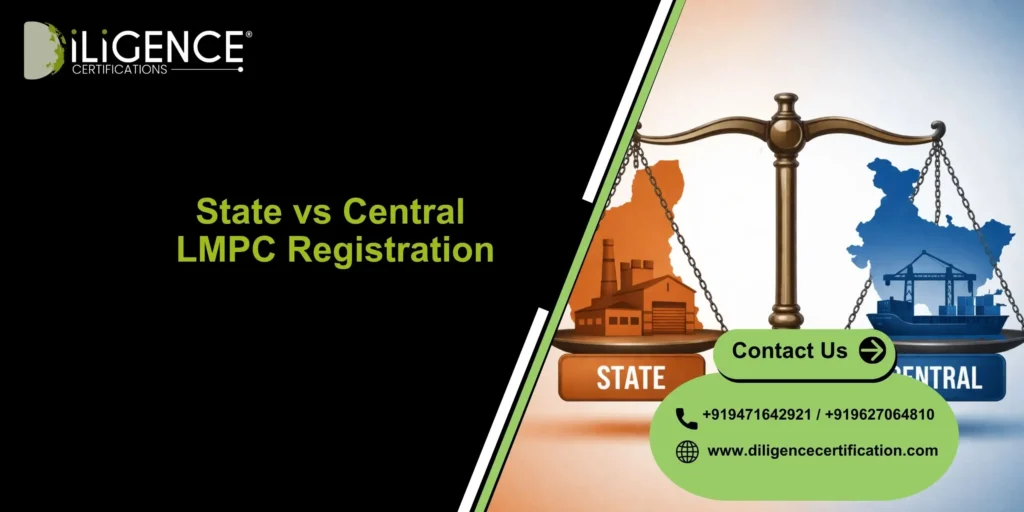
- State vs Central LMPC Registration Choosing the wrong authority can lead to penalties, delays, and legal issues.
- Proper compliance ensures smooth business operations and builds consumer trust.
Introduction | State vs Central LMPC Registration
In India, compliance with legal regulations is crucial for any business dealing with packaged goods. One such important requirement is LMPC registration under the Legal Metrology Act. However, many businesses often get confused between State LMPC registration and Central LMPC registration.
Understanding which registration your business needs is not just a legal formality—it directly impacts your ability to operate, import, manufacture, or sell products without facing penalties. Selecting the correct authority helps avoid delays, fines, and compliance issues.
In this blog, we will clearly explain the difference between State vs Central LMPC Registration, who needs which one, and how to obtain it in a simple and easy-to-understand manner.
What is LMPC Registration?
LMPC stands for Legal Metrology Packaged Commodities. It is a certification required under the Legal Metrology Act, 2009, for businesses dealing with pre-packaged goods.
This registration ensures that all packaged products sold in India comply with labeling and packaging standards. These include:
- Accurate weight or measurement
- MRP (Maximum Retail Price)
- Manufacturer or importer details
- Date of manufacturing or import
- Consumer care information
LMPC registration is divided into two types based on the nature of business:
- State LMPC Registration
- Central LMPC Registration
Why This Registration is Required
State vs Central LMPC Registration is not just a legal requirement; it plays a vital role in maintaining transparency and protecting consumer rights.
Key Reasons:
- Ensures fair trade practices
- Protects consumers from misleading packaging
- Maintains standardization in weights and measures
- Prevents legal penalties and business disruptions
- Builds credibility and trust in the market
Businesses that fail to comply may face fines, product seizures, or even suspension of operations.
State vs Central LMPC Registration: Key Differences
Understanding the difference between State vs Central LMPC Registration is essential to determine which one your business needs.
State LMPC Registration
This registration is required if your business is involved in:
- Manufacturing packaged goods
- Packing or repacking products
- Selling or distributing within a state
It is issued by the State Legal Metrology Department.
Central LMPC Registration
This registration is mandatory for:
- Importers of pre-packaged goods
- Businesses bringing packaged products from foreign countries into India
It is issued by the Central Government authority State vs Central LMPC Registration.
Importance and Benefits State vs Central LMPC Registration
| Importance of LMPC Registration | Benefits for Businesses |
| Legal compliance with Indian laws | Avoid penalties and legal issues |
| Ensures correct labeling | Builds consumer trust |
| Regulates weights and measures | Enhances brand credibility |
| Protects consumer rights | Smooth market operations |
| Mandatory for import/export | Enables business expansion |
| Standardizes packaging norms | Improves product transparency |
| Prevents unfair trade practices | Competitive advantage in market |
Process to Obtain State vs Central LMPC Registration
The process differs slightly depending on whether you are applying for State or Central LMPC registration.
Step-by-Step Process
1. Determine the Type of Registration
- Identify whether your business is a manufacturer, packer, or importer.
- Choose State or Central LMPC accordingly.
2. Prepare Required Documents
Common documents include:
- Business registration proof
- GST certificate
- PAN card
- Address proof
- Import Export Code (for importers)
- Product and packaging details
3. Application Submission
- Apply to the respective authority (State or Central).
- Fill out the prescribed application form with accurate details.
4. Verification Process
- Authorities review the application and documents.
- Inspection may be conducted if required.
5. Grant of Registration
- Upon successful verification, LMPC certificate is issued.
6. Compliance and Renewal
- Ensure ongoing compliance with labeling rules.
- Renew registration as per validity period.
Challenges of Getting This Certification Without a Consultant
While the State vs Central LMPC Registration process may seem simple, businesses often face several challenges when applying without expert guidance.
Common Issues:
- Confusion between State and Central authority
Many businesses apply under the wrong category, leading to rejection. - Incorrect documentation
Missing or incorrect documents can delay approval. - Complex legal requirements
Understanding legal metrology rules can be difficult for new businesses. - Application errors
Small mistakes in forms can result in rejection or resubmission. - Delays in approval
Lack of proper follow-up can slow down the process. - Inspection issues
Non-compliance during inspection may lead to rejection. - Time-consuming process
Managing compliance while running a business becomes challenging.
Why Choose Diligence Certification for This Certification
Choosing the right consultant can make the LMPC registration process smooth and hassle-free Diligence Certification.
Key Advantages of Diligence Certification:
- Expert Guidance
Clear understanding of whether you need State or Central LMPC registration. - End-to-End Support
From documentation to final approval, everything is handled professionally. - Error-Free Application
Ensures accurate submission to avoid rejections. - Faster Approval
Proper follow-ups reduce delays. - Compliance Assurance
Helps you meet all legal metrology requirements. - Affordable Services
Cost-effective solutions for businesses of all sizes. - Post-Registration Support
Assistance in renewal and compliance management.
With professional support, businesses can focus on growth while experts handle compliance.
Conclusion
Understanding the difference between State and Central LMPC registration is essential for any business dealing with packaged goods in India. Choosing the correct registration depends on your business activities—whether you are manufacturing, packing, or importing products.
State LMPC registration is suitable for local manufacturers and distributors, while Central LMPC registration is mandatory for importers. Making the right choice ensures smooth operations, legal compliance, and a strong market presence.
Instead of navigating complex procedures alone, working with experts like Diligence Certification can save time, reduce errors, and ensure quick approval.
Frequently Asked Questions (FAQs)
What is LMPC registration?
LMPC registration is a mandatory certification for businesses dealing with pre-packaged goods in India.
Who needs State LMPC registration?
Manufacturers, packers, and local distributors require State LMPC registration.
Who needs Central LMPC registration?
Importers of pre-packaged goods need Central LMPC registration.
Is LMPC registration mandatory in India?
Yes, it is legally required under the Legal Metrology Act, 2009.
What happens if a business does not have LMPC registration?
The business may face penalties, fines, or legal action.
Can a business have both State and Central LMPC registration?
Yes, if it operates as both a manufacturer and importer.
How long does it take to get LMPC registration?
It usually takes a few days to a few weeks depending on documentation and approval.
What documents are required for LMPC registration?
Basic documents include GST, PAN, business proof, and product details.
Is renewal required for LMPC registration?
Yes, it must be renewed as per the validity period.
Can a consultant help in LMPC registration?
Yes, consultants simplify the process and ensure faster and error-free approval.