BIS Certification
 CDSCO
 PESO
 CPCB
 LMPC
 WPC Approval
 Global Approvals
 TEC
 ARAI
 BEE
 ISO Certification
 DGCA Certification
 NOC For Steel
 APEDA Registration























 Business Registration
 FSSAI Mark Certification












 (32).jpg)
 Legal Services
 Trademark Registration
 Copyright Registration
 Patent Registration
 By
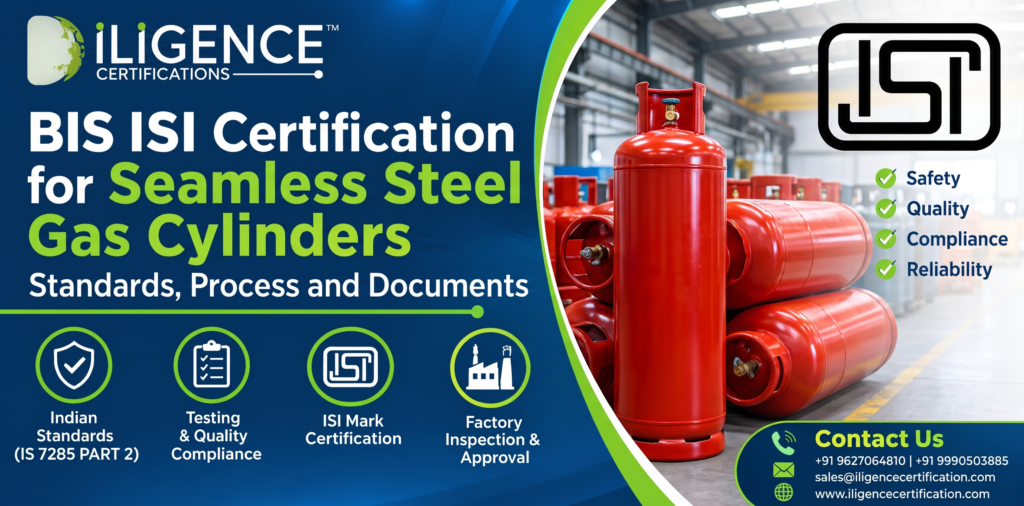
- BIS license is mandatory for quenched and tempered steel cylinders manufactured under IS 7285 (Part 2).
- Material’s yield strength must be less than 1100 MPa (160 ksi) with suitable heat treatment controls in place.
- An inspection of the factory and sample testing is required prior to the assignment of the ISI marking.
- Design changes require renewed approval and may require further testing.
- Maintained documentation and audits would require follow-on inspections to ensure compliance.
Introduction
Gas cylinders are widely used in industrial manufacturing, healthcare, laboratories, engineering and other sectors. These cylinders store gases under high pressure, which makes product quality and manufacturing safety extremely important.
A small manufacturing defect, incorrect heat treatment or weakness in the cylinder material can create serious safety risks. This is why manufacturers must follow established Indian Standards before supplying gas cylinders to the Indian market.
BIS Certification for Refillable Seamless Steel Gas Cylinders under IS 7285 Part 2 is an important compliance requirement for manufacturers producing quenched and tempered steel cylinders with tensile strength below 1100 MPa.
The standard specifies requirements related to materials, design, manufacturing, heat treatment, inspection and testing. Manufacturers must demonstrate that their production process consistently meets these requirements before obtaining the applicable BIS licence and using the ISI mark.
In this guide, we explain the certification requirements, testing procedures, documents, application process and important compliance points for manufacturers.
What is IS 7285 (Part 2)?
Indian Standard IS 7285 (Part 2):2017 is applicable to refillable, seamless, steel gas cylinders made with quenched and tempered steel which has a tensile strength of less than 1100 MPa (112 kgf/mm²). This standard addresses the design, manufacture, testing and certification of these cylinders prior to marketing and sale for use in India.

Key Points
- It is applicable to high-pressure cylinders designed for compressed, liquefied and dissolved gases.
- The sections of cylinders have a water capacity of up to 400 litres and there are specific heat-treatment criteria.
- Mandates mechanical properties so the tensile strength stays under 1100 MPa.
- Requires extensive inspection, destructive and non-destructive testing before approval.
- Licence under BIS Scheme-I is necessary to apply the ISI mark and commercially supply cylinders in India. ISI MARK
Key Requirements of IS 7285 Part 2
| Requirement | Description |
|---|---|
| Product category | Refillable seamless steel gas cylinders |
| Applicable standard | IS 7285 (Part 2):2017 |
| Material | Quenched and tempered steel |
| Tensile strength | Less than 1100 MPa |
| Manufacturing type | Seamless steel construction |
| Certification scheme | BIS Scheme-I |
| Certification mark | ISI Mark |
| Main compliance areas | Design, material, manufacturing, heat treatment and testing |
Manufacturers should consult the applicable edition of the standard and BIS product manual for the complete technical requirements.
Difference Between IS 7285 Part 1 and Part 2
Manufacturers must identify the correct part of IS 7285 before applying for certification.
| Parameter | IS 7285 Part 1 | IS 7285 Part 2 |
|---|---|---|
| Product | Seamless steel gas cylinders | Seamless steel gas cylinders |
| Steel condition | Normalized steel | Quenched and tempered steel |
| Manufacturing process | Normalizing heat treatment | Quenching and tempering |
| Standard edition | IS 7285 (Part 1):2018 | IS 7285 (Part 2):2017 |
| Product scope | Normalized steel cylinders | Cylinders with tensile strength below 1100 MPa |
These standards cover different steel conditions and manufacturing requirements. A manufacturer should not assume that certification under Part 1 automatically covers products manufactured under Part 2.
Why BIS Certification Mandatory for Refillable Seamless steel gas cylinders
The standard is included in the BIS Scheme-I list of products under compulsory certification. Therefore, manufacturers must obtain the applicable BIS licence before using the ISI mark and supplying products covered by the mandatory certification requirements in India.
The requirement supports product safety, quality control and compliance with Indian regulatory provisions.
Due to their inclusion on the mandatory product list under the BIS Act, 2016, refillable seamless steel gas cylinders are legally required to have BIS certification in India. As per gas safety regulations, cylinders must be tested and certified to prevent risks of leakages or explosion. This specifically allows only ISI-marked cylinders manufactured and handled under Indian Standards (such as IS 7285) to be legally manufactured and sold in India.
Key Points
- As gas cylinders are high-risk pressure vessels, enforcement of the conditions of public safety is mandatory under national regulations.
- BIS Act, 2016 mandates certification for products listed under Scheme-I, including cylinders.
- Without BIS marking, cylinders cannot be legally sold or supplied in the Indian market.
- Certification confirms compliance with material, testing and manufacturing requirements specified in IS 7285 standards.
- Continuous surveillance and auditing ensure ongoing safety and traceability throughout the product lifecycle.
Why Is Certification Important?
There are several reasons why BIS certification is important for gas-cylinder manufacturers:
1. Product Safety
Gas cylinders operate under pressure. Compliance with the applicable standard helps reduce risks associated with material defects, manufacturing errors and structural failures.
2. Legal Compliance
Manufacturers must obtain the required BIS licence for products covered under compulsory certification.
3. Manufacturing Quality
The certification process checks whether the manufacturer follows suitable production controls, inspection procedures and testing requirements.
4. Customer Confidence
The ISI mark helps customers identify products certified against the applicable Indian Standard.
5. Market Acceptance
BIS certification helps manufacturers meet applicable regulatory and procurement requirements when supplying cylinders in India.
Technical Requirements Under IS 7285 Part 2
Manufacturers must pay attention to different technical requirements during production. These requirements are not limited to the finished cylinder. They also cover raw materials, manufacturing operations and heat treatment.
1. Raw Material Requirements
The steel used for cylinder manufacturing must comply with the chemical and mechanical requirements specified in IS 7285 Part 2.
Manufacturers should maintain proper records of steel composition, material certificates and batch identification.
2. Design Requirements
Cylinder design must meet the applicable standard requirements for dimensions, wall thickness, operating conditions and mechanical strength.
Design calculations and drawings should be maintained for verification.
3. Heat Treatment Requirements
Quenching and tempering are important manufacturing stages.
The manufacturer must maintain controlled heat treatment conditions to achieve the required mechanical properties. Temperature records, furnace controls and process traceability should be properly documented.
4. Mechanical Properties
The standard specifies mechanical property requirements, including tensile strength, yield strength and elongation.
The maximum tensile strength specified in the title of Part 2 is less than 1100 MPa. This must not be confused with the yield strength requirement.
5. Manufacturing Quality
Manufacturers must control dimensions, wall thickness, surface condition, straightness and other relevant characteristics.
Inspection records should demonstrate that production consistently meets the applicable requirements.
Importance & Benefits of BIS Certification
| Importance & Benefits | Impact on Manufacturer |
| Ensures product safety and reliability | Reduces failure risk and liability |
| Mandatory regulatory compliance | Legal permission to manufacture and sell |
| Standardized quality requirements | Consistent production and acceptance |
| ISI mark builds customer trust | Stronger brand credibility in market |
| Supports market expansion | Eligibility for tenders and wider supply chain |
Step by Step process of BIS Certification

Step1:Documentation
- Prepare technical drawings, QC procedures and product specifications
- Ensure traceability records for raw materials and manufacturing batches
- Collect mandatory compliance documents such as test and calibration reports
- Organize files as per BIS checklist to prevent observations during review
Step2:Product Testing
- Select a BIS-recognized or BIS/NABL-approved testing laboratory
- Submit representative samples as per BIS standard requirements
- Conduct required safety and performance tests before inspection
- Review results internally to ensure compliance prior to application
Step3:Application Submission
- Apply through the official BIS online portal with complete details
- Upload test reports, manufacturing records and required forms
- Pay government certification fees, including inspection charges
- Track application status and respond quickly to queries
Step4:Scrutiny and Inspection
- BIS officer evaluates documents for compliance with the relevant IS standard
- Factory audit conducted to verify production capability and QC systems
- Equipment calibration, testing facilities and ISI marking methods are checked
- Any gap identified must be closed with corrective actions and proof submission
Step5:Grant of License
- BIS issues certification once all standards and processes meet compliance
- Product allowed to carry the ISI mark as per approved scope
- Manufacturer receives a unique licence number and validity period
- Ongoing surveillance audits ensure continuous quality and safety
Documents Required for BIS Certification
| Document Required | Purpose |
| Product drawings and specifications | Confirms design parameters and compliance with IS standard |
| Raw material test certificates | Traceability and verification of steel chemical/mechanical properties |
| Internal quality control procedures | Evidence of standardized manufacturing and inspection process |
| Test reports from BIS/NABL-approved lab | Demonstrates product performance and safety compliance |
| Manufacturing process flow chart | Shows controlled production stages and heat treatment |
| Factory licence and company registration | Validates legal manufacturing status |
| Calibration certificates of equipment | Ensures accuracy of testing and inspection tools |
| Authorized Indian Representative documents (for foreign manufacturers) | Mandated for applicants based outside India |
BIS Licence Validity, Renewal and Costs
BIS Licence Validity
Under Scheme-I, a BIS licence may initially be granted for up to two years.
The manufacturer can apply for renewal according to BIS requirements. Renewal may be granted for a period of up to five years, subject to the applicable conditions and payment requirements.
BIS Certification Renewal
Manufacturers should apply for renewal before the licence expires.
The renewal process may involve:
- Submission of the renewal application.
- Production details.
- Applicable licence and marking fees.
- Updated compliance documents.
- Required declarations and supporting records.
BIS Certification Cost
The cost of BIS certification for refillable seamless steel gas cylinders depends on several factors:
- Government application and processing fees.
- BIS licence fees.
- Product testing charges.
- Factory inspection expenses.
- Marking fees.
- Additional testing or compliance requirements.
The exact cost should be confirmed using the latest BIS fee schedule and the actual product scope.
How Much Time Does BIS Certification Take?
There is no fixed approval timeline applicable to every manufacturer.
The time required depends on document readiness, availability of testing facilities, sample conformity, factory inspection and closure of any observations.
Manufacturers should plan the certification process before starting commercial supply.
Factory Requirements for BIS Certification
A manufacturer cannot obtain certification simply by submitting product samples.
BIS also assesses the manufacturing facility and its ability to maintain consistent product quality.
Important factory requirements include:
Manufacturing Infrastructure: The facility should have the necessary machinery and equipment for producing seamless steel gas cylinders.
Heat Treatment Facilities: Suitable facilities must be available to carry out controlled quenching and tempering operations.
Testing Facilities: The manufacturer must have the testing infrastructure required under the applicable Scheme of Inspection and Testing.
Calibration System: Measuring instruments and testing equipment must be calibrated at the prescribed intervals.
Quality-Control System: A documented inspection and testing system should be followed throughout production.
Traceability: Raw materials, production batches, heat treatment cycles and finished cylinders must have suitable identification and records.
These arrangements help BIS assess whether the manufacturer can maintain compliance throughout regular production.
Timelines, Costs, Validity & Renewal
- Timelines:Typically 4-8 weeks depending on testing duration and inspection readiness
- Costs:Govt. fees, testing charges, inspection costs and marking fees vary by product scope and plant size
- Validity:BIS Licence remains valid for 2 years initially
- Renewal:Renewable every 1-2 years with updated documents, surveillance compliance and fees
Why Choose Diligence Certifications for BIS Certification?
Obtaining BIS certification for industrial pressure equipment requires a clear understanding of technical standards, documentation and factory inspection requirements.
Diligence Certifications assists manufacturers in managing the certification preparation process for products covered under Indian Standards.
Our assistance includes:
- Identifying the applicable BIS standard and certification requirements.
- Preparing the necessary application documents.
- Coordinating product testing with suitable laboratories.
- Reviewing manufacturing and quality-control documentation.
- Providing guidance for factory inspection preparation.
- Assisting with responses to BIS observations.
- Supporting licence renewal and compliance documentation.
Our objective is to help manufacturers understand the certification requirements and prepare their applications systematically.
Important: Diligence Certifications provides certification consultancy and coordination support. The BIS licence is granted only by the Bureau of Indian Standards after successful assessment.
Conclusion
BIS Certification for Refillable Seamless Steel Gas Cylinders under IS 7285 Part 2 is an important regulatory requirement for manufacturers producing quenched and tempered seamless steel cylinders with tensile strength below 1100 MPa.
The certification process covers more than finished-product testing. It also evaluates material quality, manufacturing processes, heat treatment, testing facilities and factory-level quality control.
Manufacturers should identify the correct Indian Standard, prepare complete technical documents and maintain proper production records before applying for a BIS licence.
With appropriate preparation and professional certification guidance, businesses can manage the application process more effectively and work towards meeting the applicable Indian quality and safety requirements.
Frequently Ask Questions
What is IS 7285 (Part 2) certification?
IS 7285 (Part 2) is a compulsory certification offered by the Bureau of Indian Standards (BIS) regarding quenched and tempered seamless steel gas cylinders for the utilization of gas not greater than tensile strength of 1100 MPa. This certification regards the design, manufacturing and testing of diverse gas cylinders.
Is BIS certification required for manufacturing seamless steel gas cylinders in India?
Yes, BIS Certification is compulsory, in accordance with the BIS Act, 2016. A seamless steel gas cylinder shall not be manufactured or sold unless it has met IS7285 testing and has the ISI Mark.
What type of cylinders are covered under IS 7285 (Part 2)?
Refillable seamless steel gas cylinders for storage and transport of water capacity not over 400 litres. A tank for the storage and transport of liquid gas that has either nitric, liquefied or in a dissolved condition.
Typically, how long does it take to receive BIS Certification per IS 7285 (Part 2)?
BIS Certification does not take that long and typically takes about 4 to 8 weeks depending on how fast the Manufacturer can get the inspection set at the factory, and about how long testing will take on the samples.
What tests are done as part of IS 7285 (Part 2)?
IS 7285 (Part 2) has wanted all mechanical testing to be done, and also has specifications pertaining to continuous capacity.
Are manufacturers allowed to begin production prior to obtaining certification?
No. In India, the manufacturing and/or commercial distribution of cylinders is prohibited until there is an ISI marking.
What happens if there is a design change after certification?
If there is a design change, a new BIS approval process will need to be done. It may also require testing additional samples.
What documents need to be submitted with a BIS application?
The product drawings, material certificates, QC procedures, a manufacturing flow chart, calibration records, test reports, and the legal documents of registration.
How long is a BIS licence for a product valid?
The original licence is good for 2 years and can be renewed every 1-2 years with appropriate documentation of compliance.
Why should manufacturers work with a professional BIS consultant?
The consultants do the paperwork for the application, handle the testing if needed, and prepare the factory so that the application process can be completed quickly without delays or rejection.