BIS Certification
 CDSCO
CDSCO
 PESO
PESO
 CPCB
CPCB
 LMPC
LMPC
 WPC Approval
 Global Approvals
 TEC
TEC
 ARAI
ARAI
 BEE
BEE
 ISO Certification
 DGCA Certification
 NOC For Steel
 APEDA Registration























 Business Registration
 FSSAI Mark Certification












 (32).jpg)
 Legal Services
 Trademark Registration
 Copyright Registration
 Patent Registration
 By
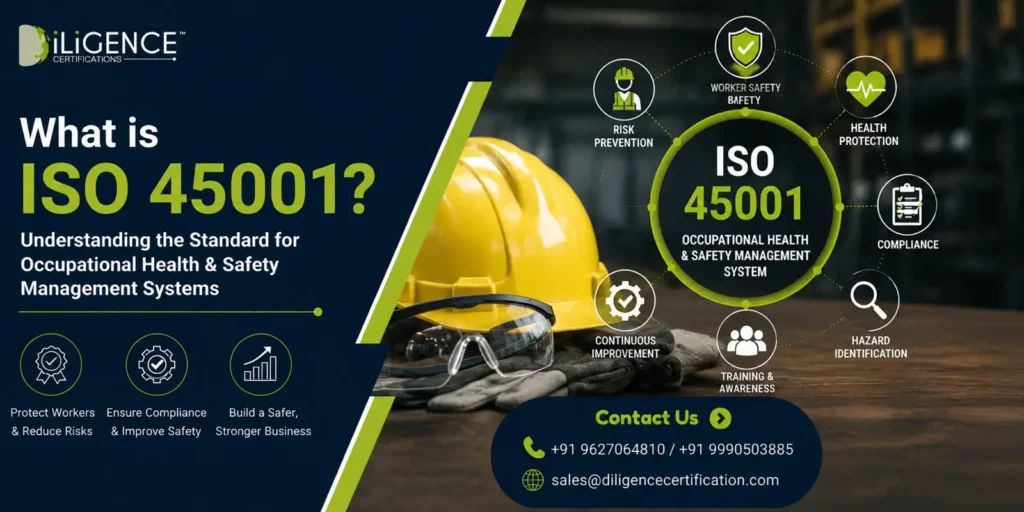
By - ISO 45001 is the standard for Occupational Health and Safety Management Systems that helps organisations prevent workplace injuries and improve employee safety.
- Manufacturers use ISO 45001 Certification to identify workplace hazards, reduce risks, comply with legal requirements and strengthen customer confidence.
- Diligence Certifications supports manufacturers in India. Globally with ISO 45001 implementation, documentation, internal audits and certification assistance.
Introduction ISO 45001 Requirements
A precision engineering manufacturer contacted Diligence Certifications after one workplace accident disrupted production for days. Although the incident caused minor injuries the investigation exposed larger issues. Missing safety procedures, inconsistent training and poor hazard reporting.
The management realised that employee safety depended on more than equipment. It required a system that identified risks before accidents occurred.
This is why many organisations search for what’s ISO 45001. The ISO 45001 standard provides a recognised framework for managing occupational health and safety helping organisations create safer workplaces while meeting customer and legal expectations.
Whether you manufacture parts, pharmaceuticals, electronics, machinery, chemicals or consumer products the ISO 45001 standard helps reduce workplace risks and demonstrates a strong commitment to employee wellbeing.
What is ISO 45001?
The ISO 45001 standard is a recognised standard for Occupational Health and Safety Management Systems, published by the International Organization for Standardization.
It specifies the requirements for establishing, implementing, maintaining and continually improving a management system that protects workers from injuries, illnesses and workplace hazards.
By reacting after accidents happen the ISO 45001 standard encourages organisations to identify hazards early, assess risks and implement preventive controls.The current version followed worldwide is the ISO 45001:2018 standard.
What is an Occupational Health and Safety Management System?
An Occupational Health and Safety Management System is a structured framework that enables an organisation to manage workplace safety.Rather than relying on occasional inspections or informal safety practices an Occupational Health and Safety Management System integrates safety into daily operations.
A typical Occupational Health and Safety Management System includes:
- Hazard identification
- Risk assessment
- Legal compliance
- Safety objectives
- Incident reporting
- Emergency preparedness
- Employee participation
- Audits
- Continual improvement
For manufacturers this results in a safer workplace, fewer disruptions and improved operational performance.
Why is the ISO 45001 standard important?
Manufacturing environments often involve machinery, chemicals, electrical systems, heavy equipment and manual handling. Without structured safety management these activities can expose employees to risks.The ISO 45001 standard helps organisations move from safety management to preventive risk control.It also supports workplace safety, legal compliance, employee wellbeing, reduced downtime, better operational control and stronger customer confidence.An implemented Occupational Health and Safety Management System protects both people and business continuity.
Why Manufacturers Need ISO45001 Certification
Manufacturers face workplace hazards that require systematic management.
Examples include:
- Moving machinery
- Welding operations
- Forklift movement
- Chemical handling
- Noise exposure
- Electrical hazards
- Fire risks
- Confined spaces
- Manual lifting
- Dust and airborne contaminants
ISO 45001 provides a structured approach to identifying these hazards and reducing associated risks.
Many multinational buyers also consider ISO 45001 Certification during supplier evaluations, particularly in high-risk industries.
Key Principles of ISO45001
ISO 45001 is built around several important management principles.
- Leadership Commitment
It is necessary that senior leadership commit to promoting workplace health and safety and not delegate all responsibility to the safety department.The involvement of leaders improves the safety culture within the organisation.
- Employee Participation
Employees know best about any hazards in the workplace.According to ISO 45001, employees should be encouraged to identify hazards, report incidents, and suggest improvements.
- Risk-Based Approach
It is necessary that the organisation conducts risk assessments and identifies hazards before an accident happens.Risk assessments become a routine part of the company’s operations.
- Continual Improvement
Health and safety management should develop constantly.Companies conduct regular reviews of incidents, audits, inspections, and feedback from employees to improve their performance.
- Obligations for Compliance
Organisations need to identify and comply with relevant legal and regulatory requirements concerning health and safety at work.
Benefits of ISO 45001 Certification
ISO 45001 provides measurable benefits beyond regulatory compliance.
- Decreased Workplace Incidents
Identification of hazards in a systematic manner can prevent any accident from happening.
- Increased Employee Satisfaction
It becomes easy for employees to stay committed when they realize their safety and well-being is considered important.
- Good Compliance with Legislation
It is helpful in achieving compliance with health and safety legislation.
- Less Downtime
In case there are no accidents, there will be no production delays and investigations required.
- Good Corporate Image
Certification will show dedication to sound business practices.
- Increased Customer Confidence
Many customers choose to work with suppliers who have internationally recognized health and safety management systems.
- Increased Productivity
Workplace safety leads to better productivity levels of employees.
- Better Risk Management
It makes organizations identify and manage risks in a proactive way.
What Industries can apply for ISO45001?
Though the above discussion revolves around manufacturers, ISO 45001 is applicable to organizations from various industries.
They are:
- Automobile manufacturing industry
- Chemical industry
- Pharmaceutical industry
- Food processing industry
- Electronics manufacturing industry
- Construction industry
- Logistics industry
- Engineering industry
- Warehousing industry
- Mining industry
- Oil & gas industry
- Health care industry
- The standards can be tailored for any sized business.
Who can apply for ISO45001 Certification?
ISO 45001 Certification is open to:
- Proprietorship organizations
- Partnership organizations
- MSMEs
- Private limited organizations
- Public limited organizations
- Exporter organizations
- Large manufacturing organizations
- Industrial organizations
- Multi location organizations
This certification is valid irrespective of the number of employees.
Key Requirements under ISO 45001
For compliance with ISO 45001, an organization needs to develop and implement an efficient OHSMS.
Some of the key requirements are listed below:
- OH&S Policy
A documented health and safety policy should be developed by the management of the organization.
- Identification of Hazards
Workplace hazards need to be identified systematically throughout the organization.
- Risk Assessment
The organizations must assess the risk involved in the above identified hazards.
- Laws and Regulations
Occupational health and safety laws and regulations must be identified, reviewed and complied with.
- Safety Objectives
Specific safety objectives need to be set and assessed from time to time.
- Emergency Planning
The organization must plan for any emergency situations that may arise.
- Internal Auditing
Internal audit checks if the OH&S management system of the organization is working efficiently.
- Management Review
Performance of the system needs to be reviewed from time to time by the management of the organization.
Common Misconceptions about ISO 45001
There are several misconceptions that prevent organisations from seeking certification.
These include:
- ISO 45001 is for large manufacturing units only.
- ISO 45001 is an alternative to all the legal requirements.
- ISO 45001 assures zero risks and accidents.
- All that you need is documentation.
- ISO 45001 is required only by hazardous industries.
However, in reality, ISO 45001 can be applied by any organisation, of whatever size and industry. ISO 45001 works in conjunction with the law and helps develop a framework for managing OH&S.
ISO 45001 Certification Procedure
Certification involves following a set procedure which ensures that OH&S Management System implementation happens before the actual certification takes place.
Step 1: GAP Analysis
The first step involves assessing the OH&S management system that exists in your organisation and comparing it with the requirements of ISO 45001:2018 standard.
This includes identification of areas where there is a deficiency, for example:
• Lack of safety procedures
• Insufficient risk assessment
• Poor incident reporting
• Training of employees
Step 2: Build the OH&S Management System
Based on the results the organization builds its Occupational Health and Safety Management System (OHSMS).
Common documents are:
- OH&S Policy
- Safety Objectives
- Risk Assessment Register
- Hazard Identification Register
- Emergency Response Procedures
- Standard Operating Procedures (SOPs)
- Incident Reporting Procedures
- Legal Compliance Register
The documents must show how the organization actually works, not just copy from examples.
Step 3: Train Employees and Raise Awareness
Employees are very important for keeping the workplace safe.
Training usually involves:
- Workplace hazards
- Emergency actions
- Ways to do the job
- How to report incidents
- Personal Protective Equipment (PPE)
- Understanding risks
- What employees need to do
- Awareness activities help make the organization safer.
Step 4: Put the System into Place
The written steps are now used throughout the organization.
Putting the system in place usually involves:
- Doing safety checks
- Writing down incidents
- Watching for dangers
- Fixing problems
- Looking at safety goals
- Keeping records of rules
The organization must keep enough records to show the system is working well.
Step 5: Do an Internal Audit
Before a certification body comes in the organization does an audit.
The audit checks:
- If the system meets ISO 45001 rules
- How well the system is working
- If the documents are correct
- If employees know about safety
- Where things can get better
- Any problems found must be fixed before the audit.
Step 6: Management Review
Top leaders look at how the Occupational Health and Safety Management System is working.
The review usually includes:
- Results from the internal audit
- Incident numbers
- How well the organization follows laws
- Safety goals
- Employee opinions
- What resources are needed
- Actions for improvement
When leaders take part it shows they care, which is a rule in ISO 45001.
Step 7: Certification Audit
A certified audit company does the certification audit in two parts.
Stage 1 Audit
The auditor looks at:
- Documents
- What the certification covers
- If the organization is ready, for the step
- How the system is set up
Stage 2 Audit
The auditor checks:
- How the system is used in the workplace
- How dangers are controlled
- If employees are involved
- How risks are handled
- How incidents are reported
- If laws are followed
- If the organization keeps getting better
After it is done well the organization gets the ISO 45001 Certificate.
Documents Needed for ISO 45001 Certification
The documents you need for ISO 45001 certification are different for each company.It depends on how big your company is.Some common documents that companies need include:
Business documents like-
- Certificate of Incorporation
- GST Registration
- PAN Card
- Factory Licence if you have a factory
- Organisation Chart
- Documents for Occupational Health and Safety like
- Occupational Health and Safety policy
- Hazard Identification Register
- Risk Assessment Reports
- Legal Compliance Register
- Emergency Response Plan
- Training Records
- Incident Investigation Reports
- Internal Audit Reports
- Management Review Records
- Corrective Action Reports
Having the documents shows that you are following the rules and helps you improve.
How Long Does it Take to Get ISO 45001 Certification?
The time it takes to get ISO 45001 certification is different for each company.It depends on things like how big your company’s,It also depends on the number of people who work for you.Other things that matter are how complicated your work is and if you already have a system in place for managing your company.If you already have a system for keeping your workers safe then you can get certified faster.
What Affects the Cost of ISO 45001 Certification?
The cost of getting ISO 45001 certification is different, for each company.
- It depends on what you need for your project.
- Some things that affect the cost are the size of your company.
- The number of people who work for you also matters.
- The number of places where you make things and what kind of business you are also affect the cost.
- You also need to think about if you need help from a consultant and how much the certification body charges.
- You need to think about if you need training and how long the audit will take.
- The best way to know how much it will cost is to get someone to look at your project.
Common Mistakes During ISO 45001 Implementation
Many companies focus on getting the certificate instead of making the workplace safer.
Common mistakes include:
- Doing risk assessments
- Looking at documentation as just paperwork
- Not involving employees
- Putting off fixing problems
- Not keeping up with legal requirements
- Doing poor internal audits
- Not having management involved
An effective Occupational Health and Safety Management System becomes part of daily work rather than just something for an audit.
Why ISO 45001 Matters in Global Supply Chains
More international buyers check suppliers based on how they handle health and safety.
Many big companies like to work with factories that have ISO 45001 Certification because it shows:
- A focus on worker safety
- ways to handle risks
- Strong controls for operations
- A culture that cares about following rules
- A habit of getting better all the time
For companies that send products abroad ISO 45001 can help them meet supplier rules and do better in the world market.
Why Choose Diligence Certifications?
Getting ISO 45001 done needs knowledge, understanding of risks in the workplace and a good way to handle papers and rules.
Diligence Certifications helps companies get ISO 45001 Certification in India and around the world.
Our help includes:
- Looking at gaps
- Creating documents
- Helping find dangers
- Guidance on risk assessments
- Programs to make employees aware
- Internal audits
- Help with the audit for certification
- Support after getting certified
Our experts work on making systems that make the workplace safer and meet global rules.
Conclusion
If you have asked what ISO 45001 is, the answer is more than following rules. ISO 45001 is a known Occupational Health and Safety Management System that helps companies make safer places to work, lower risks and create a habit of getting better.
For factories in India or other countries ISO 45001 Certification shows a focus on worker health following rules and doing business in a way. It also helps build trust with customers, money people and the people who help supply products.
Whether your company is getting certification for the time or making changes to a safety system Diligence Certifications can help with expert advice at every step of the way.
Frequently Answered Questions
What Is ISO 45001?
ISO 45001 is a standard for Occupational Health and Safety Management Systems that helps companies find dangers at work, lower risks and make employees safer.
Who should get ISO 45001 Certification?
Factories, building companies, engineering groups, transport businesses, health care places and any boss who wants to make the workplace better can get ISO 45001 Certification.
Is ISO 45001 required?
ISO 45001 is usually not required.. Many buyers, big companies and people who give work like to work with companies that have ISO 45001 Certification.
What is the newest version of ISO 45001?
The current version is ISO 45001:2018.
How long does an ISO 45001 Certificate last?
ISO 45001 Certification usually lasts three years long as the company passes the checks by the certification company.
Can small factories get ISO 45001?
Yes. The standard works for medium and big factories.
Does ISO 45001 stop workplace accidents?
It gives a way to find dangers, look at risks and put in steps to stop problems helping companies avoid accidents.
What papers are needed for ISO 45001 Certification?
Common papers are the OH&S policy, list of dangers and risks plans for emergencies, records of training reports from audits and records from management reviews.