BIS Certification
 CDSCO
CDSCO
 PESO
PESO
 CPCB
CPCB
 LMPC
LMPC
 WPC Approval
 Global Approvals
 TEC
TEC
 ARAI
ARAI
 BEE
BEE
 ISO Certification
 DGCA Certification
 NOC For Steel
 APEDA Registration























 Business Registration
 FSSAI Mark Certification












 (32).jpg)
 Legal Services
 Trademark Registration
 Copyright Registration
 Patent Registration
 By
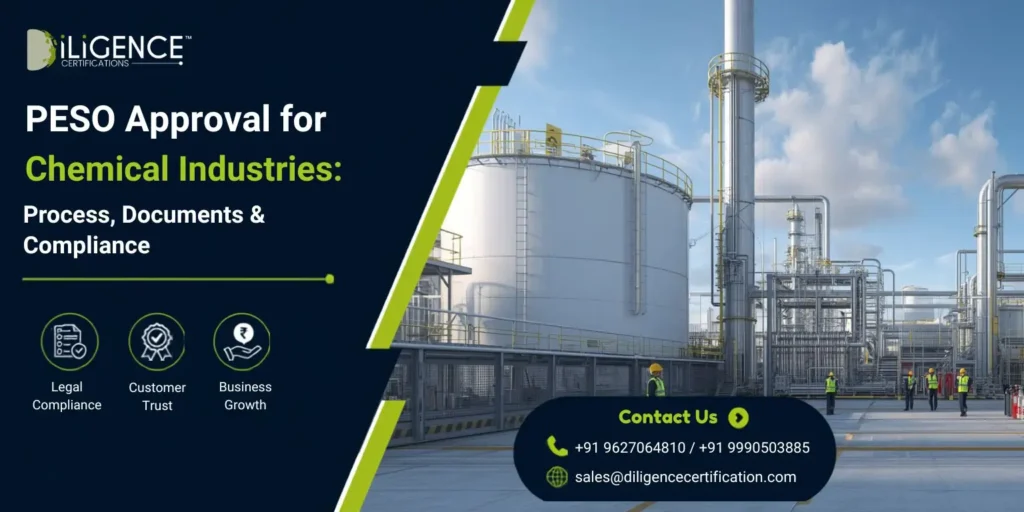
By - PESO Approval for Chemical Industries is mandatory for businesses handling hazardous chemicals, flammable liquids, gases, and explosive substances.
- It helps in complying with regulations, maintaining workplace safety, and safe storage and transport of hazardous materials.
- This guide will help you understand the entire process of PESO approval for chemical industries in India.
Introduction
The chemical manufacturing company based in Gujarat had spent crores of rupees on setting up their manufacturing unit. The machines had been installed, workers were recruited, and it was all set to roll out the first batch for transportation. But just a few days before the planned start date, it was realized that they cannot store some hazardous materials without getting proper permission from the Petroleum and Explosive Safety Organisation (PESO).
This is something that happens much more often than most business owners realize. No matter if it is a chemical manufacturing plant, solvent storage unit, paint factory, pesticide plant, or an industrial gas plant; all these businesses need approvals before being allowed to commence operations.
PESO Approval for Chemical Industries is no formality - it is one of the most essential safety measures that have been put in place to safeguard the life of workers, community members, and the surroundings from any hazard arising due to hazardous materials. It ensures that the manufacturing unit is adhering to the prescribed safety measures.
If you manufacture, store, import, transport or handle any hazardous chemicals, then the information about PESO approval procedure will definitely come in handy.
What is PESO Approval for Chemical Industries?

“PESO Approval for Chemical Industries” is the official clearance granted by the Petroleum and Explosives Safety Organisation (PESO) on behalf of the Government of India. The clearance is an indication that the chemical industry has fulfilled the necessary safety norms regarding the storage, handling, transport, production, and usage of chemicals, petroleum products, compressed gases, and explosives.
The main aim of PESO is to reduce accidents through safety norms. Chemical industries dealing with hazardous substances such as flammable liquids, toxic chemicals, industrial gases, and solvents must fulfill the norms before starting business operations.
The approval process involves a detailed technical assessment of several factors, including:
- Plant layout and site plan
- Storage tanks and vessels
- Pressure equipment
- Fire protection systems
- Safety distances
- Ventilation arrangements
- Emergency response measures
- Operational safety procedures
Only after these aspects comply with PESO guidelines is approval granted.
Who Needs PESO Approval for Chemical Industries?
Any company engaged in the manufacture, processing, storage, importation, exportation, transportation, and distribution of dangerous chemicals needs the PESO clearance.
Industries that commonly require this approval include:
Chemical Manufacturing Plants
Manufacturers of industrial chemicals, specialty chemicals, solvents, acids, alkalis, and intermediates.
Petrochemical Industries
Petroleum refining and petrochemical production facilities.
Paint and Coating Manufacturers
Firms dealing in flammable solvents, thinners, resins, and chemical additives.
Pharmaceutical Manufacturers
Facilities storing dangerous solvents, compressed gases, and/or flammable ingredients.
Fertilizer and Agrochemical Companies
Manufacturers of pesticides, insecticides, herbicides, and fertilizers containing regulated chemicals.
Industrial Gas Manufacturers
Facilities producing or storing oxygen, nitrogen, hydrogen, acetylene, LPG, CNG, and other compressed gases.
Chemical Warehouses
Storage facilities for hazardous chemicals awaiting distribution or export.
Oil and Lubricant Industries
Businesses storing petroleum products, lubricants, transformer oils, and industrial oils.
Explosives and Fireworks Manufacturers
Industries covered under explosive safety regulations requiring specialised PESO approvals.
Types of PESO Approvals for Chemical Industries
The kind of approval will vary based on the chemical substance involved, the process being followed, and the safety standards required.
1. Storage Approval
Is needed for industries which are handling hazardous chemicals, flammable liquids, industrial gases, petroleum products, or explosives beyond the set limits.
2. Manufacturing Approval
Applies to any factory dealing with manufacturing of hazardous chemicals or chemical formulations involving regulated substances.
3. Import Approval
Needed for importation of specific hazardous chemicals, pressure vessels, cylinders, valves, or regulated industrial equipment in India.
4. Pressure Vessel Approval
This is compulsory in industries that use pressure vessels, storage tanks, boilers, reactors, and compressed gas systems.
5. Gas Cylinder Approval
Compulsory for the manufacturer, filler, tester, and users of industrial gas cylinders and associated equipment.
6. Petroleum Storage Approval
For storage tanks containing diesel oil, petrol, aviation fuel, kerosene, solvents, and other petroleum products beyond specified amounts.
7. Explosives Approval
Industries engaged in manufacture, storage, transport, and use of explosives, detonators, firecrackers, and blasting agents.
8. Equipment Approval
For manufacturers of electrical equipment, valves, pumps, flameproof equipment, and safety equipment for use in hazardous areas.
Importance & Benefits of PESO Approval for Chemical Industries
| Importance | Benefits |
| Ensures compliance with PESO regulations and other applicable safety laws. | Helps avoid legal penalties and operational disruptions. |
| Promotes safe handling, storage, and transportation of hazardous chemicals. | Reduces the risk of fire, explosions, and chemical accidents. |
| Verifies that the facility meets prescribed safety standards. | Creates a safer workplace for employees and visitors. |
| Supports compliance during government inspections and audits. | Makes inspections and regulatory approvals smoother. |
| Demonstrates adherence to national industrial safety requirements. | Builds trust with customers, suppliers, and business partners. |
| Essential for industries handling flammable liquids, gases, and hazardous substances. | Enhances business credibility and professional reputation. |
| Helps maintain proper documentation and safety procedures. | Improves operational efficiency and risk management. |
Documents Required for PESO Approval for Chemical Industries
It may depend upon the type of chemical industry and the kind of approvals required for that particular chemical industry. The below documents are typically mandatory.
Business Documents
- Certificate of Incorporation
- Partnership Deed or LLP Agreement (if applicable)
- PAN Card
- GST Registration Certificate
- Factory Licence
- UDYAM Registration (if applicable)
Site & Technical Documents
- Detailed Site Layout Plan
- Plant Layout Drawing
- Storage Tank Layout
- Hazardous Area Classification Drawing
- Electrical Layout
- Fire Fighting System Layout
- Equipment Specifications
- Pressure Vessel Details
- Pipeline Layout
- Process Flow Diagram
Safety Documents
- Risk Assessment Report
- Hazard Analysis Report
- Safety Management Plan
- Emergency Response Plan
- Fire Safety Compliance Documents
- Material Safety Data Sheets (MSDS)
- Standard Operating Procedures (SOPs)
Operational Documents
- Chemical Storage Details
- Capacity Calculations
- Product Information
- Manufacturing Process Details
- Machinery List
- Employee Safety Training Records
Other Supporting Documents
- Identity Proof of Authorised Signatory
- Address Proof
- Land Ownership or Lease Documents
- Previous Approvals (if applicable)
- NOCs from relevant authorities (where required)
Step-by-Step Process for PESO Approval for Chemical Industries
Obtaining PESO Approval for Chemical Industries involves careful planning, documentation, technical verification, and regulatory assessment.
Step 1: Determine Applicability
Check if your manufacturing plant, storage, warehouse, or process is covered by PESO regulations. There are different types of approvals depending on your process.
Step 2: Collect Technical Information
Compile your engineering drawings, plant layout plan, details of equipment and pressure vessels, capacities of storage tanks, and chemical inventory data.
Step 3: Prepare Safety Documentation
Prepare fire safety plan, emergency procedure, hazard analysis, MSDS, and other required safety documentation.
Step 4: Submit the Application
The application is filed, along with all the required supporting documents.
Step 5: Technical Examination
An evaluation is done by PESO on the submitted documents to ensure that the proposed plant conforms to the relevant technical and safety standards.
Step 6: Site Inspection
The inspecting bodies may pay a visit to the site and conduct an inspection of the following areas based on the project involved:
- Storage tanks
- Pipelines
- Pressure vessels
- Electrical installations
- Fire protection systems
- Safety signage
- Ventilation
- Emergency exits
- Operational practices
Step 7: Rectification (If Required)
The rectifications are necessary where there are any deficiencies and must be performed by the applicant prior to approval.
Step 8: Grant of Approval
After meeting all the criteria, PESO will grant the required approval to the chemical industry.
Timeline, Cost & Validity
Timeline
The approval timeline depends on factors such as:
- Type of chemical industry
- Nature of hazardous substances
- Project complexity
- Completeness of documentation
- Inspection schedules
- Regulatory observations
A well-prepared application is generally processed faster than one requiring multiple revisions.
Cost
The total cost depends on several factors, including:
- Applicable government fees
- Type of approval
- Plant capacity
- Number of storage tanks
- Pressure vessels
- Technical consultancy requirements
- Inspection and testing charges
Businesses should obtain a customised quotation based on their project scope rather than relying on standard estimates.
Validity
The validity of PESO Approval for Chemical Industries varies according to the specific licence or approval category. Businesses must ensure continuous compliance and apply for renewal before expiry, where applicable.
Why PESO Approval for Chemical Industries Is Important
Most industrial proprietors consider regulations important when the time for an inspection arrives. However, they affect every aspect of a project from the time it is initiated until its completion and beyond.
PESO approval is important because it:
- Protection from dangers
- Protection from chemical leakages and explosions
- Protection in handling chemicals
- Protection of the environment
- Efficiency in the process of work
- Protection from legal actions
- Protection of business credibility
- Continuous operation of industries
- Responsibility of manufacturers
For industries dealing with hazardous chemicals, compliance is not just about meeting regulations-it is about building a safe and sustainable business.
Risks of Operating Without PESO Approval
Operating in the absence of PESO Approval for Chemical Industries can put organizations at a risk of facing serious problems.
These are some of the serious issues that an organization may face in the absence of PESO approval:
Legal Penalties
Legally imposed penalties and actions may be taken against non-compliance to the safety regulations.
Suspension of Operations
Operations may be stopped until all the regulations are met.
Rejection of Expansion Projects
Any requests for expansion in storage capacities or facilities or more approvals will be delayed or rejected if there are still problems with compliance.
Increased Safety Risks
Improper handling or storage of dangerous chemicals will lead to fire, explosion, toxic spillage, and accidents in the workplace.
Financial Losses
Project and equipment downtime due to these hazards will result in financial losses.
Damage to Business Reputation
Clients, investors, and business partners will be hesitant to work with the businesses that do not comply with the statutory requirements of safety and regulations.
Insurance Challenges
The insurers could be reluctant in accepting any claims or could put stringent conditions if the facility is not working according to the statutory requirements.
Renewal of PESO Approval for Chemical Industries
PESO Certification for Chemical Industries is just the beginning. Business enterprises need to maintain their certification in order for them to continue being up to date and compliant to all safety regulations.
The process of renewal varies according to the type of certification, size of storage, hazardous materials being handled, and rules governing such certification.
When Should You Apply for Renewal?
It would be ideal if the process of renewal was started long before the approval period expires. That will provide enough time to update documents, correct any non-conformities and do any inspections necessary.
Documents Commonly Required for Renewal
- Current Approval of PESO or License
- Modified Site and Facility Plan (if any)
- Report on Safety Audit
- Certificate for Fire Safety Compliance
- Maintenance Record of Equipment
- Reports on Pressure Vessel Inspection (where applicable)
- Revised Material Safety Data Sheets (MSDS)
- Additional Documents as required by PESO
Why Choose Diligence Certifications?
Getting PESO Approvals for the Chemical Industry needs specialized knowledge, expertise, and documentation. Diligence Certifications makes the process hassle-free for our clients, ensuring that their businesses are fully compliant.
Our Services Include
- PESO approval eligibility assessment
- Document creation and validation
- Technical assistance for compliance requirements
- Cooperation with the concerned agencies
- Assistance with application process
- Inspection assistance
- Compliance gap analysis
- Renewal and amendment support
- Chemical industry and hazardous substance facility consultancy
Conclusion
Running a chemical industry is not just about having the machinery and commencing the manufacturing activities. Companies dealing with hazardous substances are bound by stringent safety guidelines in order to ensure the protection of their staff and their property as well as the nearby surroundings.
The PESO Approval for Chemical Industries is highly significant for ensuring that all safety standards are adhered to when it comes to manufacturing plants, storage facilities, and processing units. Each and every process involved in this procedure helps in achieving safe industry operations.
This is why getting the correct regulatory guidance is vital for the success of your business.
Frequently Asked Questions
What is PESO Approval for Chemical Industries?
PESO Approval for Chemical Industries is an approval given by the Petroleum and Explosives Safety Organisation to organizations dealing with dangerous chemicals, inflammable liquids, gases, or explosives.
Is PESO approval necessary for all chemical industries?
No, not all chemical industries require the same approval. It is dependent upon the chemicals dealt with, storage capacity, manufacturing process, and the prevailing laws.
Which organization provides PESO approval in India?
It is the Petroleum and Explosives Safety Organisation (PESO) working under the Government of India.
What documents are needed for the issuance of PESO approval?
Common documents usually include registration certificate of the company, plan view, safety reports, fire protection reports, equipment reports, Material Safety Data Sheets (MSDS) and other technical documents.
How long will the PESO approval process be?
It varies depending on the nature of the project, the completeness of the submitted documents and the complexity of the facility.
What is the duration of PESO approval?
It varies depending on the nature of the approval granted.
Is there a possibility of an application being rejected?
Yes, there is a possibility that an application may get rejected or delayed due to missing technical data, non-compliance of safety issues, or pending observations from the inspection process.
What will happen in case a company operates without PESO approval?
There might be penalties, operating constraints, legal implications, and more safety hazards.
Can an already existing facility seek PESO approval?
Yes, chemical industries having existing facilities can apply for the same or regularize their operations.
Why should companies seek professional help to get PESO approval?
Professional consultants will assist in providing correct technical documentation and make the process easier.