BIS Certification
 CDSCO
CDSCO
 PESO
PESO
 CPCB
CPCB
 LMPC
LMPC
 WPC Approval
 Global Approvals
 TEC
TEC
 ARAI
ARAI
 BEE
BEE
 ISO Certification
 DGCA Certification
 NOC For Steel
 APEDA Registration























 Business Registration
 FSSAI Mark Certification












 (32).jpg)
 Legal Services
 Trademark Registration
 Copyright Registration
 Patent Registration
 By
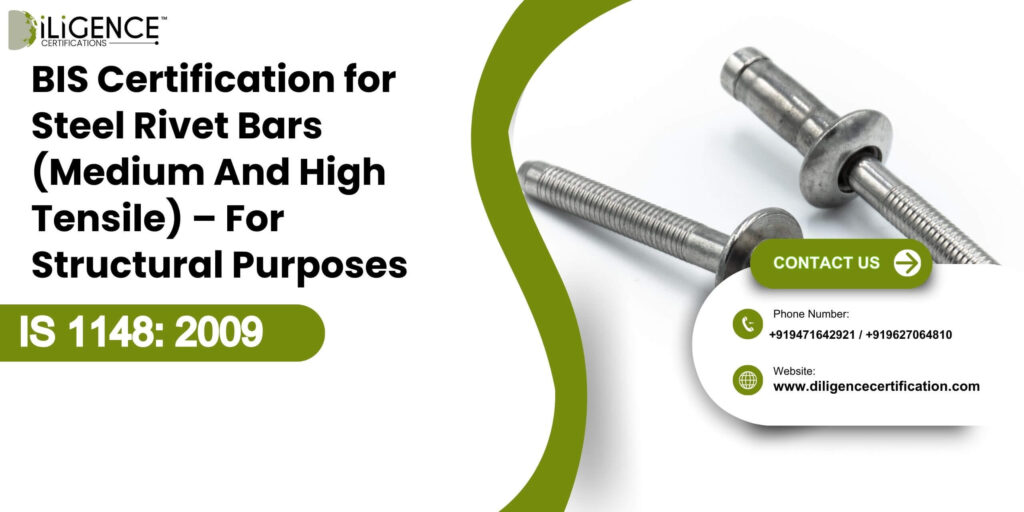
By - By conforming to IS 1148:2009, a BIS Certification is a guarantee of structural-grade safety of the product that is steel rivet bars.
- It is compulsory for manufacturers who supply to the facilities, EPC, and rail projects.
- The scope includes fixed requirements for the product in terms of its chemical, mechanical, and heat-treatment nature.
- Being far more visible in tenders, it is less likely that the product will be rejected.
- Essential for both domestic and foreign manufacturers entering the Indian market.
Introduction
We were once told by a structural fabrication contractor that choosing rivet bar suppliers without BIS certification is as risky as approving untested welders for a bridge project. Over the last ten years, EPC firms, railways, and metro corporations have gone very strict about using only certified inputs, particularly for the parts where tensile strength cannot be weakened. Those manufacturers who used to supply without restrictions are now getting stuck at the pre-qualification stage if they do not have the BIS Certification for Steel Rivet Bars (Medium and High Tensile) - IS 1148:2009. Bureau of Indian Standards
What is IS 1148:2009?
The standard is concerned with the quality aspects, the mechanical properties, and the heat treatment of wrought steel rivet bars of different diameters for structural purposes. It is a benchmark ensuring that steel rivet bars for use in bridges, masts, industrial structures, and heavy fabrications have the same mechanical characteristics and meet the safety-critical performance requirements. BIS employs this standard for a factory inspection to issue a certificate to suppliers as a prerequisite for their products to be allowed in the supply chains of large-scale infrastructures.
Key Points
- Covers medium and high tensile steel rivet bars for structural use.
- Defines chemical composition limits and permissible impurities.
- Specifies mechanical requirements like tensile strength, elongation, and bend properties.
- Mandates normalising or controlled heat treatment for stability. ISI MARK
- Includes sampling, testing, and traceability requirements for BIS certification.
Why is BIS Certification Mandatory
Steel rivet bars require a mandatory BIS certification as these are the products that have a major impact on the safety of the structure of bridges, towers, railways, and heavy fabrication work. A license under IS 1148:2009 is a guarantee that the manufacturer is performing controlled production, verified testing, and heat treatment according to standards before giving it for supply in infrastructure projects.
Key Points
- Required for legal use of the ISI mark on steel rivet bars.
- Mandatory for government, railway, defence, and EPC procurement.
- Ensures verified tensile strength, ductility, and composition control.
- Prevents supply of sub-standard or inconsistent batches.
- Builds credibility and traceability across structural steel supply chains.
Importance and Benefits of BIS Certification
| Importance | Benefits |
|---|---|
| Ensures structural safety and reliability of rivet bars | Reduces rejection rates and improves batch consistency |
| Mandatory for government, railways, and EPC procurement | Increases eligibility for major tenders and projects |
| Confirms compliance with IS 1148:2009 mechanical and chemical standards | Builds buyer trust and enhances market reputation |
| Prevents supply of sub-standard material | Minimises legal and liability risks |
| Enables traceability and quality control across production | Supports smoother audits and long-term certifications |
Step-by-Step Process of BIS Certification
Step 1: Documentation
- Collect required technical documents
- Prepare product specifications
- Gather company registration details
- Ensure documents follow BIS format
Step 2: Product Testing
- Send samples to a BIS-approved lab
- Conduct safety and quality tests
- Receive test reports
- Confirm compliance with BIS standards
Step 3: Application Submission
- Fill out the BIS application form
- Upload all required documents
- Attach valid test reports
- Pay the necessary BIS fees
Step 4: Scrutiny and Inspection
- BIS reviews submitted documents
- Authority verifies test results
- Factory/product inspection may occur
- Clarifications requested if needed
Step 5: Grant of License
- BIS approves the application
- License number is issued
- Product can carry BIS mark
- Renewal required before expiry
Documents Required for BIS Certification
| Category | Documents Required |
|---|---|
| Business Documents | Business license/registration, ISO certificate, organizational details |
| Manufacturer Details | Factory layout, process flow chart, machinery list, production details |
| Product Documents | Product specifications, component list, user manual, model details |
| Testing Documents | Test report from BIS-recognized lab, sample details, test request form |
| Legal & Compliance | Authorization letter, brand ownership proof, trademark certificate (if any) |
| Import/Foreign Manufacturer (If applicable) | AIR (Authorized Indian Representative) details, contract agreement, overseas manufacturer documents |
Timelines, Costs, Validity & Renewal
- Timelines: Usually from 20 to 30 days, with only 7-15 days for the testing.
- Costs: The cost of the government and the test varies depending on the product. There can be some additional charges though.
- Validity: The validity period is 2 years in most situations.
- Renewal: The renewal is done before the expiration; there should be updated documents and tests before the renewal.
Why Choose Diligence Certifications
- Expert team with strong BIS and regulatory knowledge
- Fast, streamlined processing to reduce approval delays
- Accurate documentation and testing coordination
- Transparent guidance with clear communication
- High success rate and complete end-to-end support
Conclusion
BIS certification for steel rivet bars IS 1148:2009 is not merely a compliance requirement that has been maintained; it is actually a very important measure of quality, safety, and the manufacturer’s credibility. As infrastructure projects are requiring more and more precision and reliability, EPCs, PSUs, and government bodies have made certified rivet bars their first choice and in many cases their mandatory supply. The certification provides the assurance of consistent mechanical performance, correct heat treatment, and production practices that can be traced. Thus, it is a great opportunity for the producers to gain access to the high-value tenders, lessen the rejection risks, and get more customer loyalty.
Frequently Asked Questions
What is BIS Certification for Steel Rivet Bars under IS 1148:2009?
BIS certification is a measure of quality and safety that the Bureau of Indian Standards grants to medium and high tensile metal rivet bars that are used for the structural framework construction of buildings.
Is BIS Certification mandatory for steel rivet bars?
Yes. A BIS certification is necessary for government, railways, metro, defence, and EPC procurements. Besides, it is a condition for the local market of India, whereby the production of structural-grade rivet bars is allowed to be supplied only with valid BIS certification.
Who needs BIS Certification under IS 1148:2009?
Any steel manufacturer of either a local or foreign origin that makes steel rivet bars for the bridge, tower, rail, power, heavy fabrication, or related-project industries.
What properties does IS 1148:2009 cover?
The standard defines the material through the chemical composition, tensile strength, yield stress, elongation, bend properties, heat treatment, and the traceability of the material.
How long does it take to get BIS Certification?
Usually, the period varies from 20 to 30 calendar days and consists of 7 to 15 days of testing. Besides, timeframes depend on the availability of documents and the time set aside for audits by BIS.
Which documents are required for BIS Certification?
The manufacturer should submit business licenses, a list of machines, process flow diagrams, product specifications, BIS test reports, applicant authorization, and factory layout details.
Can foreign manufacturers get BIS Certification?
Yes, foreign manufacturers may apply under the FMCS scheme. Also, they must designate an Authorized Indian Representative (AIR) who will coordinate the BIS formalities.
What if the sample fails BIS testing?
If the sample fails, the BIS will send letters to the concerned parties to either collect another sample from the lot or, if they need to take corrective actions, to do so. The procedure will only be allowed to continue when all the parameters fully comply with IS 1148:2009 requirements.
What is the validity of a BIS license for steel rivet bars?
A BIS license for steel rivet bars is usually valid for two years, and the renewal which involves testing and updating documents should be done prior to the expiration date.
Why do EPC and government bodies insist on BIS-certified rivet bars?
One very important reason is that, with certified rivet bars, EPC and government agencies can be sure of the metal’s quality, confirmed tensile properties, correct heat treatment, and production that can be traced to the source, thus minimizing the chances of structural failure.