BIS Certification
 CDSCO
CDSCO
 PESO
PESO
 CPCB
CPCB
 LMPC
LMPC
 WPC Approval
 Global Approvals
 TEC
TEC
 ARAI
ARAI
 BEE
BEE
 ISO Certification
 DGCA Certification
 NOC For Steel
 APEDA Registration























 Business Registration
 FSSAI Mark Certification












 (32).jpg)
 Legal Services
 Trademark Registration
 Copyright Registration
 Patent Registration
 By
By - BIS Certification under IS 16046 (Part 1): 2018 is compulsory for all Nickel-Cadmium batteries in India.
- Products must pass safety testing for electrical, mechanical, and thermal performance.
- Proper paperwork, model numbers, and labels are of great importance for getting the approval and clearance from the Customs.
- It normally takes from five to seven weeks the whole certification period starting from testing and ending with registration.
- Ni-Cd batteries that are approved by BIS are a source of power Railways, aviation, telecom, and emergency lighting sectors.
Introduction
An emergency-lighting manufacturer based in Pune shared the story of how a small change in the model number of a Nickel-Cadmium battery made by their supplier resulted in a complete Customs hold of the goods. Their shipment was stopped as it did not match the BIS Certification for Nickel-Cadmium Battery IS 16046 (Part 1): 2018, even though the batteries met the technical requirements. Such cases have become frequent due to Indian buyers and authorities who are imposing strict compliance requirements. Bureau of Indian Standards
Nickel-Cadmium batteries continue to be the hard power of the future in signaling, avionics, telecom backup, and industrial safety equipment, so any handling of documents can result in a project standstill. Most companies are not challenged by the testing itself but by the way BIS expects the product to be documented and labelled. How efficiently a battery reaches the Indian market is now dependent on whether the company has a well-organized compliance system in place.
What is IS 16046 (Part 1): 2018?
IS 16046 (Part 1): 2018 is the Indian safety standard for Nickel-Cadmium rechargeable cells and batteries. The standard mandates that the batteries should meet the required electrical, mechanical and thermal aspects. This makes it safe to use the batteries in consumer and industrial applications. The Indian standard is aligned with IEC 62133-1 and is the core standard for BIS mandatory certification in India.
Key Points:

- The standard specifies the requirements for Nickel-Cadmium cells, battery packs, and assemblies that are either products of the domestic market or imports.
- The main safety tests include the examination of the device under conditions of overcharge, short-circuit, vibration, impact, and temperature.
- The batteries will not become a source of danger in portable devices or an industrial environment.
- In addition, the standard provides for correct labelling, technical documentation, and traceable component details.
- If a product is sold legally in the Indian market, registration under the BIS Compulsory Registration Scheme is mandatory for that product. ISI MARK
Why Bis Certification is Mandatory
Nickel-Cadmium batteries BIS certification is one of the most essential conditions in India. Firstly, it aims at product safety, regulatory and legal compliance, and acceptance of products in the local market. The government imposes it by means of the Compulsory Registration Scheme (CRS) to protect consumers from accidents and to assure their rights as well as to keep the quality standards.
Key reasons include:
- Safety guarantee: Ni-Cd batteries are capable of overheating, releasing harmful substances, or even short-circuiting in the case of a bad manufacturing process. The BIS certification is one of the certifications to IS 16046 (Part 1): 2018 that assures the safety requirements of the product.
- Compliance with the law: Customs and government buyers (Railways, Defence, PSUs, etc.) require that the batteries be certified. Shipments that do not meet the requirements are stopped.
- Market trust: OEMs and industrial clients are the ones who will choose a BIS-certified product to stay away from the problems of the warranty and the liability.
- Legal trade: In the case of Ni-Cd batteries without BIS registration, selling or importing in India is illegal.
- Consumer protection: The end-users are ensured to buy reliable, tested, and safe batteries that are suitable for industrial and domestic applications.
Importance and Benefits of BIS Certification
| Importance | Benefits |
| Ensures compliance with IS 16046 (Part 1): 2018 | Legal clearance for sale and import in India |
| Confirms product safety for electrical, thermal, and mechanical risks | Builds trust with OEMs and institutional buyers |
| Required by Customs, government agencies, and large industrial clients | Reduces risk of shipment rejection or penalties |
| Standardizes quality for Nickel-Cadmium batteries | Enhances brand credibility and market acceptance |
| Protects end-users from substandard or unsafe batteries | Supports long-term business reliability |
Step-by-Step Process of BIS Certification
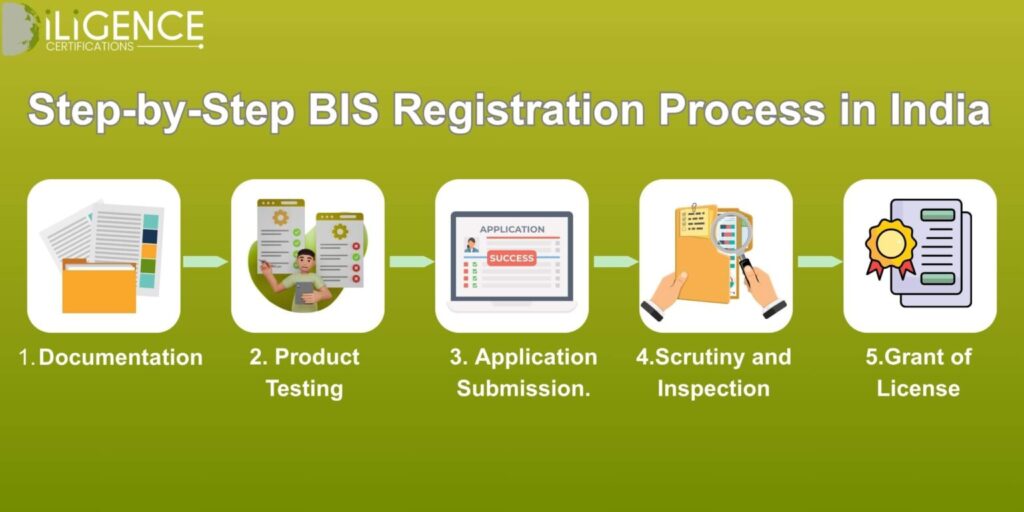
Step1:Documentation
- Collect required technical documents
- Prepare product specifications
- Gather company registration details
- Ensure documents follow BIS format
Step2:Product Testing
- Send samples to a BIS-approved lab
- Conduct safety and quality tests
- Receive test reports
- Confirm compliance with BIS standards
Step3:Application Submission
- Fill out the BIS application form
- Upload all required documents
- Attach valid test reports
- Pay the necessary BIS fees
Step4:Scrutiny and Inspection
- BIS reviews submitted documents
- Authority verifies test results
- Factory/product inspection may occur
- Clarifications requested if needed
Step5:Grant of License
- BIS approves the application
- License number is issued
- Product can carry BIS mark
- Renewal required before expiry
Documents Required for BIS Certification
| Category | Documents Required |
| Business Documents | Business license/registration, ISO certificate, organizational details |
| Manufacturer Details | Factory layout, process flow chart, machinery list, production details |
| Product Documents | Product specifications, component list, user manual, model details |
| Testing Documents | Test report from BIS-recognized lab, sample details, test request form |
| Legal & Compliance | Authorization letter, brand ownership proof, trademark certificate (if any) |
| Import/Foreign Manufacturer (If applicable) | AIR (Authorized Indian Representative) details, contract agreement, overseas manufacturer documents |
Timelines, Costs, Validity & Renewal
- Timelines: Usually from 20 to 30 days, with only 7-15 days for the testing.
- Costs: The cost of the government and the test varies depending on the product. There can be some additional charges though.
- Validity: The validity period is 2 years in most situations.
- Renewal: The renewal is done before the expiration; there should be updated documents/tests; the renewal
Why Choose Diligence Certifications
- Expert team with strong BIS and regulatory knowledge
- Fast, streamlined processing to reduce approval delays
- Accurate documentation and testing coordination
- Transparent guidance with clear communication
- High success rate and complete end-to-end support
Conclusion
BIS Certification for Nickel-Cadmium Battery IS 16046 (Part 1): 2018 is a must-have for a manufacturer, importer, or OEM that is operating in India. It is a confirmation that Ni-Cd batteries conform to the necessary safety and quality standards, thus, the first consumers are safeguarded and the compliance with the government regulations is secured.
Besides avoiding Customs delays and legal issues, getting BIS clearance also helps to increase brand trust among institutional buyers and industrial clients. It is easier to go through the whole procedure when you have a professional like Diligence Certifications by your side who can guide and support you from the initial documentation and testing stage until the final BIS registration. So, getting BIS certification is a tactical move for operations in the battery industry that are safe, compliant, and successful in India.
Frequently Ask Questions
What is BIS Certification for Nickel-Cadmium batteries?
BIS certification is a safety certification that is required for Ni-Cd batteries based on IS 16046 (Part 1): 2018 in India.
Is BIS Certification mandatory for importing Ni-Cd batteries into India?
Yes, it is. It is a legal requirement that all the imports have to be certified if the products are to be sold in India.
What does IS 16046 (Part 1): 2018 cover?
The standard describes the safety features of different tests related to electric, mechanical, and thermal performance conducted on the battery and also the specification for the label.
How long does the BIS Certification process take?
The duration between the different stages leading to the final certification is usually 5-7 weeks.
What are the key tests performed on Ni-Cd batteries for BIS Certification?
Tests include the ones on overcharge, short-circuit, vibration, impact, and temperature.
What documents are required for BIS Certification?
These are documents relating to the business, manufacturer, product, tests, and legal compliance.
Can foreign manufacturers apply for BIS Certification?
They sure can, but an AIR should represent them in India.
How long is BIS Certification valid?
The validity period is generally 2 years, after which the license holder has to submit a renewal application before the expiration date.
What are the benefits of BIS Certification for Ni-Cd batteries?
Following the law, product safety, customer trust, and improved brand image are some of the benefits that come with BIS Certification.
How can Diligence Certifications help with BIS Registration?
By giving Stages the process facilitation support in the forms of guidance, documentation, testing, and application